

19-2
Physical Mechanism of Convection
19–1C A fluid flow during which the density of the fluid remains nearly constant is called incompressible flow. A fluid whose
19-2C In forced convection, the fluid is forced to flow over a surface or in a tube by external means such as a pump or a fan.
In natural convection, any fluid motion is caused by natural means such as the buoyancy effect that manifests itself as the rise
19–3C If the fluid is forced to flow over a surface, it is called external forced convection. If it is forced to flow in a tube, it is
19–5C The potato will normally cool faster by blowing warm air to it despite the smaller temperature difference in this case
since the fluid motion caused by blowing enhances the heat transfer coefficient considerably.
19–6C Nusselt number is the dimensionless convection heat transfer coefficient, and it represents the enhancement of heat
k
hL
Nu c
where Lc is the characteristic length of the surface and k is the thermal conductivity of the fluid.
19–7C Heat transfer through a fluid is conduction in the absence of bulk fluid motion, and convection in the presence of it.
19-4
19–10 Heat transfer coefficients at different air velocities are given during air cooling of potatoes. The initial rate of heat
transfer from a potato and the temperature gradient at the potato surface are to be determined.
0.02458 W/m∙K (from Table A-22).
Analysis The initial rate of heat transfer from a potato is
222 m 02011.0m) 08.0(
DAs
W5.8 C5))(20m C)(0.02011. W/m1.19()( 22
TThAQss
where the heat transfer coefficient is obtained from the table at 1 m/s velocity. The
initial value of the temperature gradient at the potato surface is
C/m11,666
C W/m.02458.0
C5)C)(20. W/m1.19(
)(
)(
2
fluidcondconv
k
TTh
r
T
TTh
r
T
kqq
s
Rr
s
Rr
19-11 The upper surface of a solid plate is being cooled by water. The water convection heat transfer coefficient and the
water temperature gradient at the upper plate surface are to be determined.
Assumptions 1 Steady operating conditions exist. 2 Properties are constant. 3 Heat conduction in solid is one-dimensional. 4
No-slip condition at the plate surface.
Air
V = 1 m/s
T = 5C
Potato
Ti = 20C

19-6
19-13 The expression for the heat transfer coefficient for air cooling of some fruits is given. The initial rate of heat transfer
from an orange, the temperature gradient at the orange surface, and the value of the Nusselt number are to be determined.
Assumptions 1 Steady operating conditions exist. 2 Orange is spherical in shape. 3 Convection heat transfer coefficient is
constant over the entire surface. 4 Properties of water is used for orange.
222 m 01539.0m) 07.0(
DAs
m) m/s)(0.07 3.0(
VD
Air
V =0.3 m/s
T = 5C
19-7
19–14 Heat transfer coefficient as a function of air velocity is given during air cooling of steel balls. The initial values of the
heat flux and the temperature gradient in the steel ball at the surface are to be determined.
Assumptions 1 Steady operating conditions exist. 2 The thermal conductivity is constant. 3 Convection heat transfer
K W/m28.22)5.1(9.179.17 254.054.0 Vh
V = 1.5 m/s
T = 10C
Steel ball
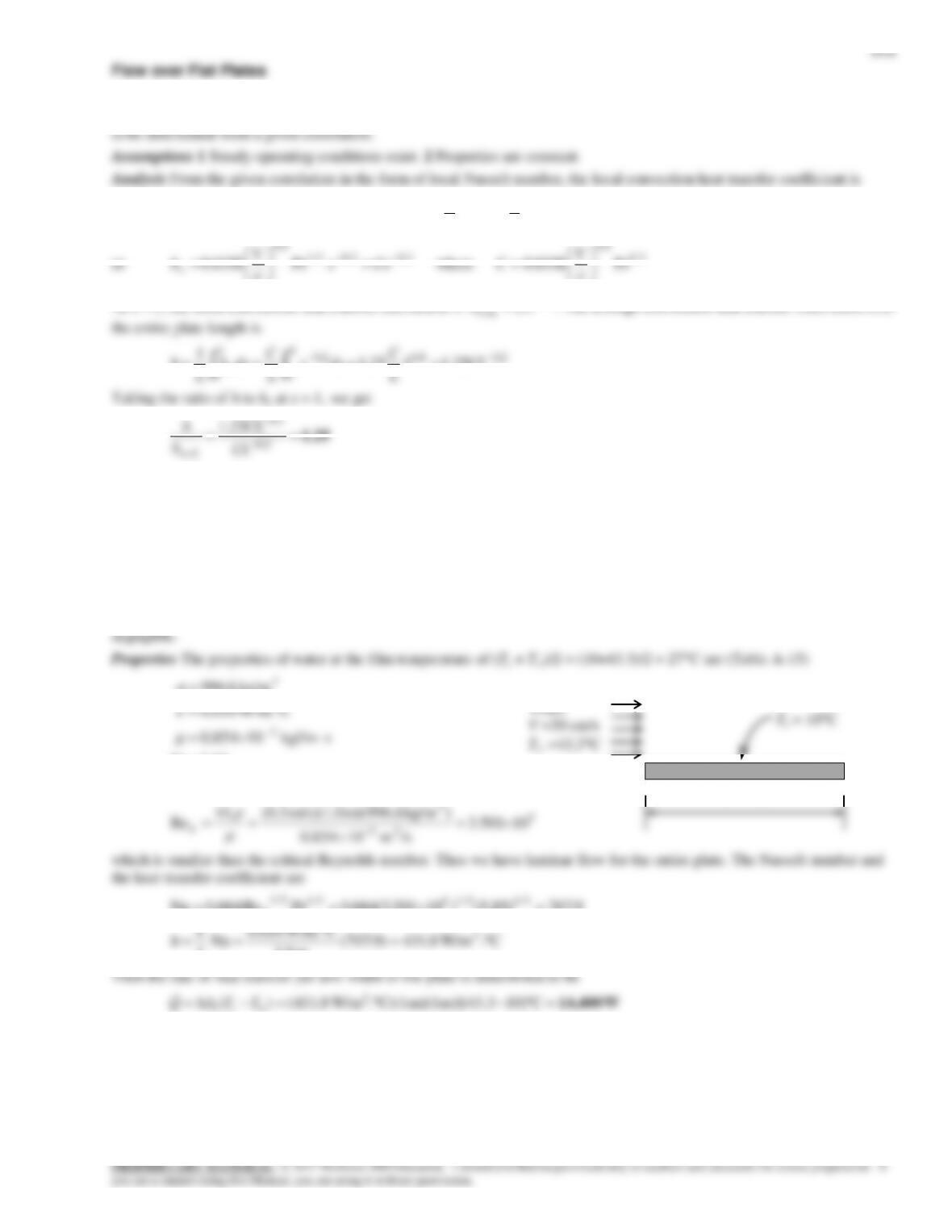
19–15 The ratio of the average convection heat transfer coefficient (h) to the local convection heat transfer coefficient (hx) is
3/18.0 PrRe035.0Nu xx
→
3/18.0 PrRe035.0Nu xxx x
k
x
k
h
2.02.03/1
8.0
V
3/1
8.0
V
At x = L, the local convection heat transfer coefficient is
2.0
CLhLx
. The average convection heat transfer coefficient over
2.08.0
0
2.0
0
25.125.1
1 CLL
L
C
dxx
L
C
dxh
L
h
LL
x
19–11
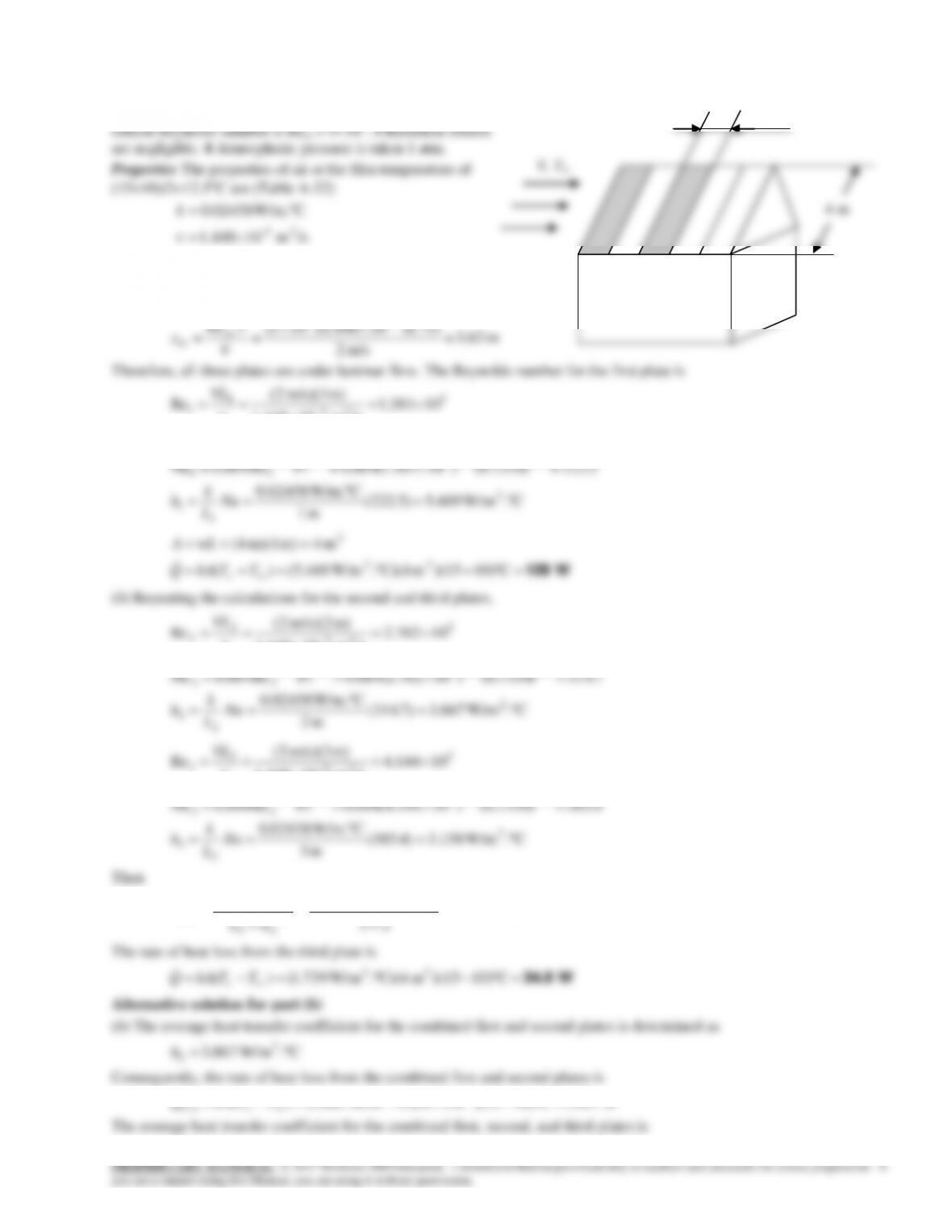
19–19 Ambient air flows over parallel plates of a solar collector that is maintained at a specified temperature. The rates of
convection heat transfer from the first and third plate are to be determined.
Assumptions 1 Steady operating conditions exist. 2 The
7330.0Pr
Analysis (a) The critical length of the plate is first
determined to be
m 62.3
m/s 2
/s)m 10448.1)(105(
Re 255
cr
cr
V
x
Therefore, all three plates are under laminar flow. The Reynolds number for the first plate is
5
25
1
110381.1
/sm 10448.1
m) m/s)(1 2(
Re
VL
Using the relation for Nusselt number, the average heat transfer coefficient and the heat transfer rate are determined to be
5.222)7330.0()10381.1(664.0PrRe664.0Nu
3/12/153/1
2/1
11
1 m

19–12
C. W/m158.3 2
3h
Consequently, the rate of heat loss from the combined first, second, and third plates is
W5.189C10))(15m 3C)(4. W/m158.3()( 22
31 TThAQs
W34.8 7.1545.189
21313 QQQ
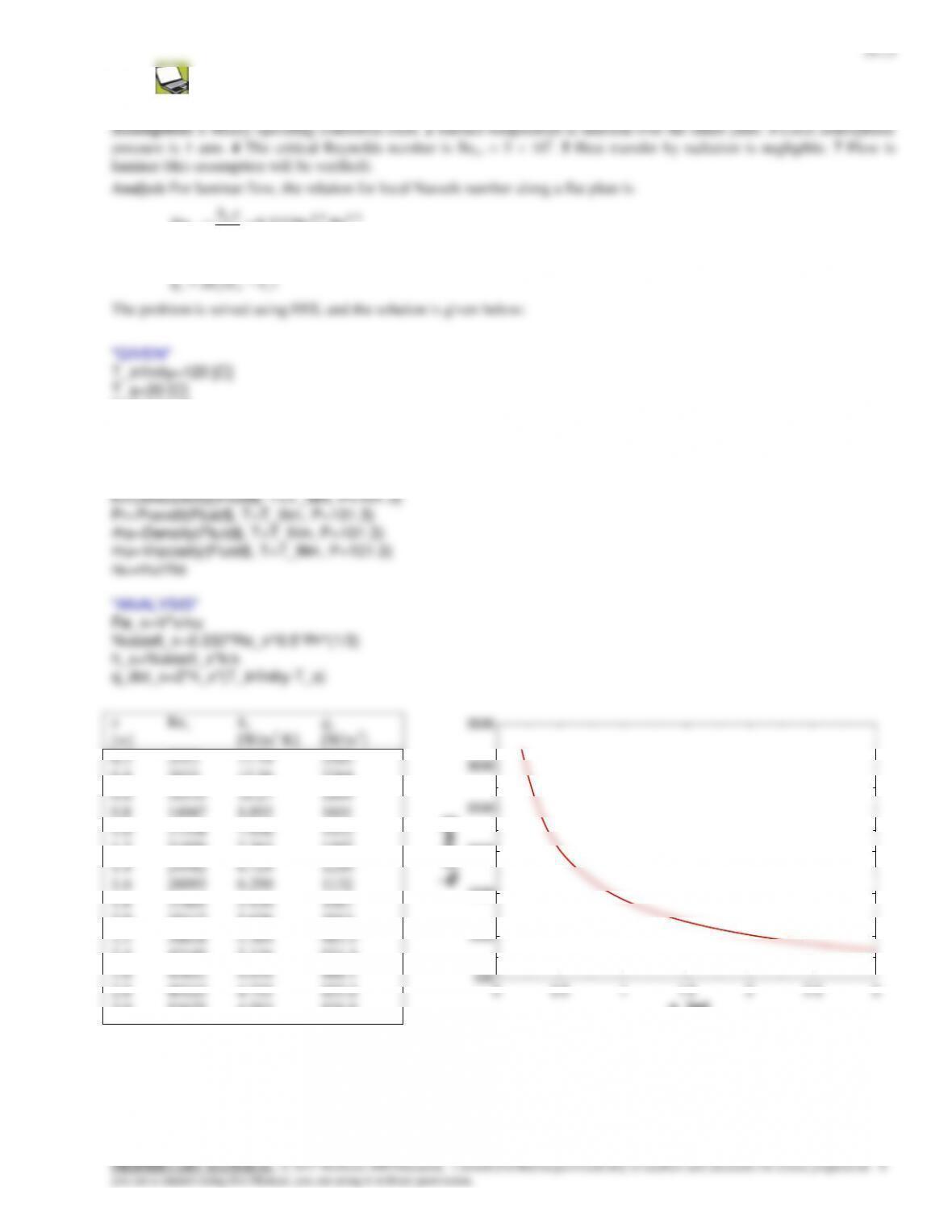

19–14
0 0.5 1 1.5 2 2.5 3
2
4
6
8
10
12
14
16
18
20
x [m]
hx [W/m2·K]

19–16
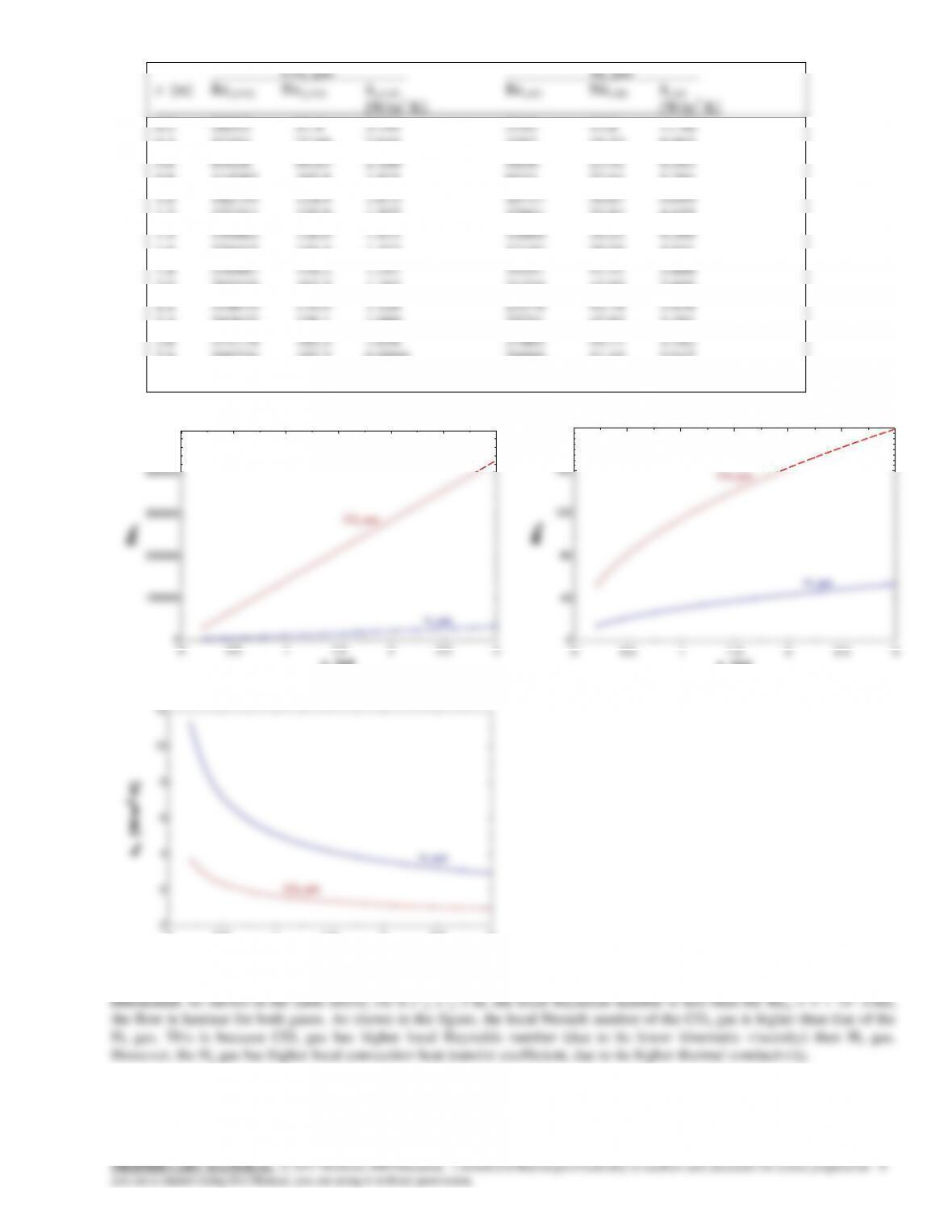
CO2 gas H2 gas
x [m] Rex,CO2 Nux,CO2 hx,CO2 Rex,H2 Nux,H2 hx,H2
[W/m2∙K] [W/m2∙K]
0.2 28552 51.4 3.741 2143 13.8 11.40
0.4 57104 72.69 2.645 4287 19.52 8.062
0.6 85656 89.03 2.160 6430 23.91 6.583
0.8 114207 102.8 1.871 8574 27.61 5.701
1.0 142759 114.9 1.673 10717 30.87 5.099
1.2 171311 125.9 1.527 12861 33.81 4.655
1.4 199863 136.0 1.414 15004 36.52 4.309
1.6 228415 145.4 1.323 17147 39.05 4.031
1.8 256967 154.2 1.247 19291 41.41 3.800
2.0 285518 162.5 1.183 21434 43.65 3.605
2.2 314070 170.5 1.128 23578 45.78 3.438
2.4 342622 178.1 1.080 25721 47.82 3.291
2.6 371174 185.3 1.038 27865 49.77 3.162
2.8 399726 192.3 0.9999 30008 51.65 3.047
3.0 428278 199.1 0.9660 32151 53.46 2.944
However, the H2 gas has higher local convection heat transfer coefficient, due to its higher thermal conductivity.
0 0.5 1 1.5 2 2.5 3
0
100000
200000
300000
400000
500000
x [m]
Rex
CO2 gas
H2 gas
0 0.5 1 1.5 2 2.5 3
0
2
4
6
8
10
12
x [m]
hx [W/m2·K]
CO2 gas
H2 gas
0 0.5 1 1.5 2 2.5 3
0
40
80
120
160
200
x [m]
Nux
CO2 gas
H2 gas
19–17
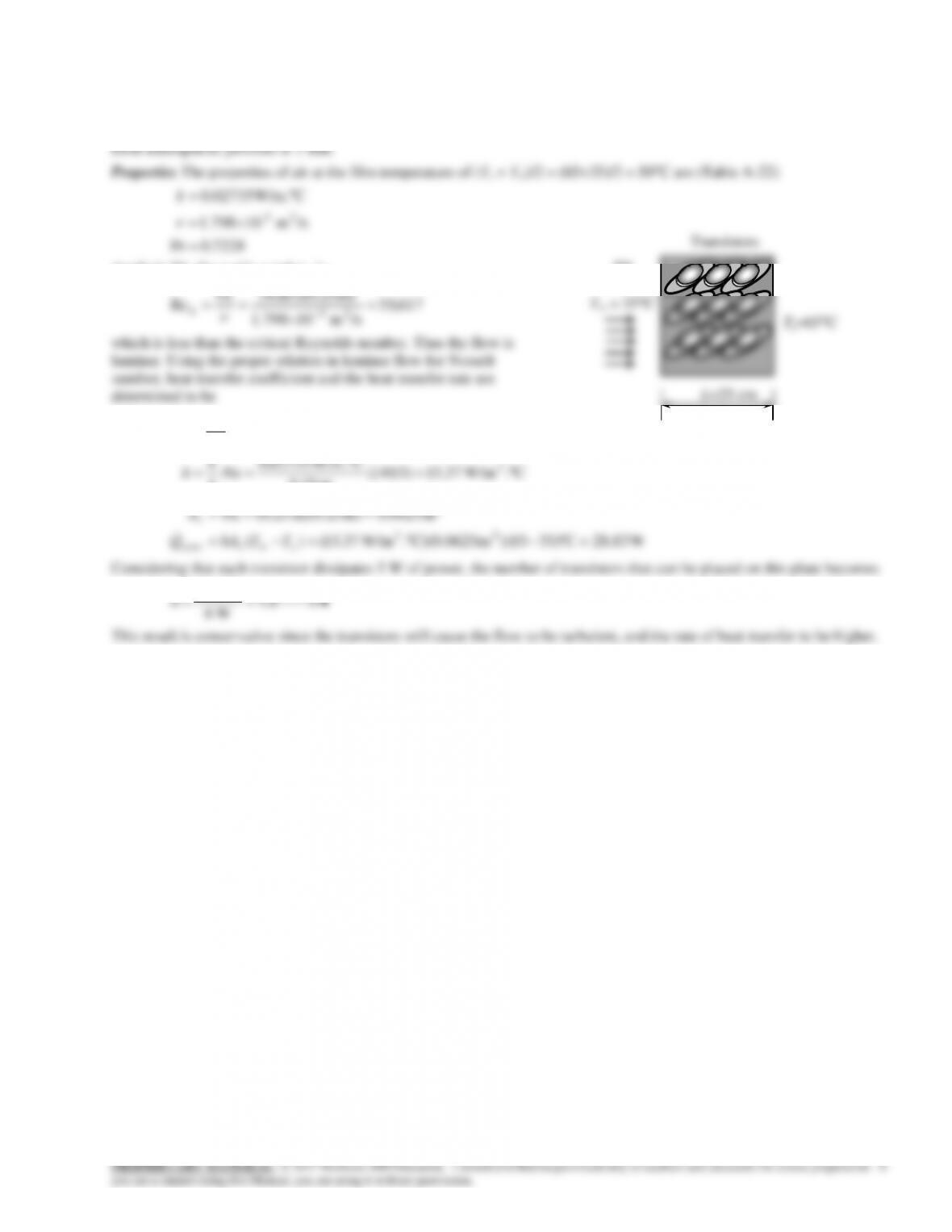
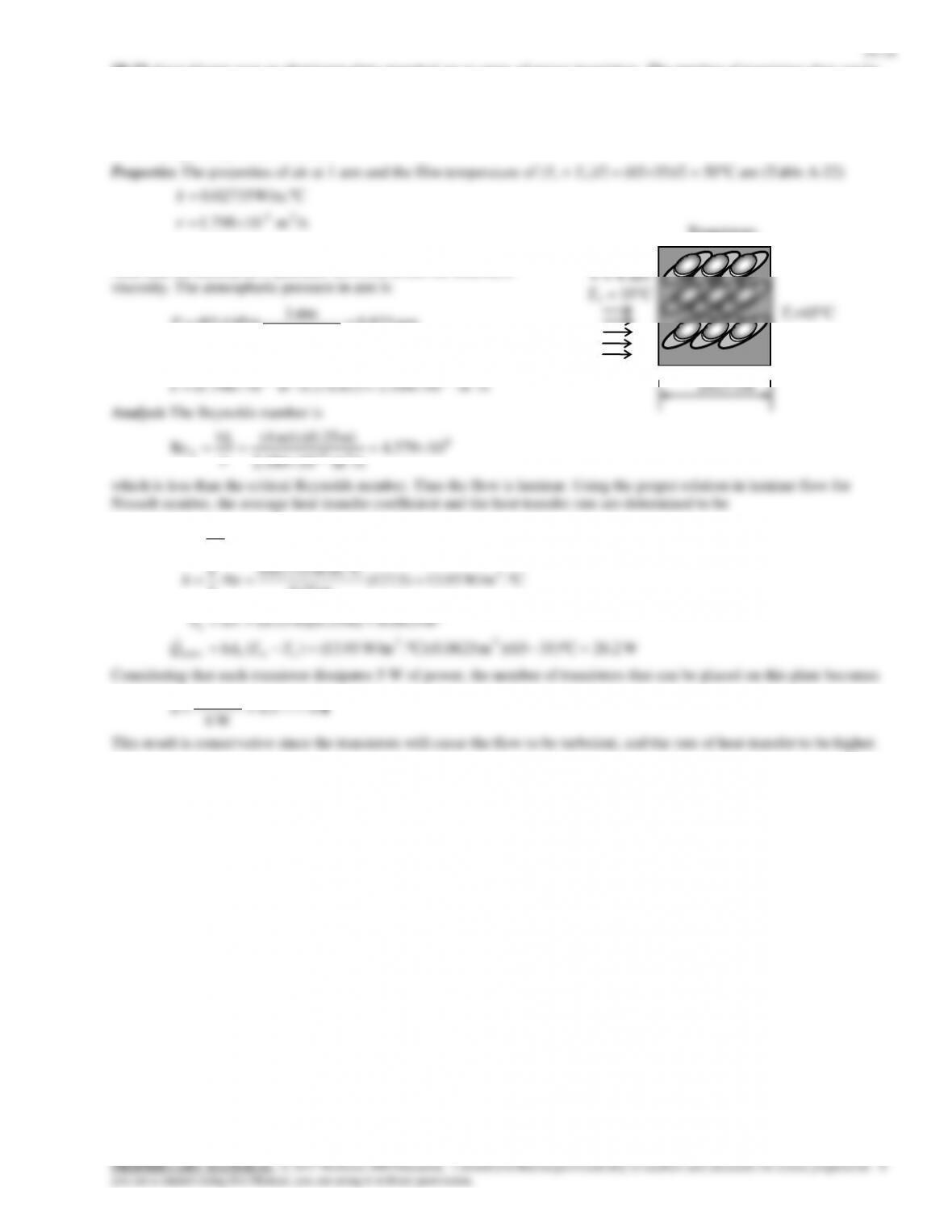
19-22 Air is blown over an aluminum plate mounted on an array of power transistors. The number of transistors that can be
placed on this plate is to be determined.
Assumptions 1 Steady operating conditions exist. 2 The critical Reynolds number is Recr = 5105. 3 Radiation effects are
negligible 4 Heat transfer from the back side of the plate is negligible. 5 Air is an ideal gas with constant properties. 6 The
7228.0Pr
Analysis The Reynolds number is
m) m/s)(0.25 (4
VL
C. W/m37.15)5.140(
m 25.0
C W/m.02735.0
5.140)7228.0()617,55(664.0PrRe664.0
2
3/15.03/1
5.0
Nu
L
k
h
k
hL
Nu L
m 0.0625=m) m)(0.25 25.0(
2
s
wLA
Transistors
Air
V = 4 m/s
19–20
19-25 A car travels at a velocity of 80 km/h. The rate of heat transfer from the bottom surface of the hot automotive engine
block is to be determined.
7202.0Pr
Analysis Air flows parallel to the 0.4 m side. The Reynolds number in this
Engine block