17-1
Solutions Manual
for
Fundamentals of Thermal Fluid Sciences
5th Edition
Yunus A. Çengel, John M. Cimbala, Robert H. Turner
McGraw-Hill, 2017
Chapter 17
STEADY HEAT CONDUCTION
PROPRIETARY AND CONFIDENTIAL
This Manual is the proprietary property of McGraw-Hill Education and protected by copyright and other
state and federal laws. By opening and using this Manual the user agrees to the following restrictions,
and if the recipient does not agree to these restrictions, the Manual should be promptly returned
unopened to McGraw-Hill Education: This Manual is being provided only to authorized professors
and instructors for use in preparing for the classes using the affiliated textbook. No other use or
distribution of this Manual is permitted. This Manual may not be sold and may not be distributed
to or used by any student or other third party. No part of this Manual may be reproduced,
displayed or distributed in any form or by any means, electronic or otherwise, without the prior
written permission of McGraw-Hill Education.
17–2C In steady heat conduction, the rate of heat transfer into the wall is equal to the rate of heat transfer out of it. Also, the
surface area since it is defined as
)/(1hARconv
.
17-3
17-10C The blanket will introduce additional resistance to heat transfer and slow down the heat gain of the drink wrapped in
a blanket. Therefore, the drink left on a table will warm up faster.
17-11C For a surface of A at which the convection and radiation heat transfer coefficients are
h h
conv rad
and
, the single
17-12C The thermal resistance network associated with a five-layer composite wall involves five single-layer resistances
17-13C Once the rate of heat transfer
Q
is known, the temperature drop across any layer can be determined by multiplying
17-14C The window glass which consists of two 4 mm thick glass sheets pressed tightly against each other will probably
17-15 The two surfaces of a wall are maintained at specified temperatures. The rate of heat loss through the wall is to be
determined.
Properties The thermal conductivity is given to be k = 0.8 W/m°C.
Analysis The surface area of the wall and the rate of heat loss through the wall
are
2
2C
14C
L= 0.3 m
Q
17-6
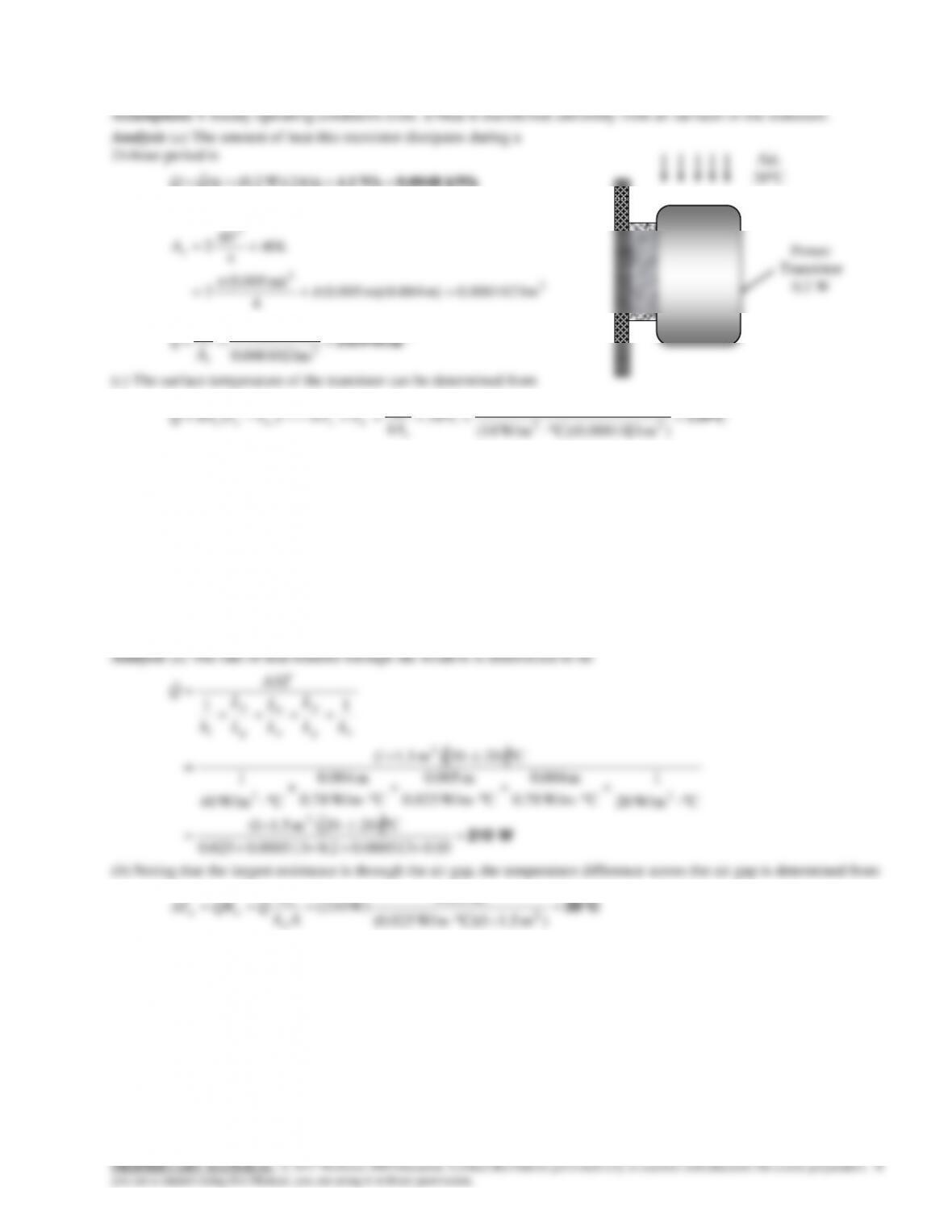
17-20 A power transistor dissipates 0.2 W of power steadily in a specified environment. The amount of heat dissipated in 24
h, the surface heat flux, and the surface temperature of the resistor are to be determined.
(b) The heat flux on the surface of the transistor is
2
2
2
m 0001021.0m) m)(0.004 005.0(
4
m) 005.0(
2
4
2
DL
D
As
2
W/m1959 2
m 0001021.0
W2.0
s
A
Q
q
(c) The surface temperature of the transistor can be determined from
W2.0
s
Q
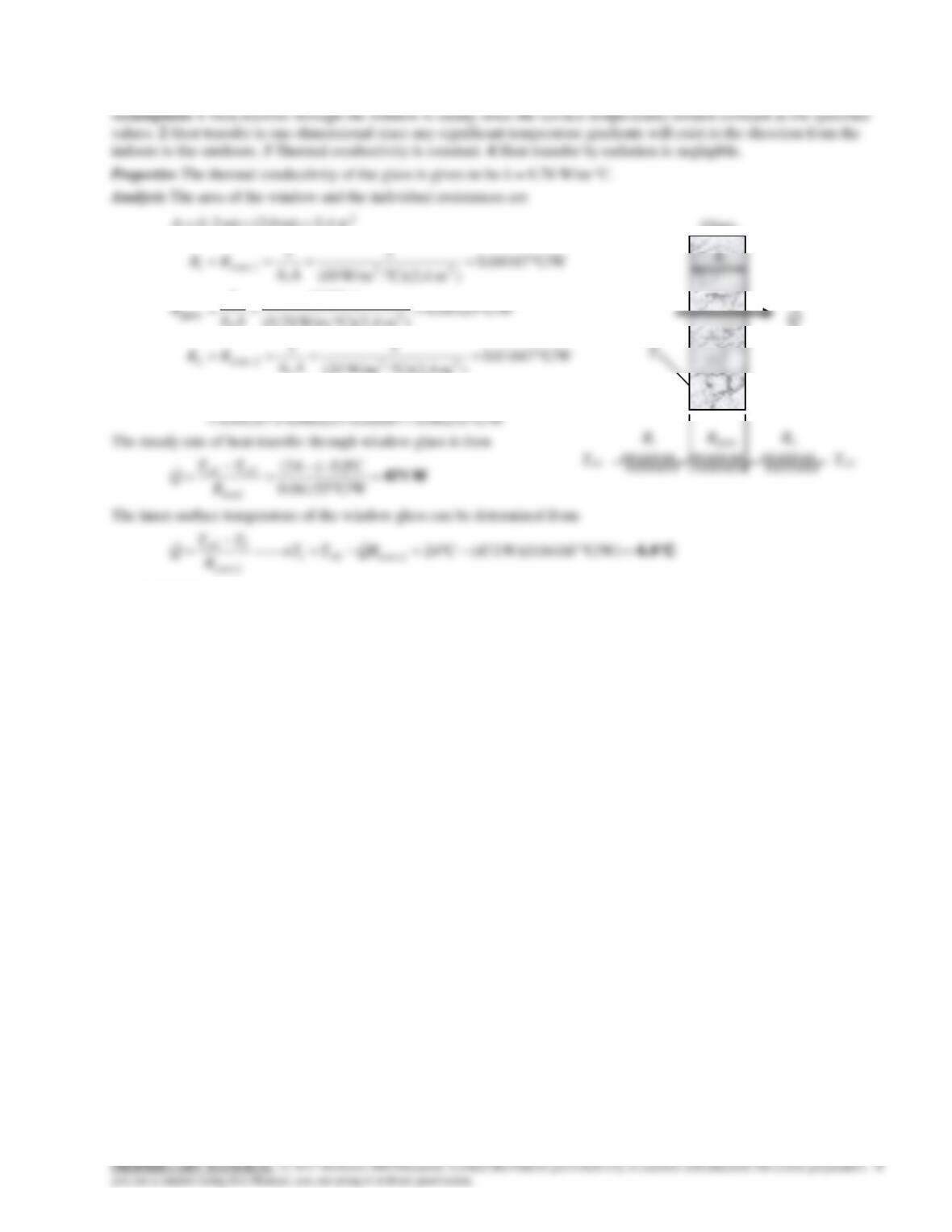
17–21 A double-pane window is considered. The rate of heat loss through the window and the temperature difference across
the largest thermal resistance are to be determined.
Assumptions 1 Steady operating conditions exist. 2 Heat transfer coefficients are constant.
Properties The thermal conductivities of glass and air are given to be 0.78 W/mK and 0.025 W/mK, respectively.
Power
Transistor
0.2 W
17-7
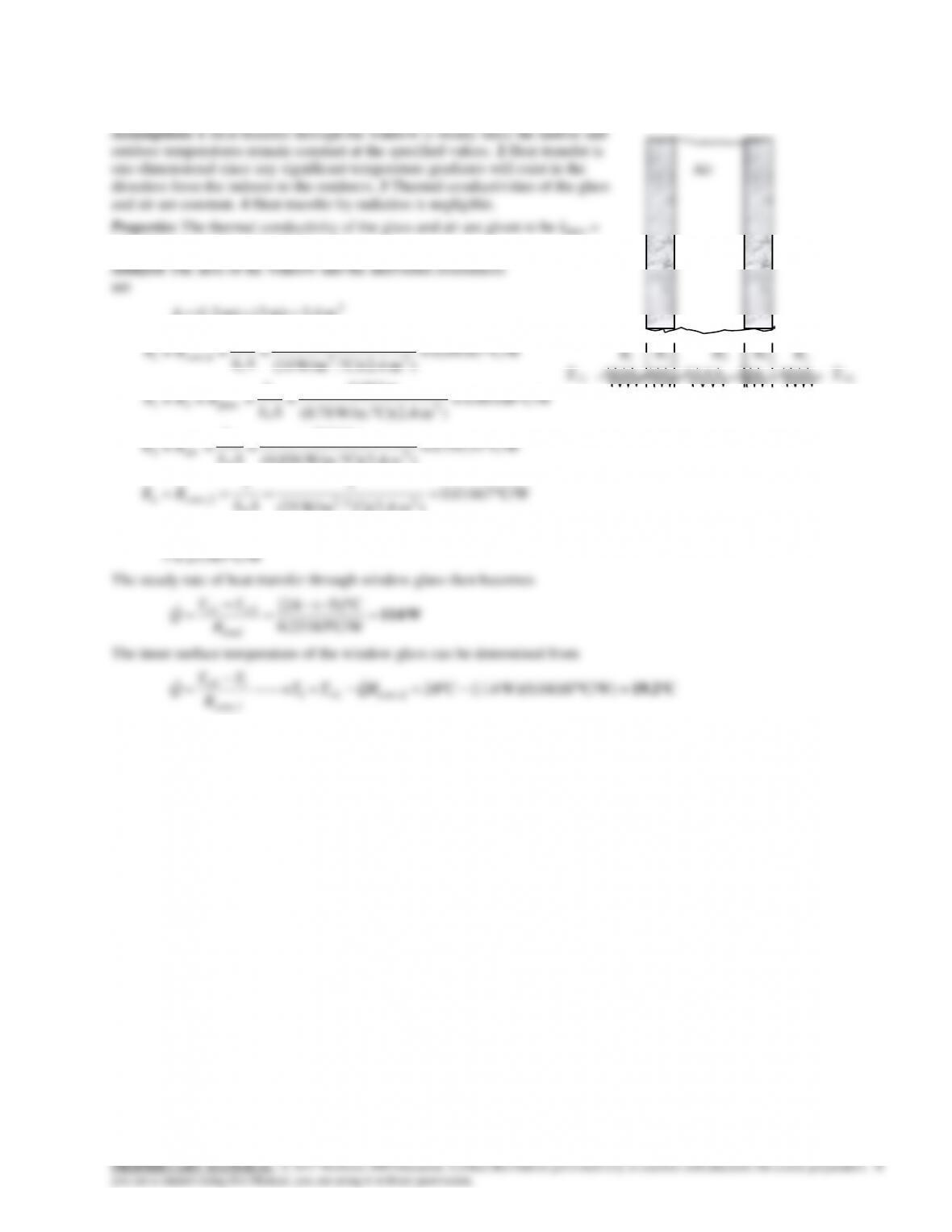
17–22 The two surfaces of a window are maintained at specified temperatures. The rate of heat loss through the window and
the inner surface temperature are to be determined.
17-8
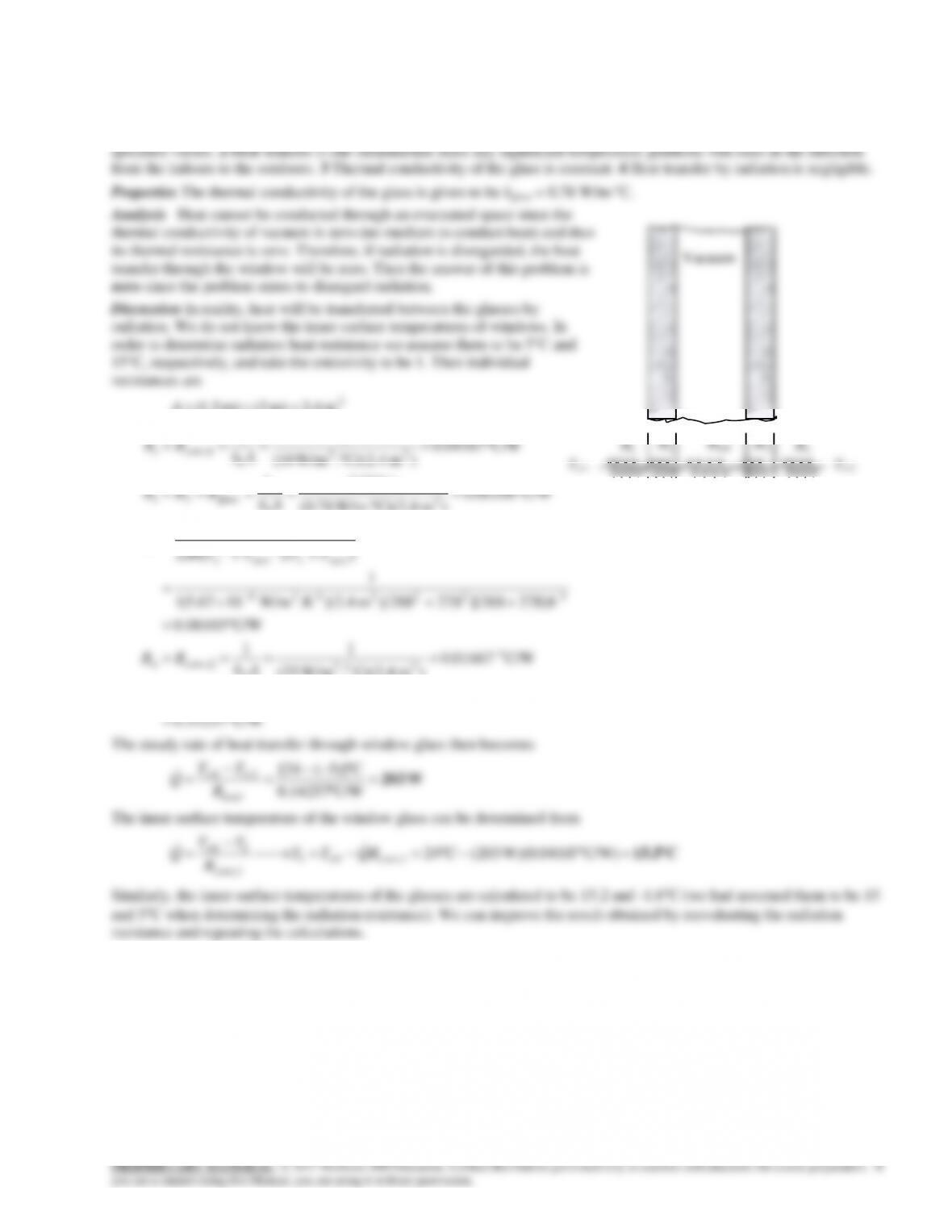
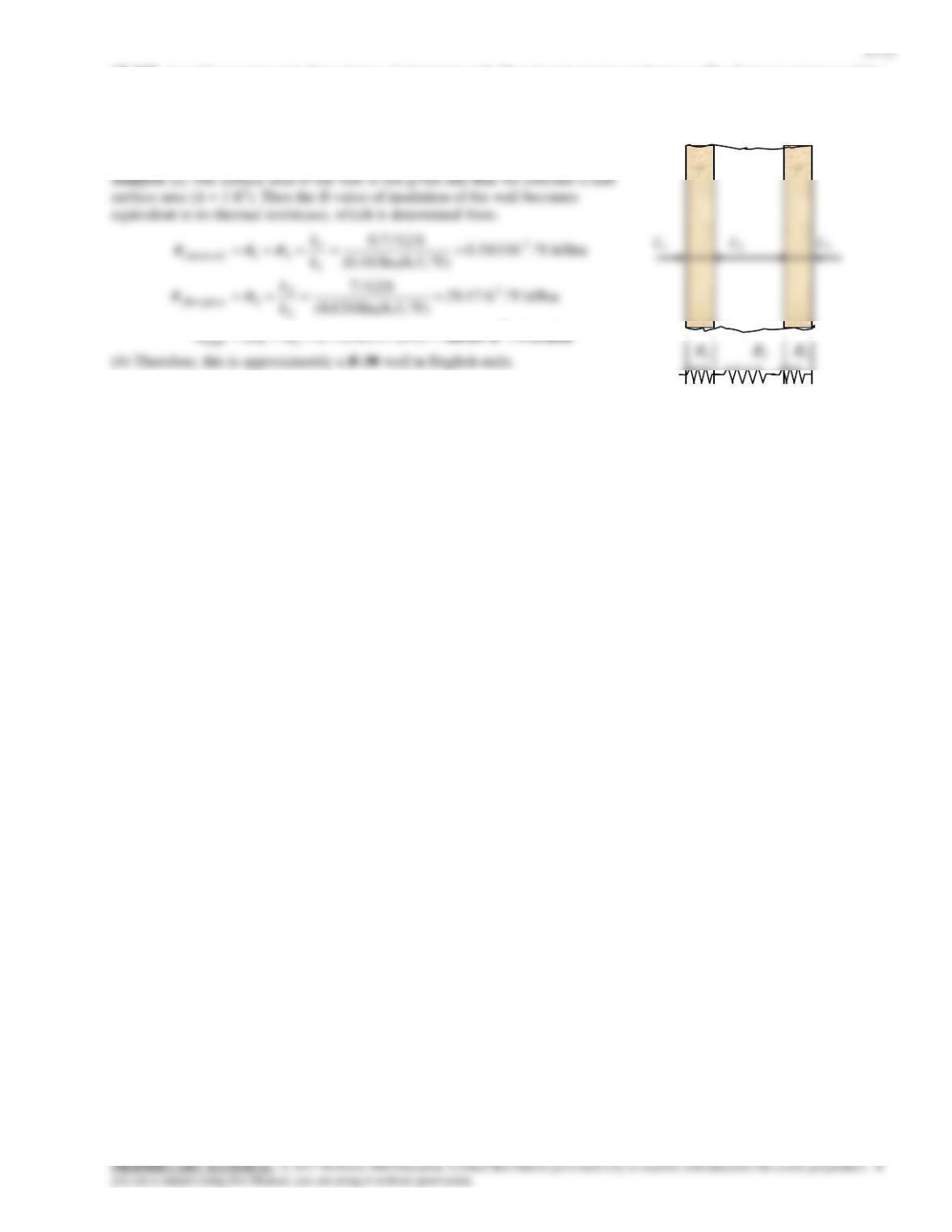
17-23 A double-pane window consists of two layers of glass separated by a stagnant air space. For specified indoors and
outdoors temperatures, the rate of heat loss through the window and the inner surface temperature of the window are to be
determined.
0.78 W/m°C and kair = 0.026 W/m°C.
2
m 4.2m) 2(m) 2.1( A
m 012.0
C/W 00160.0
)m 4.2(C) W/m.78.0(
m 003.0
C/W 04167.0
)m 4.2(C). W/m10(
11
2
2
1
1
glass31
22
1
1,i
conv
L
Ak
L
RRR
Ah
RR
R1 R2 R3
Ro
Ri
T1
T2
17-9
17-24 A double-pane window consists of two layers of glass separated by an evacuated space. For specified indoors and
outdoors temperatures, the rate of heat loss through the window and the inner surface temperature of the window are to be
determined.
Assumptions 1 Heat transfer through the window is steady since the indoor and outdoor temperatures remain constant at the
2
m 4.2m) 2(m) 2.1( A
))((
1
C/W 00160.0
)m 4.2(C) W/m.78.0(
m 003.0
C/W 04167.0
)m 4.2(C). W/m10(
11
22
2
1
1
glass31
22
1
1,i
surrssurrs
rad
conv
TTTTA
R
Ak
L
RRR
Ah
RR
R1 Rrad R3
Ro
Ri
T1
T2
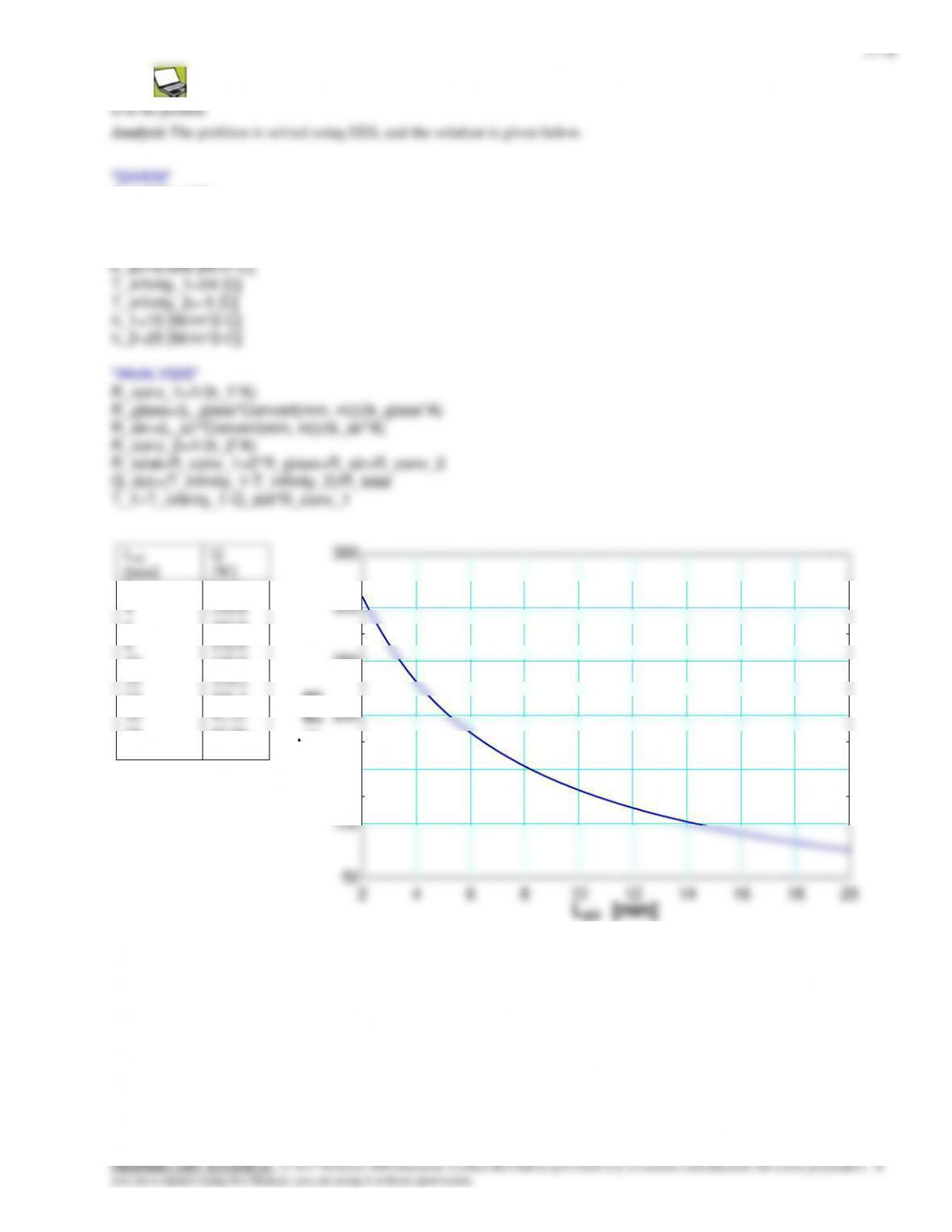
17–12
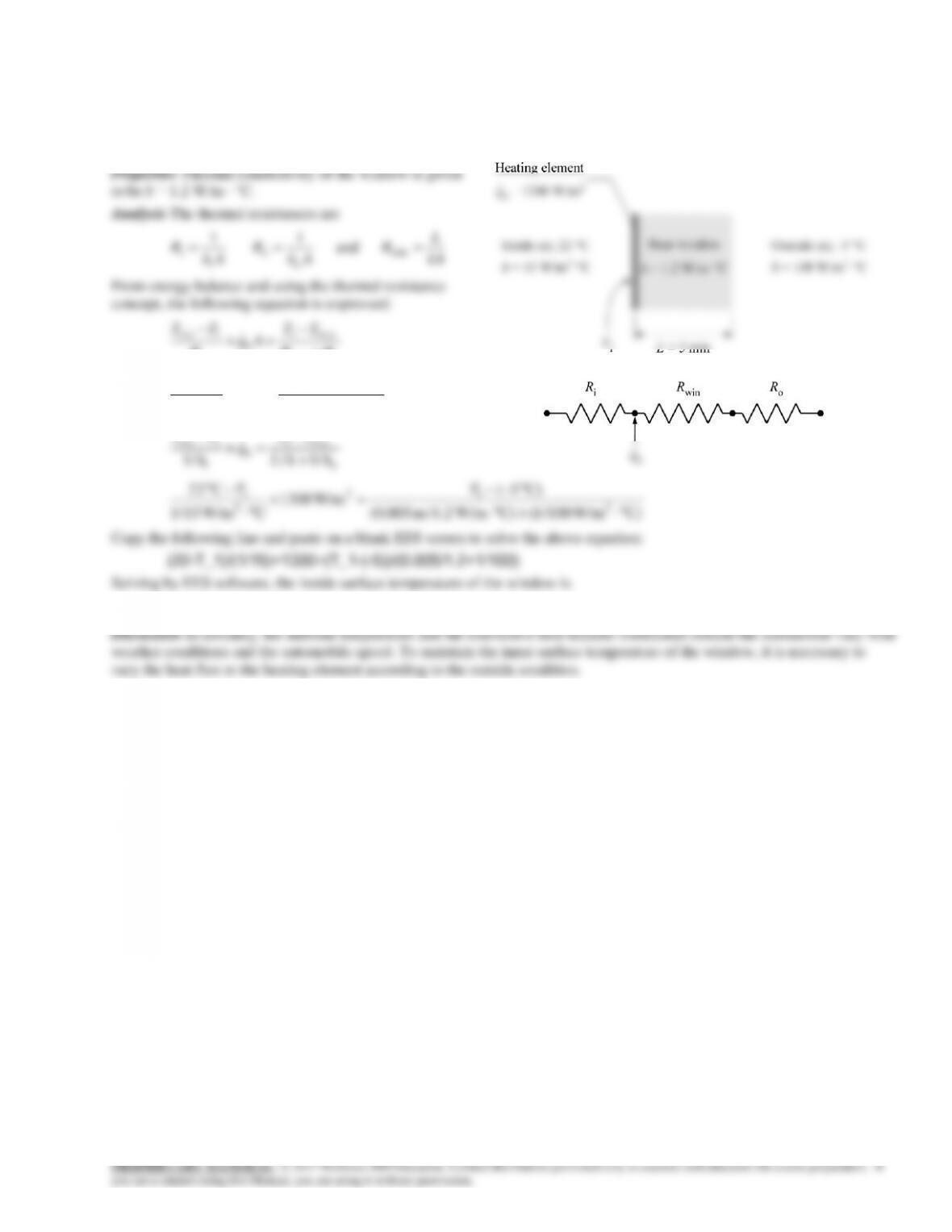
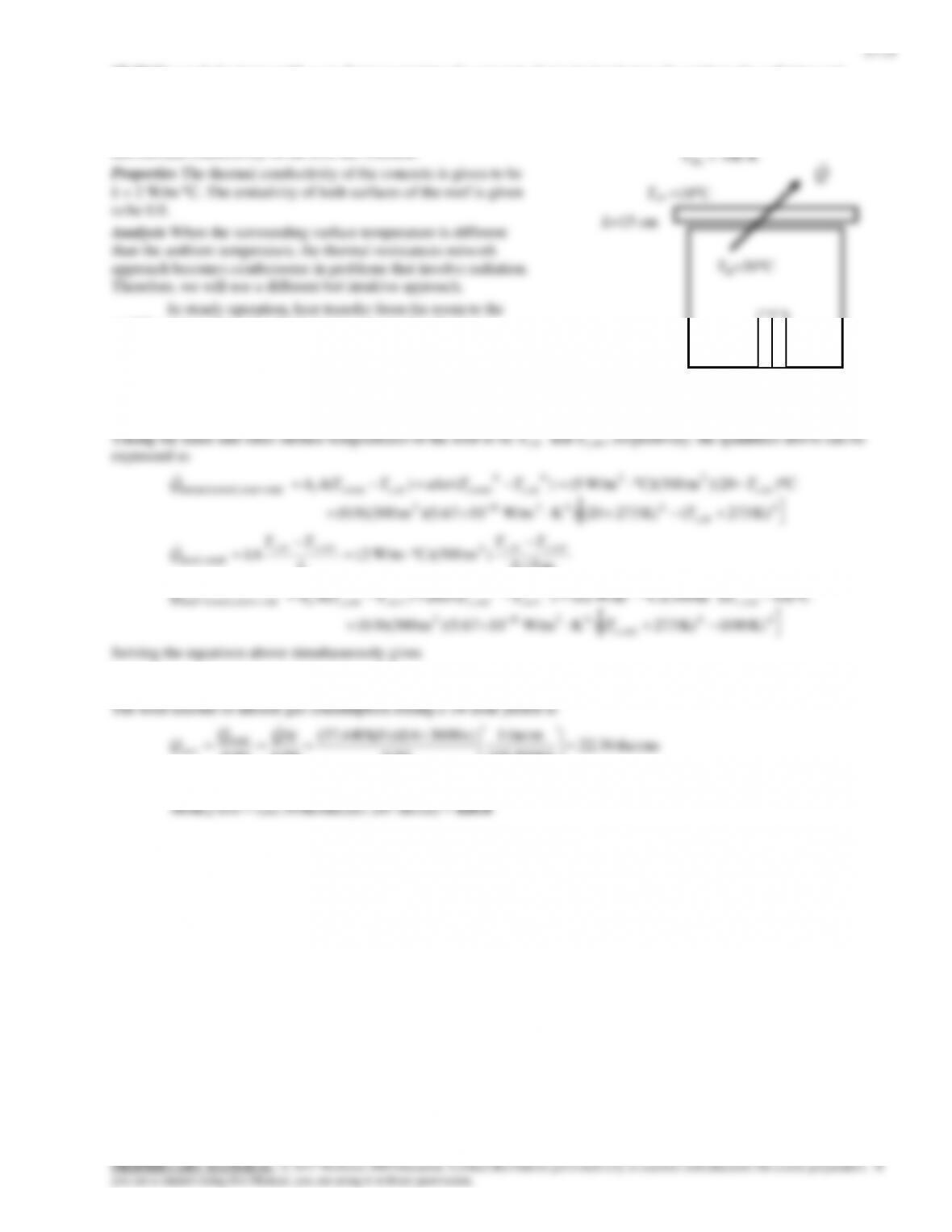
17-27 A very thin transparent heating element is attached to the inner surface of an automobile window for defogging
purposes, the inside surface temperature of the window is to be determined.
Assumptions 1 Steady operating conditions exist. 2 Heat transfer through the window is one-dimensional. 3 Thermal
properties are constant. 4 Heat transfer by radiation is negligible. 5 Thermal resistance of the thin heating element is
negligible.
o
i
RR
R
win
or
)/(1)/()/(1
,11,
AhkAL
TT
Aq
Ah
TT
o
o
h
i
i
o
i
TT
TT
,11,
17–14
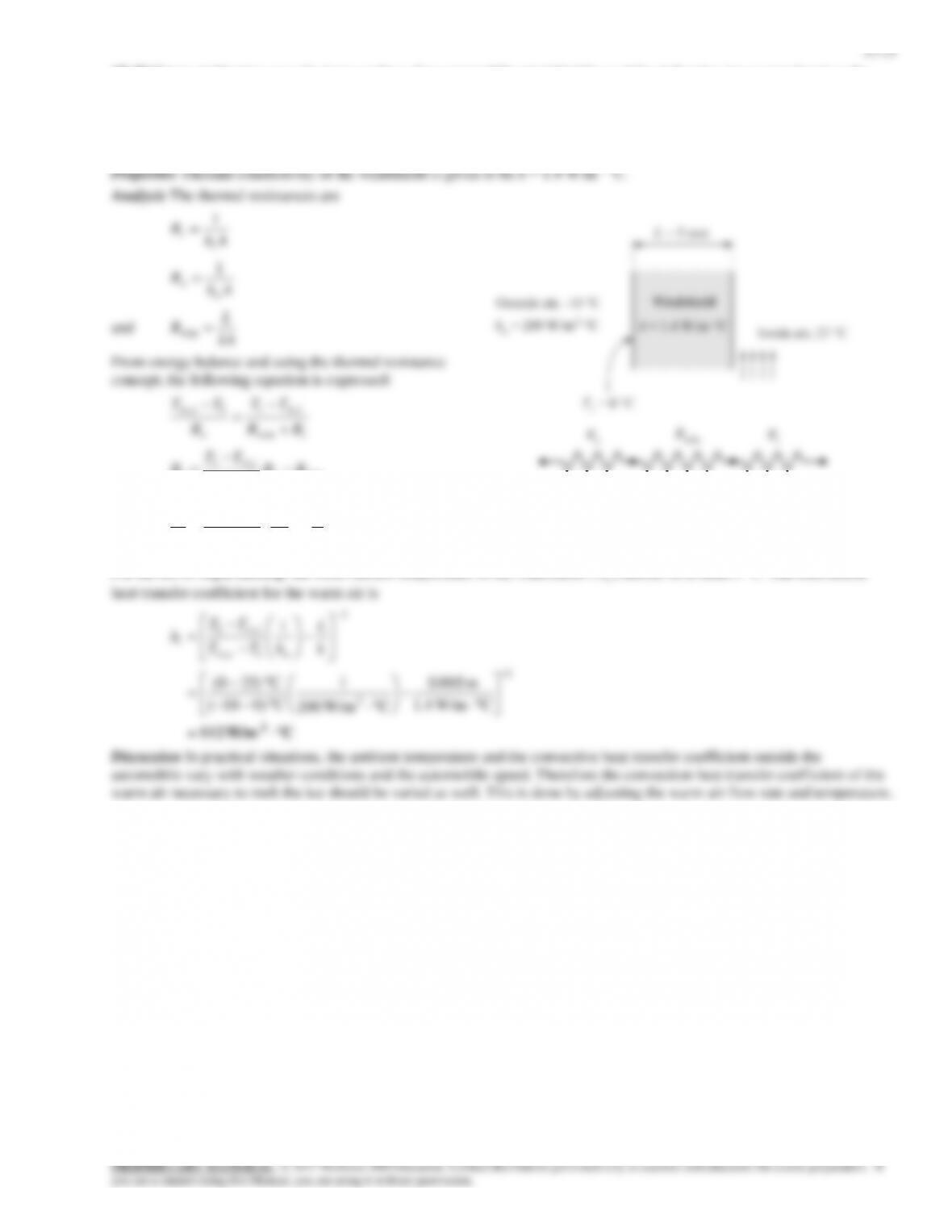
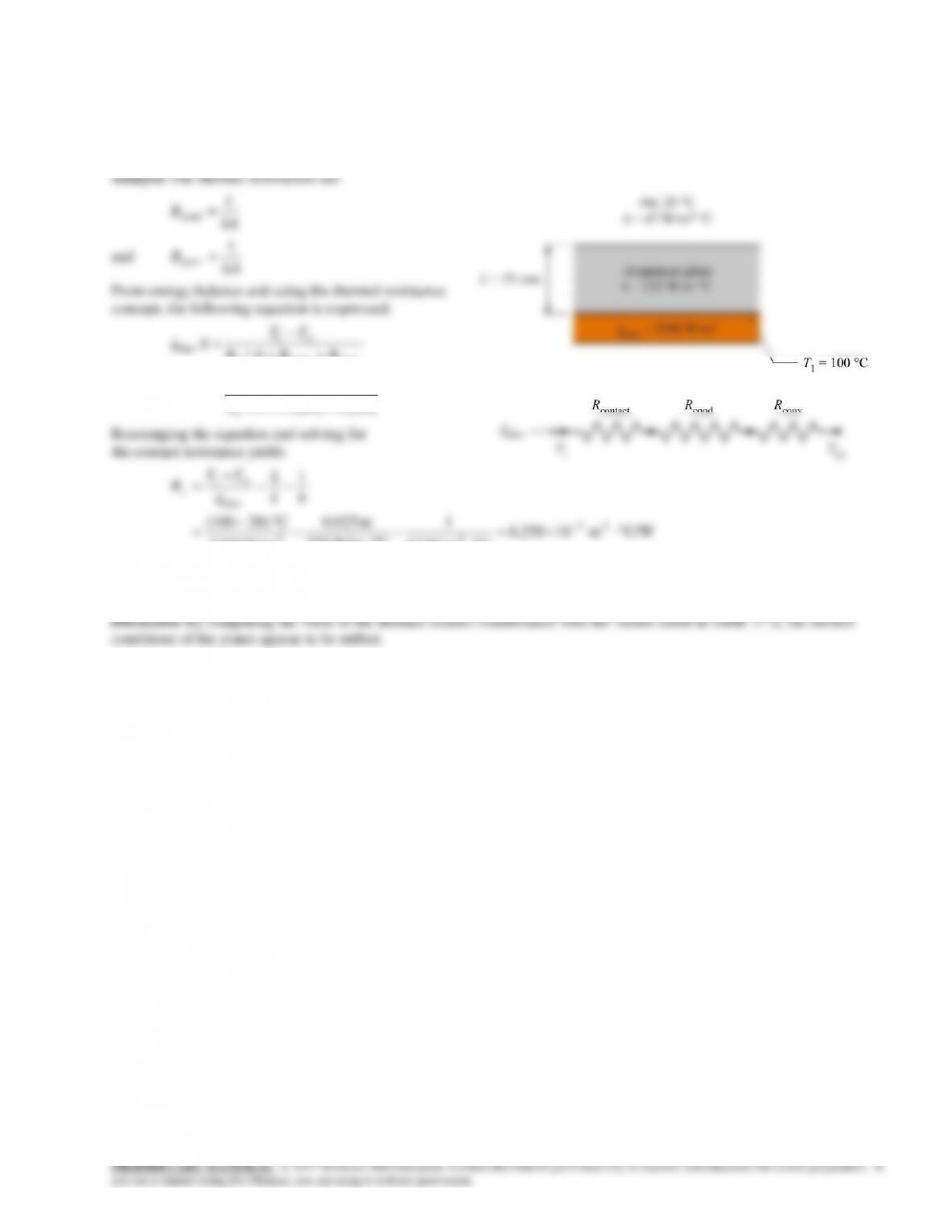
17–29 The thermal contact conductance for an aluminum plate attached on a copper plate, that is heated electrically, is to be
determined.
Assumptions 1 Steady operating conditions exist. 2 Heat transfer is one-dimensional. 3 Thermal properties are constant. 4
Heat transfer by radiation is negligible.
Properties The thermal conductivity of the aluminum plate is given to be 235 W/m ∙ °C.
convcond
c
or
)/(1)/(/
1
elec hAkALAR
TT
Aq
c
17–16
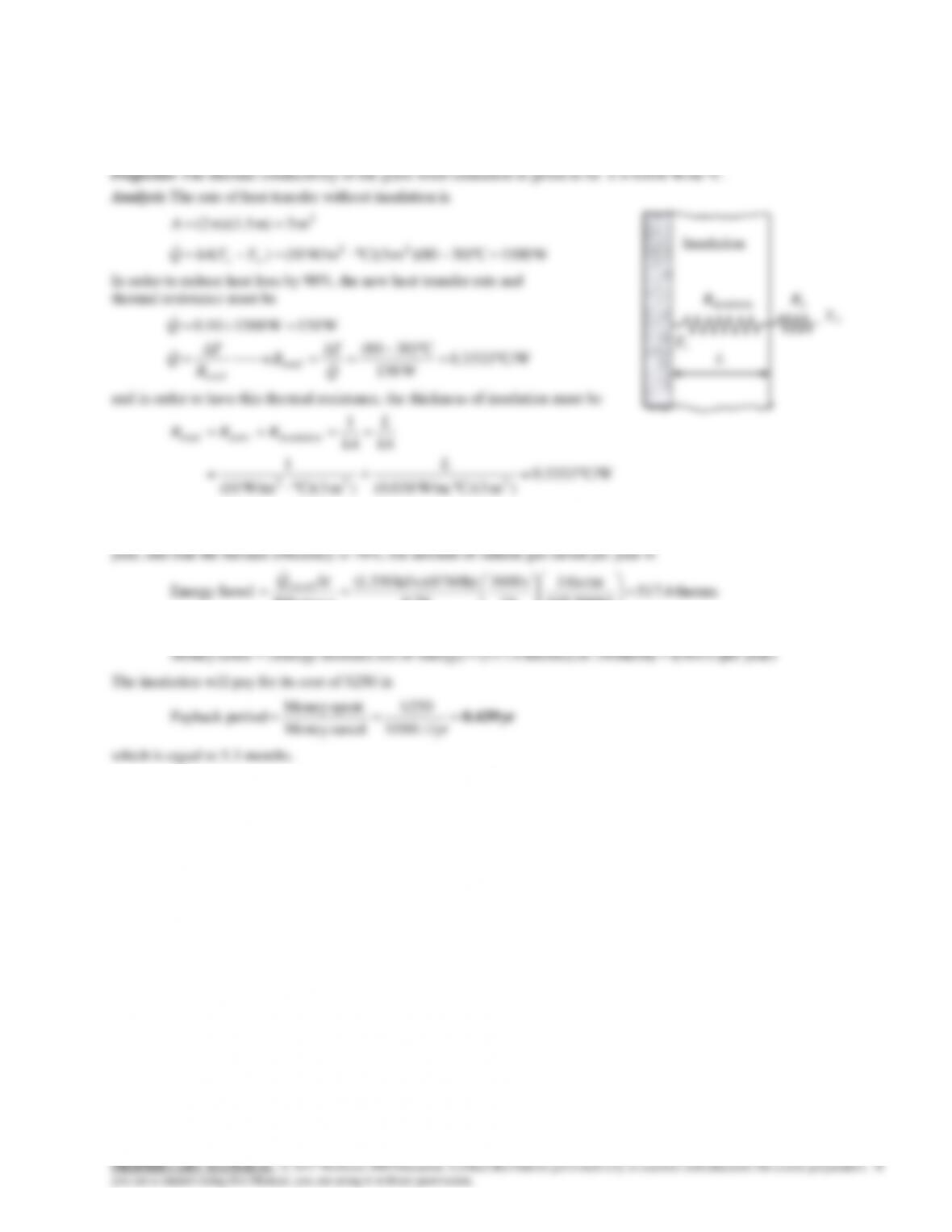
17-31 An exposed hot surface of an industrial natural gas furnace is to be insulated to reduce the heat loss through that
section of the wall by 90 percent. The thickness of the insulation that needs to be used is to be determined. Also, the length of
time it will take for the insulation to pay for itself from the energy it saves will be determined.
Assumptions 1 Heat transfer through the wall is steady and one-dimensional. 2 Thermal conductivities are constant. 3 The
furnace operates continuously. 4 The given heat transfer coefficient accounts for the radiation effects.
cm 3.42
m 0342.0
)m C)(3 W/m.038.0()m C)(3 W/m10(
222
L
Noting that heat is saved at a rate of 0.91500 =1350 W and the furnace operates continuously and thus 36524 = 8760 h per