15–41
15–64
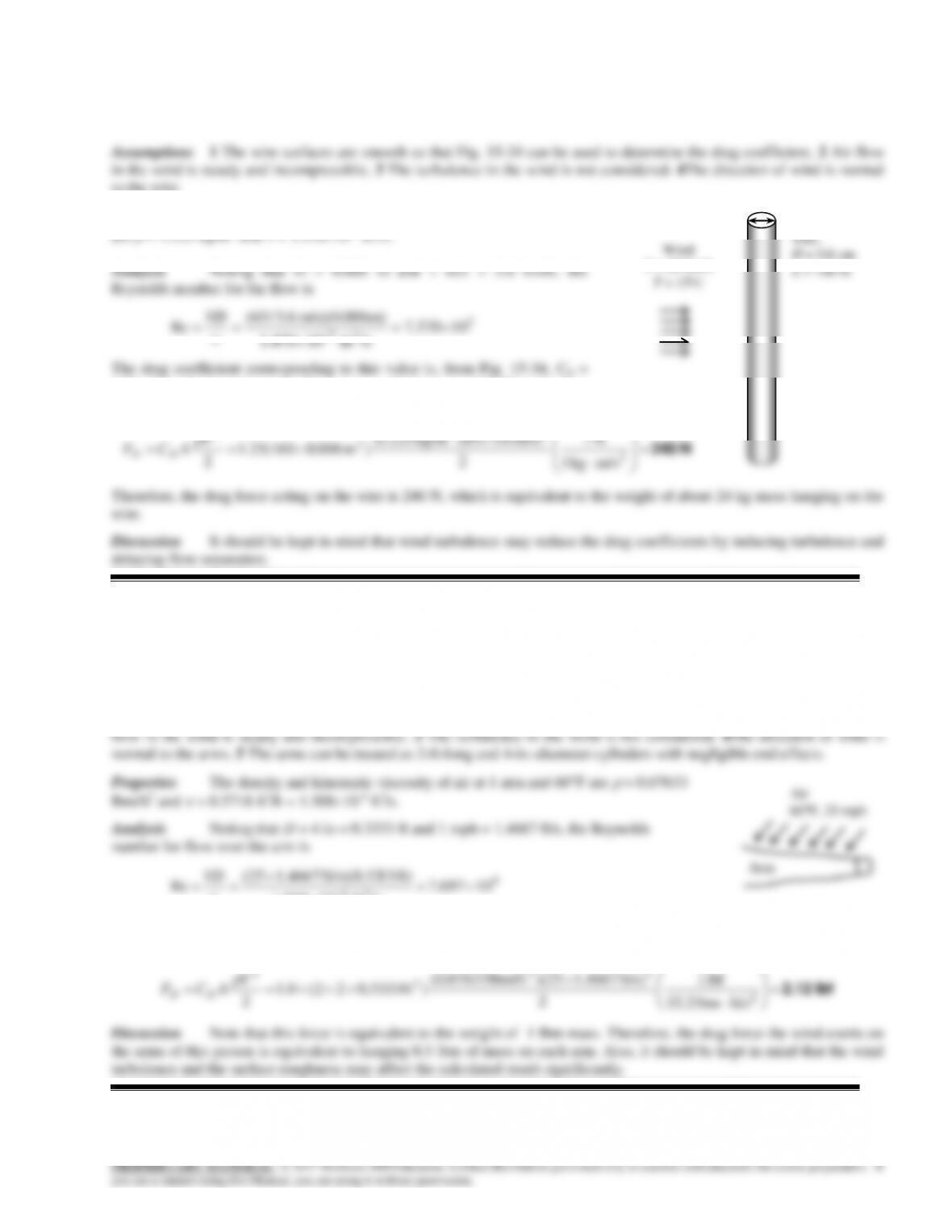
Solution Wind is blowing across the wire of a transmission line. The drag force exerted on the wire by the wind is to
be determined.
to the wire.
Properties The density and kinematic viscosity of air at 1 atm and 15C
Transmission
15–42
Lift
15–66C
Solution We are to discuss why the contribution of viscous effects to lift of airfoils is usually negligible.
15–67C
Solution We are to define and discuss stall.
15–68C
Solution We are to discuss the lift and drag on a nonsymmetrical airfoil at zero angle of attack.
15–69C
Solution We are to discuss the lift and drag on a symmetrical airfoil at zero angle of attack.
15–43
15–70C
Solution We are to discuss which increases at a greater rate – lift or drag – with increasing angle of attack.
15–71C
Solution We are to why flaps are used on aircraft during takeoff and landing.
15–72C
Solution We are to discuss the effect of wing tip vortices on drag and lift.
15–73C
Solution We are to discuss induced drag and how to minimize it.
15–74C
Solution We are to explain why some airplane wings have endplates or winglets.
15–75C
Solution We are to discuss how flaps affect the lift and drag of airplane wings.
15–76
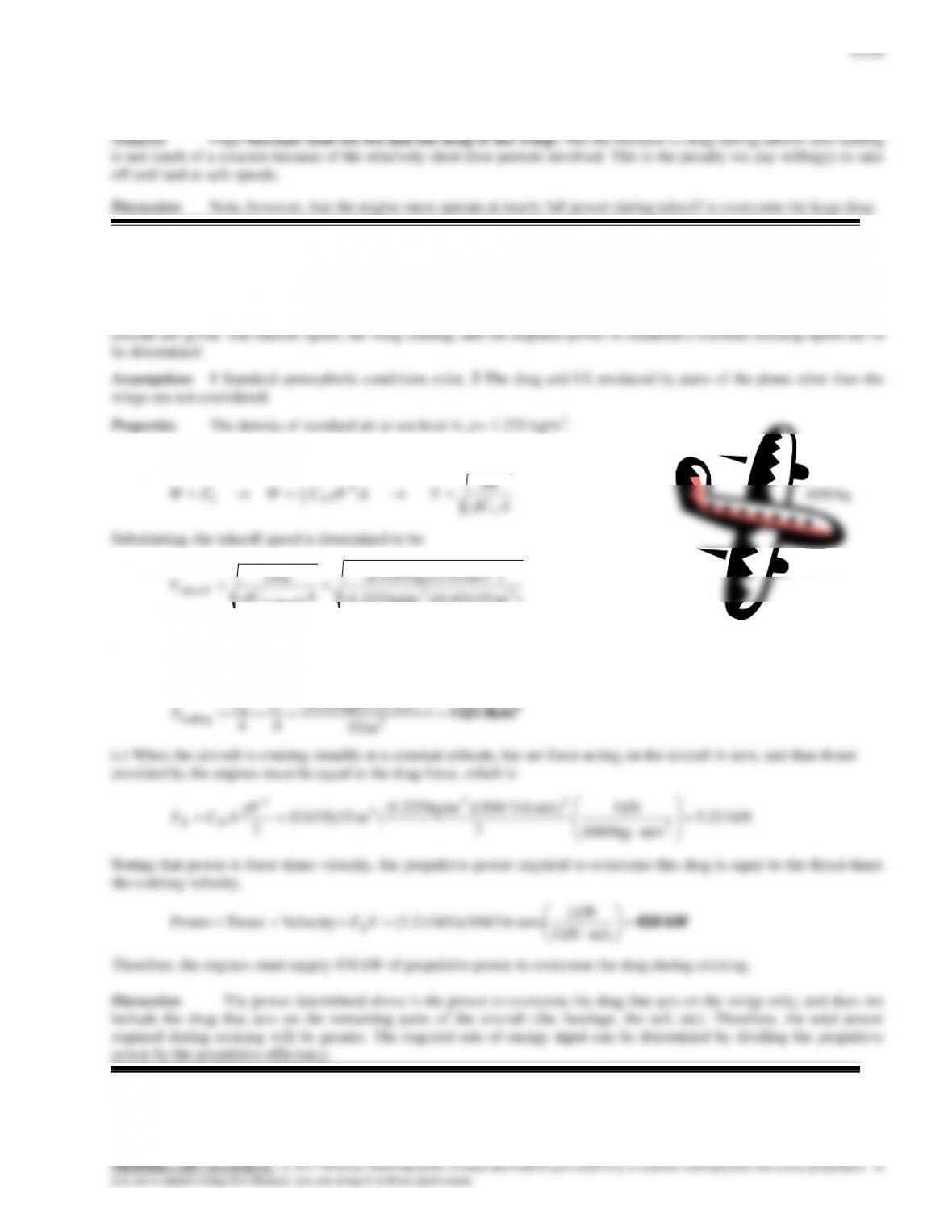
Solution The wing area, lift coefficient at takeoff settings, the cruising drag coefficient, and total mass of a small
Analysis (a) An aircraft will takeoff when lift equals the total weight. Therefore,
AC
W
VAVCWFW
L
LL
2
2
2
1
Substituting, the takeoff speed is determined to be
km/h 230
m/s 8.63
)m 35)(45.0)(kg/m 225.1(
)m/s kg)(9.81 4000(22
2
takeoff,
takeoff AC
mg
V
L
(b) Wing loading is the average lift per unit planform area, which is equivalent to the ratio of the lift to the planform area of
the wings since the lift generated during steady cruising is equal to the weight of the aircraft. Therefore,
2
N/m 1121 2
2
loading m 35
)m/s kg)(9.81 4000(
A
W
A
F
FL
(c) When the aircraft is cruising steadily at a constant altitude, the net force acting on the aircraft is zero, and thus thrust
provided by the engines must be equal to the drag force, which is
kN 211.5
m/skg 1000
kN 1
2
m/s) 6.3/300)(kg/m 225.1(
)m 35)(035.0(
22
23
2
2
V
ACF DD
Noting that power is force times velocity, the propulsive power required to overcome this drag is equal to the thrust times
the cruising velocity,
kW 434
m/skN 1
kW 1
m/s) 6kN)(300/3. 211.5(VelocityThrustPower VFD
Therefore, the engines must supply 434 kW of propulsive power to overcome the drag during cruising.
Discussion The power determined above is the power to overcome the drag that acts on the wings only, and does not
include the drag that acts on the remaining parts of the aircraft (the fuselage, the tail, etc). Therefore, the total power
required during cruising will be greater. The required rate of energy input can be determined by dividing the propulsive
power by the propulsive efficiency.
Awing=35 m2
4000 kg
CL=0.45
15–77
Solution The takeoff speed of an aircraft when it is fully loaded is given. The required takeoff speed when the weight
of the aircraft is increased by 10% as a result of overloading is to be determined.
Assumptions 1 The atmospheric conditions (and thus the properties of air) remain the same. 2 The settings of the plane
during takeoff are maintained the same so that the lift coefficient of the plane remains the same.
15–46
15–78
Solution The takeoff speed and takeoff time of an aircraft at sea level are given. The required takeoff speed, takeoff
time, and the additional runway length required at a higher elevation are to be determined.
Assumptions 1 Standard atmospheric conditions exist. 2 The settings of the plane during takeoff are maintained the same
km/h 238 048.1
225.1
km/h) 220(
/2
/2
2
1
12
2
1
1
2
1
2
VV
ACW
ACW
V
V
L
L
15–79E
Solution The rate of fuel consumption of an aircraft while flying at a low altitude is given. The rate of fuel
consumption at a higher altitude is to be determined for the same flight velocity.
Assumptions 1 Standard atmospheric conditions exist. 2 The settings of the plane during takeoff are maintained the same
so that the drag coefficient of the plane and the planform area remain constant. 3 The velocity of the aircraft and the
15–48
15–80
Solution The takeoff speed of an aircraft when it is fully loaded is given. The required takeoff speed when the
aircraft has 100 empty seats is to be determined.
Assumptions 1 The atmospheric conditions (and thus the properties of air) remain the same. 2 The settings of the plane
during takeoff are maintained the same so that the lift coefficient of the plane remains the same. 3 A passenger with
the ratio of the velocities of the under-loaded and fully loaded aircraft becomes
1
2
12
1
2
1
2
1
2
1
2
1
2
/2
/2
m
m
VV
m
m
gm
gm
W
W
ACW
ACW
V
V
L
L
15–81
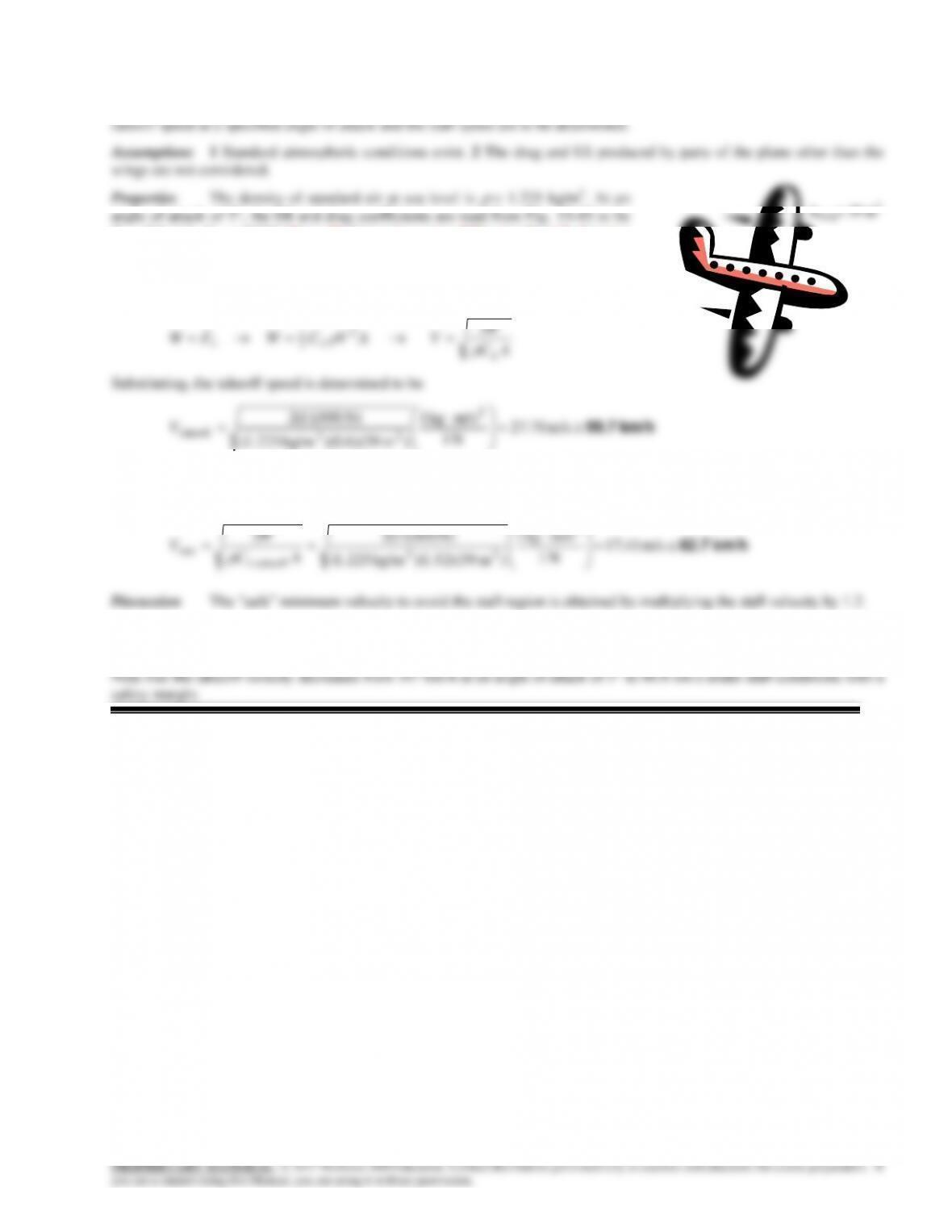
Solution The previous problem is reconsidered. The effect of empty passenger count on the takeoff speed of the
aircraft as the number of empty seats varies from 0 to 500 in increments of 50 is to be investigated.
Analysis The EES Equations window is printed below, along with the tabulated and plotted results.
m_passenger=140 “kg”
15–50
15–83
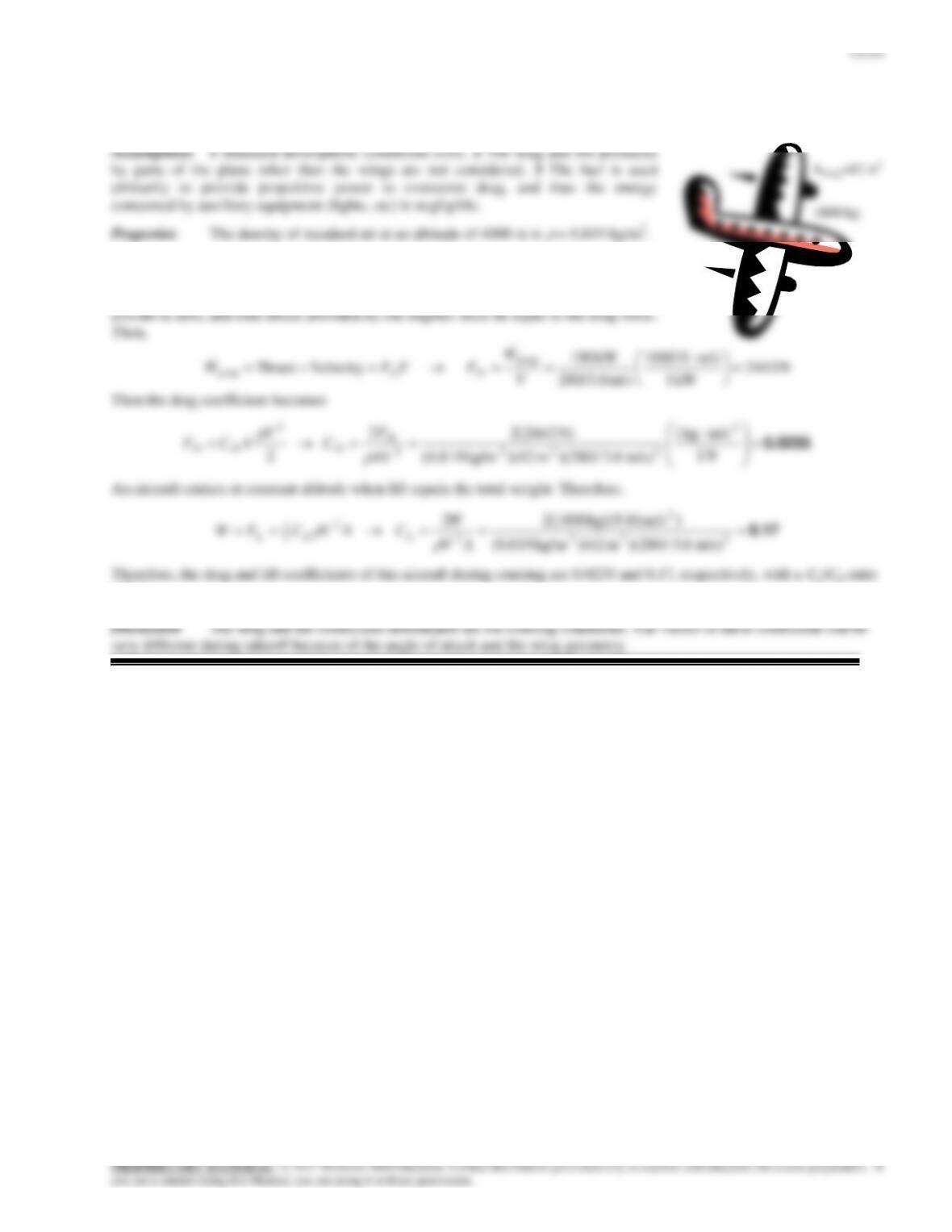
Solution The wings of a light plane resemble the NACA 23012 airfoil with no flaps. Using data for that airfoil, the
CL = 0.6 and CD = 0.015 [Note: Student values may differ significantly because
these values are very hard to read from the plots]. The maximum lift coefficient is
CL,max = 1.52 and it occurs at an angle of attack of 15°.
Analysis An aircraft will takeoff when lift equals the total weight. Therefore,
AC
W
VAVCWFW
L
LL
2
2
2
1
Substituting, the takeoff speed is determined to be
km/h 99.7
m/s 70.27
N 1
m/skg 1
)m 39)(6.0)(kg/m 225.1(
N) 000,11(2 2
23
takeoff
V
since 1 m/s = 3.6 km/h. The stall velocity (the minimum takeoff velocity corresponding the stall conditions) is determined
by using the maximum lift coefficient in the above equation,
km/h 62.7
m/s 41.17
N 1
m/skg 1
)m 39)(52.1)(kg/m 225.1(
N) 000,11(2
22
23
takeoff,
min AC
W
V
L
Discussion The “safe” minimum velocity to avoid the stall region is obtained by multiplying the stall velocity by 1.2:
km/h 75.2m/s 20.9m/s 41.172.12.1 minsafemin, VV
W = 11,000 N
15–84
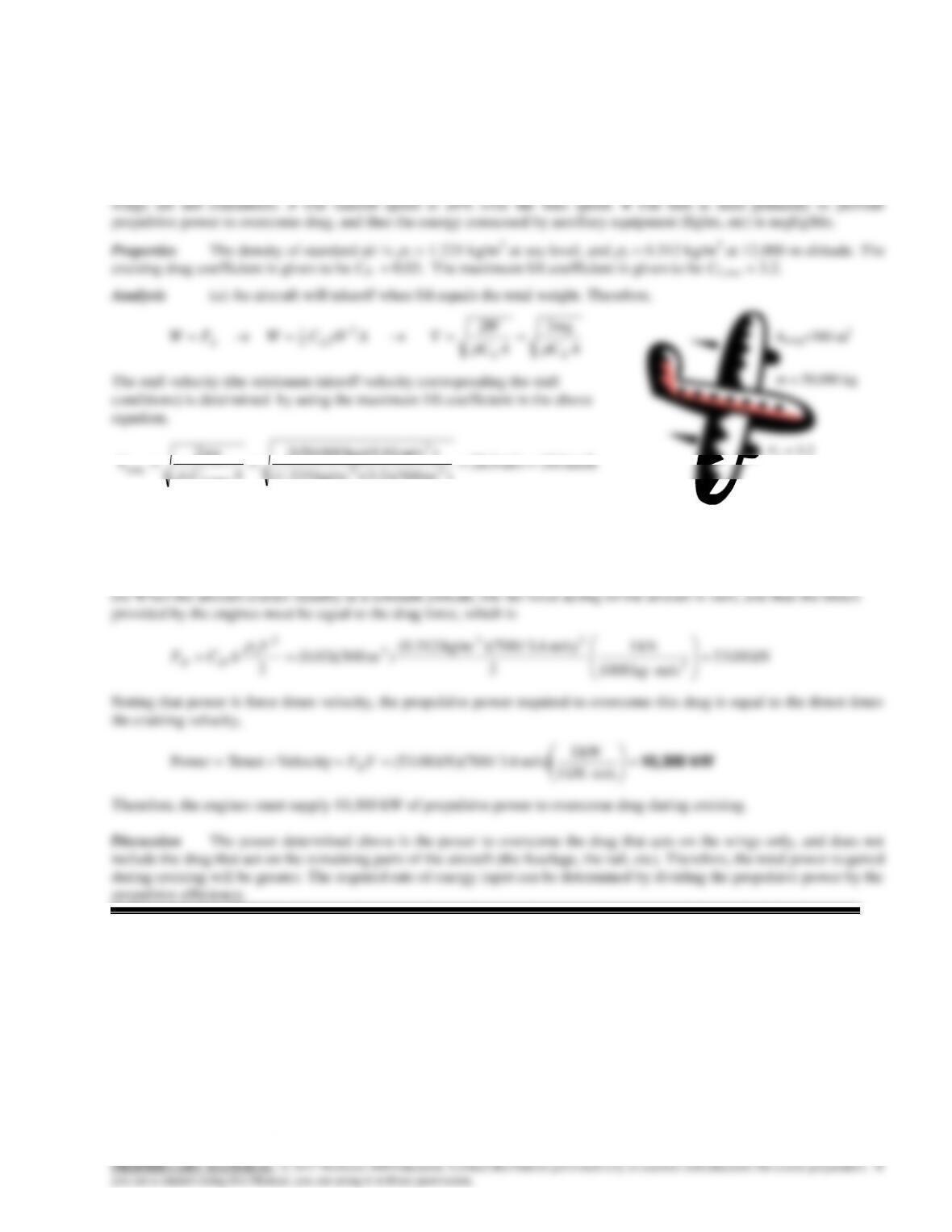
Solution The total mass, wing area, cruising speed, and propulsive power of a small aircraft are given. The lift and
drag coefficients of this airplane while cruising are to be determined.
Analysis Noting that power is force times velocity, the propulsive power
required to overcome this drag is equal to the thrust times the cruising velocity. Also,
when the aircraft is cruising steadily at a constant altitude, the net force acting on the
of 7.2.
280 km/h
15–52
15–85
Solution The mass, wing area, the maximum (stall) lift coefficient, the cruising speed and the cruising drag
coefficient of an airplane are given. The safe takeoff speed at sea level and the thrust that the engines must deliver during
cruising are to be determined.
Assumptions 1 Standard atmospheric conditions exist 2 The drag and lift produced by parts of the plane other than the
15–86
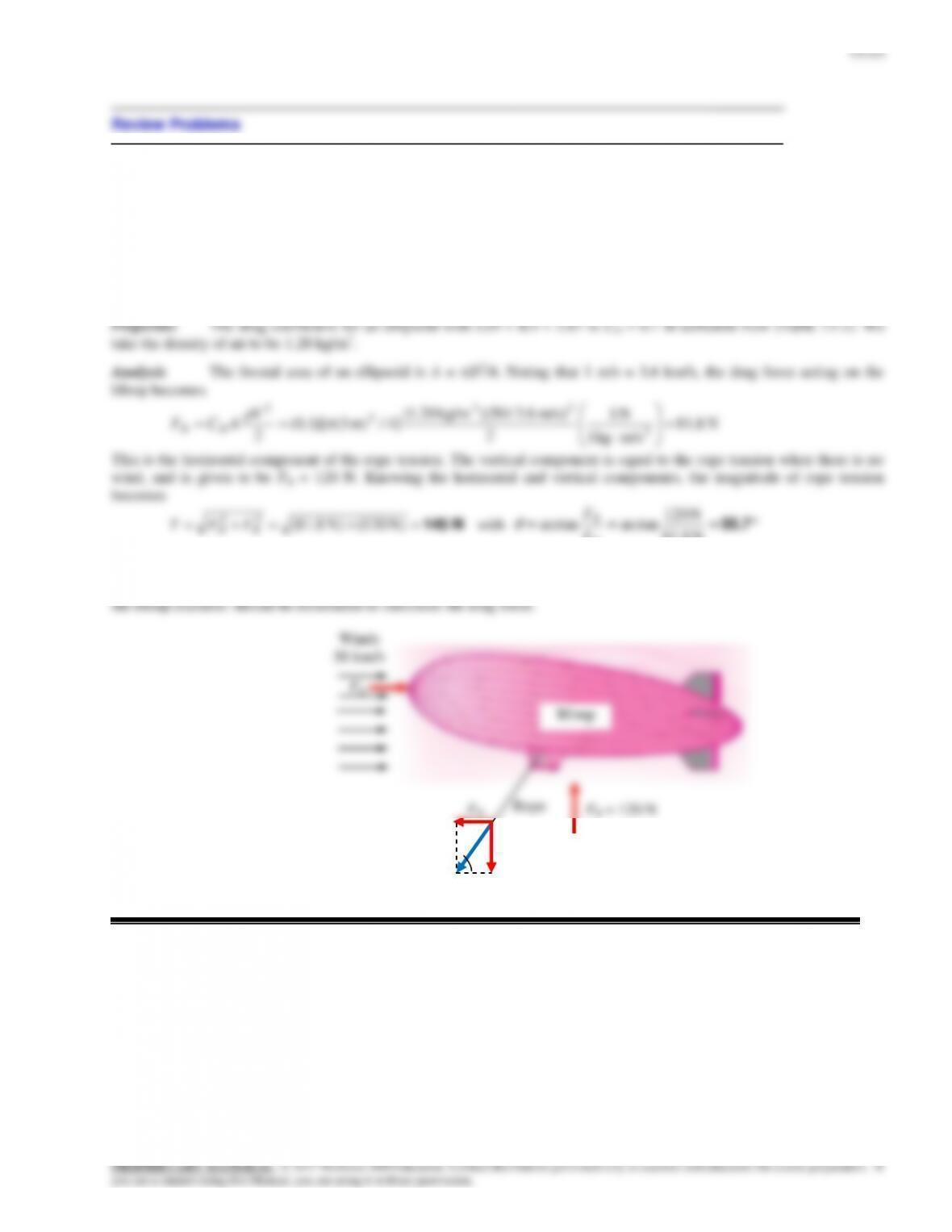
Solution A blimp connected to the ground by a rope is subjected to parallel winds. The rope tension when the wind is
at a specified value is submarine is to be determined.
Assumptions 1 The blimp can be treated as an ellipsoid. 2 The wind is steady and turbulent, and blows parallel to the
ground.
15–54
15–87
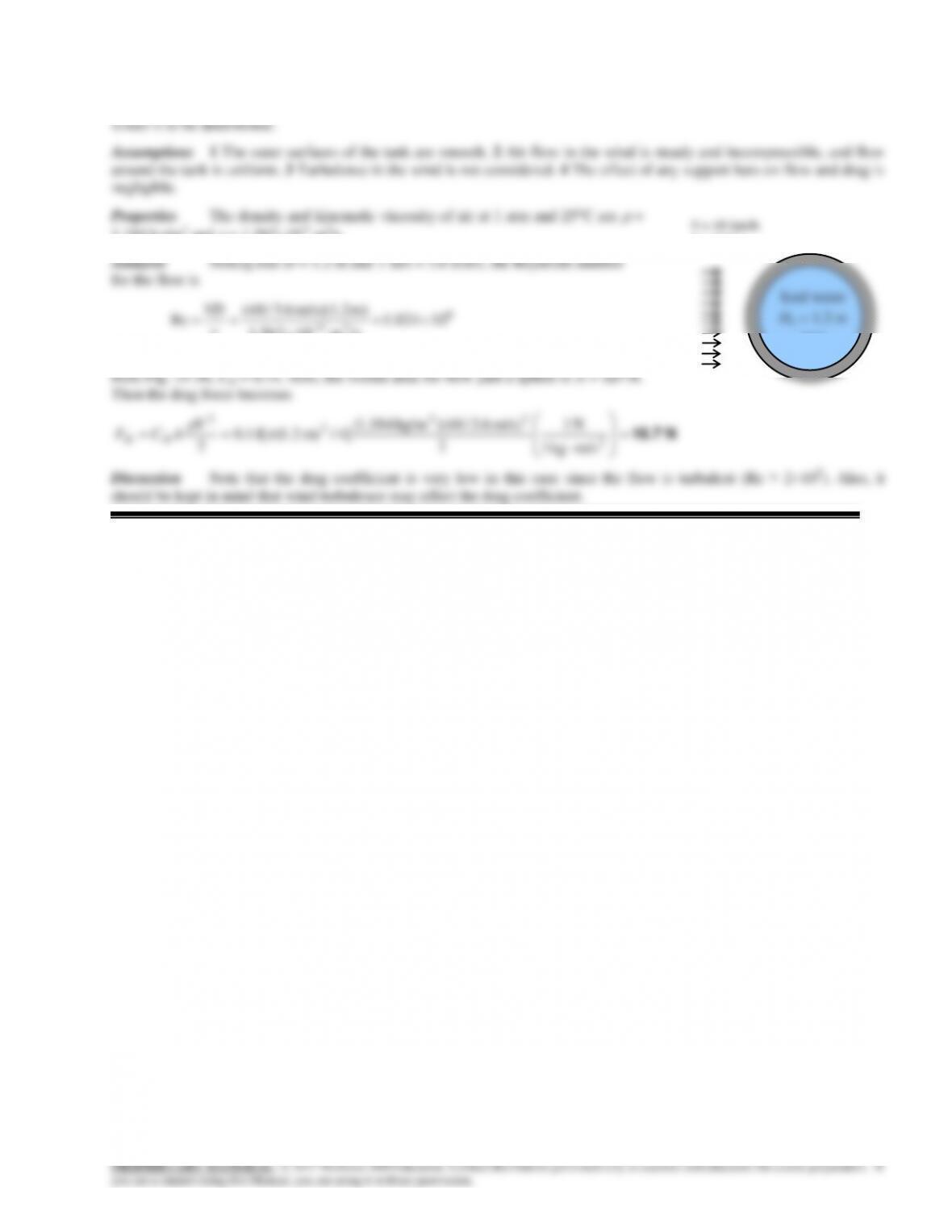
Solution A large spherical tank located outdoors is subjected to winds. The drag force exerted on the tank by the
1.184 kg/m3 and
= 1.56210-5 m2/s.
V = 48 km/h
T = 25C
15–55
15–88
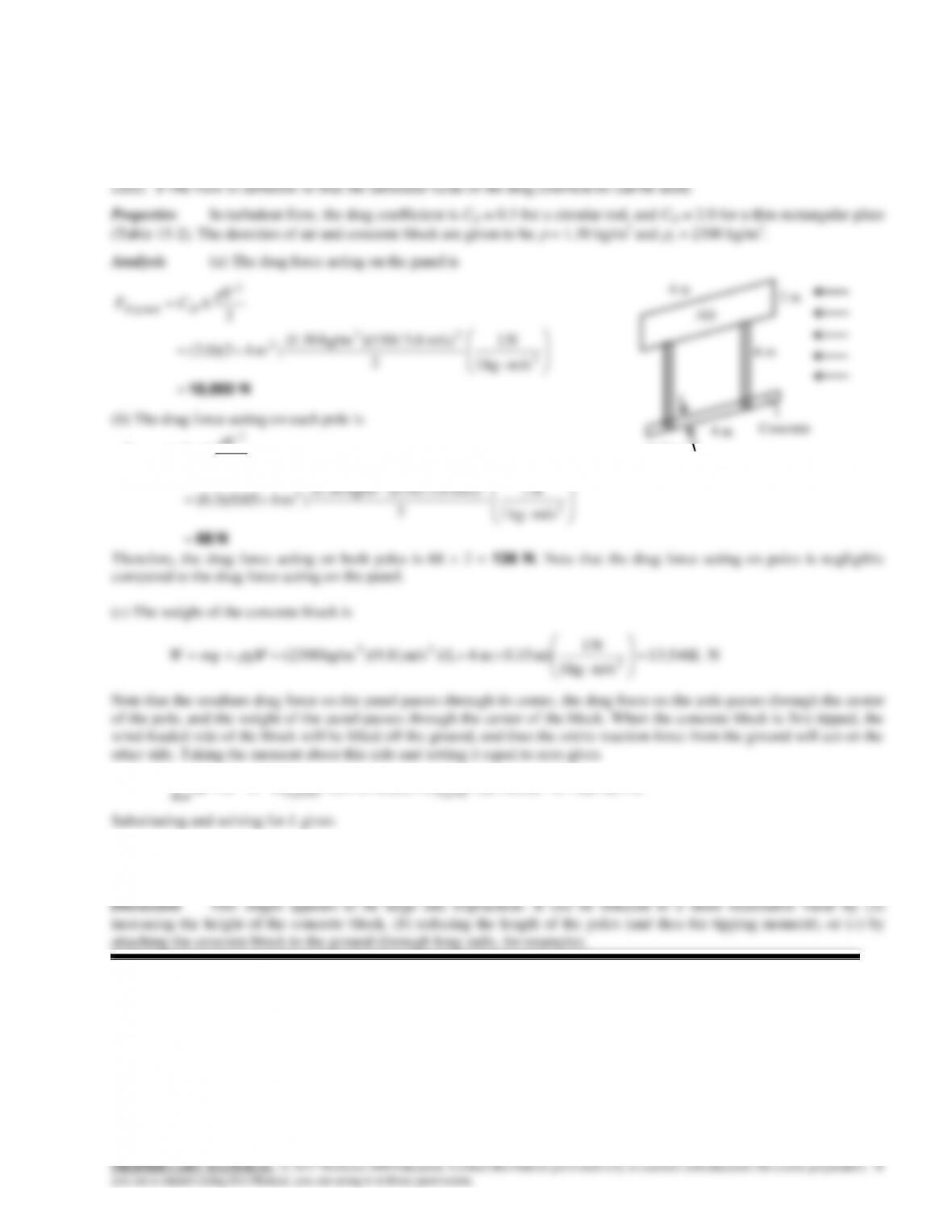
Solution A rectangular advertisement panel attached to a rectangular concrete block by two poles is to withstand high
winds. For a given maximum wind speed, the maximum drag force on the panel and the poles, and the minimum length L
of the concrete block for the panel to resist the winds are to be determined.
Assumptions 1 The flow of air is steady and incompressible. 2 The wind is normal to the panel (to check for the worst