S9–5 (continued)
Req. 2 (continued)
unnecessary costs associated with renegotiating the terms of its loan to the company—
renegotiations that could ultimately reveal that the company is generating sufficient cash
flows to repay the loan (despite what net income suggests under the alternative
S9–6
One way to evaluate a company’s success is to look for trends in its financial results.
The trend in Fast Corporation’s earnings is a positive one, suggesting that Fast has
improved its management of operations. In contrast, the slight decline in earnings for
(1) different assets were acquired at different costs, (2) different estimates are used for
useful lives, (3) different estimates are used for residual values, and (4) different
depreciation methods are used. The first potential explanation can be ruled out because
the case indicates that the companies “use very similar assets.” Among the remaining
three possibilities, the most likely explanation is that different depreciation methods are
S9–6 (continued)
The prior analysis would probably get you an interview with the Wall Street firm. If you
extended your analysis as shown below, you’d likely get the job without an interview.
The analysis can be taken even deeper yet, by breaking apart gains (losses) on fixed
asset disposals. The equation for computing a gain (or loss) subtracts the book value
AD – Gain (Loss) = C – SP.
Now, using last year and current year numbers for Fast in the above equation, you can
determine the following:
AD – Gain (Loss) = C – SP
($10,667 + 3,555) – 2,222 = C – SP
$30,000 and Fast has earned total income of $30,000.)
The above analysis relies on two key assumptions: (1) it assumes that both companies
disposed of identical equipment, and (2) the numbers used above actually assume that
both companies sold all of their equipment. While unrealistic, these assumptions allow
the analysis to demonstrate the key point of all this: differences in depreciation affect
S9–6 (continued)
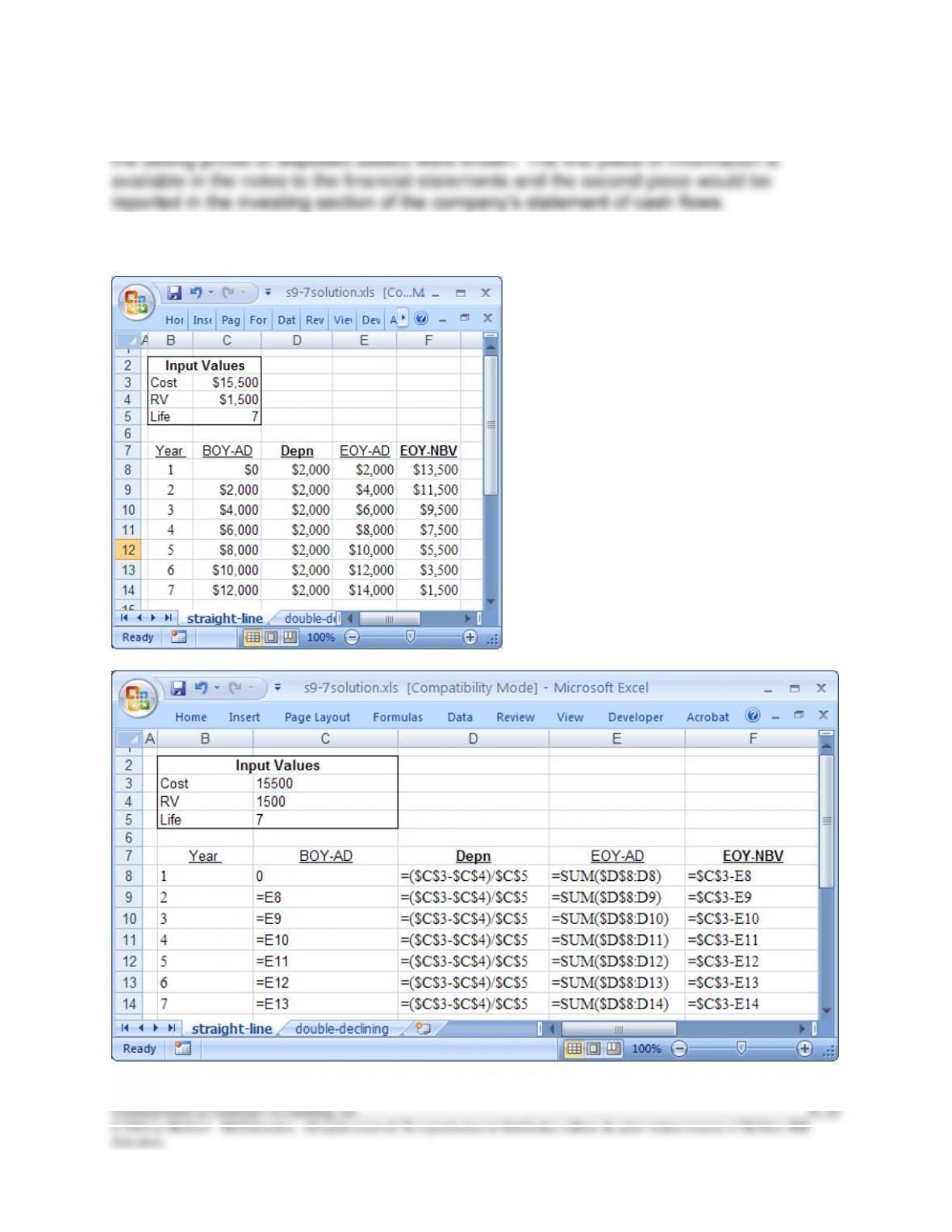
A more informed decision could be made if the companies’ depreciation methods and
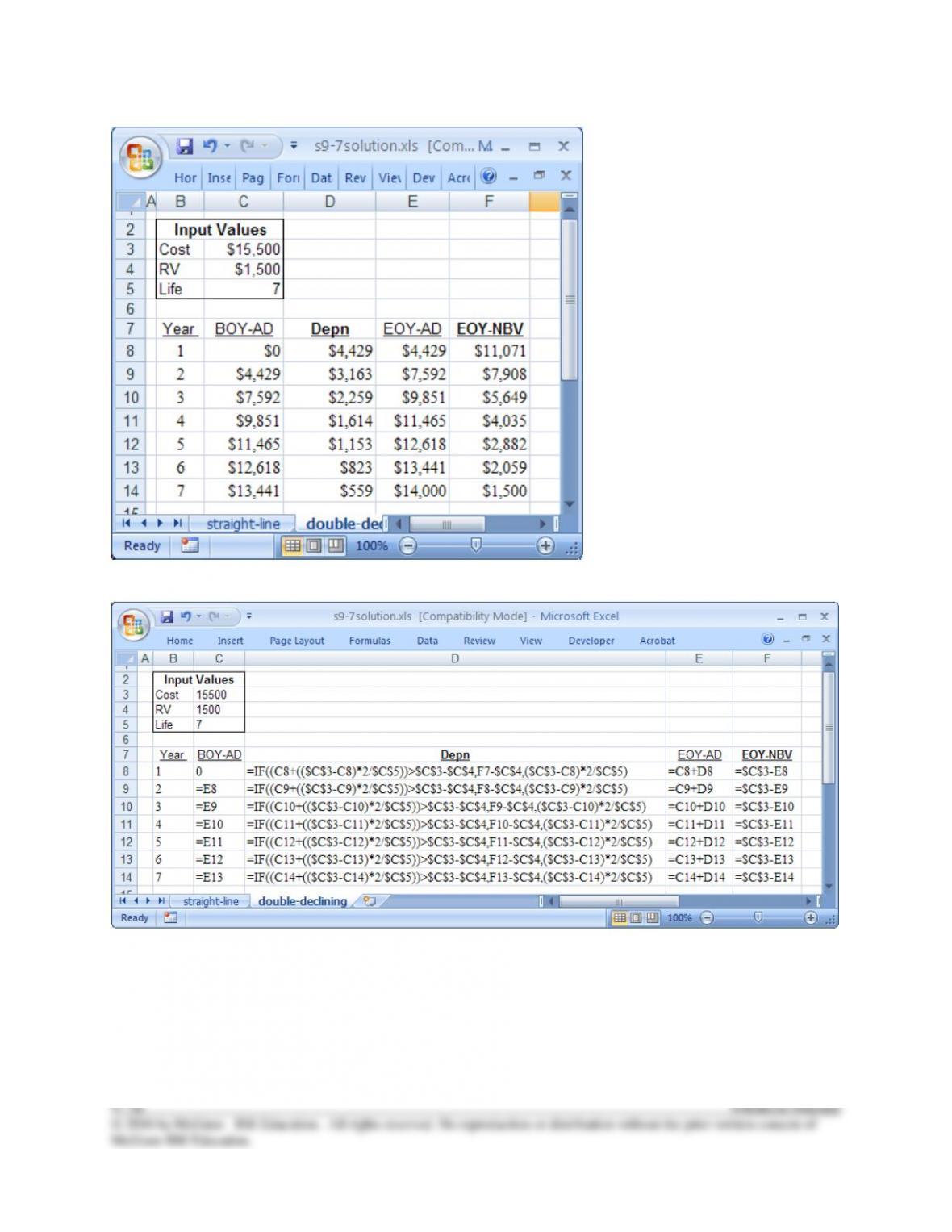
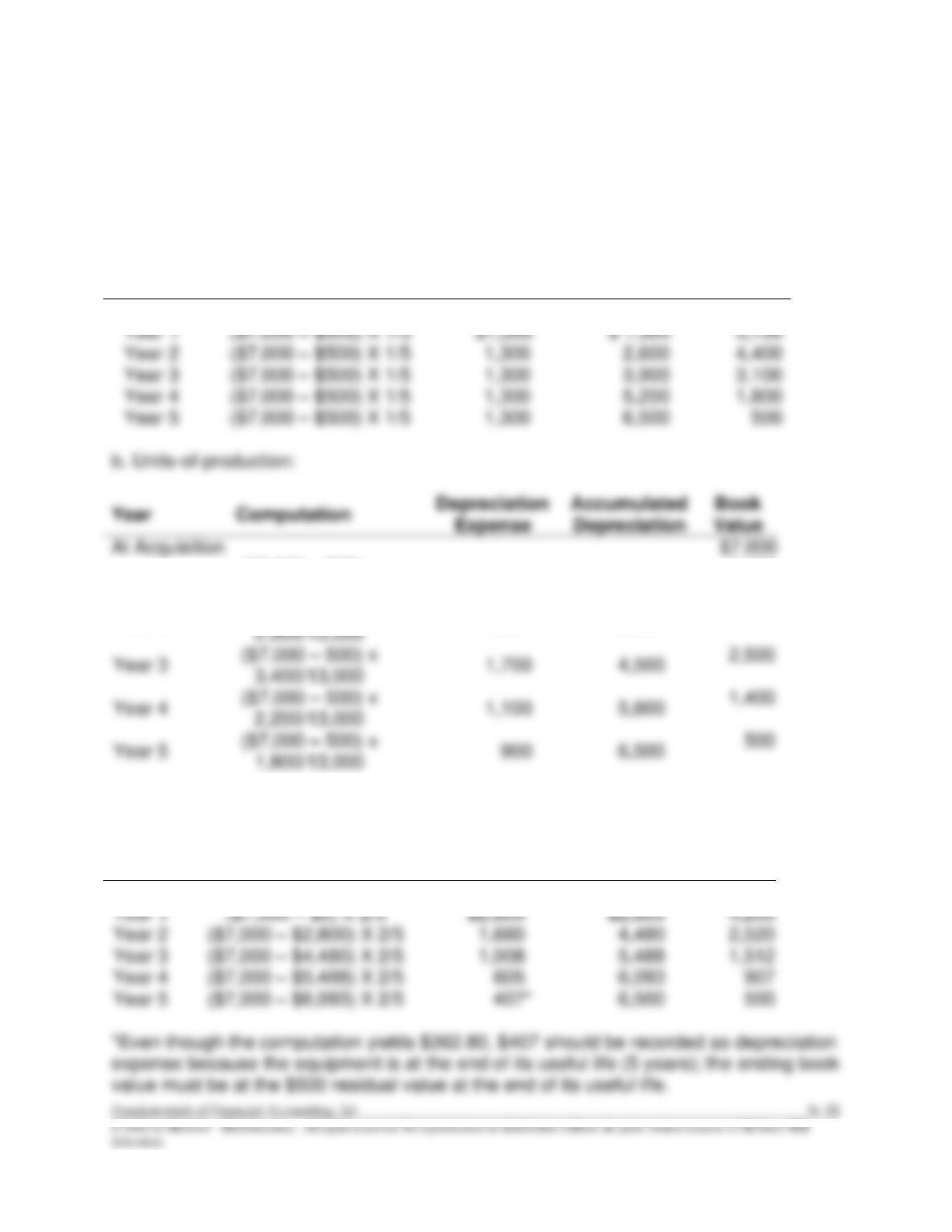
S9–7
S9–7 (continued)
ANSWERS TO CONTINUING CASE
CC9-1
Req. 1
a. Straight-line:
Year
Computation
Depreciation
Expense
Accumulated
Depreciation
Book
Value
At Acquisition
$7,000
Year 1
($7,000 – $500) X 1/5
$1,300
$ 1,300
5,700
Year 2
($7,000 – $500) X 1/5
1,300
2,600
4,400
Year 3
($7,000 – $500) X 1/5
1,300
3,900
3,100
Year 4
($7,000 – $500) X 1/5
1,300
5,200
1,800
Year 5
($7,000 – $500) X 1/5
1,300
6,500
500
b. Units-of-production:
Year
Computation
Depreciation
Expense
Accumulated
Depreciation
Book
Value
At Acquisition
$7,000
Year 1
($7,000 – 500) x
3,100/13,000
$1,550
$1,550
5,450
Year 2
($7,000 – 500) x
2,500/13,000
1,250
2,800
4,200
Year 3
($7,000 – 500) x
3,400/13,000
1,700
4,500
2,500
Year 4
($7,000 – 500) x
2,200/13,000
1,100
5,600
1,400
Year 5
($7,000 – 500) x
1,800/13,000
900
6,500
500
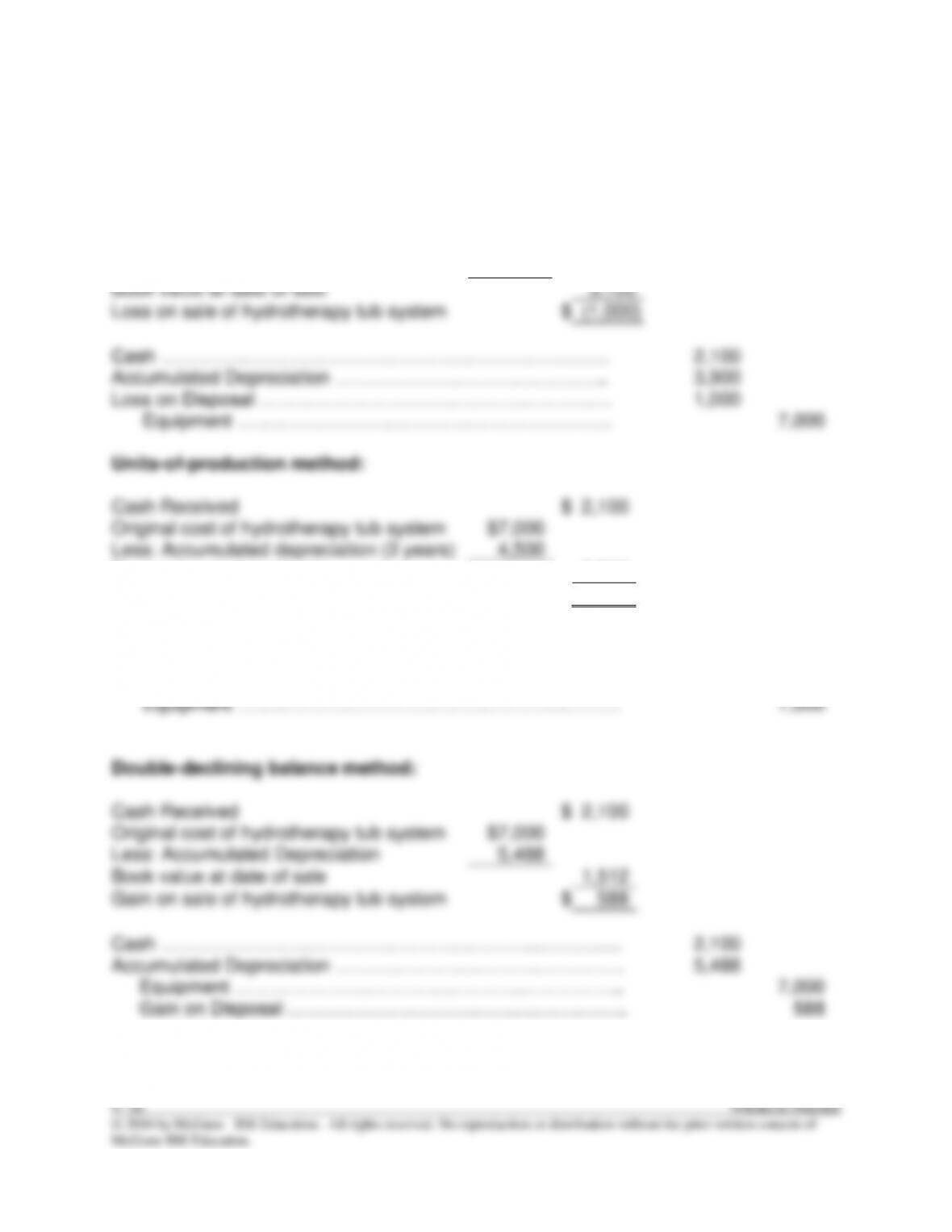
c. Double-declining balance:
Year
Computation
Depreciation
Expense
Accumulated
Depreciation
Book
Value
At Acquisition
$7,000
Year 1
($7,000 – $0) X 2/5
$2,800
$2,800
4,200
Year 2
($7,000 – $2,800) X 2/5
1,680
4,480
2,520
Year 3
($7,000 – $4,480) X 2/5
1,008
5,488
1,512
Year 4
($7,000 – $5,488) X 2/5
605
6,093
907
Year 5
($7,000 – $6,093) X 2/5
407*
6,500
500
*Even though the computation yields $362.80, $407 should be recorded as depreciation
expense because the equipment is at the end of its useful life (5 years); the ending book
value must be at the $500 residual value at the end of its useful life.
CC9-1 (continued)
Req. 2
Straight line method
Cash Received
$
2,100
Original cost of hydrotherapy tub system
$7,000
Less: Accumulated depreciation (3 years)
3,900
Book value at date of sale
3,100
Loss on sale of hydrotherapy tub system
$
(1,000)
Cash ………………………………………………………………..
Accumulated Depreciation ……….……………………………...
Loss on Disposal …………………………………………………
Equipment ……………..……………………………………..
2,100
3,900
1,000
7,000
Units–of-production method:
Cash Received
$
2,100
Original cost of hydrotherapy tub system
$7,000
Less: Accumulated depreciation (3 years)
4,500
Book value at date of sale
2,500
Loss on sale of hydrotherapy tub system
$
(400)
Cash ……………………………………………………………....….
Accumulated Depreciation ………………………………………..
Loss on Disposal ……………….…….…….…….…….…….…...
Equipment ……………………………………………………..
2,100
4,500
400
7,000
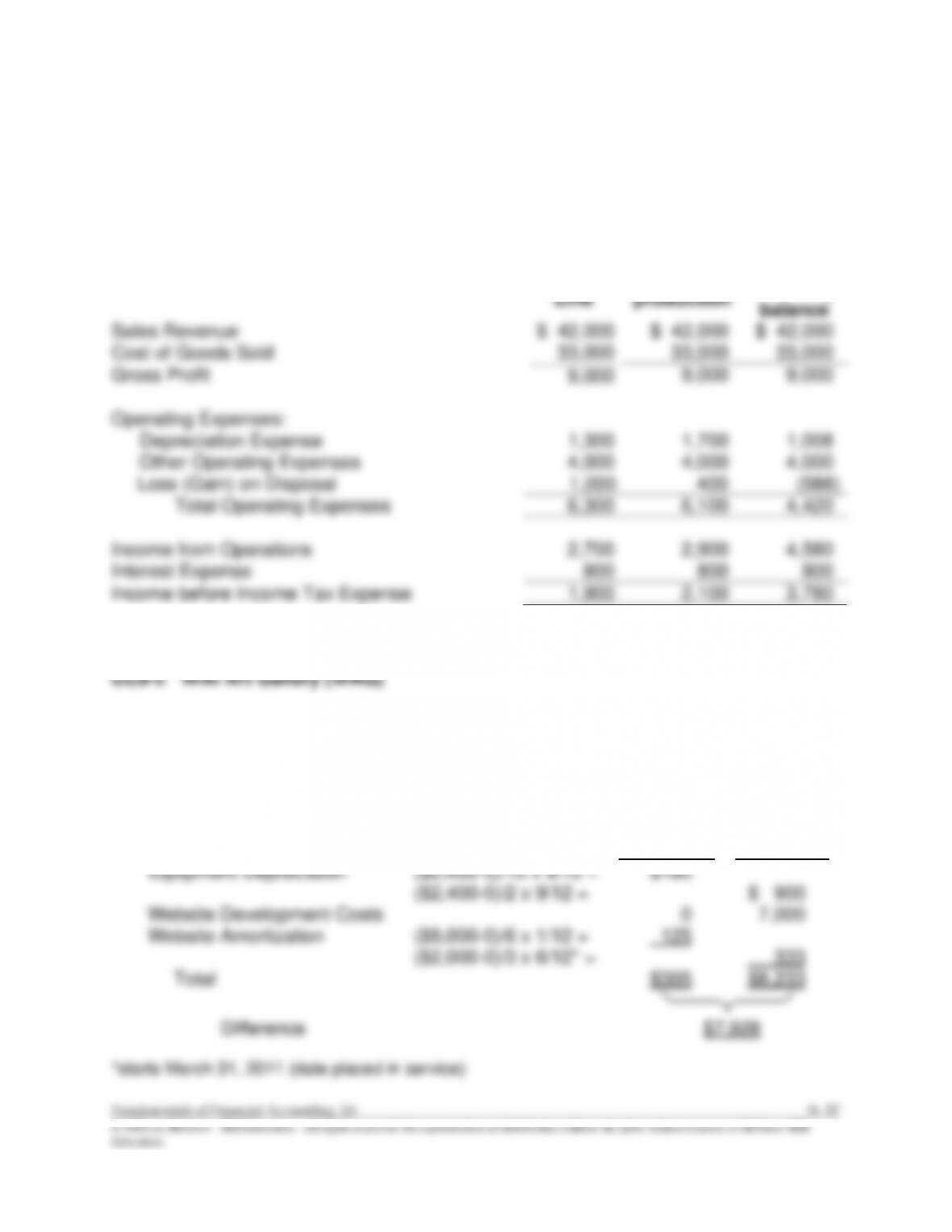
Double-declining balance method:
Cash Received
$
2,100
Original cost of hydrotherapy tub system
$7,000
Less: Accumulated Depreciation
5,488
Book value at date of sale
1,512
Gain on sale of hydrotherapy tub system
$
588
Cash ……………………………………………………………....….
Accumulated Depreciation ………………………………………..
Equipment ……………….……………………………………..
Gain on Disposal ………………….…….…….…….…….…...
2,100
5,488
7,000
588
CC9-1 (continued)
Req. 3
NICOLE’S GETAWAY SPA
(Forecasted) Income Statement
For Year 3
Straight
Line
Units-of–
production
Double-
declining
balance
Sales Revenue
Cost of Goods Sold
$ 42,000
33,000
9,000
$ 42,000
33,000
$ 42,000
33,000
Gross Profit
9,000
9,000
Operating Expenses:
Depreciation Expense
Other Operating Expenses
Loss (Gain) on Disposal
1,300
4,000
1,000
1,700
4,000
400
1,008
4,000
(588)
Total Operating Expenses
6,300
6,100
4,420
Income from Operations
Interest Expense
2,700
800
2,900
800
4,580
800
Income before Income Tax Expense
1,900
2,100
3,780
1. B
2. A
3. D
4. D (see computations below) Amount deducted
from net income
As reported
As restated
Equipment Depreciation
($2,400-0)/10 x 9/12 =
$180
($2,400-0)/2 x 9/12 =
$ 900
Website Development Costs
0
7,000
Website Amortization
($9,000-0)/6 x 1/12 =
125
($2,000-0)/3 x 6/12* =
333
Total
$305
$8,233
Difference
$7,928
*starts March 31, 2011 (date placed in service)