C9–1 (continued)
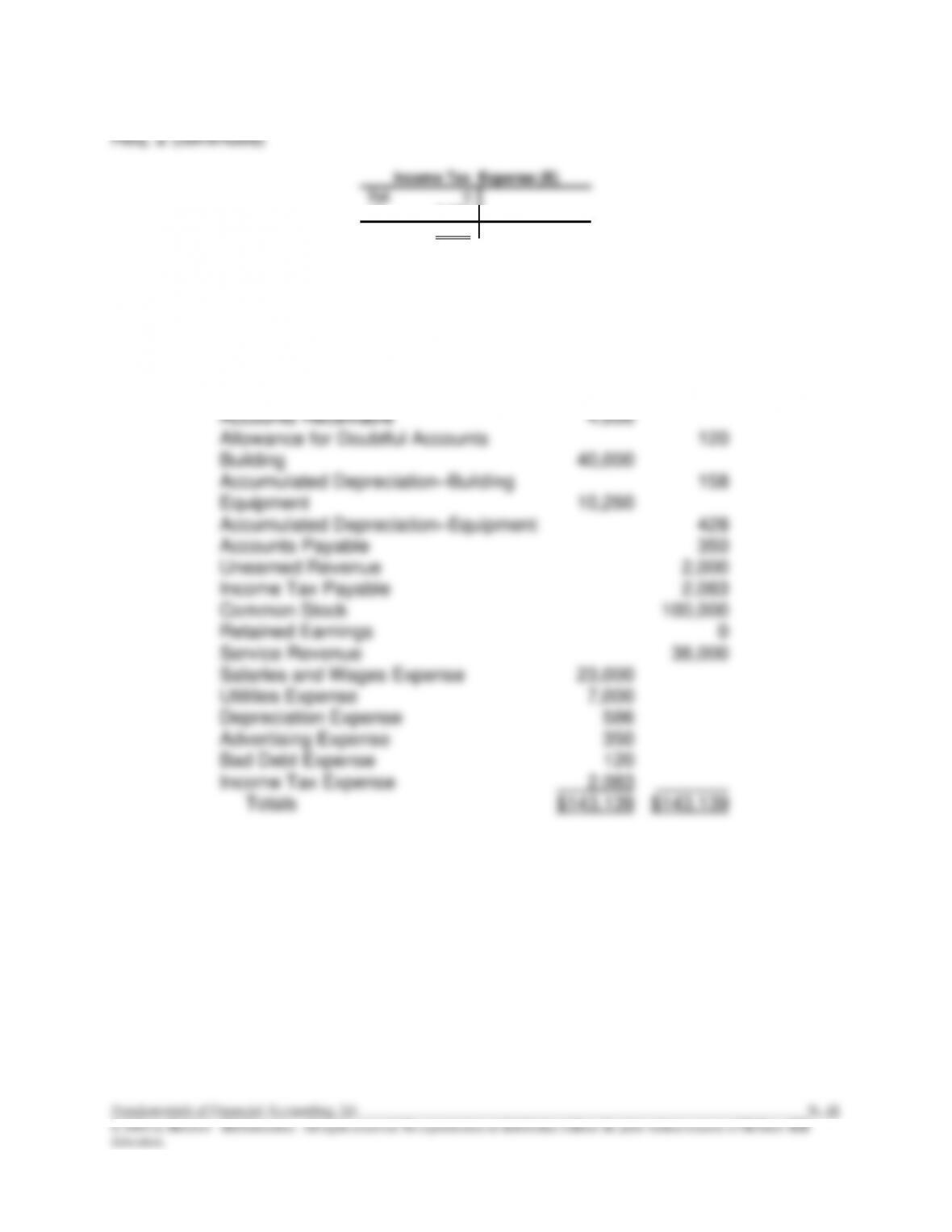
GRID IRON PREP INC.
Adjusted Trial Balance
As of December 31
Account Titles
Debit
Credit
Cash
55,740
Accounts Receivable
4,000
Allowance for Doubtful Accounts
120
Building
40,000
Accumulated Depreciation–Building
158
Equipment
10,260
Accumulated Depreciation–Equipment
428
Accounts Payable
350
Unearned Revenue
2,000
Income Tax Payable
2,083
Common Stock
100,000
Retained Earnings
0
Service Revenue
38,000
Salaries and Wages Expense
23,000
Utilities Expense
7,000
Depreciation Expense
586
Advertising Expense
350
Bad Debt Expense
120
Income Tax Expense
2,083
Totals
$143,139
$143,139
Bal.
10.
0
2,083
2,083
C9–1 (continued)
Req. 3
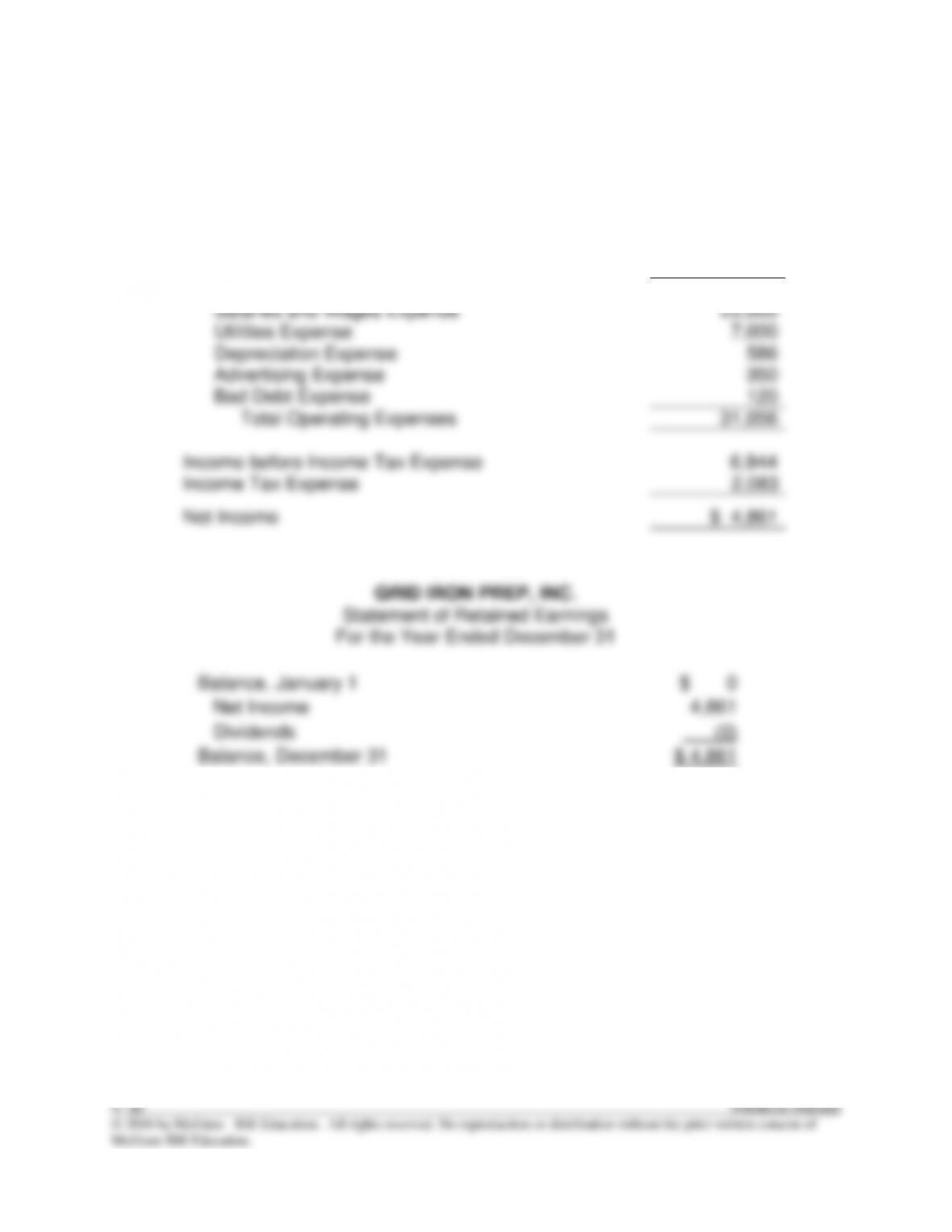
GRID IRON PREP, INC.
Income Statement
For the Year Ended December 31
Service Revenue
$ 38,000
Expenses:
Salaries and Wages Expense
23,000
Utilities Expense
7,000
Depreciation Expense
586
Advertising Expense
350
Bad Debt Expense
120
Total Operating Expenses
31,056
Income before Income Tax Expense
6,944
Income Tax Expense
2,083
Net Income
$ 4,861
GRID IRON PREP, INC.
Statement of Retained Earnings
For the Year Ended December 31
Balance, January 1
$ 0
Net Income
4,861
Dividends
(0)
Balance, December 31
$ 4,861
C9–1 (continued)
Req. 2 (continued)
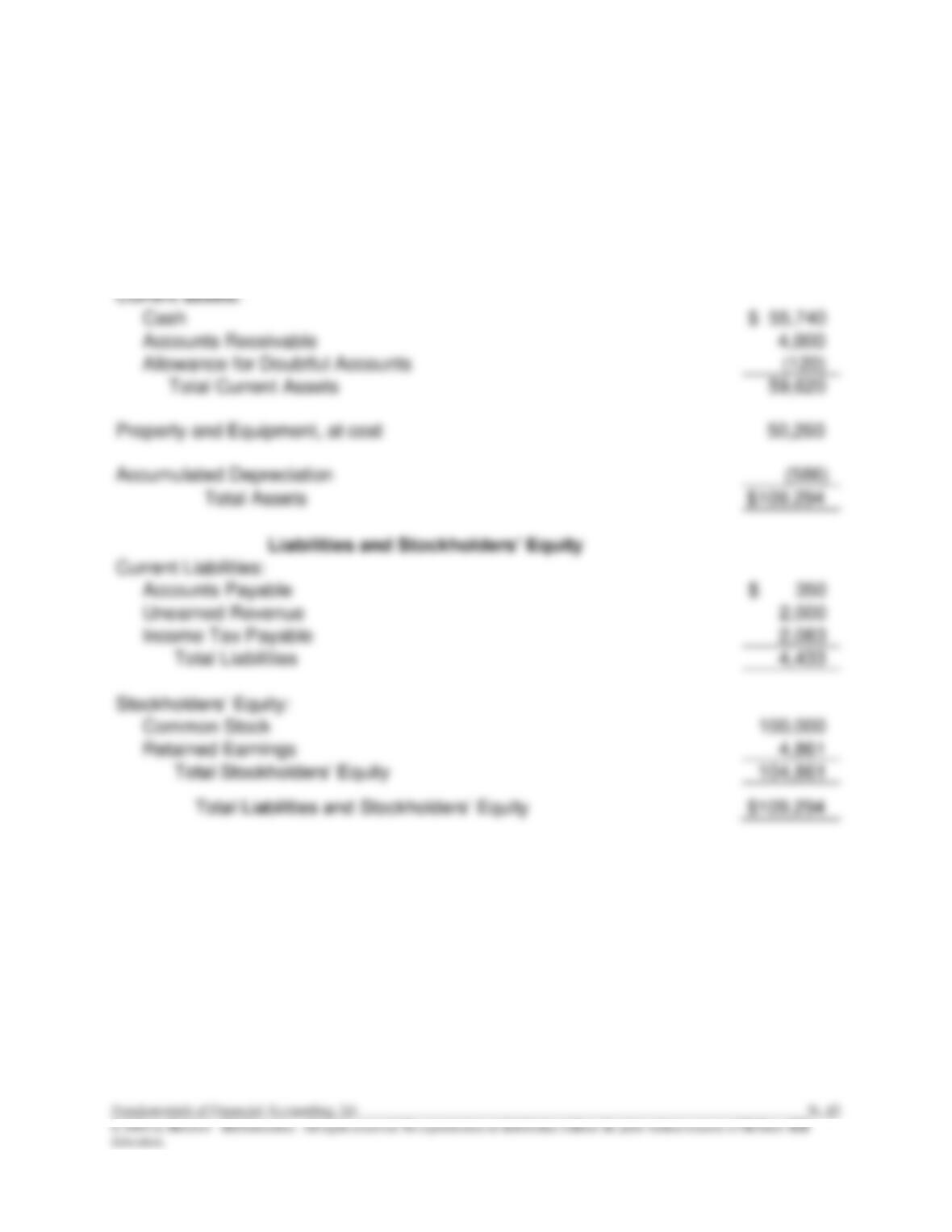
GRID IRON PREP, INC.
Balance Sheet
As of December 31
Assets
Current assets:
Cash
$ 55,740
Accounts Receivable
4,000
Allowance for Doubtful Accounts
(120)
Total Current Assets
59,620
Property and Equipment, at cost
50,260
Accumulated Depreciation
(586)
Total Assets
$109,294
Liabilities and Stockholders’ Equity
Current Liabilities:
Accounts Payable
$ 350
Unearned Revenue
2,000
Income Tax Payable
2,083
Total Liabilities
4,433
Stockholders’ Equity:
Common Stock
100,000
Retained Earnings
4,861
Total Stockholders’ Equity
104,861
Total Liabilities and Stockholders’ Equity
$109,294
ANSWERS TO SKILLS DEVELOPMENT CASES
S9–1
Req.1
Answer: A
Accumulated Depreciation and Amortization at February 2, 2014, is $15,716.
This represents 40.2% of the total cost of the property and equipment of $39,064.
($15,716 / $39,064 = 0.402)
Req. 2
S9–2
Req. 1
Note 1 reports that Lowe’s uses the straight-line depreciation method for its property.
Req. 2
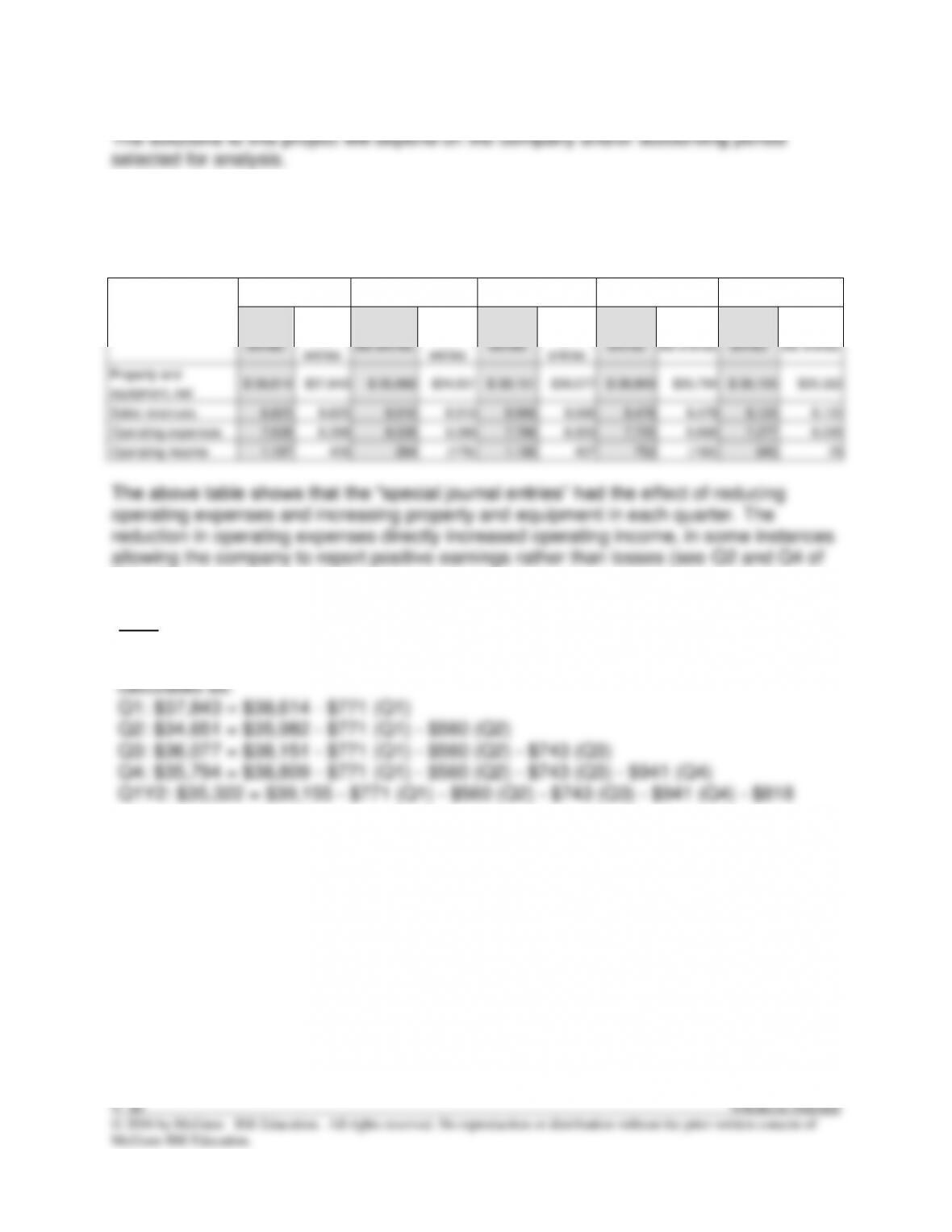
The fixed asset turnover ratio for Lowe’s Companies for the year ended January 31,
S9–3
S9–4
Req. 1
Amounts in millions of
US dollars
Q1 Year 1
(March 31)
Q2 Year 1
(June 30)
Q3 Year 1
(September 30)
Q4 Year 1
(December 31)
Q1 Year 2
(March 31)
With the
entries
Without
the
entries
With
the entries
Without
the
entries
With the
entries
Without
the
entries
With the
entries
Without
the entries
With the
entries
Without
the entries
Property and
equipment, net
$ 38,614
$37,843
$ 35,982
$34,651
$ 38,151
$36,077
$ 38,809
$35,794
$ 39,155
$35,322
Sales revenues
8,825
8,825
8,910
8,910
8,966
8,966
8,478
8,478
8,120
8,120
Operating expenses
7,628
8,399
8,526
9,086
7,786
8,529
7,725
8,666
7,277
8,095
Operating income
1,197
426
384
(176)
1,180
437
753
(188)
843
25
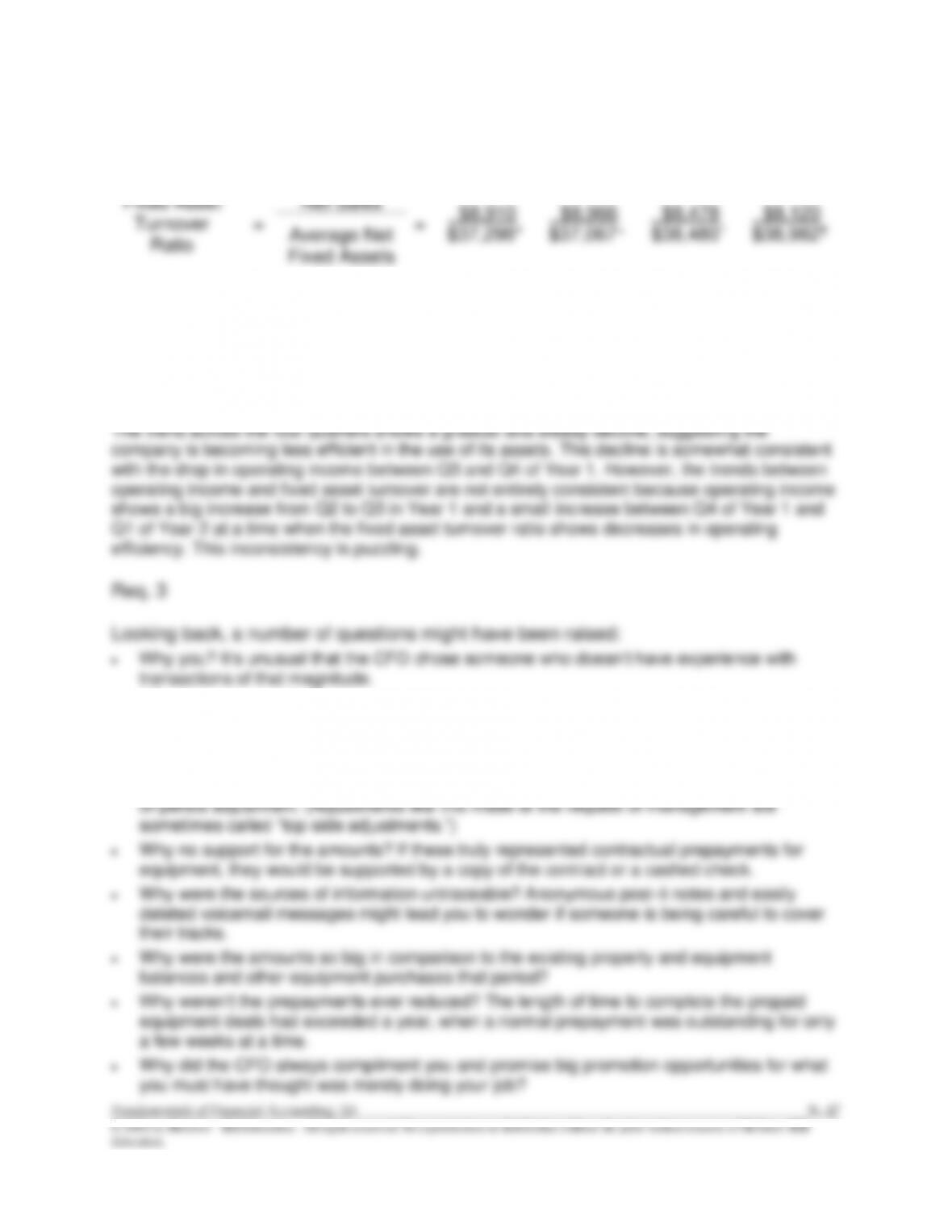
The above table shows that the “special journal entries” had the effect of reducing
operating expenses and increasing property and equipment in each quarter. The
reduction in operating expenses directly increased operating income, in some instances
allowing the company to report positive earnings rather than losses (see Q2 and Q4 of
Year 1).
Note: Because Property and Equipment is a balance sheet account that carries its
balance forward from one period to the next, the computation of its book value
“without the entries” must take into consideration the cumulative effects of the entries,
calculated as:
Q1: $37,843 = $38,614 – $771 (Q1)
Q2: $34,651 = $35,982 – $771 (Q1) – $560 (Q2)
Q3: $36,077 = $38,151 – $771 (Q1) – $560 (Q2) – $743 (Q3)
Q4: $35,794 = $38,809 – $771 (Q1) – $560 (Q2) – $743 (Q3) – $941 (Q4)
Q1Y2: $35,322 = $39,155 – $771 (Q1) – $560 (Q2) – $743 (Q3) – $941 (Q4) – $818
S9–4 (continued)
Req. 2
Q2 Yr 1
Q3 Yr 1
Q4 Yr 1
Q1 Yr 2
Fixed Asset
Turnover
Ratio
=
Net Sales
=
$8,910
$37,298*
$8,966
$37,067+
$8,478
$38,480^
$8,120
$38,982†
Average Net
Fixed Assets
=
0.24
0.24
0.22
0.21
37,298* = (38,614 + 35,982)/2
37,067+ = (35,982 + 38,151)/2
38,480^ = (38,151 + 38,809)/2
38,982† = (38,809 + 39,155)/2
• Why a new account? It’s unusual that a new account has been created for these special
advance payments, when an “equipment deposit” account already existed for transactions
supposedly of a similar nature.
• Why process the transactions through the operating division? The CFO didn’t offer a clear
reason why the transactions were posted in an abnormal manner, requiring an unusual end–
S9–4 (continued)
Req. 4
As a staff person, you can’t doubt or mistrust every assignment you are given. If you did,
you’d likely find yourself out of a job. So, instead, you need to be able to tell the
difference between routine/ordinary requests and unusual requests. When you are
confronted with unusual requests, attempt to understand and evaluate the reasons for
the company entered into and emerged from bankruptcy. This meant that millions of
working people and retirees no longer had the investment income for which they had
saved and on which they had made their retirement plans. It also meant that money
invested in kids’ college funds was gone—more than likely, you or one of your
classmates has to work a part-time job this term to pay for tuition that could have been
situation was even worse because WorldCom’s external auditors had been Arthur
Andersen—the same firm that had failed to detect and report the Enron fraud just one
year earlier. Just as Andersen was bracing for a whirlwind of Enron-related lawsuits,
WorldCom’s problems were discovered and that was the end of Arthur Andersen.
These are just three of the groups directly affected by WorldCom’s fraud. Countless
S9–5
Req.1
Method
Computation
Depreciation
Expense
Book
Value
Straight-line
(Cost – Residual Value) x (1/ Useful Life)
($35,000 – $7,000) x 1/4
$7,000
$28,000
Units-of–
Production
(Cost – Res. Value) x Actual Production
Estimated Total Production
{($35,000 – $7,000) ÷ 28,000} x 4,000
$4,000
31,000
Double-
declining-
balance
(Cost – Accumulated Depreciation) x (2/ Useful Life)
($35,000 – 0) x 2/4
$17,500
17,500
The units-of–production method would meet the owner’s objective of keeping the total
assets above $250,000. Under this method, the depreciation expense would be $4,000
leaving a book value for the new equipment of $31,000, which would keep the total
assets at $251,000. The straight-line and double-declining-balance methods would
produce book values that would cause total assets to fall below $250,000.
Req. 2
One could justifiably argue that it is unethical to choose a particular method if the sole
purpose of the choice is to mislead others or if existing rules are knowingly violated.
This isn’t the case in this situation however. The choice of the units–of-production
method is supported by a valid business reason. By using this method, the company is
able to match the cost of using the new equipment to the periods in which the output
from the equipment is sold to generate revenue. Arguably, this provides more useful
financial information than the other two alternative methods, which assume asset usage
patterns that differ from actual usage.
The two parties most directly affected by this decision—the owner and the bank—can
both benefit from this decision. The owner gets a more appropriate measure of his
company’s net income for the year and its net assets at the end of the year. The bank
similarly receives more useful information that will enable the bank to avoid incurring