Chapter Outline
Teaching Notes
7. Partial-Year Depreciation Calculations
a. Purchases of long-lived assets seldom occur on the
first or last day of the period; depreciation must
sometimes be calculated for periods shorter than a
year.
b. Under the straight-line and declining-balance methods,
the annual depreciation is multiplied by the fraction of
the year for which depreciation is being calculated.
c. These partial-year modifications are not required in
the units-of-production method.
8. Tax Depreciation
a. Most public companies use one method of
depreciation for reporting to stockholders and a
different method for determining income taxes.
i. The IRS allows companies to deduct larger
amounts of tax depreciation allowed by GAAP; the
deduction reduces the company’s income taxes
significantly in the years immediately following
the purchase of a long-lived asset.
ii. The IRS doesn’t allow a company to depreciate
more than an asset’s depreciable cost over its life;
so, the tax savings enjoyed in the early years of an
asset’s life will eventually be paid back in later
years of the asset’s life.
iii. The amount of tax put off (deferred) as a result of
taking large tax depreciation deductions is reported
as a long-term liability called Deferred Income
Tax.
b. Least and latest rule––All taxpayers want to pay the
least tax that is legally permitted and at the latest
possible date.
LO 9-4 Explain the effect of asset impairment on the financial statements.
C. Asset Impairment Losses––An asset’s book value could
exceed its current value
1. Impairment––Occurs when the cash to be generated by
an asset is estimated to be less than the carrying value of
that asset.
2. Events or changed circumstances can interfere with a
company’s ability to recover the value of an asset through
future operations.
3. If this occurs, the book value should be written down to
what the asset is worth (called fair value); the amount of
the write-down is reported as an impairment loss.
4. Impairment losses are classified as an operating expense
on the income statement and reported above the Income
from Operations subtotal.
Chapter Outline
Teaching Notes
LO 9-5 Analyze the disposal of long-lived tangible assets.
D. Disposal of Tangible Assets
1. In some cases, a business may voluntarily decide not to
hold a long-term asset for its entire life.
2. The disposal of a depreciable asset usually requires two
accounting adjustments:
a. Update the Depreciation Expense and Accumulated
Depreciation accounts; if asset is disposed of during
the year, must first record depreciation through the
date of disposal.
b. Record the disposal.
i. All disposals of long-lived assets require
accounting for (1) the book value of the items
given up, (2) the value of the items received, and
(3) any difference between the two amounts, which
reflects a gain or loss on the disposal.
ii. Any gain or loss on disposal is included on the
income statement when calculating Income from
Operations.
3. At the end of the year, the company sold equipment for
$50,000 cash. The original cost was $100,000 and the
related accumulated depreciation is $60,000.
a. Analyze (rounded to nearest thousand):
Assets = Liabilities + Stockholders’ Equity
Equipment (–A) –100; Accumulated Depreciation
(–xA) +60; Cash (A) +50; Gain on Disposal (+R) +10
b. Record:
Cash
50
Accumulated Depreciation
60
Equipment
100
Gain on Disposal
10
LO 9-6 Analyze the acquisition, use, and disposal of long-lived intangible assets.
E. Intangible Assets
1. Intangible assets––Long-lived assets that lack physical
substance. Examples:
a. Trademark––A special name, image, or slogan
identified with a product or company.
b. Copyright––A form of protection provided to the
original authors of literary, musical, artistic, dramatic,
and other works of authorship.
c. Patent––A right to exclude others from making,
using, selling, or importing an invention.
d. Technology assets––Acquired computer software and
development costs.
e. Licensing rights––The limited permissions to use
property according to specific terms and conditions set
out in a contract.
Chapter Outline
Teaching Notes
f. Franchise––A contractual right to sell certain
products or services, use certain trademarks, or
perform activities in a certain geographical region.
g. Goodwill––The premium a company pays to obtain
the favorable reputation associated with another
company.
2. Acquisition, Use, and Disposal
a. The costs of intangible assets are recorded as assets
only if they have been purchased.
i. Research and development––Expenditures that
may someday lead to patents, copyrights, or other
intangible assets; the uncertainty about their future
benefits requires they be expensed.
ii. The primary reason that the cost of self-developed
intangibles is reported as an expense rather than an
asset is that it’s easy for people to claim that
they’ve developed a valuable (but invisible)
intangible asset.
iii. Evidence of what it is actually worth only happens
when someone gives up their hard-earned cash to
buy it; at that time, the purchaser records the
intangible asset at its acquisition cost.
iv. This general rule applies to trademarks, copyrights,
patents, licensing rights, franchises, and goodwill.
v. Goodwill is the difference between the purchase
price of a company as a whole and the fair market
value of the net assets of the business.
The “Spotlight on Business
Decisions” feature addresses
valuing goodwill.
b. Use of intangible assets, after they have been
purchased––Rules depend on whether the intangible
asset has a limited or unlimited life.
i. Intangibles with limited useful lives––Cost is
spread on a straight-line basis over each period of
useful life.
▪ Amortization––Process of allocating the cost
of intangible assets over their limited useful
lives; similar to depreciation.
▪ Most companies do not estimate a residual
value because intangible assets usually have no
value at the end of their useful lives.
▪ Amortization is reported as an expense each
period on the income statement.
▪ Amortization is accumulated on the balance
sheet in the contra asset account, Accumulated
Amortization.
Chapter Outline
Teaching Notes
ii. Assume that amortization of $40,000 is recorded.
▪ Analyze (rounded to nearest thousand):
Assets = Liabilities + Stockholders’ Equity
Accumulated Amortization (xA) –40;
Amortization Expense (E) –40
▪ Record:
Amortization Expense
40
Accumulated Amortization
40
iii. Intangibles with unlimited or indefinite lives
(trademarks and most goodwill)––Cost is not
amortized.
The “Spotlight on the World”
feature addresses differences
between GAAP and IFRS.
c. Disposal of intangible assets––Results in gains (or
losses) if the amounts received on disposal are greater
than (less than) their book values.
III. Evaluate the Results
LO 9-7 Interpret the fixed asset turnover ratio.
A. Turnover Analysis
1. The fixed asset turnover ratio measures the sales dollars
generated by each dollar invested in (tangible) fixed
assets.
2. Fixed Asset Turnover Ratio = Net Sales Revenue ÷
Average Net Fixed Assets.
3. Average net fixed assets equals sum of beginning and
ending balances (net of accumulated depreciation)
divided by 2.
4. A higher fixed asset turnover ratio implies greater
efficiency.
LO 9–8 Describe factors to consider when comparing companies’ long-lived assets.
B. The Impact of Depreciation Differences
1. Depreciation can vary from one company to the next.
Illustrated in Exhibit 9.6
a. Even if the two companies are otherwise the same, the
reported net income will differ each year if the two
companies use different (but equally acceptable)
methods of depreciation.
i. These differences in depreciation affect more than
just depreciation expense; a different gain/loss on
disposal may also be reported on the income
statement.
Illustrated in Exhibit 9.7
ii. Any gain or loss on disposal that is reported on the
income statement tells you as much about the
method used to depreciate the asset as about
management’s apparent ability to successfully
negotiate the sale of long-lived assets.
Chapter Outline
Teaching Notes
b. The same effects can exist between two companies
that use the same depreciation methods but estimate
different useful lives or different residual values for
their long-lived assets. Useful lives can vary for
several reasons including differences in the:
i. Type of equipment each company used.
ii. Frequency of repairs and maintenance.
iii. Frequency and duration of use.
iv. Degree of conservatism in estimates.
2. Some analysts try to sidestep possible differences in
depreciation calculations by focusing on financial
measures that exclude the effects of depreciation.
a. EBITDA––An abbreviation for “earnings before
interest, taxes, depreciation, and amortization,” which
is a measure of operating performance that some
managers and analysts use in place of net income.
b. The idea is that this measure allows analysts to
conduct financial analyses without having to deal with
possible differences in depreciation and amortization.
IV. Natural Resources
LO 9-S1 Analyze and report depletion of natural resources.
A. Acquisition––When a company first acquires or develops a
natural resource, the cost of the natural resource is recorded
in conformity with the cost principle.
B. Use––As the natural resource is used up, its acquisition cost
must be split among the periods in which revenues are
earned in conformity with the expense recognition principle.
1. Depletion––Process of allocating a natural resource’s
cost over the period of its extraction or harvesting.
2. When a natural resource is depleted, the company obtains
inventory.
3. Because depletion is necessary to obtain the inventory,
the depletion computed during a period is added to the
cost of the inventory, not expensed in the period.
4. A timber tract costing $530,000 is depleted over its
estimated cutting period based on a “cutting” rate of
approximately 20 percent per year, it would be depleted
by $106,000 each year.
a. Analyze (rounded to nearest thousand):
Assets = Liabilities + Stockholders’ Equity
Accumulated Depletion (xA) –106; Depletion
Expense (E) –106.
b. Record:
Depletion Expense
106
Accumulated Depletion
106
Chapter Outline
Teaching Notes
V. Changes in Depreciation Estimates
LO 9–S2 Calculate changes in depreciation arising from changes in estimates or capitalized cost.
A. Depreciation is based on two estimates, useful life and
residual value.
1. One or both of these initial estimates may need to be
revised; in addition, extraordinary repairs and additions
may be added to the original acquisition cost at some time
during the asset’s use.
2. If either estimate is revised or if the asset’s cost has
changed, the undepreciated asset balance (less any
residual value estimated at that date) should be assigned
to each of the remaining years of estimated life using a
new amount of depreciation.
3. To compute the new depreciation expense due to the
changes described above, substitute the book value for the
original acquisition cost, the new residual value for the
original residual value, and the estimated remaining life
for the original useful life.
B. Companies may also change depreciation methods (for
example, from declining-balance to straight-line).
Covered more fully in
intermediate accounting
1. Change requires significantly more disclosure.
textbooks.
2. Under GAAP, changes in accounting estimates and
depreciation methods should be made only when a new
estimate or accounting method “better measures” the
periodic income of the business.

Supplemental Enrichment Activities
Note: These activities would be suitable for individual or group activities and class discussion.
1. Handout 9–1
Use Handout 9–1 for an in-class activity designed to review acquisition cost, depreciation
computations using all four methods, and the calculation of a gain/loss on sale. The solution follows
the handout master.
2. Handout 9–2
If you used Handout 9–1, use Handout 9–2 for an in-class discussion of the results of the calculations
performed in Handout 9–1.

HANDOUT 9–1
DEPRECIATION METHODS AND GAIN (LOSS) ON SALE
Joel Harvey Florists acquired a truck on January 1, 2016. The company paid $11,000 for the truck, $500
for destination charges, and $250 to paint the company name on the side of the truck. The company’s
accounting manager estimates the truck to have a five-year useful life and a residual value of $1,750. The
truck is expected to be driven 100,000 miles in five years. It is actually driven 15,000 miles in 2016,
25,000 miles in 2017, 30,000 miles in 2018, 25,000 miles in 2019, and 5,000 miles in 2020.
Part 1
On January 1, 2016, how much should Joel Harvey Florists capitalize for the cost of the truck?
Part 2
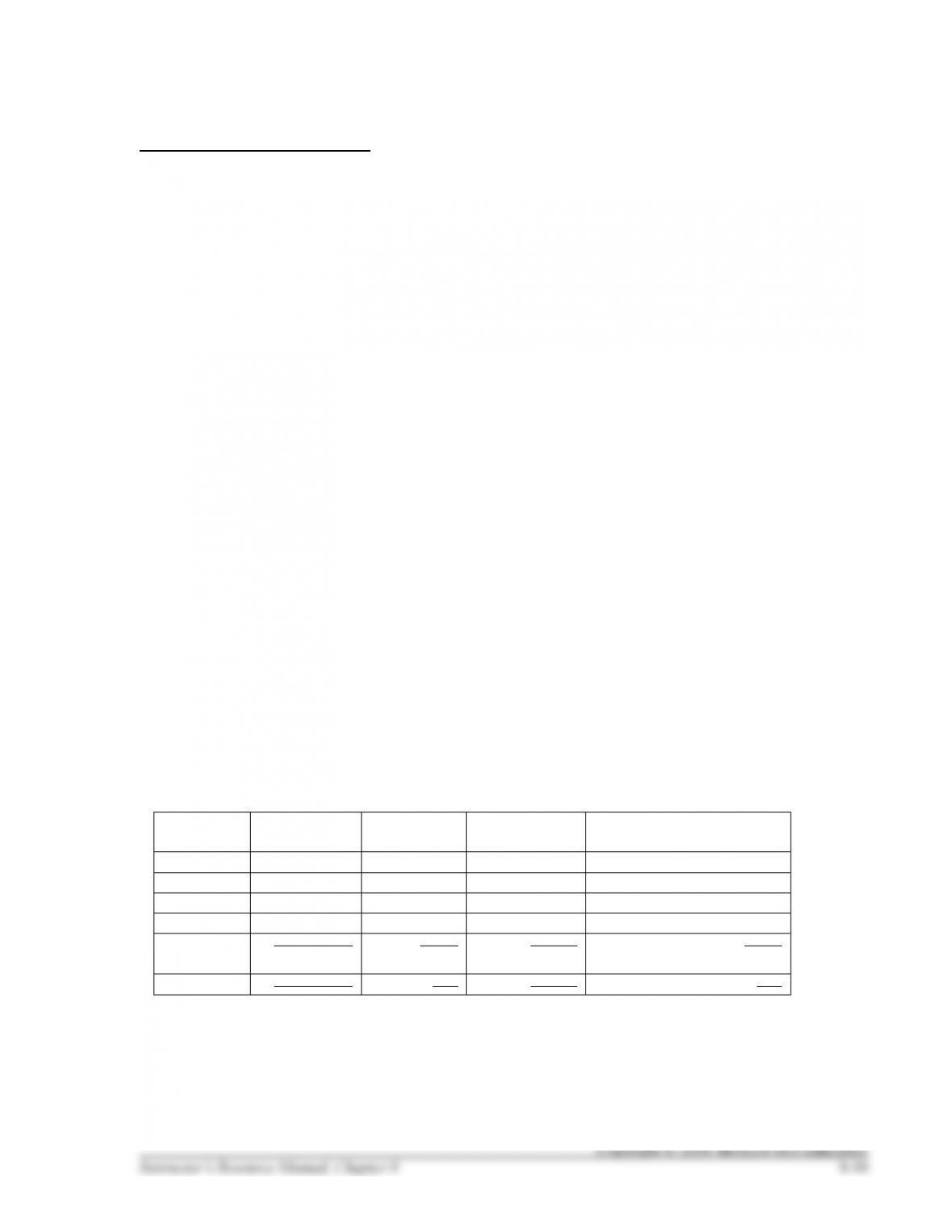
How much depreciation expenses would be recorded for the years 2016 through 2020 using each of the
following methods?
a. Straight-line
b. Unit-of-production
c. Declining-balance
Part 3
On December 31, 2020, at the end of its useful life, Joel Harvey sold the truck for $3,000 cash. Compute
the gain or loss on sale.
HANDOUT 9–1 SOLUTION
DEPRECIATION METHODS AND GAIN (LOSS) ON SALE
Joel Harvey Florists acquired a truck on January 1, 2016. The company paid $11,000 for the truck, $500
for destination charges, and $250 to paint the company name on the side of the truck. The company’s
accounting manager estimates the truck to have a five-year useful life and a residual value of $1,750. The
truck is expected to be driven 100,000 miles in five years. It is actually driven 15,000 miles in 2016,
25,000 miles in 2017, 30,000 miles in 2018, 25,000 miles in 2019, and 5,000 miles in 2020.
Part 1
On January 1, 2016, how much should Joel Harvey Florists capitalize for the cost of the truck?
11,000 + 500 + 250 = $11,750.
Part 2
How much depreciation expenses would be recorded for the years 2016 through 2020 using each of the
following methods?
a. Straight-line
(11,750 – 1,750) ÷ 5 = $2,000 per year
b. Unit-of-production
(11,750 – 1,750) ÷ 100,000 = 10 cents/mile
2016: 15,000 × 0.10 = $1,500;
2017: 25,000 × 0.10 = $2,500;
2018: 30,000 × 0.10 = $3,000;
2019: 25,000 × 0.10 = $2,500;
2020: 5,000 × 0.10 = $500.
c. Declining-balance
Year
Computation
Depreciation
Expense
Accumulated
Depreciation
Net Book Value
Acquisition
11,750
2016
11,750 × 2/5
$4,700
$4,700
7,050
2017
7,050 × 2/5
2,820
7,520
4,230
2018
4,230 × 2/5
1,692
9,212
2,538
2019
2,538 × 2/5
2,538 – 1,750
788 1,015
10,000 10,227
1,750 1,448
2020
1,448 × 2/5
0 579
0 10,806
1,750 944
Part 3
On December 31, 2020, at the end of its useful life, Joel Harvey sold the truck for $3,000 cash. Compute
the gain or loss on sale.
Cost of $3,000 – Accumulated depreciation of $1,750 = Gain of $1,250
HANDOUT 9–2
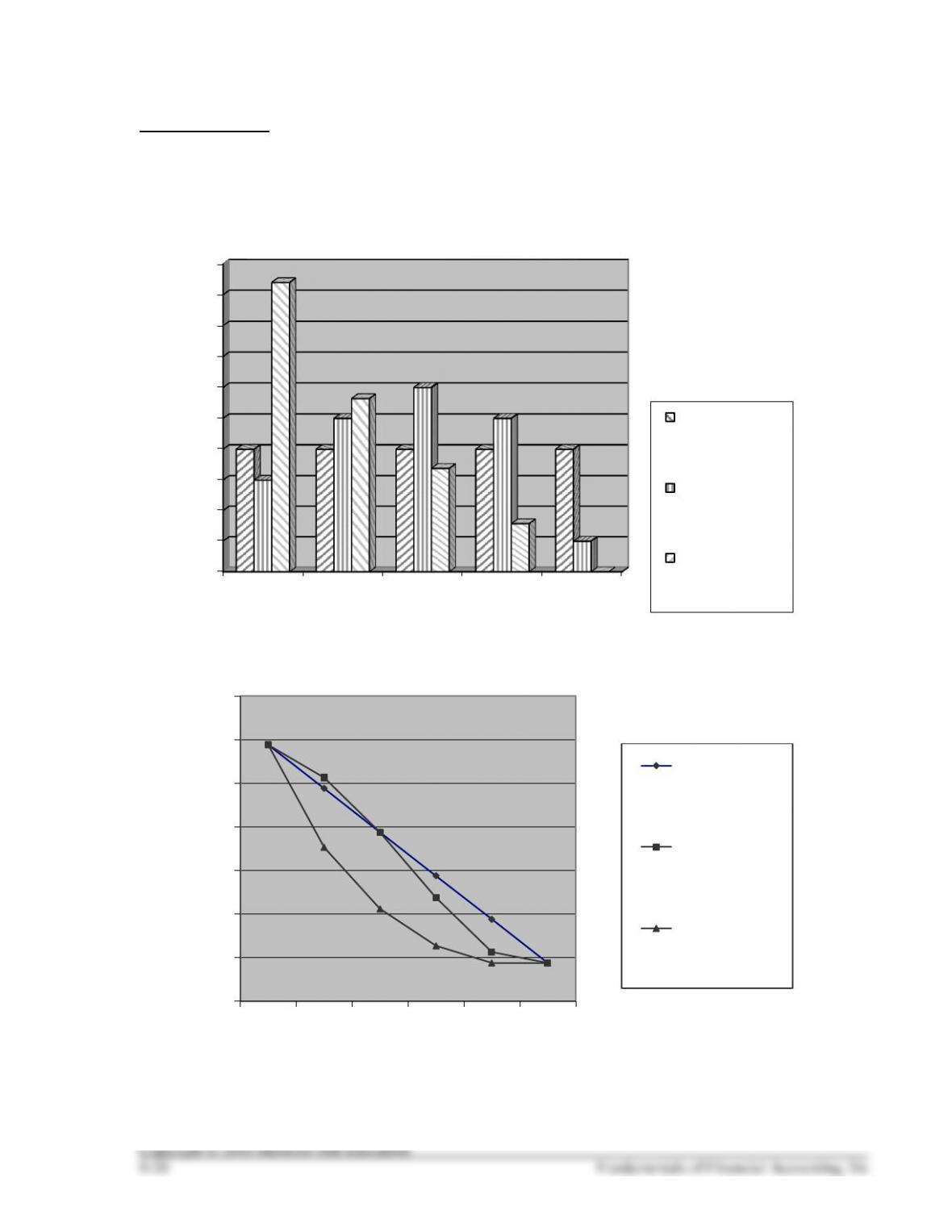
COMPARISON OF DEPRECIATION EXPENSE AND NET BOOK VALUE
$0
$500
$1,000
$1,500
$2,000
$2,500
$3,000
$3,500
$4,000
$4,500
$5,000
2016 2017 2018 2019 2020
$2,000 $2,000 $2,000 $2,000 $2,000
$1,500
$2,500
$3,000
$2,500
$500
$4,700
$2,820
$1,692
$788
$0
Depreciation Expense
Straight-line
Units–of-
production
Double-
declining
balance
$11,750
$9,750
$7,750
$5,750
$3,750
$1,750
$11,750
$10,250
$7,750
$4,750
$2,250 $1,750
$11,750
$7,050
$4,230
$2,538
$1,750 $1,750
$0
$2,000
$4,000
$6,000
$8,000
$10,000
$12,000
$14,000
Pre-
2016 2016 2017 2018 2019 2020
Net Book Value
Straight-line
Units–of–
production
Double-
declining
balance