Chapter 8
1. The advantages of extending credit are that it allows a company to compete
effectively with competitors who extend credit. The additional gross profit earned
2. Before discontinuing its credit card program, Kohl’s Corporation would have
compared the gross profit given up as a result of lost credit card sales to the
3. In conformity with the expense recognition (“matching”) principle, the allowance
method records Bad Debt Expense in the same period in which the credit was
4. Using the allowance method, Bad Debt Expense is recognized in the period in
which (a) sales related to the uncollectible account were made.
5. The write-off of uncollectible accounts using the allowance method decreases the
asset Accounts Receivable and decreases the contra-asset Allowance for
6. With the aging of accounts receivables method, the calculated amount is the
desired balance to which the Allowance for Doubtful Accounts is to be adjusted.
Accounts.
7. Using the allowance method, the company would report $300 of revenue and
$15 of Bad Debt Expense in 2015. In 2016, the write off would reduce Accounts
8. An account receivable is an amount owed to the business by a customer for
9. The three components of the interest formula are: (1) the principal, which is
simply the amount of the receivable or payable, (2) the interest rate, which
10. Under GAAP, the Accounts Receivable would be reported as a current asset, net
11. An increase in the receivables turnover ratio generally indicates faster collection
of receivables. Both the top number (net credit sales) and the bottom number
12. To speed up sluggish receivables collections, managers can:
• Hound customers for payment. Disadvantages of this method are: (1) it is
time consuming and costly and (2) it can annoy customers and cause
13. Longer credit periods could entice customers to buy more on account than they
might otherwise do with shorter credit periods. The consequences of greater
credit sales are increased Sales Revenue and increased Accounts Receivable.
All else equal, an increase in Accounts Receivable will require an increase in the
14. The direct write-off method accounts for uncollectible accounts in the period that
the accounts are determined to be bad. It violates the concept of conservatism by
reporting accounts receivable at the total amount owed by customers (an overly
15. If the direct write-off method were used, the company would record $300 of
revenue and no Bad Debt Expense in 2015. When the company writes off the
account in 2016, it would decrease Accounts Receivable and increase Bad Debt
Expense, causing a decrease in 2016 Net Income. The allowance method
follows the expense recognition (“matching”) principle and is the more accurate
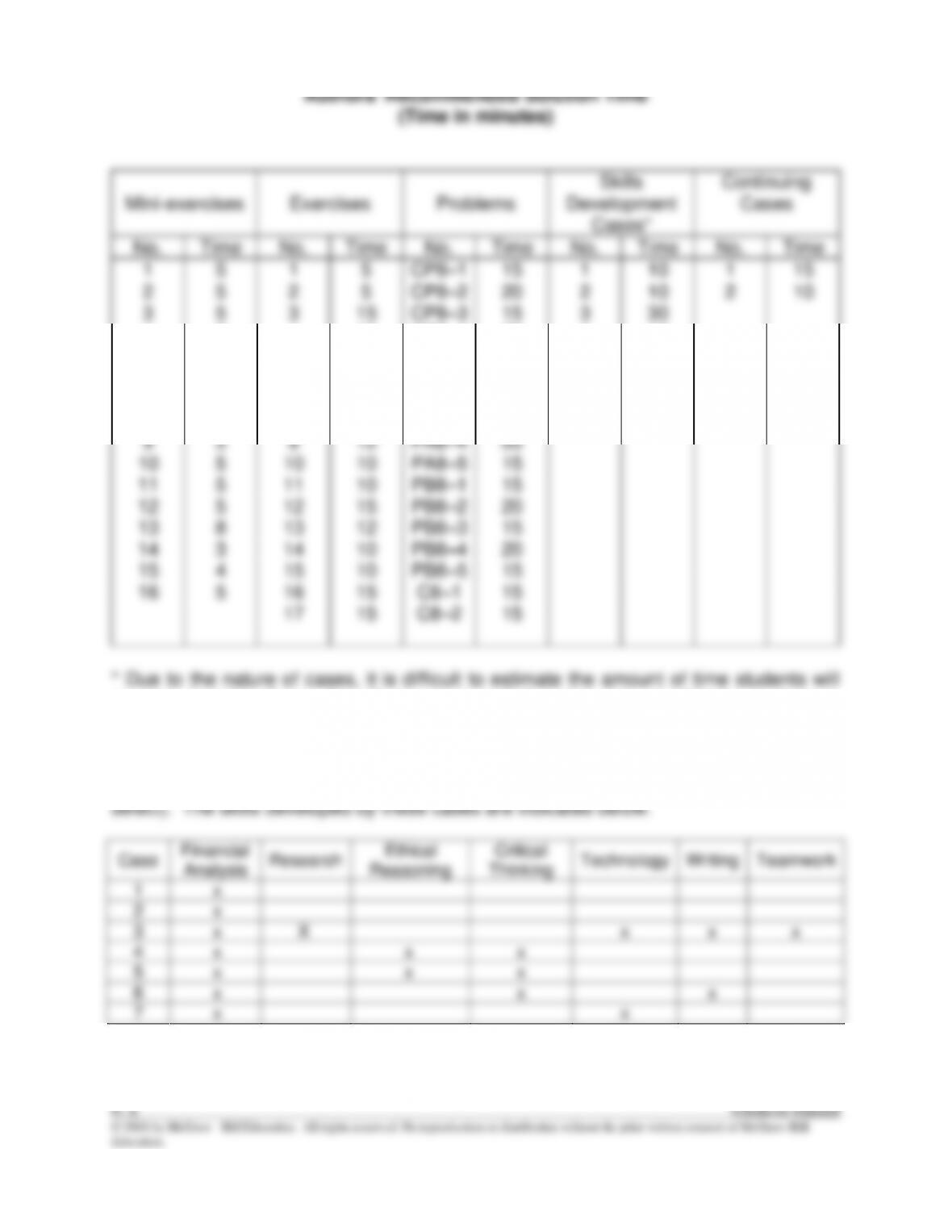
Authors’ Recommended Solution Time
(Time in minutes)
Mini-exercises
Exercises
Problems
Skills
Development
Cases*
Continuing
Cases
No.
Time
No.
Time
No.
Time
No.
Time
No.
Time
1
5
1
5
CP8–1
15
1
10
1
15
2
5
2
5
CP8–2
20
2
10
2
10
3
5
3
15
CP8–3
15
3
30
4
3
4
10
CP8–4
20
4
10
5
3
5
5
CP8–5
20
5
20
6
3
6
15
PA8–1
15
6
15
7
3
7
15
PA8–2
20
7
30
8
3
8
15
PA8–3
15
9
5
9
12
PA8–4
20
10
5
10
10
PA8–5
15
11
5
11
10
PB8–1
15
12
5
12
15
PB8–2
20
13
8
13
12
PB8–3
15
14
3
14
10
PB8–4
20
15
4
15
10
PB8–5
15
16
5
16
15
C8–1
15
17
15
C8–2
15
need to complete them. As with any open-ended project, it is possible for students to
devote a large amount of time to these assignments. While students often benefit from
the extra effort, we find that some become frustrated by the perceived difficulty of the
task. You can reduce student frustration and anxiety by making your expectations
clear, and by offering suggestions (about how to research topics or what companies to
Fundamentals of Financial Accounting, 5/e 8– 5
© 2016 by McGraw– Hill Education. All rights reserved. No reproduction or distribution without the prior written consent of McGraw-Hill
Education.
ANSWERS TO MINI-EXERCISES
M8–1
Without extending credit, Nutty generated $30,000 of revenue and $10,000 of operating
income, implying $20,000 of operating expenses. With $25,000 in additional expenses
M8–2
If Pastis Productions were to double sales, it also would double its cost of goods sold
(assuming no change in efficiencies arising from the increase in sales volume). Thus,
M8–3
a.
Accounts Receivable
$ 800,000
Allowance for Doubtful Accounts
(55,000)
Net Accounts Receivable
$745,000
As of December 31, 2014, Extreme Fitness expected to collect $745,000.
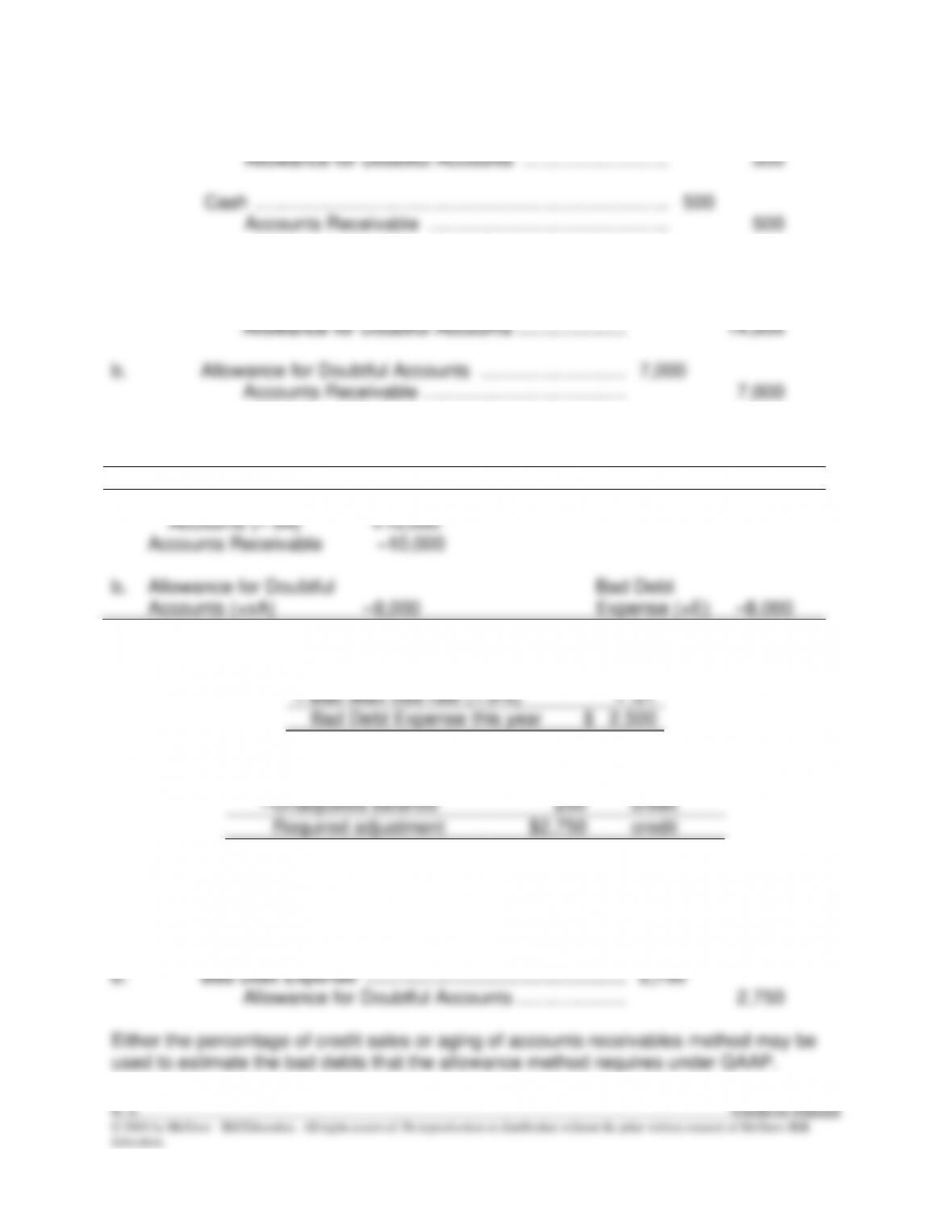
b.
Accounts Receivable
$ 790,000
Allowance for Doubtful Accounts
(45,000)
Net Accounts Receivable
$ 745,000
M8–4
Accounts Receivable …………………………..…………………. 500
M8–5
a. Bad Debt Expense ………………………………………….. 14,000
M8–6
Assets =
Liabilities
+ Stockholders’ Equity
a.
Allowance for Doubtful
Accounts (– xA) +10,000
Accounts Receivable –10,000
b.
Allowance for Doubtful
Accounts (+xA) –8,000
Bad Debt
Expense (+E) –8,000
M8–7
Credit sales this period
$250,000
Bad debt loss rate (1.0%)
.01
Bad Debt Expense this year
$ 2,500
M8–8
Desired balance
$3,000
credit
–Unadjusted balance
250
credit
Required adjustment
$2,750
credit
M8–9
a. Bad Debt Expense ………………………………………….. 2,500
Allowance for Doubtful Accounts ………………… 2,500
M8–10
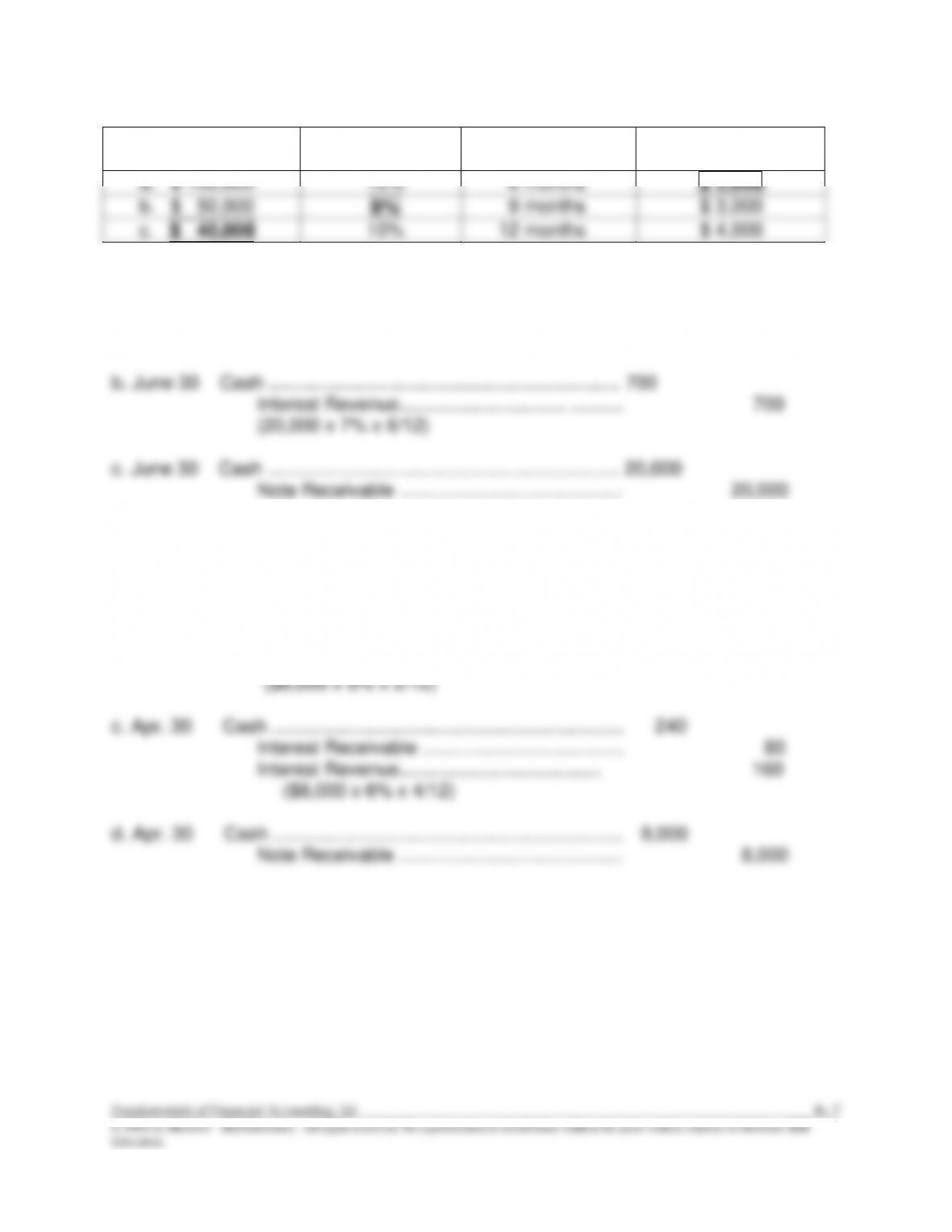
Principal Amount
on Note Receivable
Annual Interest
Rate
Time Period
Interest Earned
a. $ 100,000
10%
6 months
$ 5,000
b. $ 50,000
8%
9 months
$ 3,000
c. $ 40,000
10%
12 months
$ 4,000
M8–11
a. Jan. 1 Note Receivable …………………………………………….. 20,000
Cash ………………………………………………………. 20,000
M8–12
a. Nov. 1 Notes Receivable …………………………………………… 8,000
Accounts Receivable ………………………………… 8,000
b. Dec 31 Interest Receivable …………………………………………. 80
Interest Revenue ……………………………………… 80
M8–13
M8–14
Receivables Turnover Ratio
Days to Collect
a.
+
–
b.
–
+
c.
+
–
M8–15
Imperative will receive $485,000 [500,000 x (1.00–0.03)] from the sale. The factoring
fee will be equal to $15,000 (500,000 x 3%) and, because the company rarely factors its
M8–16
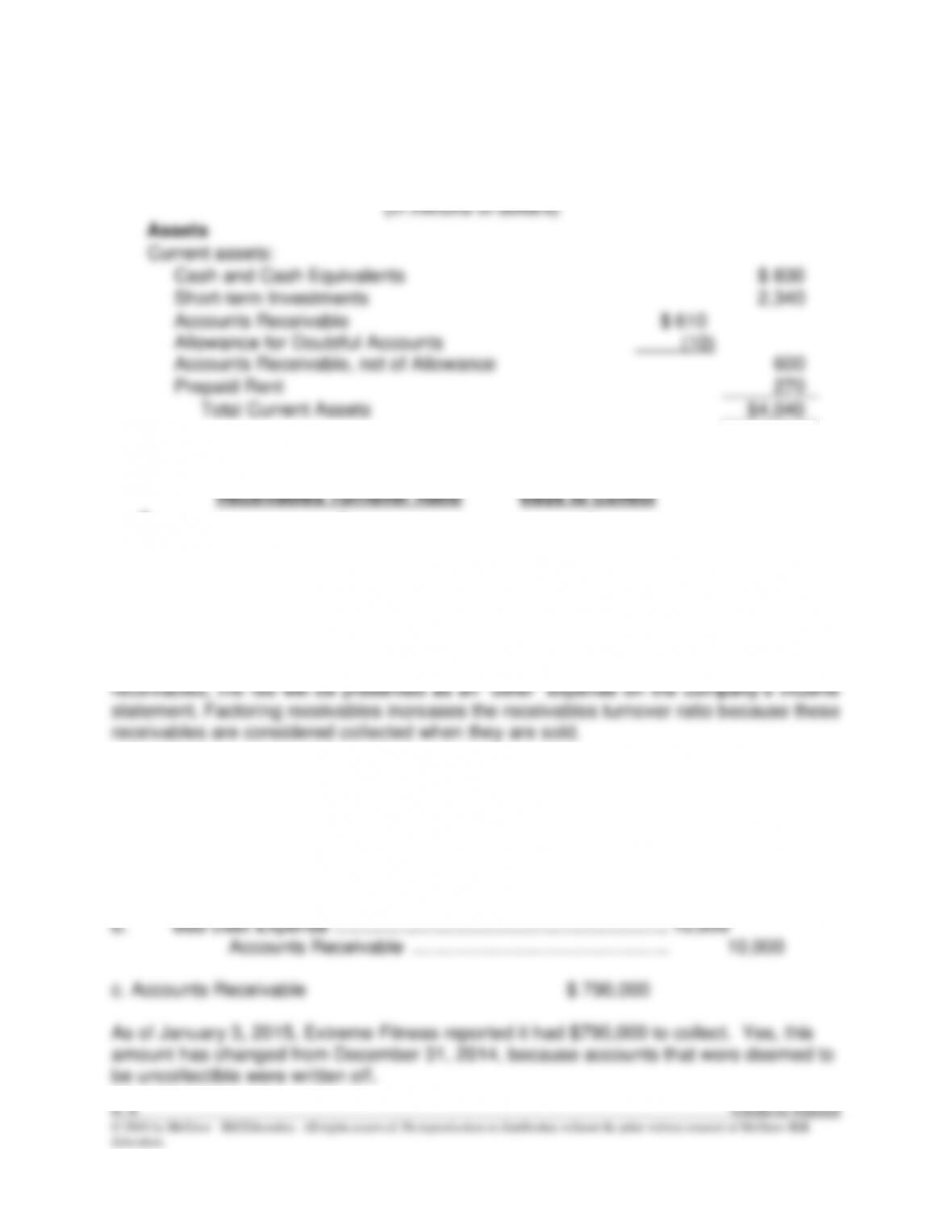
a. Accounts Receivable
$ 800,000
As of December 31, 2014 Extreme Fitness reported it had $800,000 to collect (even
though only $745,000 was estimated as collectible).
c. Accounts Receivable
$ 790,000
Adobe Systems, Inc.
Partial Balance Sheet
As of November 30, 2013
(in millions of dollars)
Assets
Current assets:
Cash and Cash Equivalents
$ 830
Short-term Investments
2,340
Accounts Receivable $ 610
Allowance for Doubtful Accounts (10)
Accounts Receivable, net of Allowance
600
Prepaid Rent
270
Total Current Assets
$4,040
Fundamentals of Financial Accounting, 5/e 8– 9
© 2016 by McGraw– Hill Education. All rights reserved. No reproduction or distribution without the prior written consent of McGraw-Hill
Education.
ANSWERS TO EXERCISES
E8–1
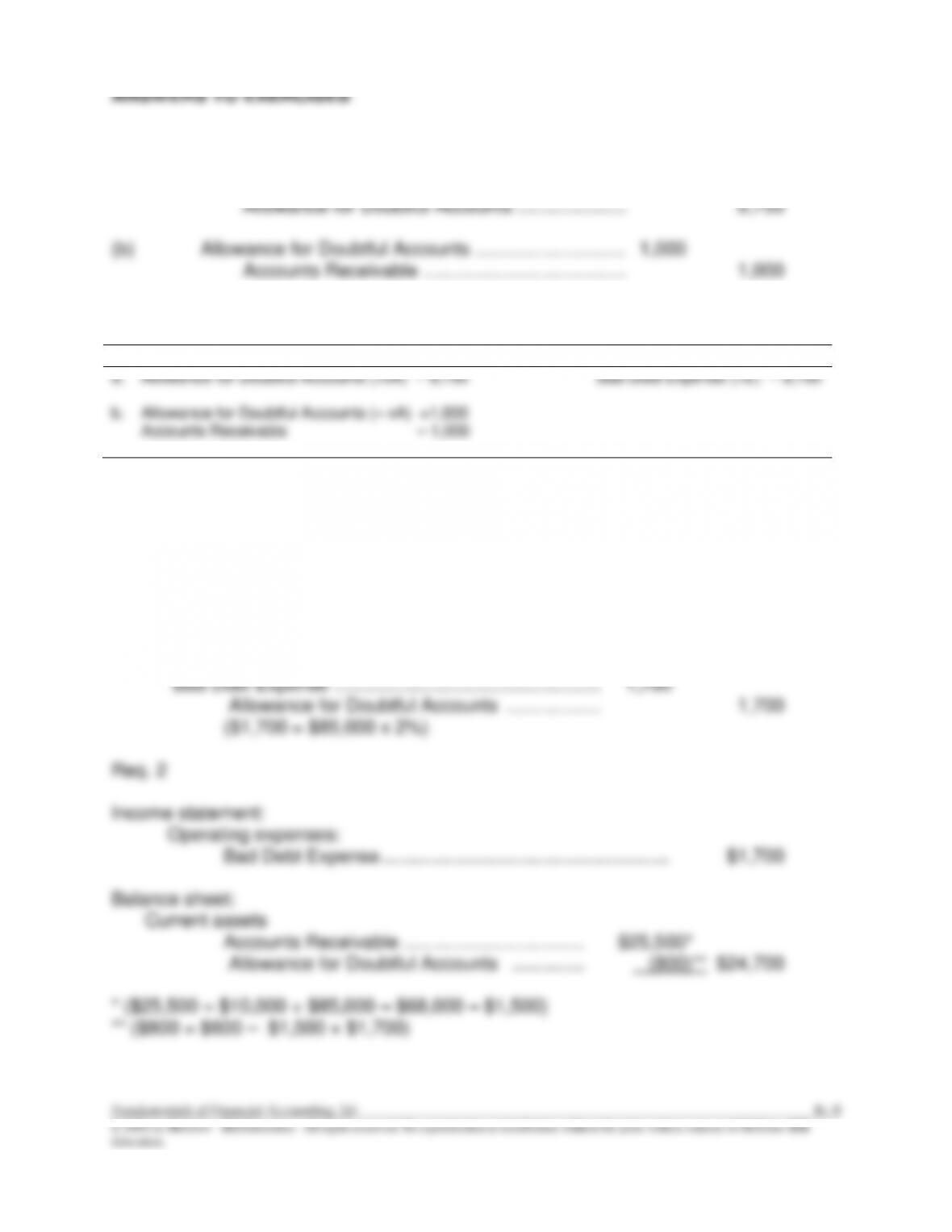
(a) Bad Debt Expense ………………………………………….. 9,750
E8–2
Assets =
Liabilities
+ Stockholders’ Equity
a.
Allowance for Doubtful Accounts (+xA) – 9,750
Bad Debt Expense (+E) – 9,750
b.
Allowance for Doubtful Accounts (– xA) +1,000
Accounts Receivable – 1,000
E8–3
Req. 1
Dec. 10, 2015
Allowance for Doubtful Accounts ……………………….. 1,500
Accounts Receivable ……………………………… 1,500
Dec. 31, 2015
E8–3 (continued)
Req. 3
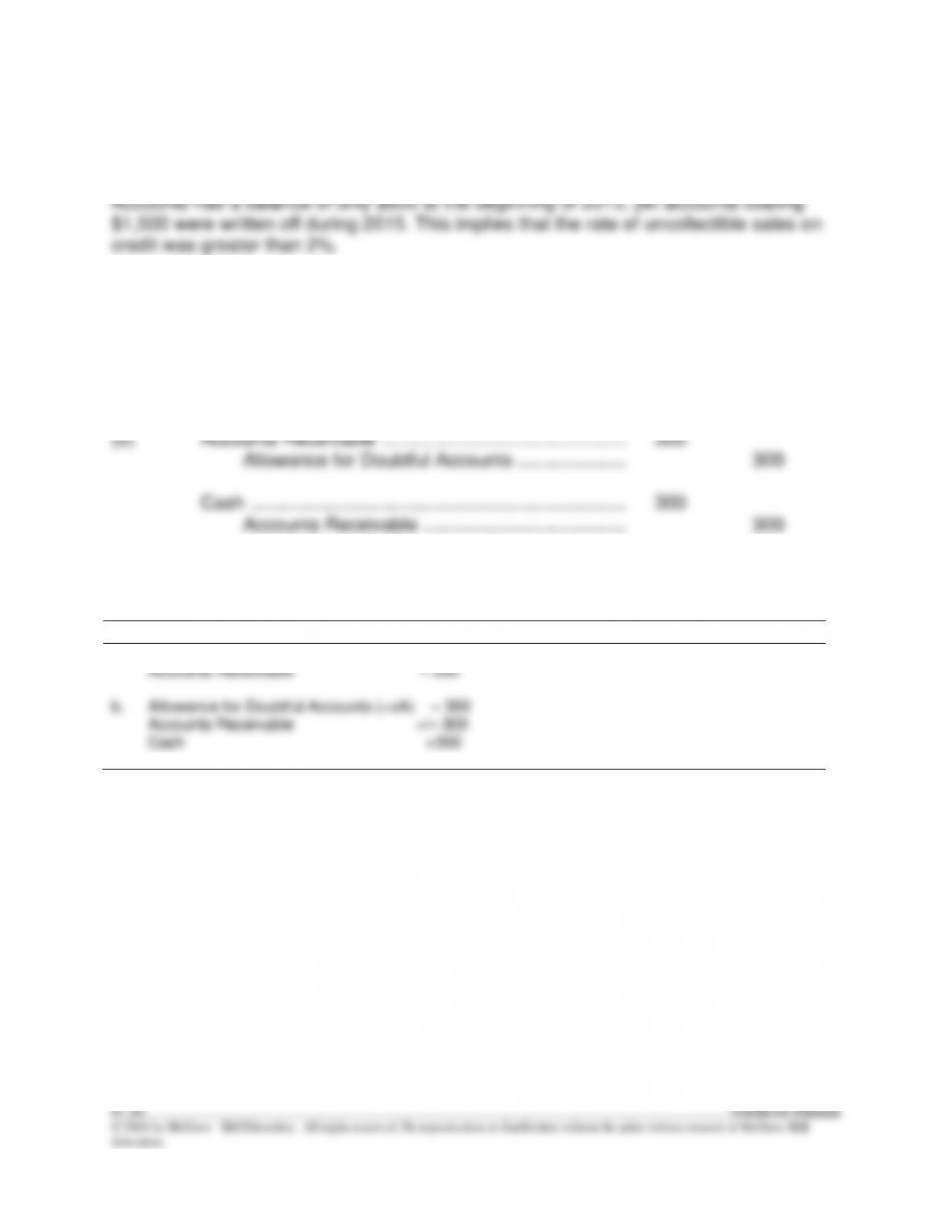
The 2% rate on credit sales appears to be too low because the Allowance for Doubtful
E8–4
(a) Allowance for Doubtful Accounts ……………………….. 300
Accounts Receivable ………………………………… 300
E8–5
Assets =
Liabilities
+ Stockholders’ Equity
a.
Allowance for Doubtful Accounts (– xA) +300
Accounts Receivable – 300
b.
Allowance for Doubtful Accounts (+xA) – 300
Accounts Receivable +/– 300
Cash +300