C7–2 (continued)
COLLEGE COASTERS
Adjusted Trial Balance
At December 31
Account Titles
Debit
Credit
Cash
$ 8,905
Accounts Receivable
2,800
Inventory
275
Prepaid Rent
500
Equipment
810
Accumulated Depreciation–Equipment
$ 120
Accounts Payable
910
Income Tax Payable
789
Salaries and Wages Payable
100
Common Stock
6,500
Retained Earnings
3,030
Sales Revenue
17,785
Cost of Goods Sold
9,935
Office Expense
1,600
Salaries and Wages Expense
2,300
Rent Expense
1,200
Depreciation Expense
120
Income Tax Expense
789
Totals
$ 29,234
$ 29,234
Req. 4
COLLEGE COASTERS
Income Statement
For the Year Ended December 31
Sales Revenues
$ 17,785
Cost of Goods Sold
9,935
Gross Profit
7,850
Operating Expenses
Salaries and Wages Expense
2,300
Office Expenses
1,600
Rent Expense
1,200
Depreciation Expense
120
Total Operating Expenses
5,220
Income before Income Tax Expense
2,630
Income Tax Expense
789
Net Income
$ 1,841
C7–2 (continued)
Req. 4 (continued)
COLLEGE COASTERS
Balance Sheet
As of December 31
Assets
Current Assets:
Cash
$ 8,905
Accounts Receivable
2,800
Inventory
275
Prepaid Rent
500
Total Current Assets
12,480
Equipment, net of accumulated depreciation of $120
690
Total Assets
$ 13,170
Liabilities and Stockholders’ Equity
Current Liabilities:
Accounts Payable
$ 910
Salaries and Wages Payable
100
Income Taxes Payable
789
Total Liabilities
1,799
Stockholders’ Equity:
Common Stock
6,500
Retained Earnings
4,871
Total Stockholders’ Equity
11,371
Total Liabilities and Stockholders’ Equity
$ 13,170
C7–3
1) The gross profit percentage of Merchandise Mavens Corporation (MMC) has
declined from 15.9% to 10.0% to 3.8% over the last three years (see calculations
below). The 3.8% gross profit percentage in the most recent year indicates MMC’s
selling price barely exceeds its cost to acquire the goods. If the gross profit
Gross Profit
$ 15,000 /$ 390,000
$ 40,000/ $ 398,000
$ 63,000/$ 397,000
Percentage
= 3.8%
= 10.0%
= 15.9%
2) Sales returns and allowances have grown dramatically in the most recent year,
3)
2015
2014
Inventory Turnover
Ratio
=
Cost of Goods Sold
=
8.3*
11.3**
Average Inventory
Days to Sell
=
365 Days
=
44.0
32.3
Inventory Turnover
Ratio
* 8.3 =
$375,000
** 11.3 =
$358,000
($34,000 + $56,410) ÷ 2
($29,425 + $34,000) ÷ 2
The previous calculations demonstrate that Merchandise Mavens Corporation’s
inventory turnover ratio is drastically decreasing from 11.3 times in 2014 to 8.3 times in
2014. Consequently, the days to sell ratio has increased suggesting that the inventory
is not selling as quickly, possibly due to a decreased demand for the product.
times per year
days
S7–1
1. D
2. B
3. A
4. B
Calculations:
Req. 3
Inventory
Turnover
Ratio
=
Cost of Goods Sold
=
$51,422
Average Inventory
($11,057 + $10,710) ÷ 2
=
4.7 times per year
Days to Sell
=
365 Days
=
(365 ÷ 4.7) = 77.7 days
Inventory Turnover
Ratio
S7–2
Req. 1
Lowe’s inventories of $9,127 (million) are less than The Home Depot’s inventories of
$11,057 (million).
Req. 2
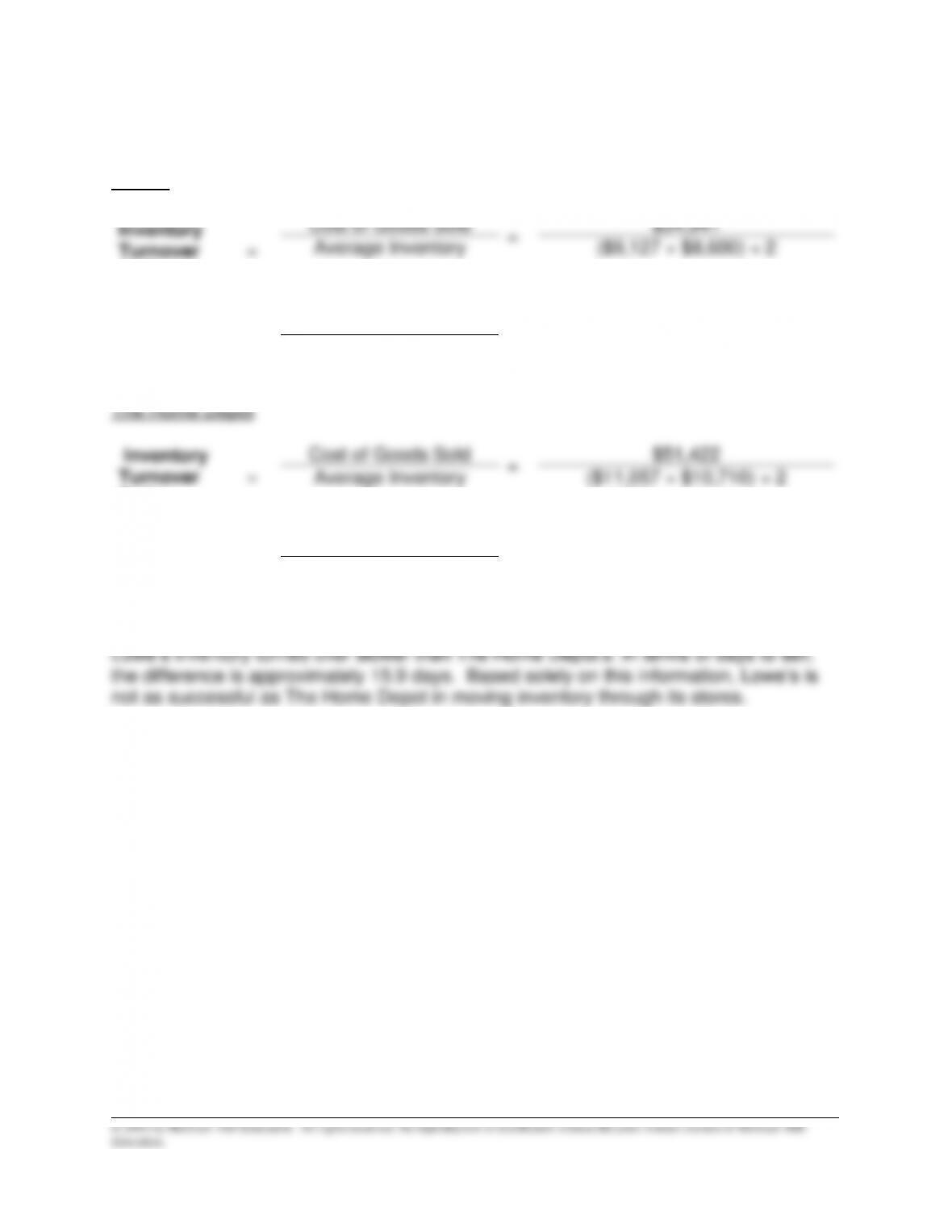
S7–2 (continued)
Req. 3
Lowe’s
Inventory
Turnover
Ratio
=
Cost of Goods Sold
=
$34,941
Average Inventory
($9,127 + $8,600) ÷ 2
=
3.9 times per year
Days to Sell
=
365 Days
=
(365 ÷ 3.9) = 93.6 days
Inventory Turnover
Ratio
Cost of Goods Sold
=
$51,422
Average Inventory
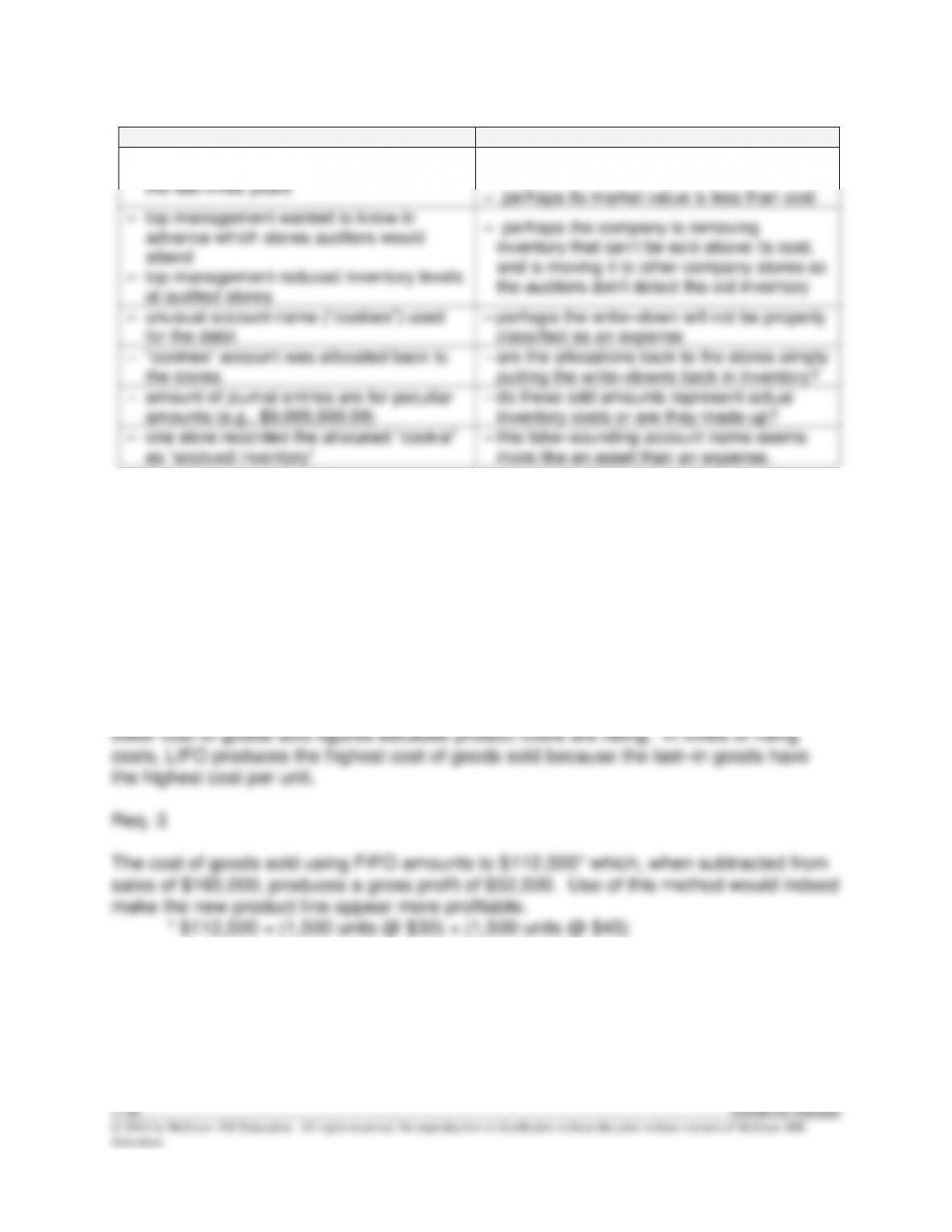
S7–4
Evidence
Suspicion
– inventory tripled and then quadrupled in
the last three years
– is it possible that this much inventory
exists?
– perhaps its market value is less than cost
– top management wanted to know in
advance which stores auditors would
attend
– top management reduced inventory levels
at audited stores
– perhaps the company is removing
inventory that can’t be sold above its cost,
and is moving it to other company stores so
the auditors don’t detect the old inventory
– unusual account name (“cookies”) used
for the debit
– perhaps the write–down will not be properly
classified as an expense
– “cookies” account was allocated back to
the stores
– are the allocations back to the stores simply
putting the write–downs back in inventory?
– amount of journal entries are for peculiar
amounts (e.g., $9,999,999.99)
– do these odd amounts represent actual
inventory costs or are they made up?
– one store recorded the allocated “cookie”
as “accrued inventory”
– this fake–sounding account name seems
more like an asset than an expense.
S7–5
Req. 1
The cost of goods sold using LIFO is (2,500 units @ $50) + (500 units @ $45) which
totals $147,500. This is the exact figure used in calculating the reported gross profit of
$17,500.
Req. 2
Yes it is likely that both FIFO and the weighted average cost method would produce
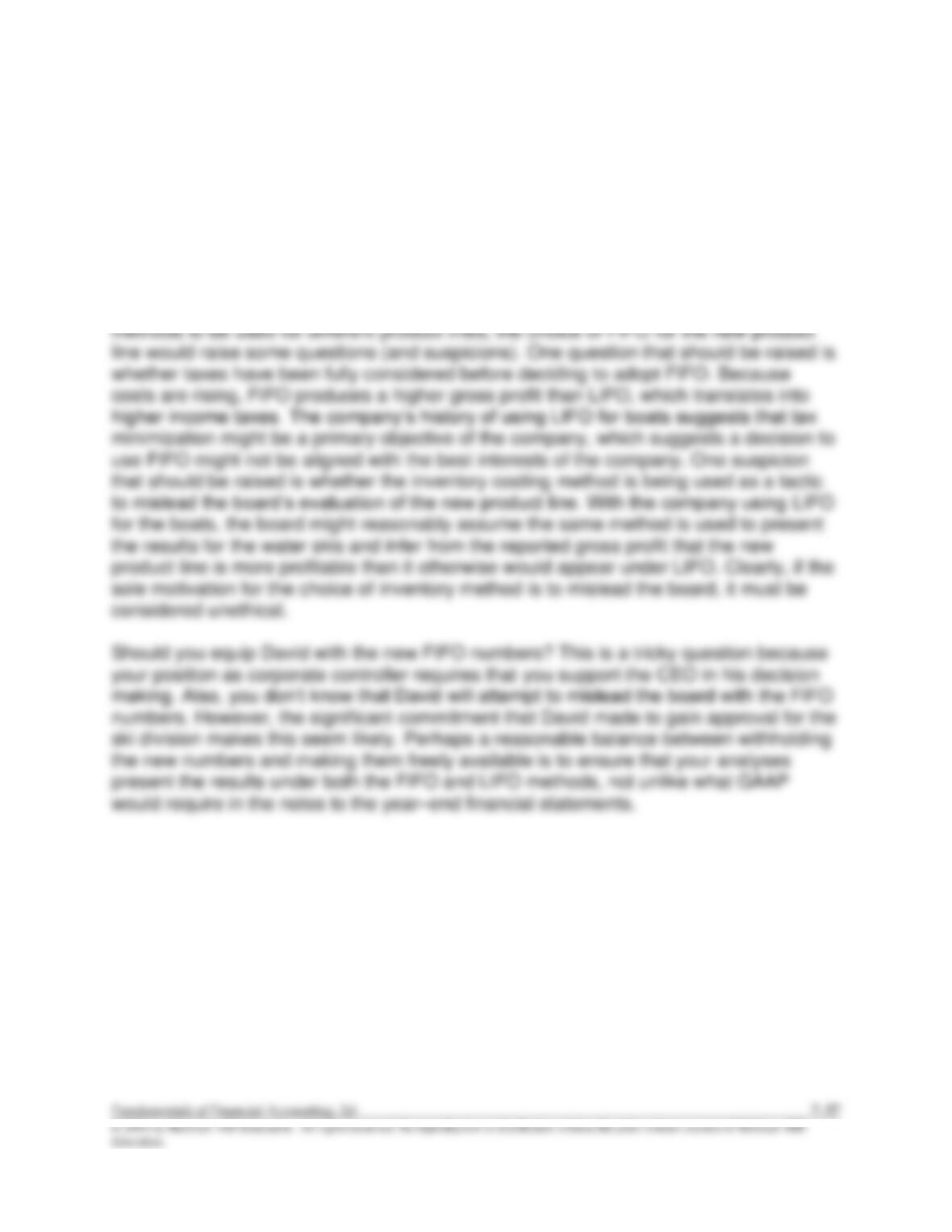
S7–5 (continued)
Req. 4
Yes, it is acceptable within GAAP for companies to use different inventory methods for
different product lines included in inventory as long as the methods are used
consistently over time.
Req. 5
Although generally accepted accounting principles do allow different inventory costing
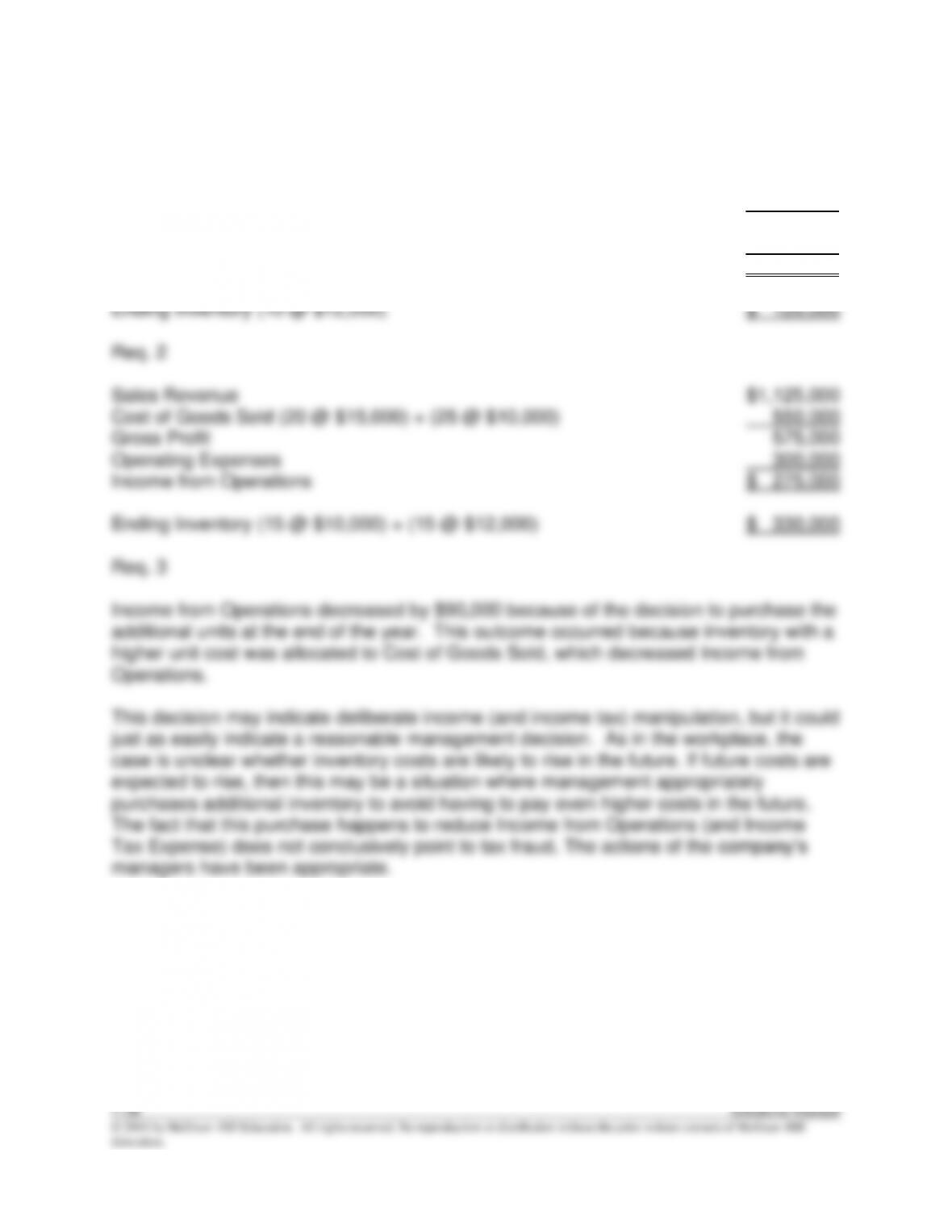
S7–6
Req.1
Sales Revenue (45 @ $25,000) $1,125,000
Cost of Goods Sold (40 @ $10,000) + (5 @ $12,000) 460,000
Gross Profit 665,000
Operating Expenses 300,000
Income from Operations $ 365,000
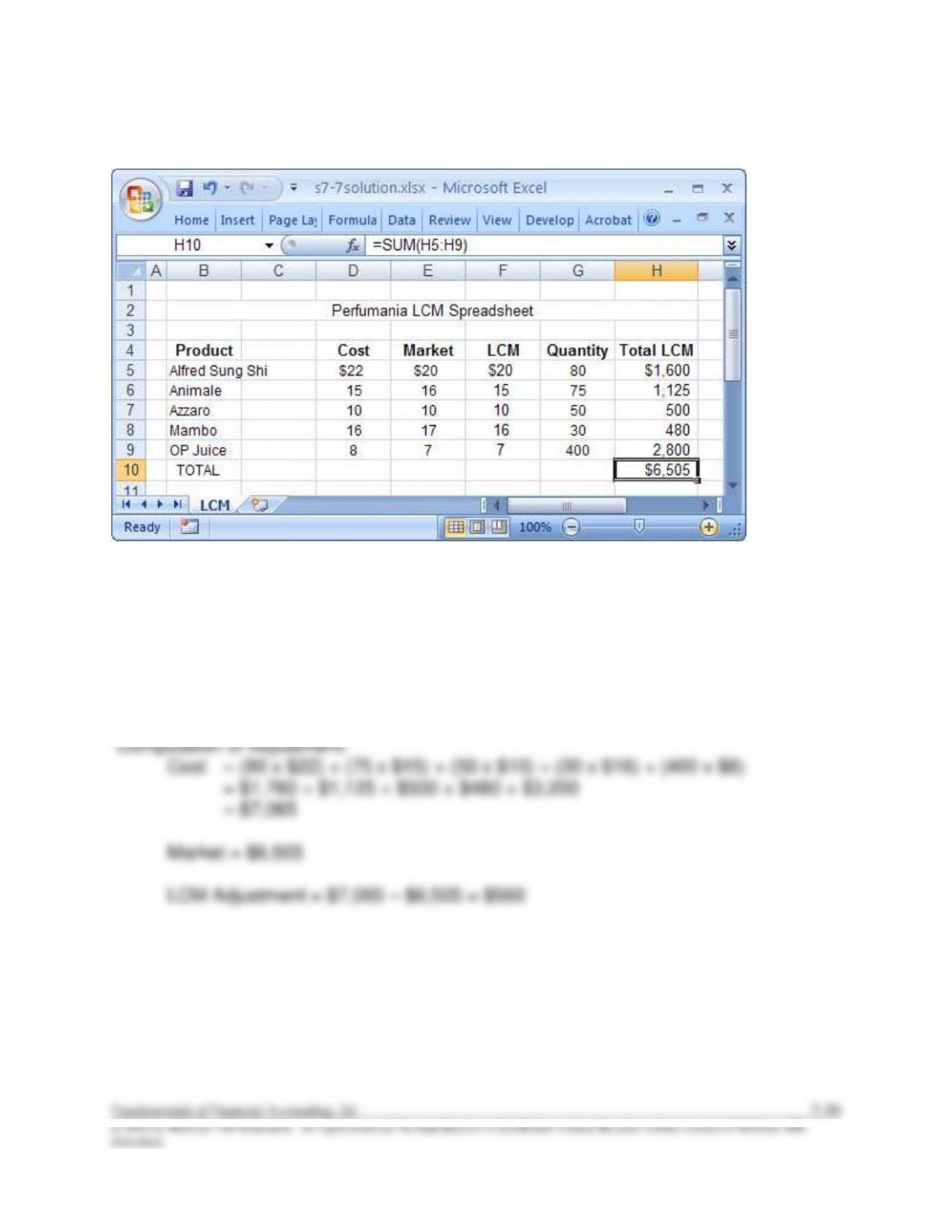
S7–7
Req. 1
Req. 2
Cost of Goods Sold …………………………………..
$560
Inventory …………………………………………
$560
To record reduction in market value of inventory.
ANSWERS TO CONTINUING CASES
CC7–1
Req. 1
According to the cost principle, inventory is recorded initially at the cost to acquire it in a
condition and location ready for sale. Transportation is a necessary cost of acquiring
inventory in location, so the costs of transportation should be recorded as part of the