Chapter 6
1. Service companies sell services and merchandising companies sell physical
products. Merchandising companies sell physical products that are purchased from
2. When goods are sold FOB destination, their cost is removed from the inventory
account and reported as an expense only when the goods reach their destination.
3. Goods available for sale is the sum of the beginning inventory and the amount of
4. Beginning inventory is the stock of goods on hand (in inventory) at the start of the
5. A general principle is that a purchaser should include in its Inventory account any
costs needed to get its inventory into a condition and location ready for sale.
6. In a perpetual inventory system, the inventory records show the number of units
and costs of each type of merchandise stocked, and are updated every time an
item is bought, sold, or returned. A periodic inventory system differs from a
7. A physical count of inventory is needed in a periodic system to determine the
quantity of inventory on hand so that its cost can be determined and used to
8. FOB shipping point and FOB destination define different points at which ownership
of merchandise transfers from the seller (merchandiser) to the buyer (customer).
This is significant in the context of the revenue principle because merchandisers
9. In a perpetual system, two journal entries are made when inventory is sold on
credit:
(2) record a reduction in Inventory and a corresponding increase in Cost of Goods
Sold.
10. When goods are damaged or otherwise unsatisfactory, a merchandiser may
accept the goods returned by the customer (a Sales Return) or may authorize
11. A sales discount is a cash discount given to a customer for prompt payment on
account. When merchandise is sold on credit, terms such as 1/10, n/30 are
12. Terms of 1/10, n/30 mean that a 1 percent discount may be taken by the buyer if
payment is made within 10 days, otherwise the balance is due in 30 days (after
which interest may be charged). Terms of 2/10, n/45 offer a larger discount or
longer period to pay. The change in terms could cause either an increase or
13. Sales Revenue represents the total selling price of all goods sold to customers.
14. Contra-revenue accounts are used (for recording sales discounts and sales returns
and allowances) so that a company can easily track the dollar amount of aborted
15. Gross Profit is Net Sales minus Cost of Goods Sold. The gross profit percentage
is computed by dividing the amount of Gross Profit by the amount of Net Sales
Authors’ Recommended Solution Time
6-6 Solutions Manual
© 2016 by McGraw-Hill Education. All rights reserved. No reproduction or distribution without the prior written consent of McGraw-Hill
Education.
ANSWERS TO MINI-EXERCISES
M6–1
1. S
2. WM
3. RM
M6–2
Beginning inventory
$ 4,000
Purchases
+41,000
Cost of Goods Available for Sale
45,000
Cost of Goods Sold
–30,000
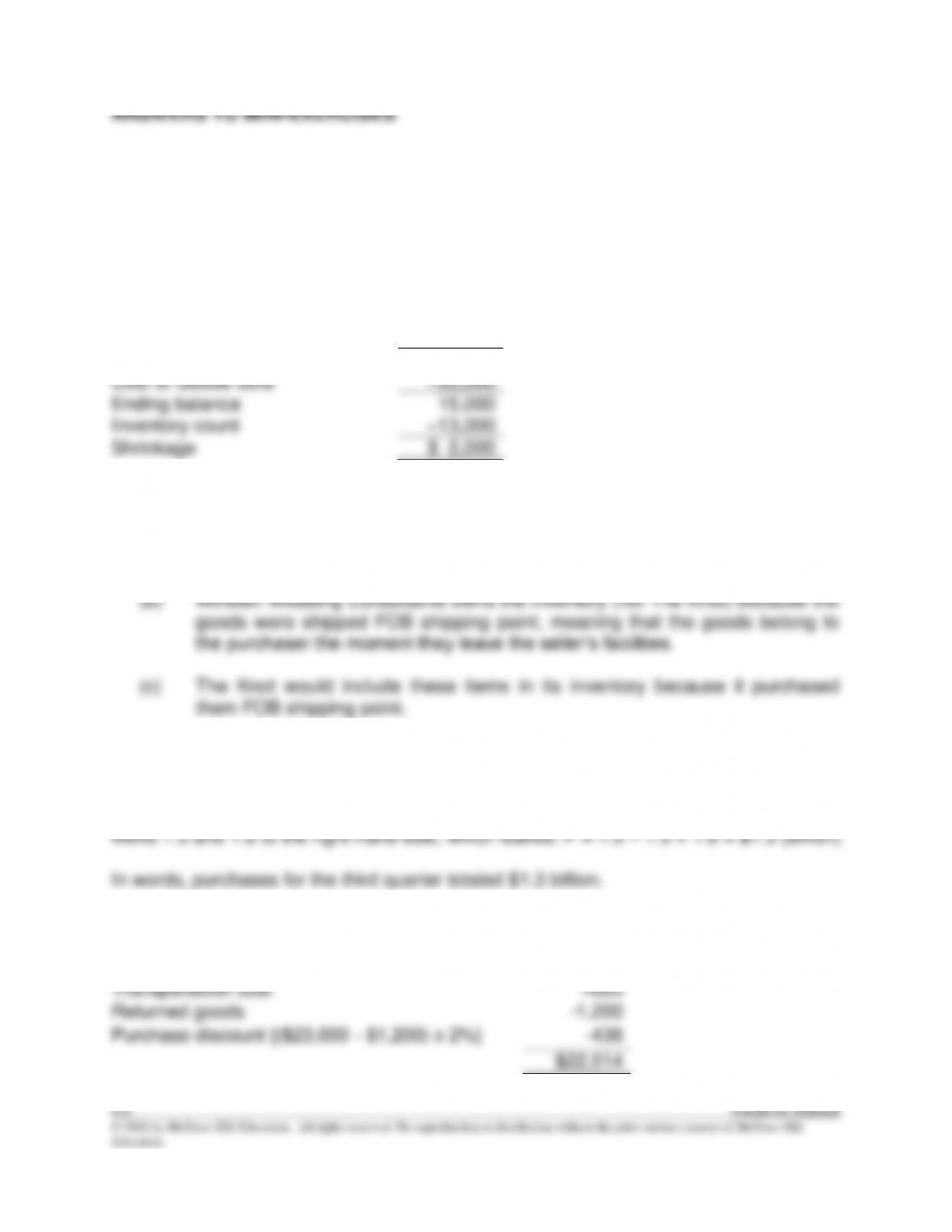
Ending balance
15,000
Inventory count
–13,000
Shrinkage
$ 2,000
M6-3
(a) These items are not reported as The Knot’s inventory because Emerald Bridal
still owns the goods.
M6–4
Solve using the cost of goods sold equation: BI + P – EI = CGS
$1.5 + P – 1.8 = 1.0 (in billions)
M6–5
Merchandise cost
$23,000
Transportation cost
+650
Returned goods
-1,200
Purchase discount [($23,000 – $1,200) x 2%]
–436
$22,014
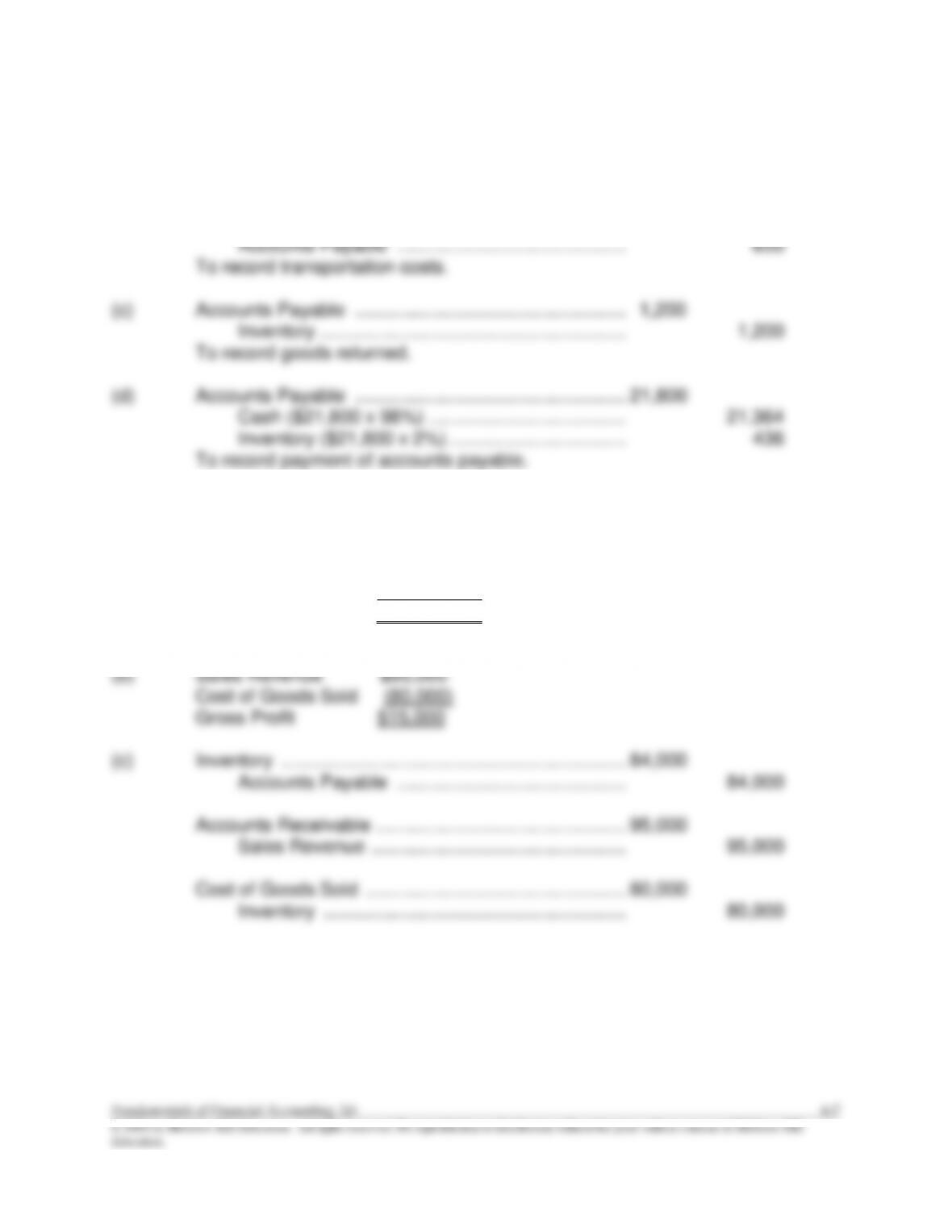
M6–6
(a) Inventory ………………………………………………………… 23,000
Accounts Payable …………………………………….. 23,000
To record inventory purchased on account.
(b) Inventory ………………………………………………………… 650
M6–7
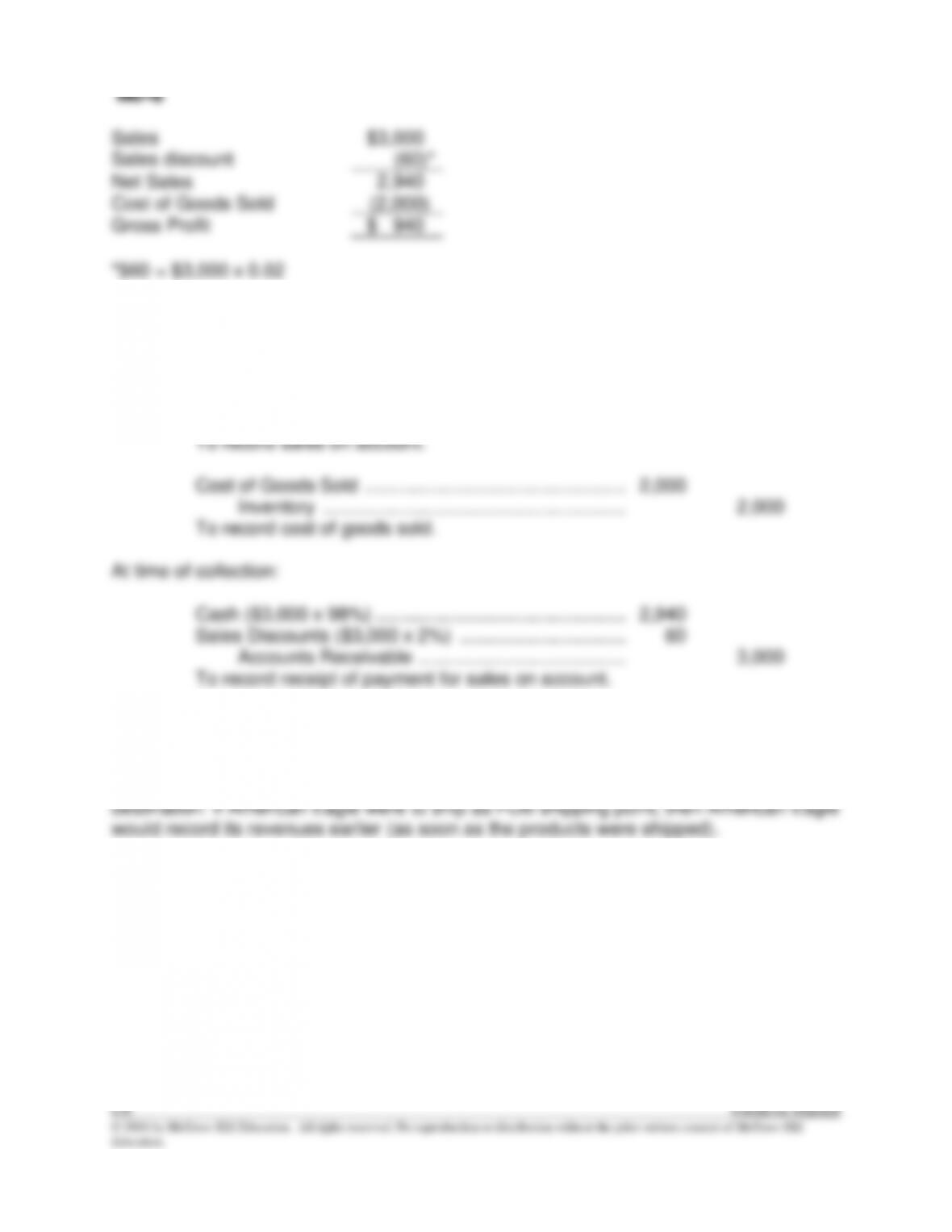
(a) Beginning Inventory
$ 13,400
+ Purchases
84,000
– Cost of Goods Sold
(80,000)
= Ending Inventory
$ 17,400
6-8 Solutions Manual
© 2016 by McGraw-Hill Education. All rights reserved. No reproduction or distribution without the prior written consent of McGraw-Hill
Education.
M6–8
Sales
$3,000
Sales discount
(60)*
Net Sales
2,940
Cost of Goods Sold
(2,000)
Gross Profit
$ 940
*$60 = $3,000 x 0.02
M6–9
At time of sale:
Accounts Receivable ………………………………………… 3,000
Sales Revenue …………………………………………. 3,000
M6–10
Recording revenue when goods reach the customer (the destination) is considered FOB
M6–11
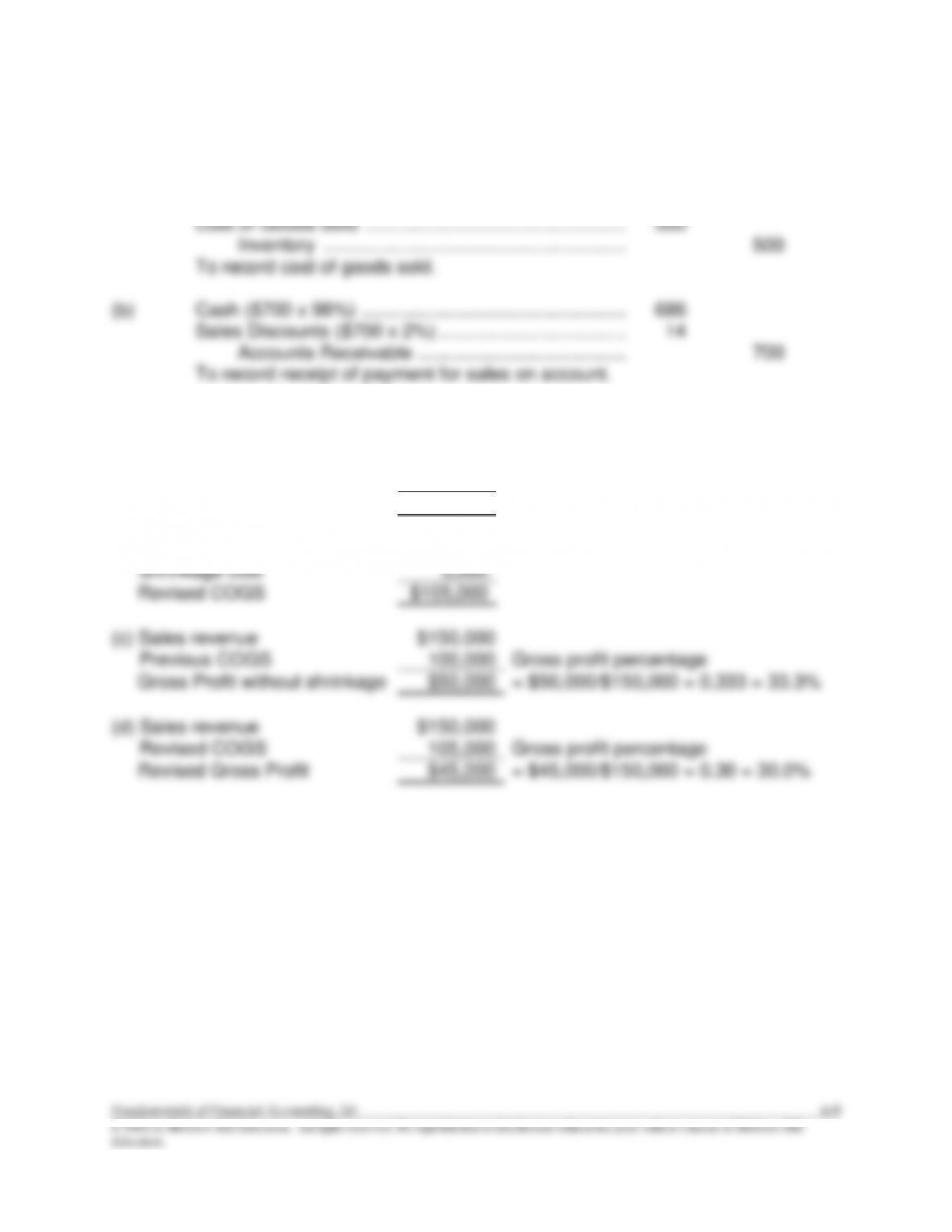
(a) Accounts Receivable ………………………………………… 700
Sales Revenue …………………………………………. 700
To record sales on account.
M6–12
(a) Inventory balance
$20,000
Inventory count
–15,000
Cost of Shrinkage
$5,000
(b) COGS before shrinkage
$100,000
Shrinkage cost
5,000
Revised COGS
$105,000
(c) Sales revenue
$150,000
Previous COGS
100,000
Gross profit percentage
Gross Profit without shrinkage
$50,000
= $50,000/$150,000 = 0.333 = 33.3%
(d) Sales revenue
$150,000
Revised COGS
105,000
Gross profit percentage
Revised Gross Profit
$45,000
= $45,000/$150,000 = 0.30 = 30.0%
M6–13
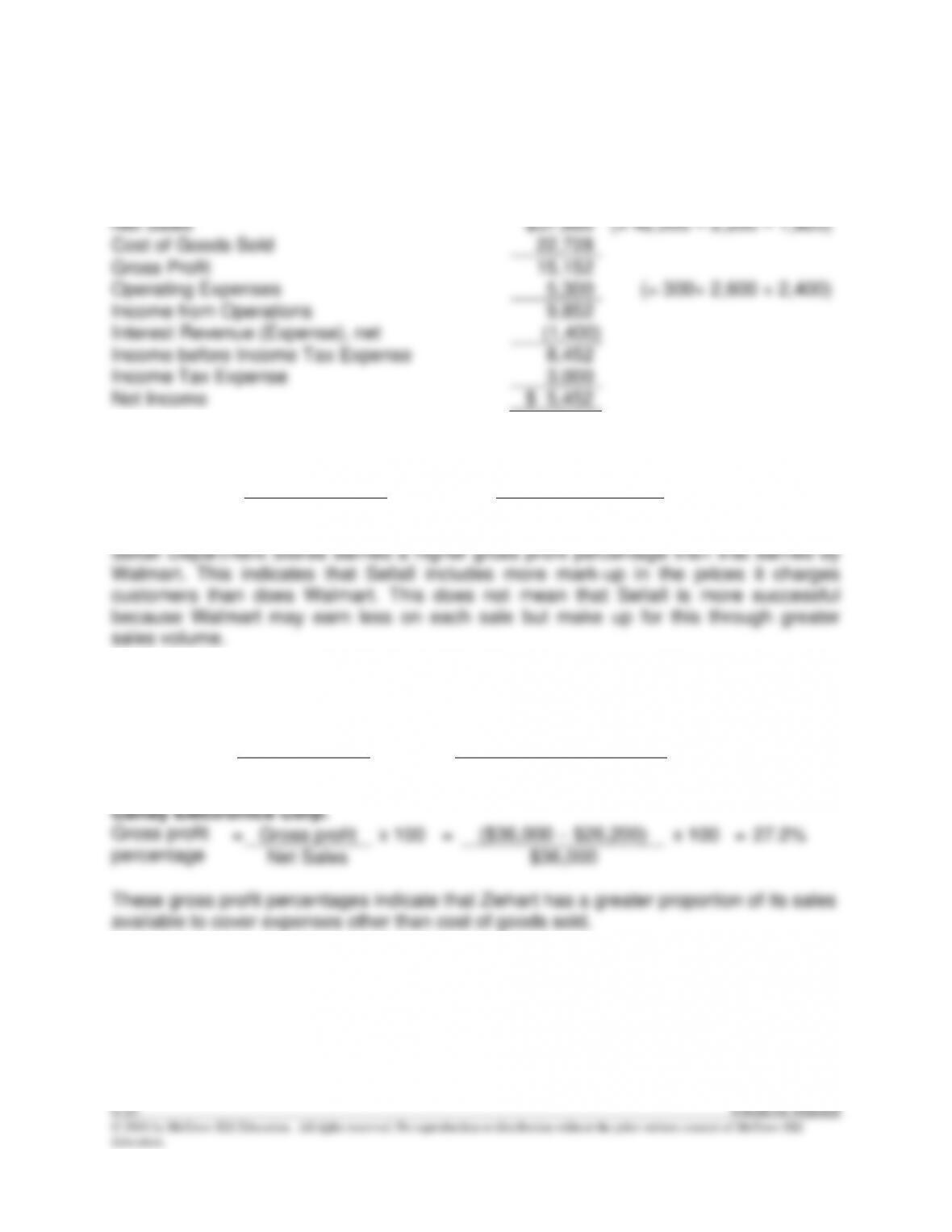
Sellall Department Stores
Income Statement
For the Year Ended December 31
Net Sales
$37,880
(= 42,000 – 2,200 – 1,920)
Cost of Goods Sold
22,728
Gross Profit
15,152
Operating Expenses
5,300
(= 300+ 2,600 + 2,400)
Income from Operations
9,852
Interest Revenue (Expense), net
(1,400)
Income before Income Tax Expense
8,452
Income Tax Expense
3,000
Net Income
$ 5,452
M6–14
Gross profit
percentage
=
Gross profit
x 100
=
$15,152
x 100
=
40.0%
Net Sales
$37,880
M6–15
Ziehart Pharmaceuticals
Gross profit
percentage
=
Gross profit
x 100
=
($178,000 − $58,000)
x 100
=
67.4%
Net Sales
$178,000
=
Gross profit
x 100
=
x 100
=
27.2%