Chapter 5
1. The three categories of employee fraud are: corruption, asset misappropriation,
2. The three points of the fraud triangle are incentive (which answers the question,
“Why would someone commit fraud?”), opportunity (which answers the
3. Managers can be motivated to misreport financial results if they are experiencing
data.
5. The Sarbanes-Oxley Act reduces the opportunity to commit fraud by requiring that
management monitor their internal controls and submit a report that indicates
6. The Sarbanes-Oxley Act attempts to encourage good employee behavior by
7. Internal control focuses on objectives relating to operations, reporting, and
compliance.
8. The five components of internal control are the control environment, risk
1) Establish responsibility. This means assigning each task to only one
employee.
3) Restrict access. Do not provide access to assets or information unless it is
needed to fulfill assigned responsibilities.
occurred.
5) Independently verify. Check others’ work.
11. Cash-handling and cash-recording activities should be separated to remove the
opportunity for theft of cash and cover-up by altering the records. This separation
12. Physically locking up valuable assets and electronically securing access to other
assets and information are good methods of restricting access.
13. Documentation allows companies to keep track of whether goods have been
14. One way that independent verification can occur is to hire an independent auditor
15. A mandatory vacation policy, particularly for employees who handle cash, acts as
16. Two limitations of internal control are that (a) controls may not be implemented
17. The primary internal control goal for cash receipts is to ensure that the business
receives the appropriate amount of cash and safely deposits it in the bank.
18. The cash register performs three important functions: it restricts access to cash, it
19. Cash received in person is independently verified in two ways. First, the amount
of cash is counted by a supervisor who verifies the amount reported by the
21. The purposes of a bank reconciliation are (a) to determine the “true” cash balance
and (b) to provide data to adjust the Cash account to that balance. A bank
22. Cash includes money and any instrument, such as a check, money order, or bank
23. Restricted cash is cash not available for general use because it has been set
24. By replenishing petty cash funds at the end of each accounting period, a company
will record all disbursements made out of petty cash during the period in which
they are made. An opposing argument is that this recording of petty cash
Authors’ Recommended Solution Time
(Time in minutes)
Mini-exercises
Exercises
Problems
Skills
Development
Cases*
Continuing
Case2
No.
Time
No.
Time
No.
Time
No.
No.
Time
1
3
1
10
CP5–1
10
1
5
1
20
2
3
2
10
CP5–2
20
2
5
2
10
3
3
3
15
CP5–3
20
3
30
4
5
4
15
CP5–4
20
4
20
5
5
5
15
PA5–1
10
5
30
6
5
6
15
PA5–2
20
6
15
7
4
7
5
PA5–3
20
8
3
8
10
PA5–4
20
9
6
9
6
PB5–1
10
10
3
10
6
PB5–2
20
11
2
PB5–3
20
12
6
PB5–4
20
13
5
C5-1
40
14
2
15
5
16
5

Fundamentals of Financial Accounting, 5/e 5-5
ANSWERS TO MINI-EXERCISES
M5–1
1. A
2. B
3. C
4. B
M5–2
1. A
2. B
3. D
4. C
5. E
M5–3
2. Segregate duties
4. Document procedures
6. Independently verify
M5–4
1. D – Document procedures
3. C – Restrict access
5. A – Establish responsibility
M5–5
a) Segregate duties – The cashiers should not have access to the cash and also be
solely responsible for reconciling the cash register tape with the cash count
summary. This would allow them to take some of the cash and understate the
amount received and deposited. Internal control would be improved by limiting
the cashiers’ responsibilities to only handling the cash (and preparing a cash
M5–6
1. C
2. A
3. E
4. D
5. B
M5–7
a) Segregate duties – The warehouse manager should not be allowed to place and
receive orders because it would allow him to divert goods to a personal location
and have the company pay for them. Ordering responsibilities should be
assigned to someone who does not receive goods.
M5–8
Reconciling Item
Bank Statement
Company’s Books
a. Outstanding checks of $12,000
−
b. Bank service charge of $15
−
c. Deposit in transit of $2,300
+
d. Interest earned of $5
+
M5–9
(b) Office Expenses ………………………………………………. 15
Cash ……………………………………………………….. 15
M5–10
Outstanding checks to be included in the May 31 bank reconciliation:
Date
Check Number
Amount
May 4
#3
$70
May 29
#7
$25
M5–11
The May 31 bank reconciliation should include a deposit in transit of $150 made on
M5–12
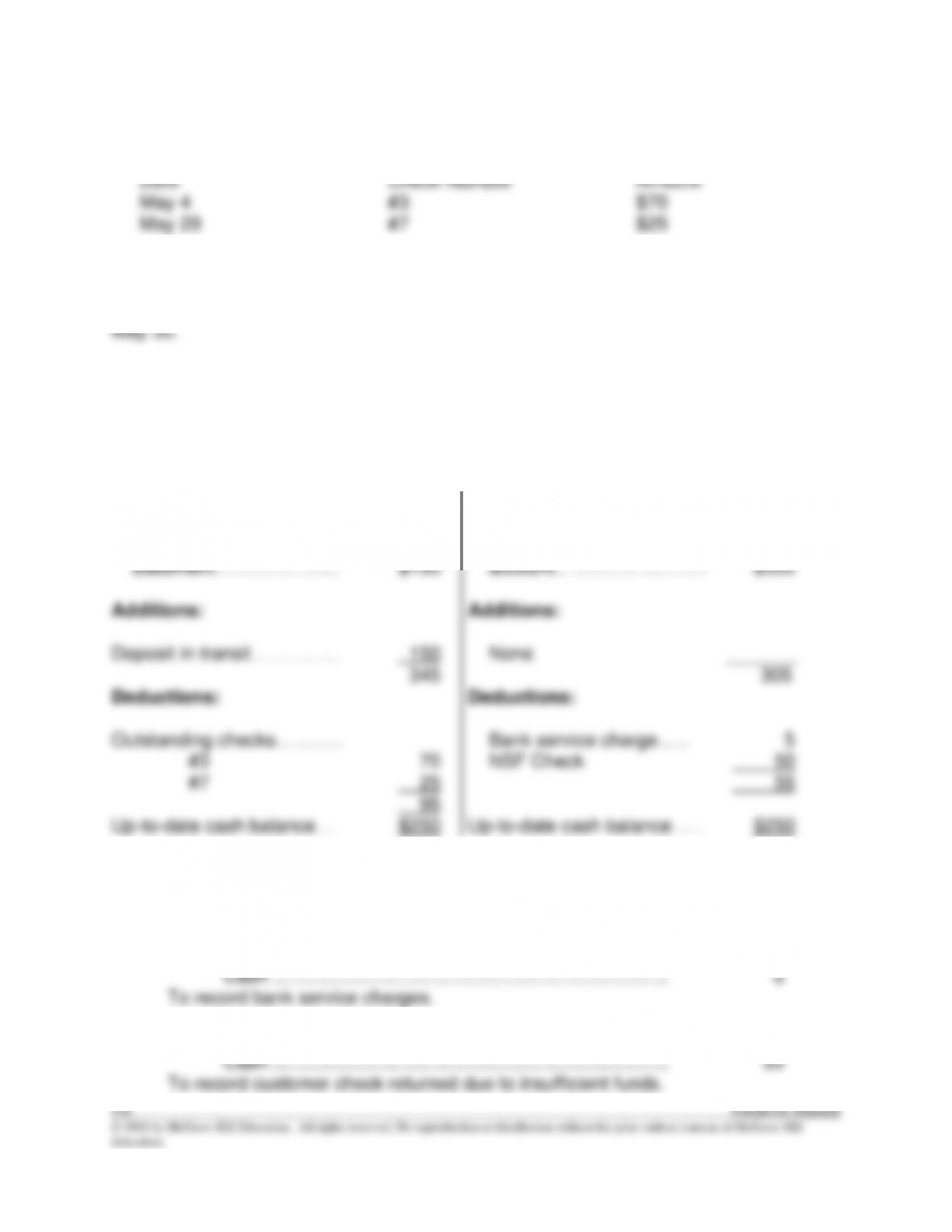
Bank Reconciliation
May 31
Bank Statement
Company’s Books
Ending balance per bank
statement………………….
$195
Ending balance per Cash
account………………………
$305
Additions:
Additions:
Deposit in transit…………….
150
None
345
305
Deductions:
Deductions:
Outstanding checks…………
Bank service charge……
5
#3
70
NSF Check
50
#7
25
55
95
Up–to-date cash balance….
$250
Up–to-date cash balance……
$250
M5–13
(1) Office Expenses …………………………………………………………… 5
(2) Accounts Receivable …………………………………………………….. 50
M5–14
Yes
1. $10,000 of government Treasury bills purchased 10
days prior to their maturity.
No
2. $50,000 of government Treasury bills purchased to
satisfy a legal requirement to set aside funds for a
landfill clean-up.
No
3. $10,000 of cash owed by customers on sales made
within 20 days of year-end.
Yes
4. $1,000 of cash in the petty cash custodian’s locked
cash box.
M5–15
(A) Office Expenses ……………………………………………………….….. 10
Cash …………………………………………………………………. 10
To record the purchasing of coffee for a client.
M5–16
Travel Expense ……………………………………………………………………… 40
Delivery Expense …………………………………………………………………… 12
5-10 Solutions Manual
© 2016 by McGraw-Hill Education. All rights reserved. No reproduction or distribution without the prior written consent of McGraw-Hill
Education.
ANSWERS TO EXERCISES
E5–1
Req. 1
The control principle is segregation of duties and the objective is to prevent or detect
unauthorized activities involving the company’s assets.
Req. 2
E5–2
By failing to issue receipts for all donation transactions, the principle of documenting
procedures has been violated in two ways: (a) you didn’t ensure that adequate records
(of donations) were maintained, and (b) the failure to issue receipts makes it difficult to
E5–3
Req. 1
a. Establish responsibility
b. Document procedures