Chapter 4
Adjustments, Financial Statements, and
Financial Results
ANSWERS TO QUESTIONS
1. Adjusting entries are made at the end of the accounting period to record all
2. (a) The time period assumption states that the long life of a company can be
divided into shorter time periods. Adjustments are required by GAAP to
ensure that a company’s financial statements include all the transactions of the
period.
3. The two different types of adjusting journal entries are:
(1) Deferral adjustments:
(2) Accrual adjustments:
(a) Revenues – revenues that have been earned by the end of the accounting
4. Adjusting entries have no effect on cash. For unearned revenues and
5. A contra–asset is an account related to an asset that is an offset or reduction to the
6. Depreciation expense is reported on the income statement. It indicates the amount
7. An adjusted trial balance is a list of the individual accounts, usually in financial
8.
Assets
=
Liabilities
+
Stockholders’ Equity
Dec
31
Cash
Prepaid Rent
−9,000
+9,000
=
Jan
31
Prepaid Rent
−3,000
=
Rent
Expense (+E)
−3,000
Feb
28
Prepaid Rent
−3,000
=
Rent
Expense (+E)
−3,000
Mar
31
Prepaid Rent
−3,000
=
Rent
Expense (+E)
−3,000
9. Balance sheet accounts at January 31:
Prepaid rent $6,000
10.
12/31
Prepaid Rent (+A) …………………………………………..
9,000
Cash (−A) ……………………………………………….
9,000
1/31
Rent Expense (+E, −SE) ………………………………….
3,000
Prepaid Rent (−A) …………………………………….
3,000
2/28
Rent Expense (+E, −SE) ………………………………….
3,000
Prepaid Rent (−A) …………………………………….
3,000
3/31
Rent Expense (+E, −SE) ………………………………….
3,000
Prepaid Rent (−A) …………………………………….
3,000
11. (a) Income statement: Revenues − Expenses = Net Income
12. The net income from the income statement is included on the statement of retained
13. Closing journal entries are made at the end of the accounting period to transfer the
balances in the temporary accounts to retained earnings. The closing journal entries
14. Permanent accounts are balance sheet accounts (for assets, liabilities, and
stockholders’ equity accounts). These accounts are not closed at the end of
15. The income statement accounts are closed at the end of the accounting period
because, in effect, they are temporary sub–accounts to retained earnings (i.e., a
part of stockholders’ equity). They are used only for accumulation during the
accounting period. When the period ends, these accumulated accounts must be
16. A post–closing trial balance is a list of all the accounts and their balances taken from
the ledger, after the adjusting and closing journal entries have been journalized and
17. The owner is correct; the adjustment process does consume a lot of time and it
delays month–end reporting of financial results. However, prior to adjustments, the
financial results are not complete or up–to–date. Important information relating to
assets, liabilities, revenues, and expenses has not yet been incorporated into the
accounting records. Without this information, the owner may make decisions that
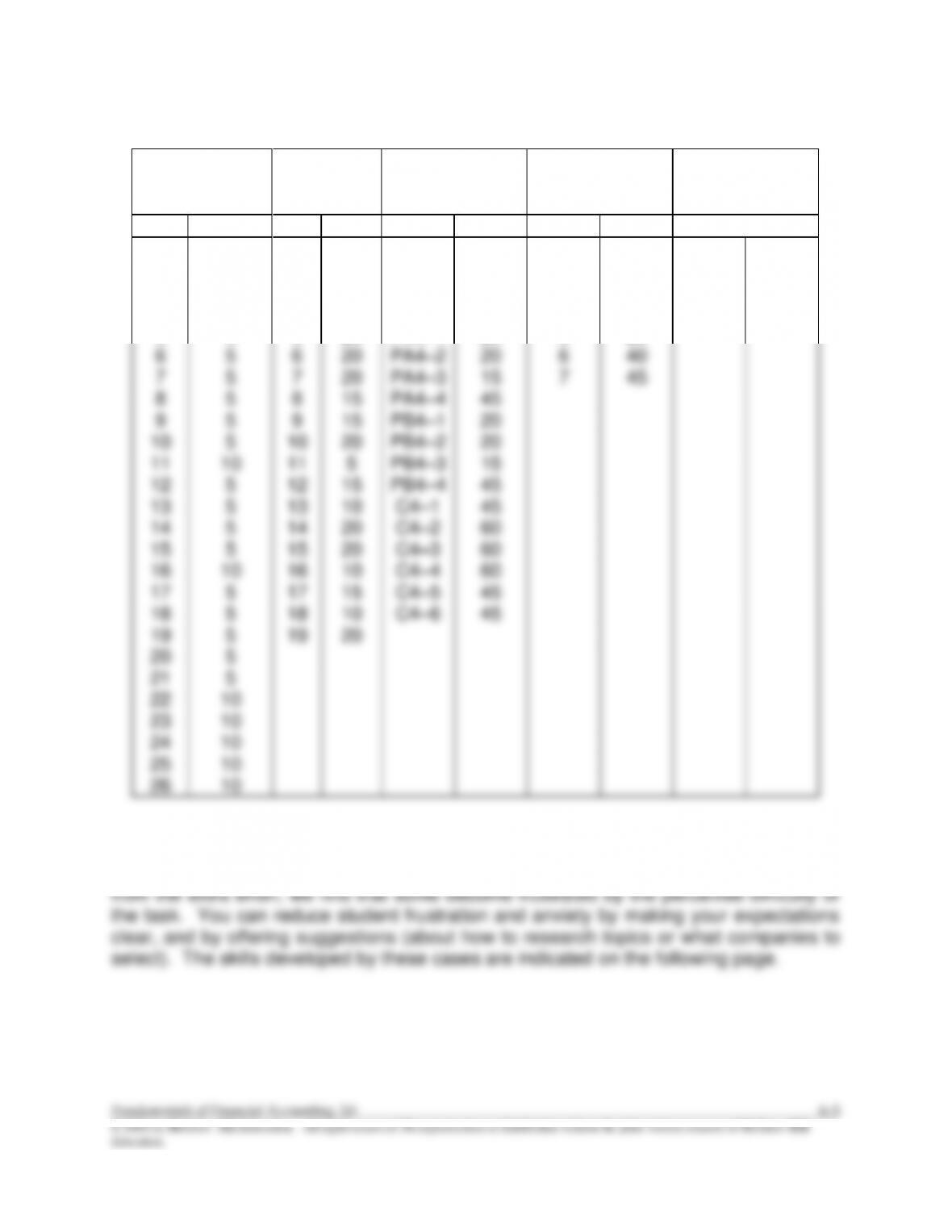
Authors’ Recommended Solution Time
(Time in minutes)
Mini–exercises
Exercises
Problems
Skills
Development
Cases*
Continuing
Case
No.
Time
No.
Time
No.
Time
No.
Time
No. Time
1
5
1
10
CP4–1
20
1
20
1
45
2
5
2
10
CP4–2
20
2
20
3
5
3
15
CP4–3
15
3
30
4
5
4
10
CP4–4
45
4
25
5
5
5
20
PA4–1
20
5
25
6
5
6
20
PA4–2
20
6
40
7
5
7
20
PA4–3
15
7
45
8
5
8
15
PA4–4
45
9
5
9
15
PB4–1
20
10
5
10
20
PB4–2
20
11
10
11
5
PB4–3
15
12
5
12
15
PB4–4
45
13
5
13
10
C4–1
45
14
5
14
20
C4–2
60
15
5
15
20
C4–3
60
16
10
16
10
C4–4
60
17
5
17
15
C4–5
45
18
5
18
10
C4–6
45
19
5
19
20
20
5
21
5
22
10
23
10
24
10
25
10
26
10
* Due to the nature of cases, it is very difficult to estimate the amount of time students
will need to complete them. As with any open–ended project, it is possible for students
to devote a large amount of time to these assignments. While students often benefit

Fundamentals of Financial Accounting, 5/e 4–6
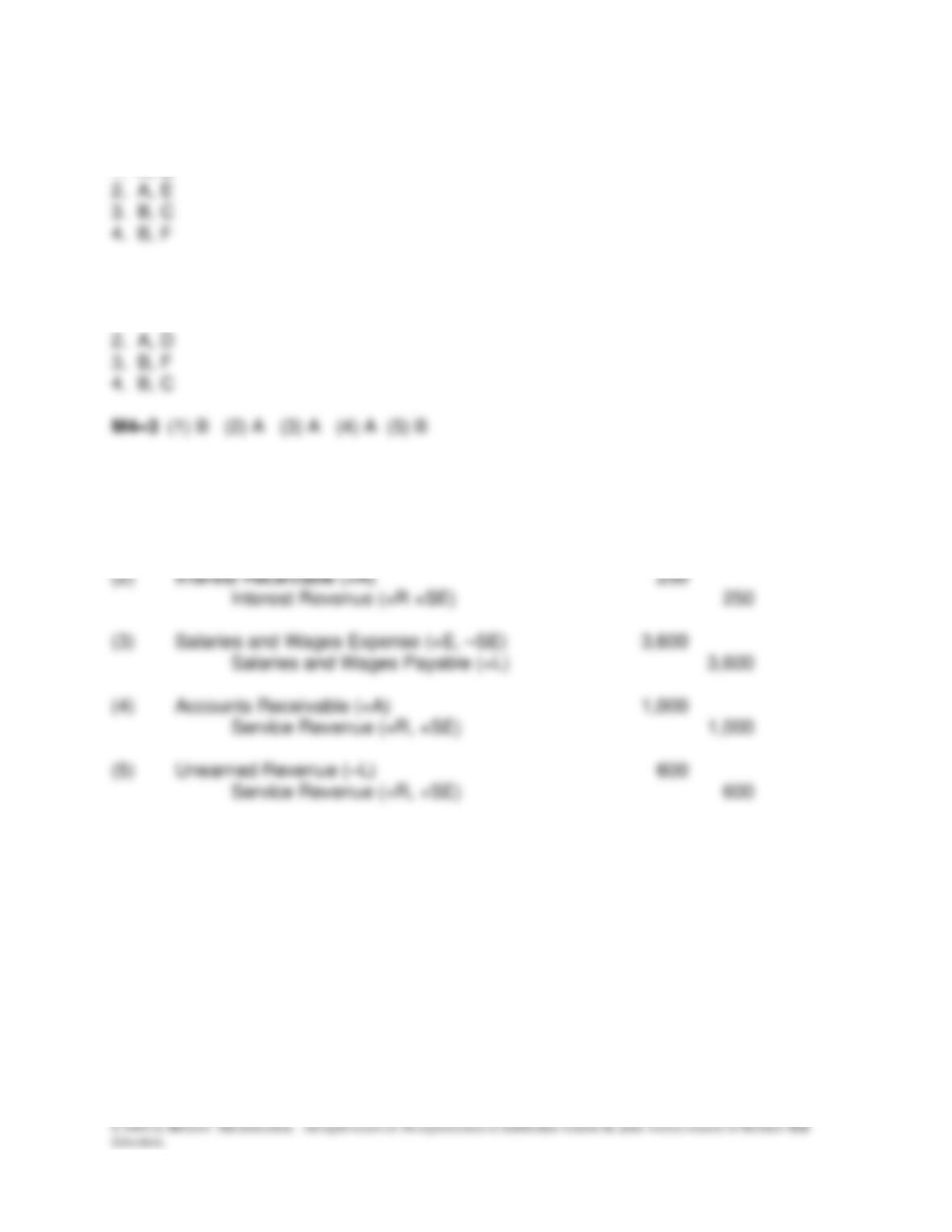
Case
Financial
Analysis
Research
Ethical
Reasoning
Critical
Thinking
Technology
Writing
Teamwork
1
x
2
x
3
x
X
x
x
x
4
x
x
x
5
x
x
x
x
6
x
x
x
7
x
x
Fundamentals of Financial Accounting, 5/e 4–7
ANSWERS TO MINI–EXERCISES
M4–1
1. A, D
M4–2
1. A, E
M4–4
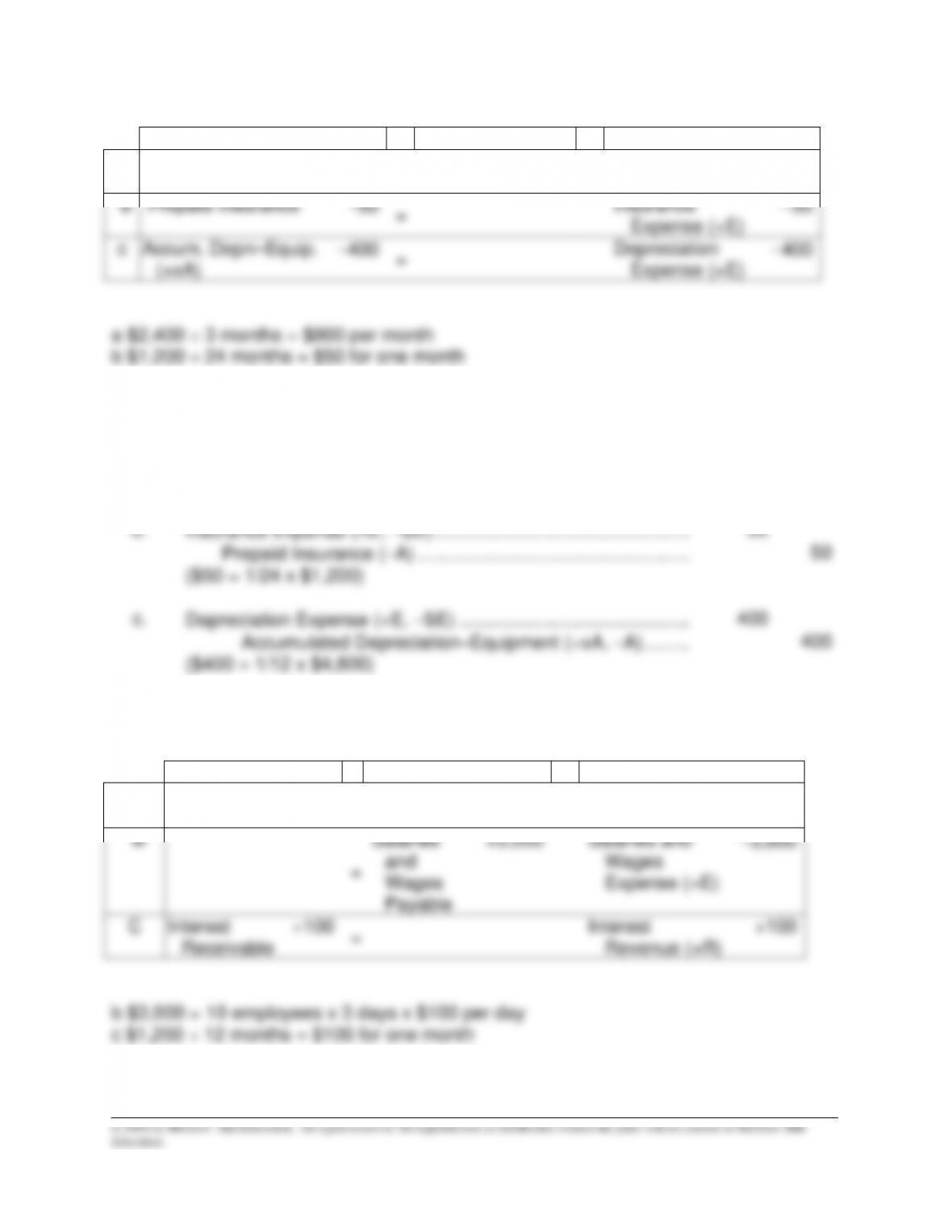
(1)
Supplies Expense (+E –SE)
400
Supplies (–A)
400
(2)
Interest Receivable (+A)
250
Interest Revenue (+R +SE)
250
(3)
Salaries and Wages Expense (+E, –SE)
3,600
Salaries and Wages Payable (+L)
3,600
(4)
Accounts Receivable (+A)
1,000
Service Revenue (+R, +SE)
1,000
(5)
Unearned Revenue (–L)
600
Service Revenue (+R, +SE)
600
Fundamentals of Financial Accounting, 5/e 4–8
M4–5
Assets
=
Liabilities
+
Stockholders’ Equity
a
=
Unearned
Revenue
−800
Rent
Revenue (+R)
+800
b
Prepaid Insurance
−50
=
Insurance
Expense (+E)
−50
c
Accum. Depn–Equip.
(+xA)
−400
=
Depreciation
Expense (+E)
−400
a $2,400 ÷ 3 months = $800 per month
b $1,200 ÷ 24 months = $50 for one month
M4–6
a.
Unearned Revenue (−L) ………………………………………………….
800
Rent Revenue (+R, +SE) ………………………………………….
800
($800 = 1/3 x $2,400)
b.
Insurance Expense (+E, −SE) ………………………………………….
50
Prepaid Insurance (−A) …………………………………………….
50
($50 = 1/24 x $1,200)
c.
Depreciation Expense (+E, −SE) ……………………………………..
400
Accumulated Depreciation–Equipment (+xA, −A) ………
400
($400 = 1/12 x $4,800)
M4–7
Assets
=
Liabilities
+
Stockholders’ Equity
A
=
Accounts
Payable
+600
Utilities
Expense (+E)
−600
B
=
Salaries
and
Wages
Payable
+3,000
Salaries and
Wages
Expense (+E)
−3,000
C
Interest
Receivable
+100
=
Interest
Revenue (+R)
+100
b $3,000 = 10 employees x 3 days x $100 per day
c $1,200 ÷ 12 months = $100 for one month
M4–8
Fundamentals of Financial Accounting, 5/e 4–9
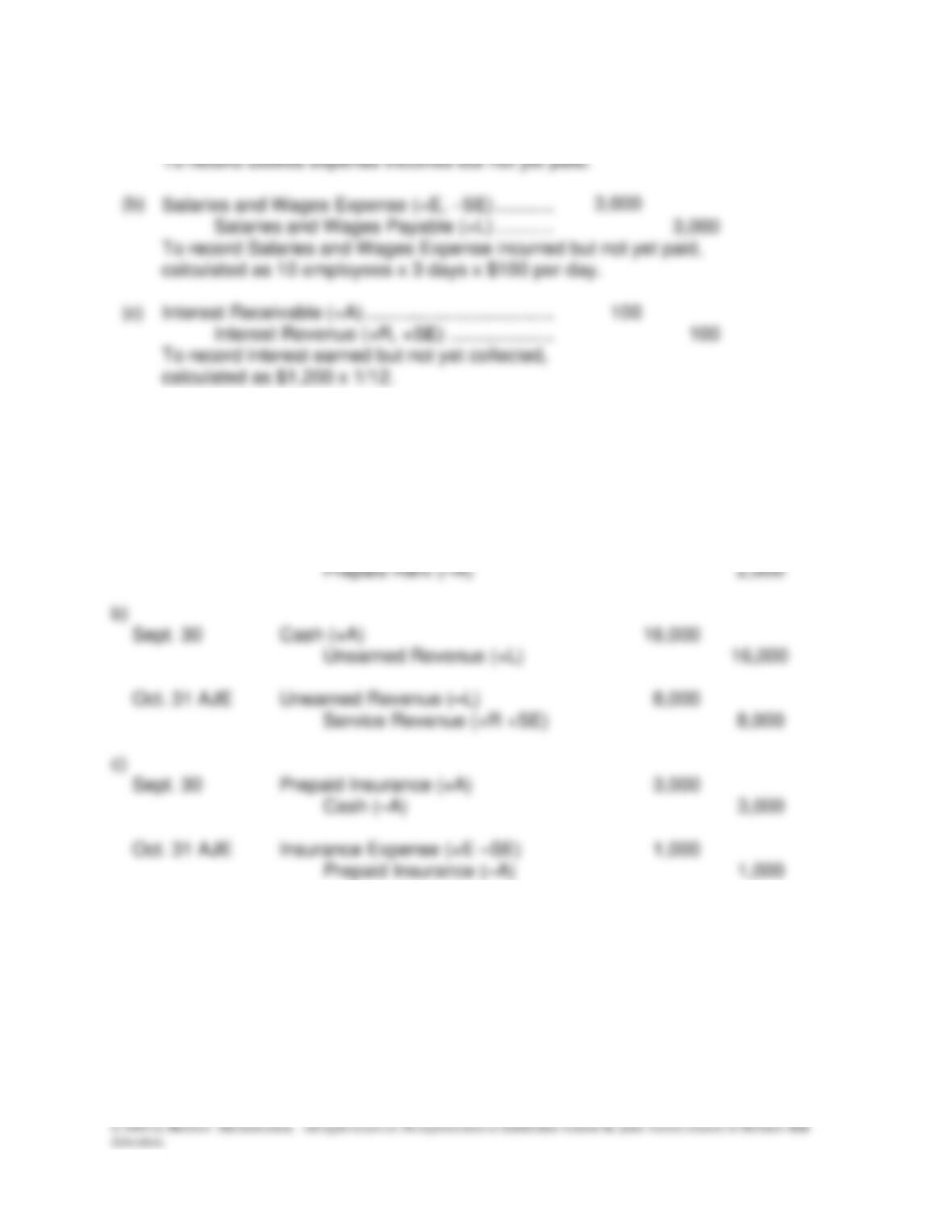
(a)
Utilities Expense (+E, −SE)…………………………..
600
Accounts Payable (+L)………………………..
600
To record utilities expense incurred but not yet paid.
(b)
Salaries and Wages Expense (+E, −SE) ………..
3,000
Salaries and Wages Payable (+L) ………..
3,000
To record Salaries and Wages Expense incurred but not yet paid,
calculated as 10 employees x 3 days x $100 per day.
(c)
Interest Receivable (+A) ………………………………
100
Interest Revenue (+R, +SE) ………………..
100
To record interest earned but not yet collected,
calculated as $1,200 x 1/12.
M4–9
a)
Sept. 30 Prepaid Rent (+A) 4,000
Cash (–A) 4,000
Oct. 31 AJE Rent Expense (+E –SE) 2,000
M4–10
a)
Dec. 31 Cash (+A) 12,000
Unearned Revenue (+L) 12,000
Jan. 31 AJE Unearned Revenue (–L) 1,000
M4–11
(a)
Prepaid Insurance (+A) ………………………………..
2,275
Insurance Expense (−E, +SE) ……………..
2,275
(b)
Service Revenue (−R, −SE) ………………………….
1,000
Unearned Revenue (+L) ……………………..
1,000
(c)
Income Tax Expense (+E, −SE) ……………………
2,000
Income Tax Payable (+L)…………………….
2,000