Chapter 3
The Income Statement
ANSWERS TO QUESTIONS
1. Net Income = Revenues – Expenses.
Each element is defined as follows:
2. The time period assumption assumes that the long life of a company can be
3. Accrual basis accounting requires recording revenues when earned and
4. Using cash basis accounting for your personal finances is acceptable because
your cash inflows and outflows tend to occur close in time to the activities that
5. To “recognize” an accounting transaction means to measure and record the
revenues.
6. Under accrual basis accounting, revenues are recognized when they are earned.
7. The expense recognition (“matching”) principle requires that expenses be
recorded when incurred in earning revenue. For example, the cost of employee
8. Revenues increase net income, which increases retained earnings—a
9. Revenues increase stockholders’ equity and expenses decrease it.
10.
Item
Increase
Decrease
Revenues
Credit
Debit
Expenses
Debit
Credit
11.
Item
Debit
Credit
Revenues
Decrease
Increase
Expenses
Increase
Decrease
12. Items on the income statement relate only to the current period and do not have
a lingering financial impact beyond the current period. Balance sheet items, on
13. The statement of retained earnings indicates that it is appropriate to consider
14. Revenue is the amount earned during a period by providing goods or services to
15. Advertising Expense is an expense account that records the cost of
advertisements incurred during the period. It is reported on the income
16.
Situation
Explanation
a.
This is an accounting error. When cash is received from a
customer on account, Cash should be debited (not credited) and
Accounts Receivable should be credited (not debited). A trial
balance would not detect this error because total debits would still
equal total credits across all accounts.
b.
This is an accounting error. A gift card represents a promise by
the company to deliver goods or services in the future when the
card is redeemed. Because the company has yet to deliver any
goods or services, the proper transaction is to debit Cash and
credit Unearned Revenue. When the card is used to purchase
goods or services, Unearned Revenue will be debited and
Revenue will be credited. A trial balance would not detect this
error because both Revenue and Unearned Revenue hold credit
balances.
c.
This is an accounting error because assets (reported on the
balance sheet) differ from expenses (reported on the income
statement). Because both assets and expenses typically hold
debit balances, this error would not be detected on a trial balance.
d.
This is an accounting error. In every accounting transaction,
debits must equal credits. Because only a debit was entered in
this transaction, the error would be detected in the trial balance.
e.
This is not an accounting error. Under the Separate Entity
Assumption, transactions of the owners (shareholders) of a
business are kept separate from those of the business itself. The
trial balance would not indicate an error.
17. One limitation of the income statement is that people mistakenly believe that net
income equals the amount of cash generated by the business during the period.
A second limitation is that net income does not measure the change in value of a
company during the period. Finally, net income is influenced by estimates, so it
is not always a precise measure.
Fundamentals of Financial Accounting, 5/e 3-4
Authors’ Recommended Solution Time
(Time in minutes)
Mini-exercises
Exercises
Problems
Skills
Development
Cases*
Continuing Case
No.
Time
No.
Time
No.
Time
No.
Time
No.
Time
1
5
1
10
CP3-1
20
1
20
1
15
2
5
2
20
CP3-2
30
2
30
3
5
3
20
CP3-3
40
3
30
4
5
4
20
CP3-4
40
4
30
5
6
5
20
PA3-1
20
5
30
6
6
6
20
PA3-2
30
6
25
7
6
7
20
PA3-3
40
7
45
8
6
8
20
PA3-4
40
9
5
9
20
PB3-1
20
10
5
10
20
PB3-2
30
11
5
11
30
PB3-3
40
12
5
12
10
PB3-4
35
13
5
13
20
C3-1
45
14
5
14
10
15
5
15
10
16
5
16
15
17
5
17
15
18
5
18
15
19
10
19
30
20
15
20
15
21
10
21
30
22
23
5
8
* Due to the nature of cases, it is very difficult to estimate the amount of time students
will need to complete them. As with any open-ended project, it is possible for students
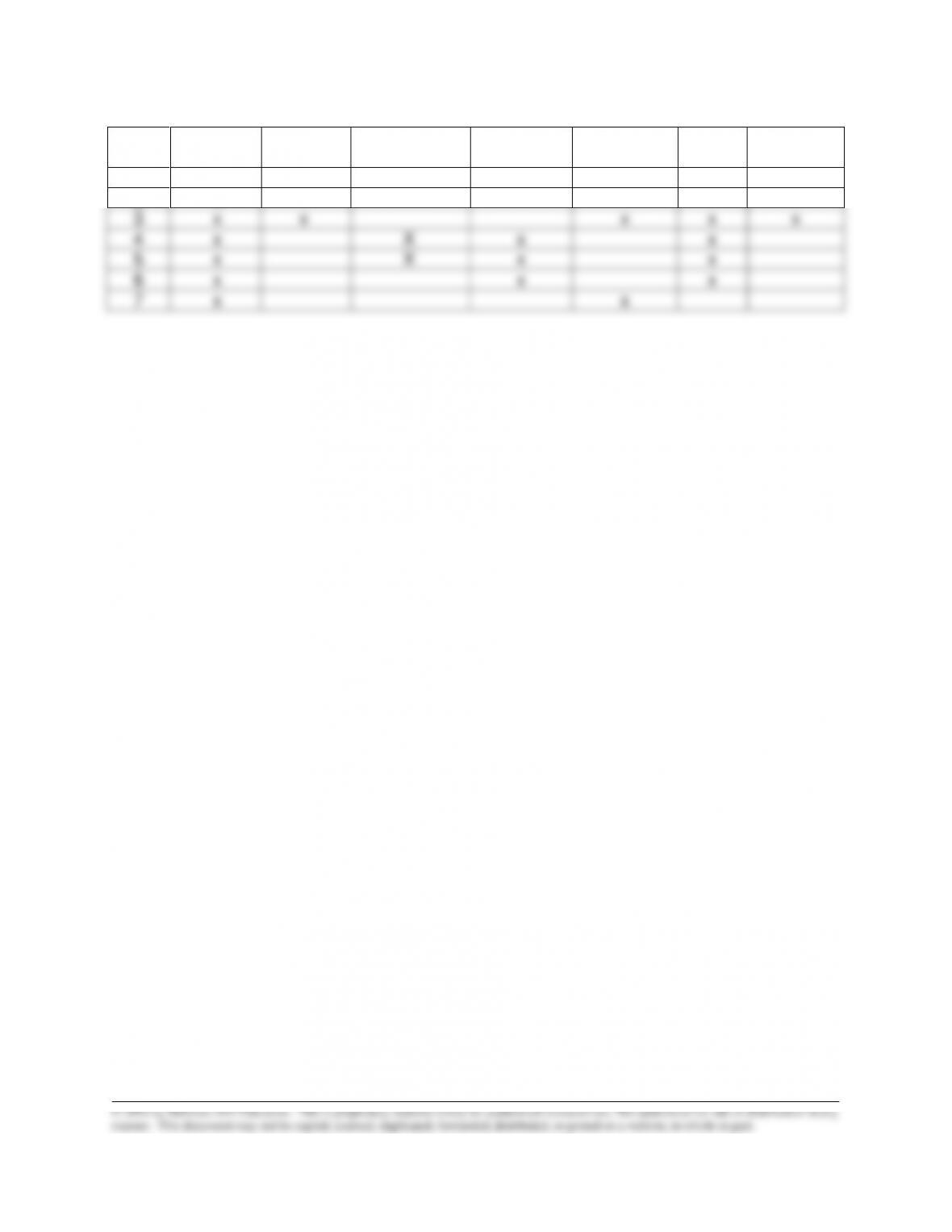
Fundamentals of Financial Accounting, 5/e 3-5
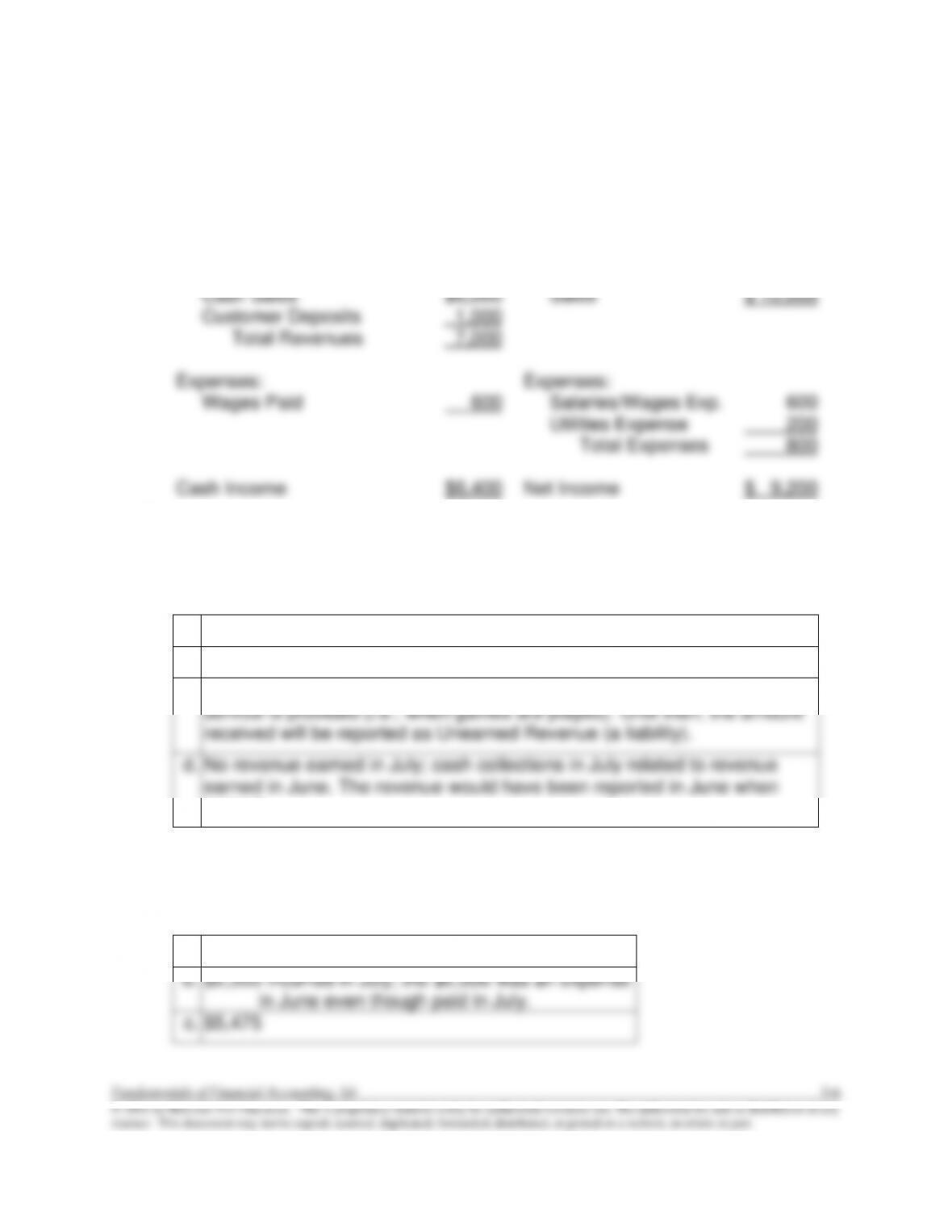
Case
Financial
Analysis
Research
Ethical
Reasoning
Critical
Thinking
Technology
Writing
Teamwork
1
x
2
x
3
x
x
x
x
x
4
x
X
x
x
5
x
X
x
x
6
x
x
x
7
x
x
ANSWERS TO MINI-EXERCISES
M3–1
MOSTERT MUSIC COMPANY
Cash Basis Income Statement
For the Month Ended March 31
MOSTERT MUSIC COMPANY
Accrual Basis Income Statement
For the Month Ended March 31
Revenues:
Cash Sales
Customer Deposits
Total Revenues
$6,000
1,000
7,000
Revenues:
Sales
$ 10,000
Expenses:
Wages Paid
600
Expenses:
Salaries/Wages Exp.
Utilities Expense
Total Expenses
600
200
800
Cash Income
$6,400
Net Income
$ 9,200
M3–2
Amount of Revenue Earned in July
a.
$12,000
b.
$250
c.
No revenue earned in July; the revenues will be earned when fall bowling
service is provided (i.e., when games are played). Until then, the amount
received will be reported as Unearned Revenue (a liability).
d.
No revenue earned in July; cash collections in July related to revenue
earned in June. The revenue would have been reported in June when
earned.
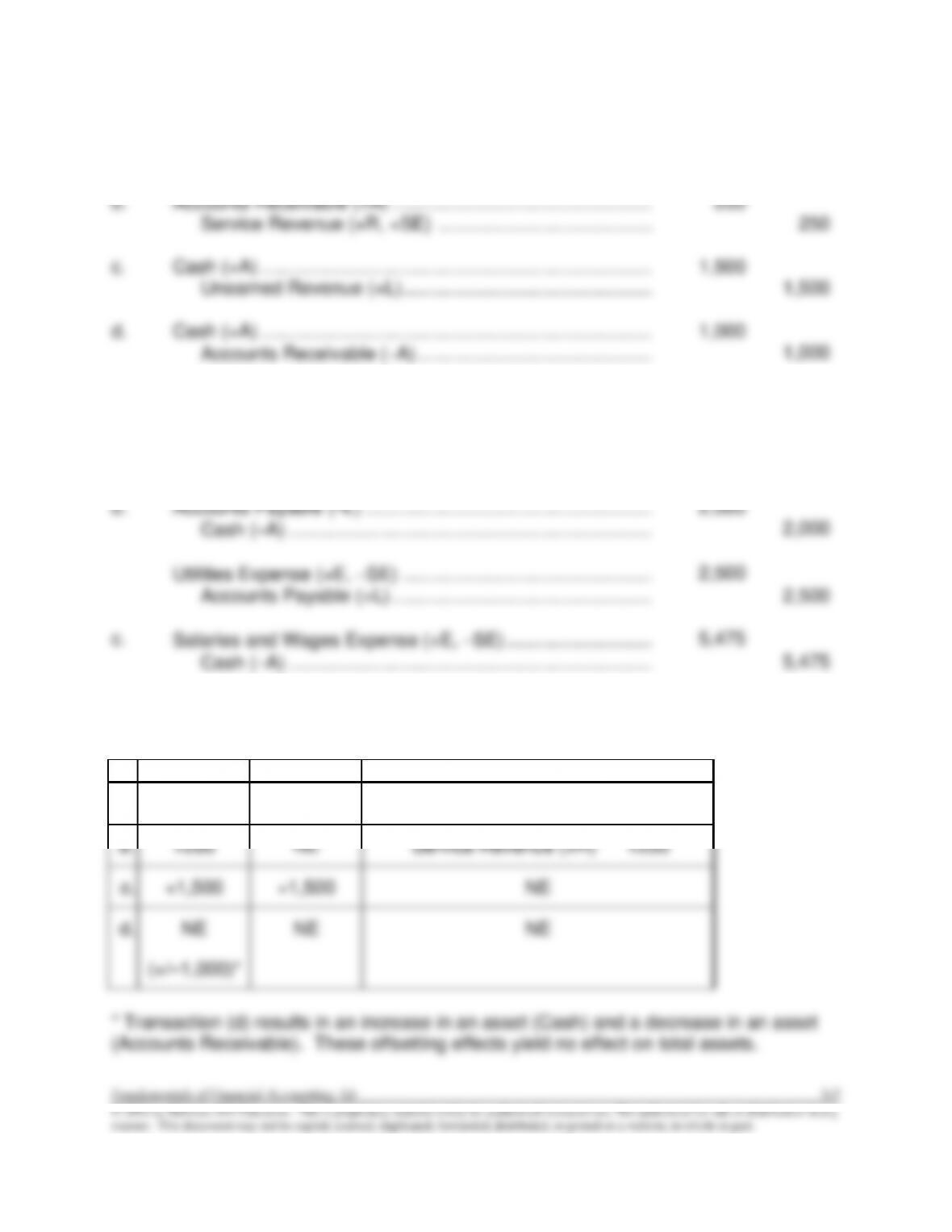
M3–3
Amount of Expense Incurred in July
a.
$1,500
b.
$2,500 incurred in July; the $2,000 was an expense
in June even though paid in July.
c.
$5,475
M3–4
a.
Cash (+A) …………………………………………………………………
12,000
Service Revenue (+R, +SE) ……………………………………
12,000
b.
Accounts Receivable (+A) …………………………………………..
250
Service Revenue (+R, +SE) …………………………………..
250
c.
Cash (+A) …………………………………………………………………
1,500
Unearned Revenue (+L) …………………………………………
1,500
d.
Cash (+A) …………………………………………………………………
1,000
Accounts Receivable (−A) ………………………………………
1,000
M3–5
a.
Repairs and Maintenance Expense (+E, −SE) ……………….
1,500
Cash (−A) …………………………………………………………….
1,500
b.
Accounts Payable (–L) ……………………………………………….
2,000
Cash (−A) …………………………………………………………….
2,000
Utilities Expense (+E, −SE) …………………………………………
2,500
Accounts Payable (+L) …………………………………………..
2,500
c.
Salaries and Wages Expense (+E, −SE) ……………………….
5,475
Cash (−A) …………………………………………………………….
5,475
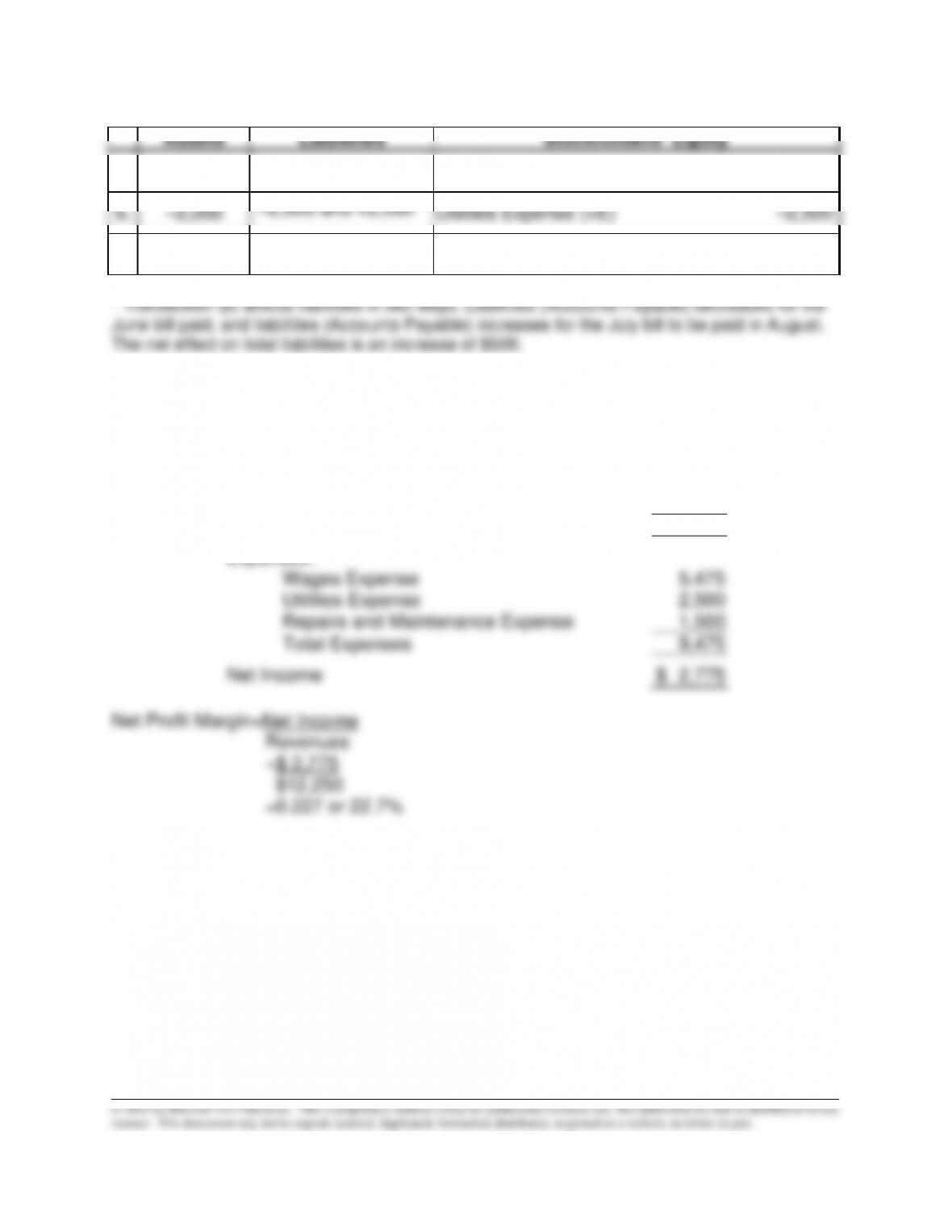
M3–6
Assets
Liabilities
Stockholders’ Equity
a.
+12,000
NE
Service Revenue (+R) +12,000
b.
+250
NE
Service Revenue (+R) +250
c.
+1,500
+1,500
NE
d.
NE
(+/–1,000)*
NE
NE
* Transaction (d) results in an increase in an asset (Cash) and a decrease in an asset
(Accounts Receivable). These offsetting effects yield no effect on total assets.
Fundamentals of Financial Accounting, 5/e 3-8
M3–7
Assets
Liabilities
Stockholders’ Equity
a.
–1,500
NE
Repairs and Maintenance Expense (+E) –1,500
b.
–2,000
–2,000 and +2,500 *
Utilities Expense (+E) –2,500
c.
–5,475
NE
Wages Expense (+E) –5,475
M3–8
BILL’S EXTREME BOWLING, INC.
Income Statement
For the Month Ended July 31
Revenues:
Service Revenue
$12,250
Total Revenues
12,250
Expenses:
Wages Expense
5,475
Utilities Expense
2,500
Repairs and Maintenance Expense
1,500
Total Expenses
9,475
Net Income
$ 2,775
Net Profit Margin=Net Income
Revenues
=$ 2,775
$12,250
=0.227 or 22.7%
M3–9
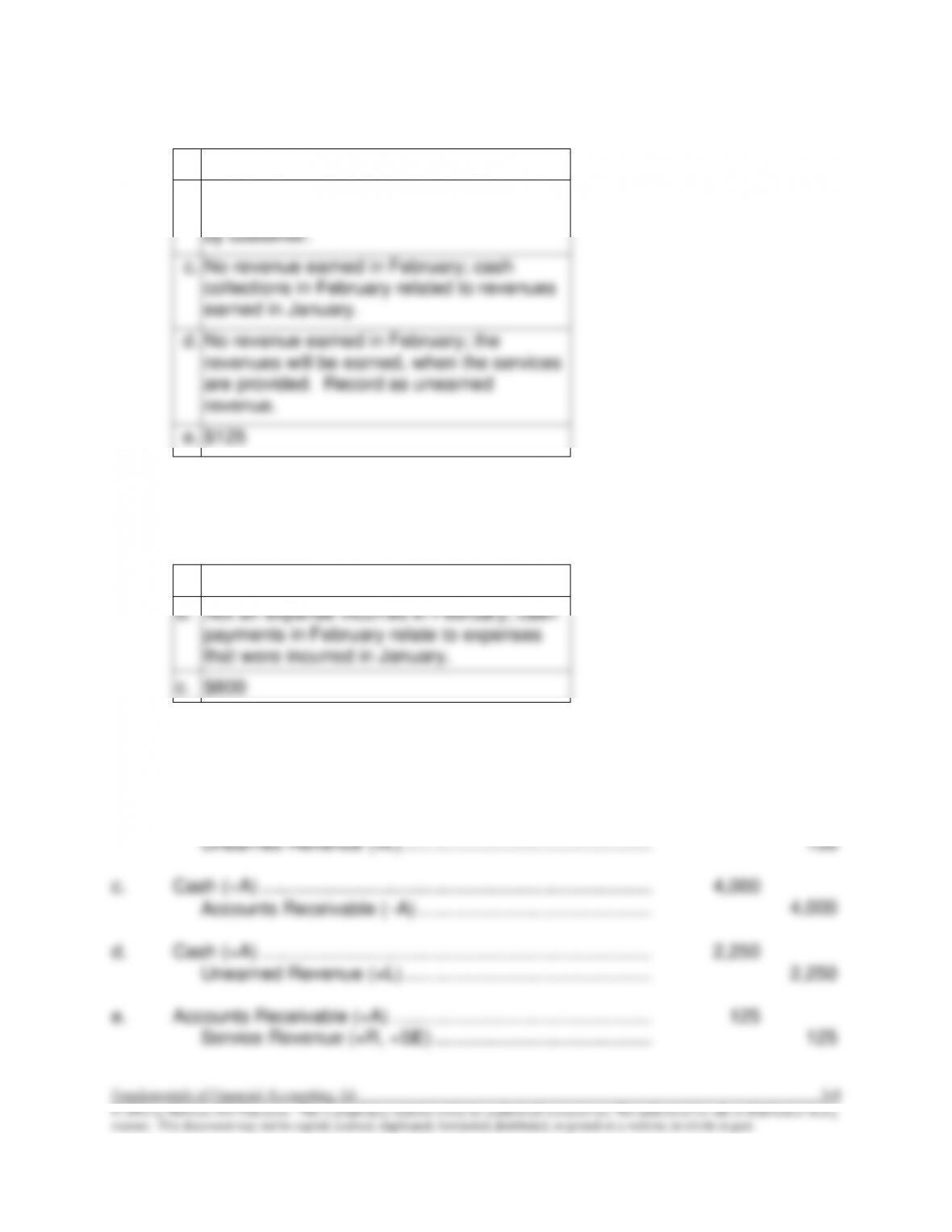
Amount of Revenue Earned in February
a.
$15,000
b.
No revenue earned in February; gift card
recorded as unearned revenue until used
by customer.
c.
No revenue earned in February; cash
collections in February related to revenues
earned in January.
d.
No revenue earned in February; the
revenues will be earned, when the services
are provided. Record as unearned
revenue.
e.
$125
M3–10
Amount of Expense Incurred in February
a.
$4,750
b.
Not an expense incurred in February; cash
payments in February relate to expenses
that were incurred in January.
c.
$800
M3–11
a.
Cash (+A) …………………………………………………………………
15,000
Service Revenue (+R, +SE) ……………………………………
15,000
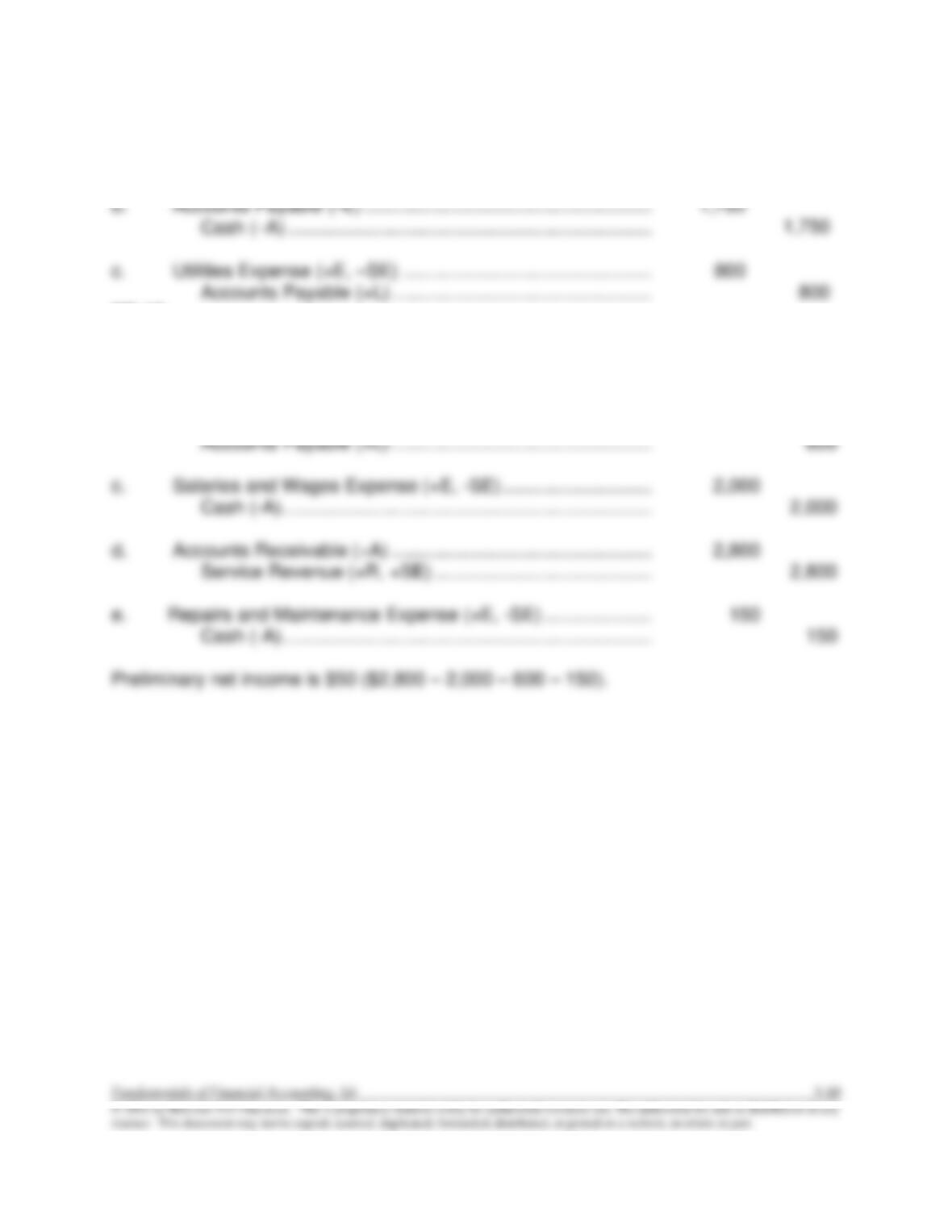
b.
Cash (+A) …………………………………………………………………
150
Unearned Revenue (+L) …………………………………………
150
c.
Cash (+A) …………………………………………………………………
4,000
Accounts Receivable (−A) ………………………………………
4,000
d.
Cash (+A) …………………………………………………………………
2,250
Unearned Revenue (+L) …………………………………………
2,250
e.
Accounts Receivable (+A) …………………………………………..
125
Service Revenue (+R, +SE) ……………………………………
125
M3–12
a.
Salaries and Wages Expense (+E, −SE) ……………………….
4,750
Cash (−A) …………………………………………………………….
4,750
b.
Accounts Payable (–L) ……………………………………………….
1,750
Cash (−A) …………………………………………………………….
1,750
c.
Utilities Expense (+E, –SE) …………………………………………
800
Accounts Payable (+L) …………………………………………..
800
M3–13
a.
Cash (+A) …………………………………………………………………
25,000
Common Stock (+SE) ……………………………………………
25,000
b.
Utilities Expense (+E, –SE) ………………………………………..
600
Accounts Payable (+L) …………………………………………..
600
c.
Salaries and Wages Expense (+E, –SE) ………………………..
2,000
Cash (-A) ……………………………………………………………..
2,000
d.
Accounts Receivable (+A) …………………………………………..
2,800
Service Revenue (+R, +SE) ……………………………………
2,800
e.
Repairs and Maintenance Expense (+E, –SE) …………………
150
Cash (-A) ……………………………………………………………..
150
Preliminary net income is $50 ($2,800 – 2,000 – 600 – 150).