© 2016 by McGraw-Hill Education. All rights reserved. No reproduction or distribution without the prior written consent of McGraw-Hill
Education.
M2–18
Assets
=
Liabilities
+
Stockholders’ Equity
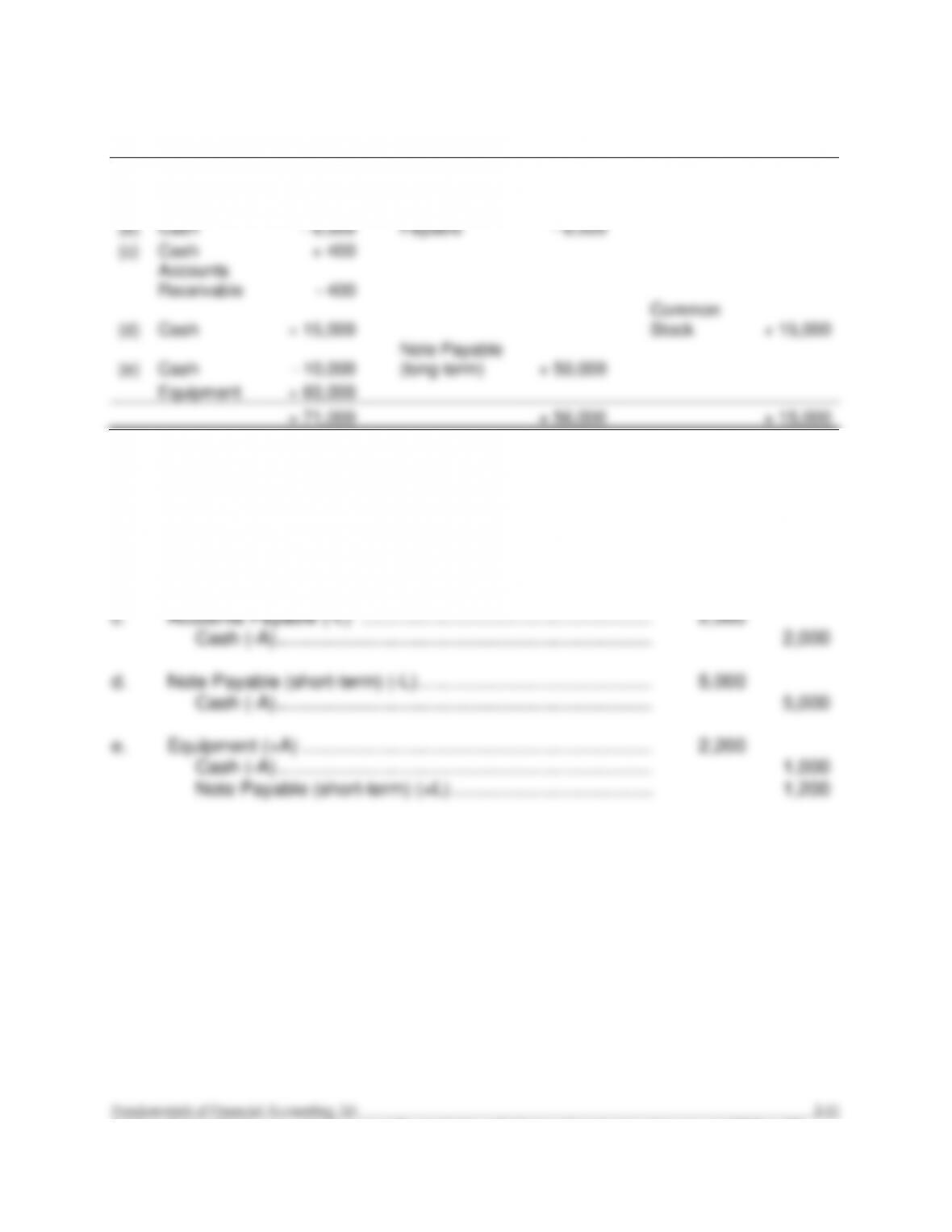
(a)
Equipment
+ 12,000
Accounts
Payable
+ 12,000
(b)
Cash
– 6,000
Accounts
Payable
– 6,000
(c)
Cash
+ 400
Accounts
Receivable
– 400
(d)
Cash
+ 15,000
Common
Stock
+ 15,000
(e)
Cash
– 10,000
Note Payable
(long-term)
+ 50,000
Equipment
+ 60,000
+ 71,000
+ 56,000
+ 15,000
M2–19
a.
Cash (+A) ………………………………………………………………….
50
Accounts Receivable (-A) ……………………………………….
50
b.
No transaction
c.
Accounts Payable (-L) ………………………………………………..
2,000
Cash (-A) ………………………………………………………………
2,000
d.
Note Payable (short-term) (-L) ………………………………………
5,000
Cash (-A) ………………………………………………………………
5,000
e.
Equipment (+A) ………………………………………………………….
2,200
Cash (-A) ………………………………………………………………
1,000
Note Payable (short-term) (+L)…………………………………
1,200
Fundamentals of Financial Accounting, 5/e 2-12
M2–20
Assets
=
Liabilities
+
Stockholders’
Equity
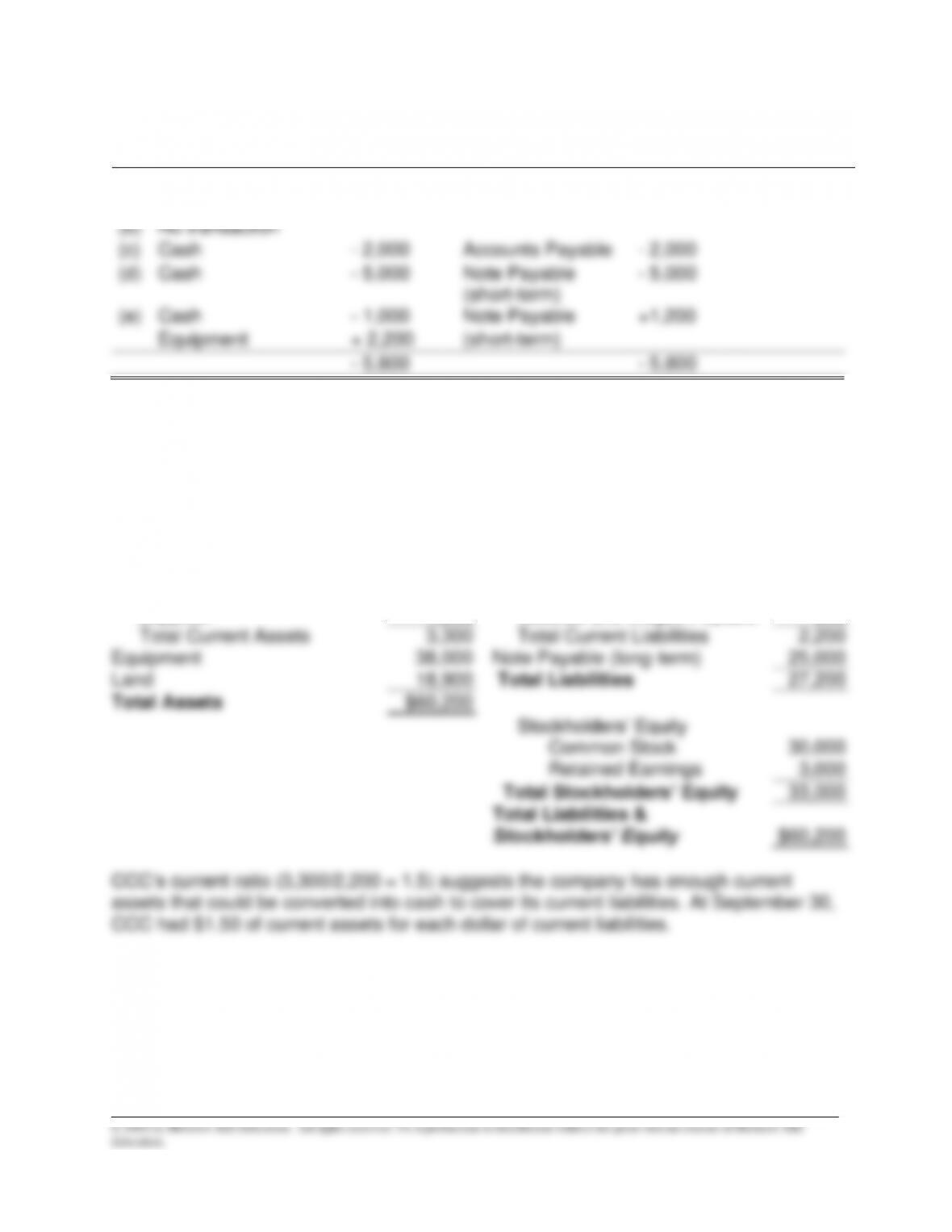
(a)
Cash
+ 50
Accounts Receivable
– 50
(b)
No transaction
(c)
Cash
– 2,000
Accounts Payable
– 2,000
(d)
Cash
– 5,000
Note Payable
(short-term)
– 5,000
(e)
Cash
– 1,000
Note Payable
+1,200
Equipment
+ 2,200
(short-term)
– 5,800
– 5,800
M2–21
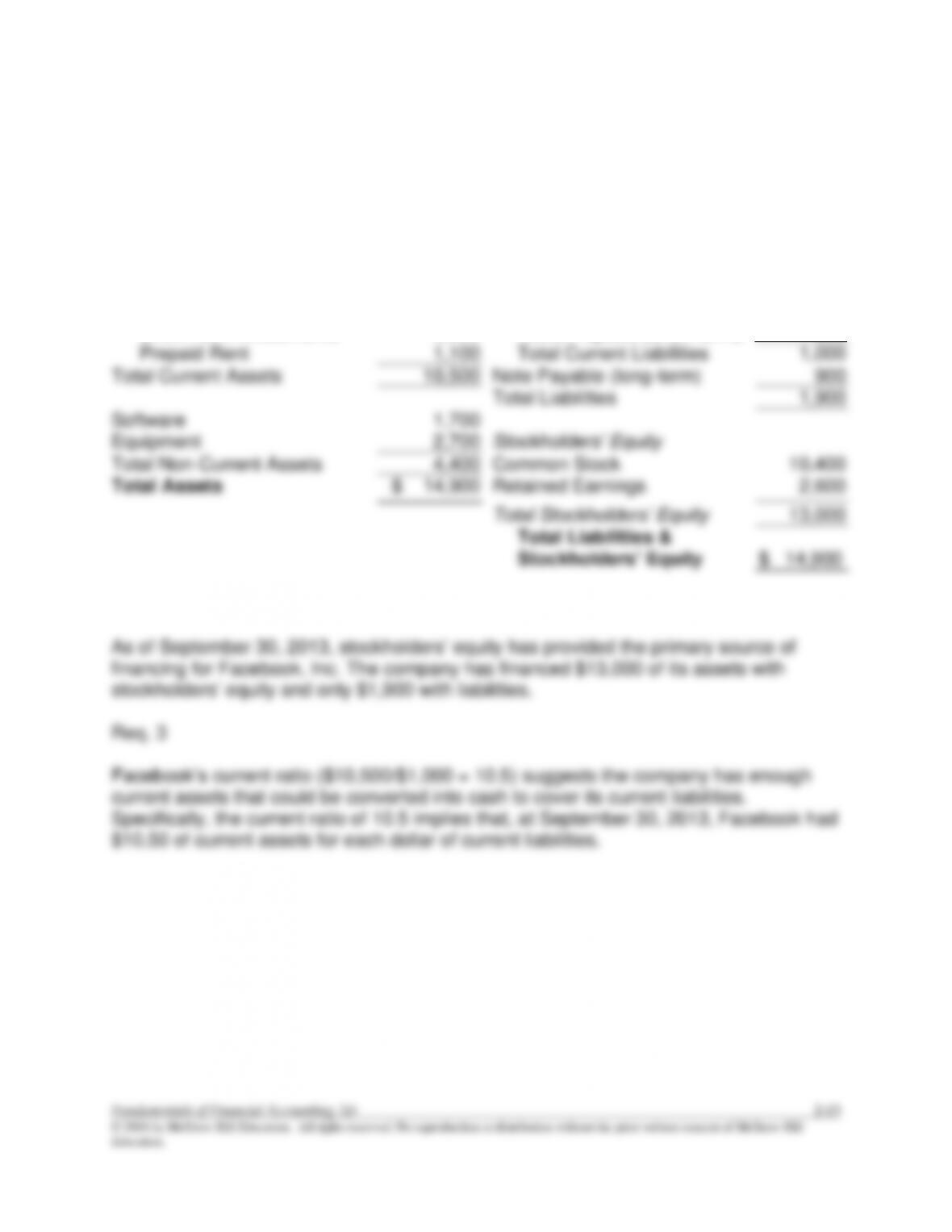
CHARLIE’S CRISPY CHICKEN
Balance Sheet
At September 30
Assets
Liabilities
Current Assets
Current Liabilities
Cash
$ 1,800
Accounts Payable
$ 2,000
Supplies
1,500
Salaries and Wages Payable
200
Total Current Assets
3,300
Total Current Liabilities
2,200
Equipment
38,000
Note Payable (long-term)
25,000
Land
18,900
Total Liabilities
27,200
Total Assets
$60,200
Stockholders’ Equity
Common Stock
30,000
Retained Earnings
3,000
Total Stockholders’ Equity
33,000
Total Liabilities &
Stockholders’ Equity
$60,200
CCC’s current ratio (3,300/2,200 = 1.5) suggests the company has enough current
assets that could be converted into cash to cover its current liabilities. At September 30,
CCC had $1.50 of current assets for each dollar of current liabilities.
M2–22
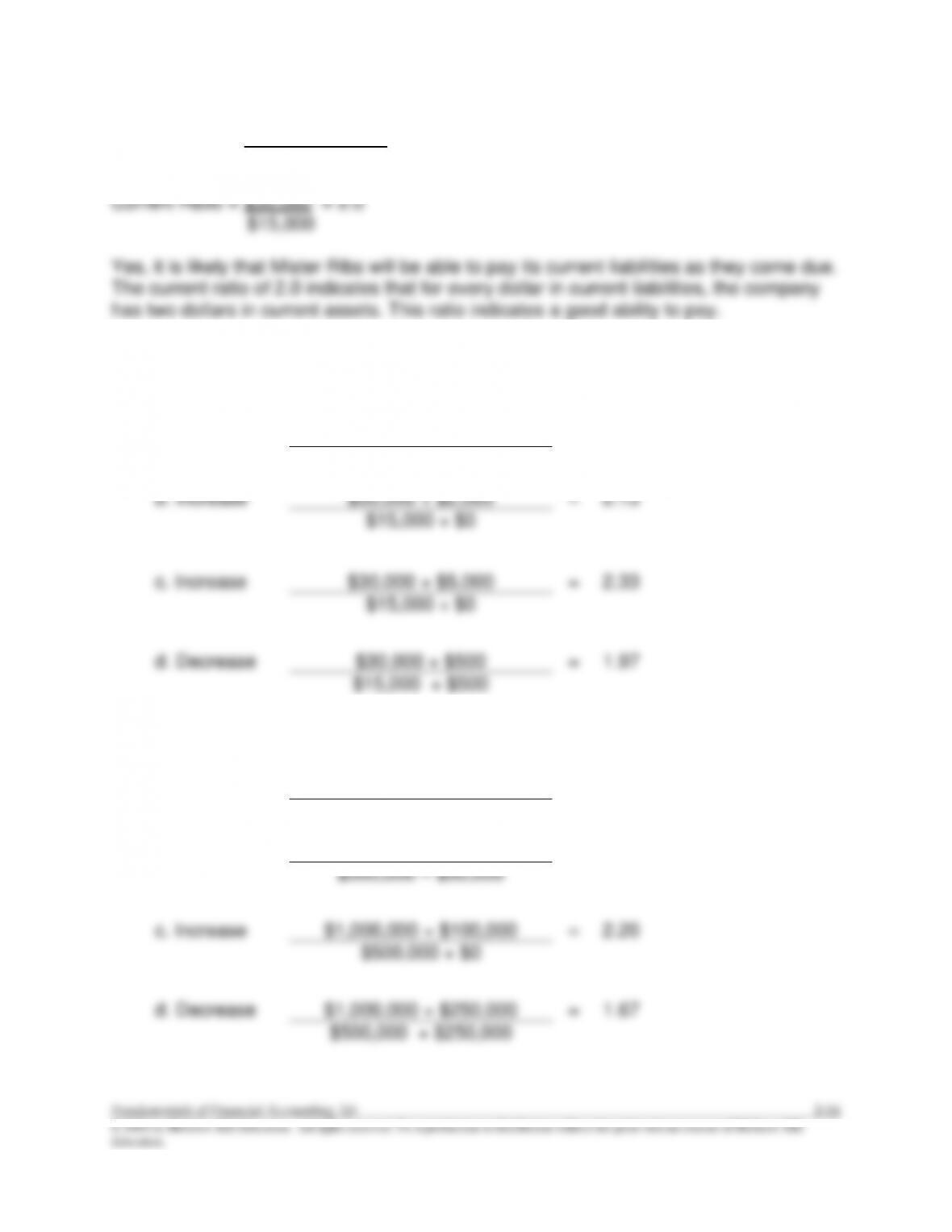
Req. 1 FACEBOOK, INC.
Balance Sheet
At September 30, 2013
(amounts in millions)
Assets
Liabilities
Current Assets
Current Liabilities
Cash
$ 3,100
Accounts Payable
$ 700
Short Term Investments
6,300
Notes Payable (short-term)
300
Prepaid Rent
1,100
Total Current Liabilities
1,000
Total Current Assets
10,500
Note Payable (long-term)
900
Total Liabilities
1,900
Software
1,700
Equipment
2,700
Stockholders’ Equity
Total Non-Current Assets
4,400
Common Stock
10,400
Total Assets
$ 14,900
Retained Earnings
2,600
Total Stockholders’ Equity
13,000
Total Liabilities &
Stockholders’ Equity
$ 14,900
Req. 2
M2–23
Current Ratio = Current Assets
Current Liabilities
M2–24
a. Decrease
$30,000 – $2,000
=
1.87
$15,000 + $0
b. Increase
$30,000 + $2,000
=
2.13
$15,000 + $0
c. Increase
$30,000 + $5,000
=
2.33
$15,000 + $0
d. Decrease
$30,000 + $500
=
1.97
$15,000 + $500
M2–25
a. Decrease
$1,000,000 + $20,000
=
1.96
$500,000 + $20,000
b. Increase
$1,000,000 – $50,000
=
2.11
$500,000 – $50,000
c. Increase
$1,000,000 + $100,000
=
2.20
$500,000 + $0
d. Decrease
$1,000,000 + $250,000
=
1.67
$500,000 + $250,000
© 2016 by McGraw-Hill Education. All rights reserved. No reproduction or distribution without the prior written consent of McGraw-Hill
Education.
ANSWERS TO EXERCISES
E2-2
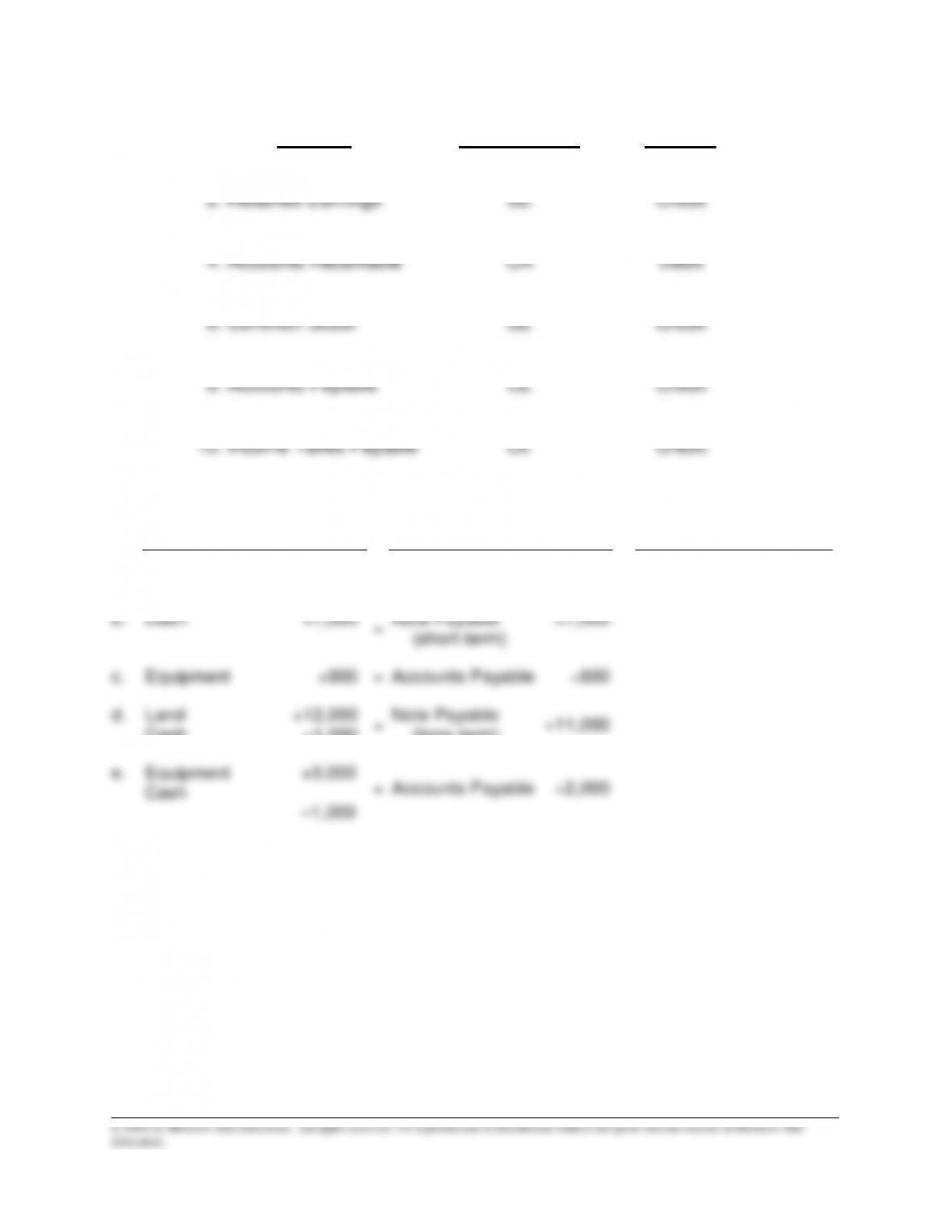
Req. 1
Given
Received
(a)
Note Payable (short-term)
Equipment
(b)
Cash
Equipment
(c)
—
—
No exchange transaction
(d)
Common Stock
Cash
(e)
Cash
Land
(f)
—
—
No company transaction
(g)
Note Payable (short-term)
Cash
(h)
Cash
Note Payable (long-term)
Req. 2
The truck in (b) would be recorded as an asset of $21,000. The land in (e) would be
recorded as an asset of $50,000. These are applications of the cost principle.
Req. 3
The agreement in (c) involves no exchange or receipt of cash, goods, or services and
thus is not a transaction. Because transaction (f) occurs between the owner and others,
the separate entity assumption implies this transaction does not affect the business.
Fundamentals of Financial Accounting, 5/e 2-16
E2-3
Account
Balance Sheet
Classification
Debit or Credit
Balance
1. Land
NCA
Debit
2. Retained Earnings
SE
Credit
3. Note Payable (3 years)
NCL
Credit
4. Accounts Receivable
CA
Debit
5. Supplies
CA
Debit
6. Common Stock
SE
Credit
7. Equipment
NCA
Debit
8. Accounts Payable
CL
Credit
9. Cash
CA
Debit
10. Income Taxes Payable
CL
Credit
E2-4
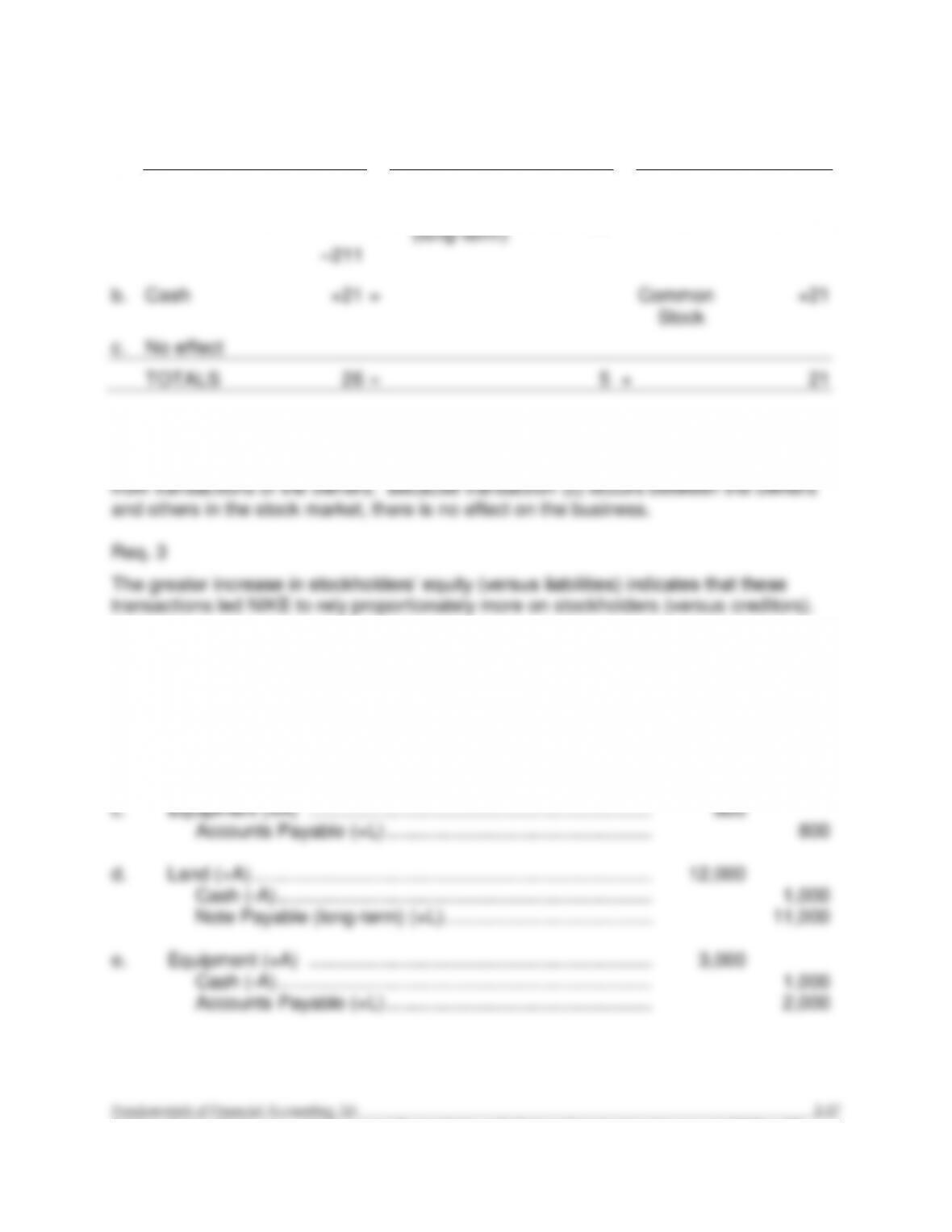
Assets
=
Liabilities
+
Stockholders’ Equity
a.
Cash
+10,000
=
Common
Stock
+10,000
b.
Cash
+7,000
=
Note Payable
(short-term)
+7,000
c.
Equipment
+800
=
Accounts Payable
+800
d.
Land
Cash
+12,000
–1,000
=
Note Payable
(long term)
+11,000
e.
Equipment
Cash
+3,000
–1,000
=
Accounts Payable
+2,000
© 2016 by McGraw-Hill Education. All rights reserved. No reproduction or distribution without the prior written consent of McGraw-Hill
Education.
E2-5
Req. 1
Assets
=
Liabilities
+
Stockholders’ Equity
a.
Equipment
Cash
+216
–211
=
Note Payable
(long–term)
+5
b.
Cash
+21
=
Common
Stock
+21
c.
No effect
TOTALS
26
=
5
+
21
Req. 2
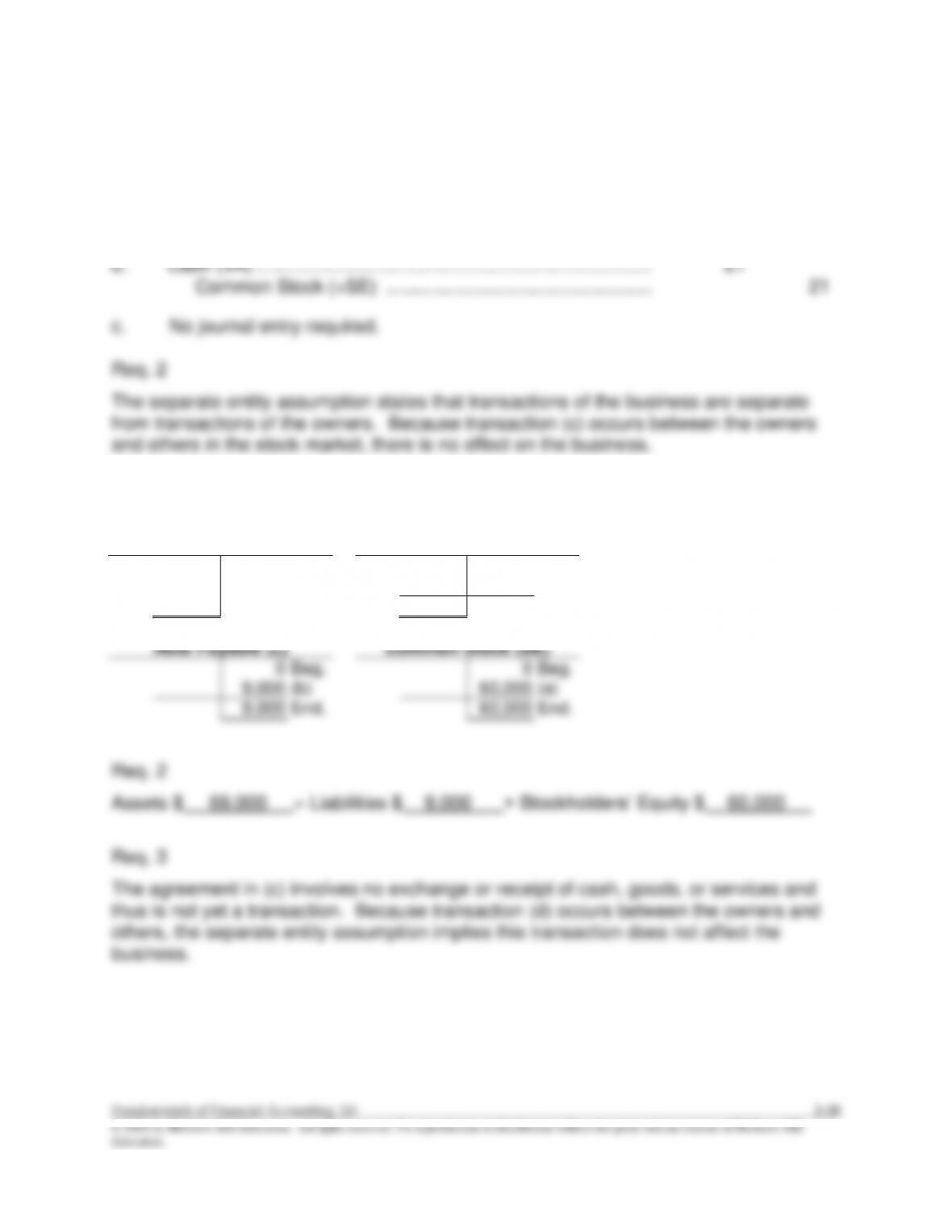
The separate entity assumption states that transactions of the business are separate
E2-6
a.
Cash (+A) ………………………………………………………………….
10,000
Common Stock (+SE) ……………………………………………
10,000
b.
Cash (+A) ………………………………………………………………….
7,000
Note Payable (short-term) (+L) ………………………………..
7,000
c.
Equipment (+A) …………………………………………………………
800
Accounts Payable (+L) ……………………………………………
800
d.
Land (+A) …………………………………………………………………..
12,000
Cash (-A) ………………………………………………………………
1,000
Note Payable (long-term) (+L) ………………………………….
11,000
e.
Equipment (+A) …………………………………………………………
3,000
Cash (-A) ………………………………………………………………
1,000
Accounts Payable (+L) ……………………………………………
2,000
E2-7
Req. 1
a.
Equipment (+A) …………………………………………………………
216
Cash (-A) ………………………………………………………………
211
Note Payable (long-term) (+L) …………………………………
5
b.
Cash (+A) ………………………………………………………………….
21
Common Stock (+SE) ……………………………………………
21
c. No journal entry required.
Req. 2
The separate entity assumption states that transactions of the business are separate
from transactions of the owners. Because transaction (c) occurs between the owners
and others in the stock market, there is no effect on the business.
E2-8
Req. 1
Cash (A)
Equipment (A)
Beg.
0
Beg.
0
(a)
60,000
3,000
(b)
(b)
12,000
End.
57,000
End.
12,000
Note Payable (L)
Common Stock (SE)
0
Beg.
0
Beg.
9,000
(b)
60,000
(a)
9,000
End.
60,000
End.
Req. 2
Assets $ 69,000 = Liabilities $ 9,000 + Stockholders’ Equity $ 60,000
Req. 3
The agreement in (c) involves no exchange or receipt of cash, goods, or services and
thus is not yet a transaction. Because transaction (d) occurs between the owners and
others, the separate entity assumption implies this transaction does not affect the
business.
© 2016 by McGraw-Hill Education. All rights reserved. No reproduction or distribution without the prior written consent of McGraw-Hill
Education.
E2-9
Req. 1
Transaction
Brief Explanation
1
Issued common stock for $12,000 cash.
2
Borrowed $50,000 cash and signed a note for this amount.
3
Purchased equipment for $12,000; paid $4,000 cash and gave an
$8,000 Note Payable for the balance.
4
Borrowed $4,000 cash and signed a note for this amount.
Req. 2
From table:
Cash + Equipment = Note Payable + Common Stock
Ending 62,000 + 12,000 = 62,000 + 12,000
Req. 3
Most of Home Comfort’s financing has come from liabilities. The company has financed
$62,000 of its investment in assets with liabilities and only $12,000 with stockholders’
equity.
E2–10
Req 1:
Assets
=
Liabilities
+
Stockholders’
Equity
(a)
No transaction – no obligation exists until the supplies are received.
(b)
Cash
– 10,000
Note Payable
+ 20,000
Equipment
+ 30,000
(short-term)
(c)
Cash
+ 5,000
Note Payable
(short-term)
+ 5,000
(d)
No transaction – no obligation exists until the manager has worked.
(e)
Cash
+ 10,000
Common
Stock
+10,000
(f)
Supplies
+ 2,000
Accounts
Payable
+ 2,000
+ 37,000
+ 27,000
+10,000
Req 2:
(a)
No transaction
(b)
Equipment (+A)………….. ……………………….
30,000
Cash (-A)…………………………………………
10,000
Note Payable (short-term) (+L)..………………
20,000
(c)
Cash (+A)………………….………………………..
5,000
Note Payable (short-term) (+L)…………………
5,000
(d)
No transaction
(e)
Cash (+A)……………………………………………
10,000
Common Stock (+SE)……………………………
10,000
(f)
Supplies (+A) ………………………………..……..
2,000
Accounts Payable(+L) …………………………..
2,000
Req 3:
Beginning Assets
220,000
Net Change in Assets
+ 37,000
Ending Assets
257,000