
Chapter Outline
Teaching Notes
d. To find ending account balance, express the T-account
as equations:
Start with beginning balance
Add “+” side
Subtract “–” side
Equals ending balance
“Spotlight on Financial
Reporting” feature addresses
the impact of needing extra
time to prepare financial
statements
e. Ending balance is double underscored to distinguish it.
E. SonicGateway’s Accounting Records
(a) Issue Stock to Owners––Scott incorporates
SonicGateway and the company issues common stock to
Scott and Angus as evidence of their contribution of
$10,000 cash, which is deposited in the company’s bank
account.
1. Analyze: Assets = Liabilities + Stockholders’ Equity
Cash (A) +10,000 = Common Stock (SE) +10,000
Refer to illustrations of
transactions (a) through (g)
2. Record:
in textbook for Step 3—
Debit
Credit
Cash (+A)
10,000
Common Stock (+SE)
10,000
Summarize (which includes
posting to T-accounts).
(b) Invest in Equipment––SonicGateway pays $300 cash for
the company’s logo.
1. Analyze: Assets = Liabilities + Stockholders’ Equity
Cash (A) –300; Logo and Trademarks (A) +300 = 0
2. Record:
Debit
Credit
Logo and Trademarks (+A)
300
Cash (–A)
300
(c) Obtain Loan from Bank––SonicGateway borrows
$20,000 from a bank and signs a formal agreement to
repay the loan in two years (on September 1, 2017).
1. Analyze: Assets = Liabilities + Stockholders’ Equity
Cash (A) +20,000 = Note Payable (long-term) (L)
+20,000
2. Record:
Debit
Credit
Cash (+A)
20,000
Note Payable (long-term) (+L)
20,000
(d) Invest in Equipment––SonicGateway purchases and
receives $9,600 in computers, printers, and desks, signing
a purchase order to indicate its promise to pay $9,600 at
the end of the month.
1. Analyze: Assets = Liabilities + Stockholders’ Equity
Equipment (A) +9,600 = Accounts Payable +9,600
2. Record:
Debit
Credit
Equipment (+A)
9,600
Accounts Payable (+L)
9,600
Chapter Outline
Teaching Notes
(e) Pay Supplier––SonicGateway pays $5,000 to the
equipment supplier in (d).
1. Analyze: Assets = Liabilities + Stockholders’ Equity
Cash –5,000 = Accounts Payable –5,000
2. Record:
Debit
Credit
Accounts Payable (–L)
5,000
Cash (–A)
5,000
(f) Order Software for App––SonicGateway signs a contract
with a programmer for program code for the Static
Charge game app for $9,000. No code has been received
yet.
1. Analyze: Assets = Liabilities + Stockholders’ Equity
No change = No change
2. Record––No journal entry is needed.
(g) Receive Software––SonicGateway receives the $9,000 of
app game code ordered in (f); pays $4,000 cash, and
promises to pay the remaining $5,000 next month.
1. Analyze: Assets = Liabilities + Stockholders’ Equity
Cash (A) –4,000 + Software (A) +9,000 = Accounts
Payable (L) +5,000
2. Record:
Debit
Credit
Software (+A)
9,000
Cash (–A)
4,000
Accounts Payable (+L)
5,000
(h) Receive Supplies––SonicGateway receives supplies
costing $600 on account.
1. Analyze:
Assets = Liabilities + Stockholders’ Equity
Supplies (A) +600 = Accounts Payable (L) +600
2. Record:
Debit
Credit
Supplies (+A)
600
Accounts Payable (+L)
600
LO 2-4 Prepare a trial balance and a classified balance sheet.
F. Preparing a Trial Balance and a Balance Sheet
✓ Activity #6
1. The trial balance lists the ending balance in every T-
account and then computes total debits and total credits;
when the column totals are equal, a balance sheet can be
prepared.
2. Classified balance sheet––A balance sheet that shows a
subtotal for current assets and current liabilities.
a. Current assets––To be used up or converted into cash
within 12 months of the balance sheet date.

Chapter Outline
Teaching Notes
b. Current liabilities––Debts and obligations that will
be paid, settled, or fulfilled within 12 months of the
balance sheet date.
c. Noncurrent (or long-term)––Assets and liabilities
that do not meet the definition of current.
III. Evaluate the Results
LO 2-5 Interpret the balance sheet using the current ratio and an understanding of related
concepts.
A. Assessing the Ability to Pay
1. The classified balance sheet format makes it easy to see
whether current assets are sufficient to pay current
liabilities.
The “Spotlight on Financial
Reporting” feature explains
how analysts reacted to
2. The only problem with this approach is that looking at
total dollar amounts can be awkward, especially if we
want to compare across several companies.
Facebook’s high current ratio
and Expedia’s low current
ratio
3. Current Ratio
✓ Activity #7
a. Current assets divided by current liabilities.
b. Used to evaluate the ability to pay liabilities as they
come due in the short run.
c. Generally speaking, a high ratio suggests good
liquidity.
B. Balance Sheet Concepts and Values
1. Some mistakenly believe that the balance sheet reports
what a business is actually worth.
2. In fact, net worth is a term that many accountants and
analysts use when referring to stockholders’ equity.
3. The answer comes from knowing that accounting is based
on recording and reporting transactions:
a. What is (and is not) recorded?
i. Only measurable exchanges are recorded.
ii. Items not acquired in an exchange are not listed on
the balance sheet.
b. What amounts are assigned to recorded items?
i. Following the cost principle, assets and liabilities
are first recorded at cost, which is their cash
equivalent value on the date of the transaction;
later, if an asset’s value:
• Increases––The increase is generally not
recorded under GAAP
• Falls––It is generally reported at that lower
value.
ii. Thus, the amount reported on the balance sheet
may not be the asset’s current value.

Chapter Outline
Teaching Notes
C. A Review of the Accounting Cycle
Summarized in Exhibit 2.15
1. During the accounting period, transactions take place.
a. Picture the documented activity.
b. Name what’s exchanged.
c. Analyze the financial effects.
d. Record a journal entry.
e. Summarize in T-accounts.
2. At the end of accounting period:
a. Prepare a trial balance.
b. Adjust the accounts.
Covered in Chapter 4
c. Prepare financial statements from the trial balance and
distribute to users. (Because the company does not
report any operations here, it prepares only the
balance sheet.)
d. Close the books
Covered in Chapter 4

Supplemental Enrichment Activities
Note: These activities would be suitable for individual or group activities.
1. Handout 2–1
Use this handout for an in-class activity designed to review the analysis of various business
transactions that affect the balance sheet. The solution follows the handout master.
2. Handout 2–2
This activity is a continuation of Activity #1. Use this handout for an in-class activity designed to
continue the review of the analysis of various business transactions that affect the balance sheet. The
solution follows the handout master.
3. Handout 2–3
Use Handout 2-3 for an in-class activity designed to review the debit/credit framework. Note that
these transactions are the same as those analyzed on Handout 2-1. However, it can be assigned even if
Activity #1 was not assigned. The solution follows the handout master.
4. Handout 2–4
This activity is a continuation of Activity #3. Use this handout for an in-class activity designed to
review the debit/credit framework. Note that these transactions are the same as those analyzed on
Handout 2–2. However, it can be assigned even if Activity #2 was not assigned. The solution follows
the handout master.
5. Handout 2–5
Use this handout for an in-class activity designed to review the posting of various balance sheet
transactions to T-accounts. This activity is a continuation of Activity #3 and Activity #4; it should be
assigned only if both of those activities were assigned. The solution follows the handout master.
6. Handout 2–6
Use this handout for an in-class activity designed to review the preparation of a trial balance and a
classified balance sheet. This activity is a continuation of Activity #5; it should be assigned only if
that activity was assigned. The solution follows the handout master.
7. Use Handout 2–7
Use this handout for an in-class activity designed to review the calculation and interpretation of the
current ratio. This activity is a continuation of Activity #6; it should be assigned only if that activity
was assigned. The solution follows the handout master.
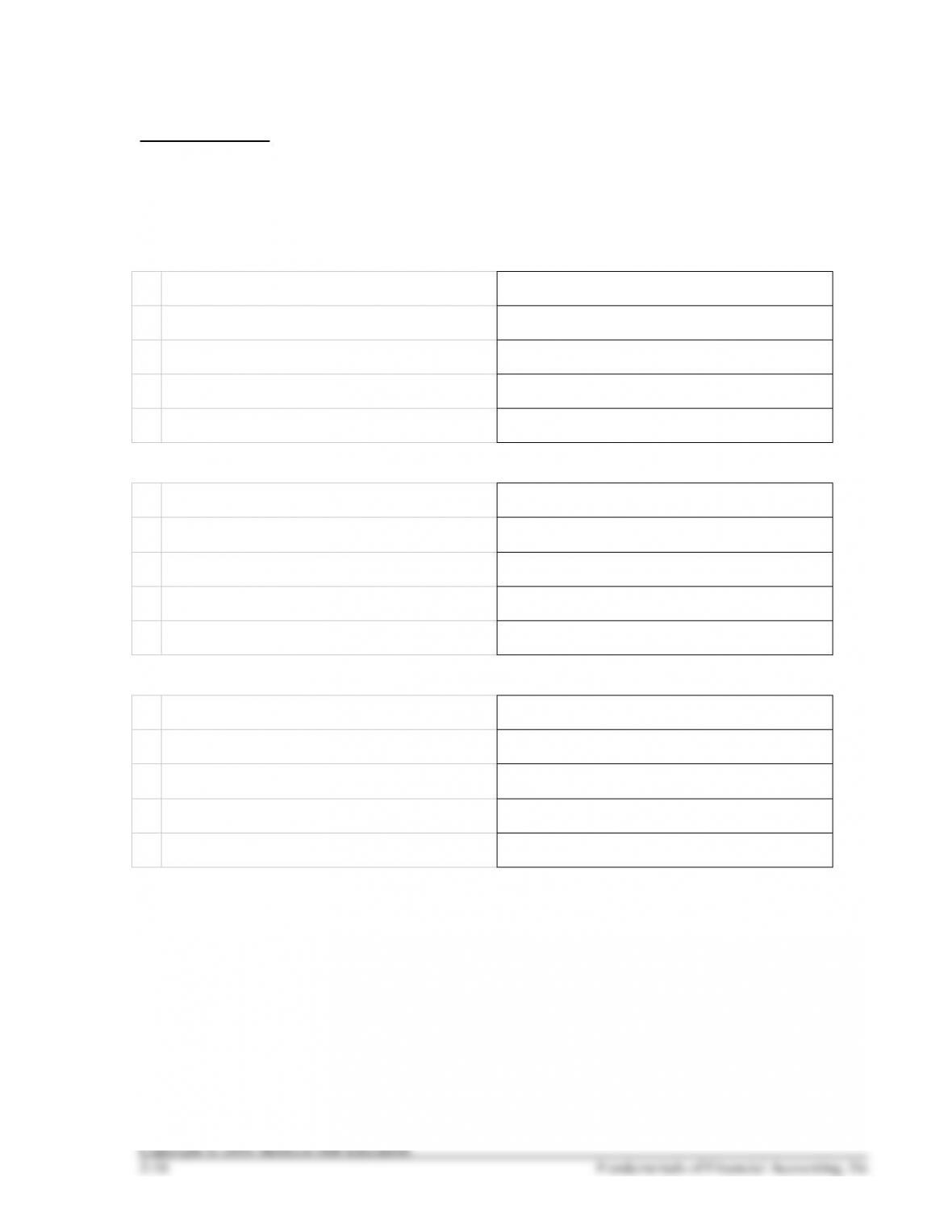
HANDOUT 2–1
ANALYZING TRANSACTIONS
Analyze each of the following transactions by answering each of the questions. Use the spreadsheet on
the following page to keep track of the amount in each account:
(a) Stockholder invests $10,000 into the business in exchange for common stock.
1.
Does a transaction exist?
2.
Examine it for accounts affected.
3.
Classify each account affected.
4.
Identify direction and amount.
5.
Ensure the equation still balances.
(b) Company borrows $15,000 signing a note payable to the bank that is due in three months.
1.
Does a transaction exist?
2.
Examine it for accounts affected.
3.
Classify each account affected.
4.
Identify direction and amount.
5.
Ensure the equation still balances.
(c) Receives and pays for a $15,000 truck and $5,000 of equipment.
1.
Does a transaction exist?
2.
Examine it for accounts affected.
3.
Classify each account affected.
4.
Identify direction and amount.
5.
Ensure the equation still balances.
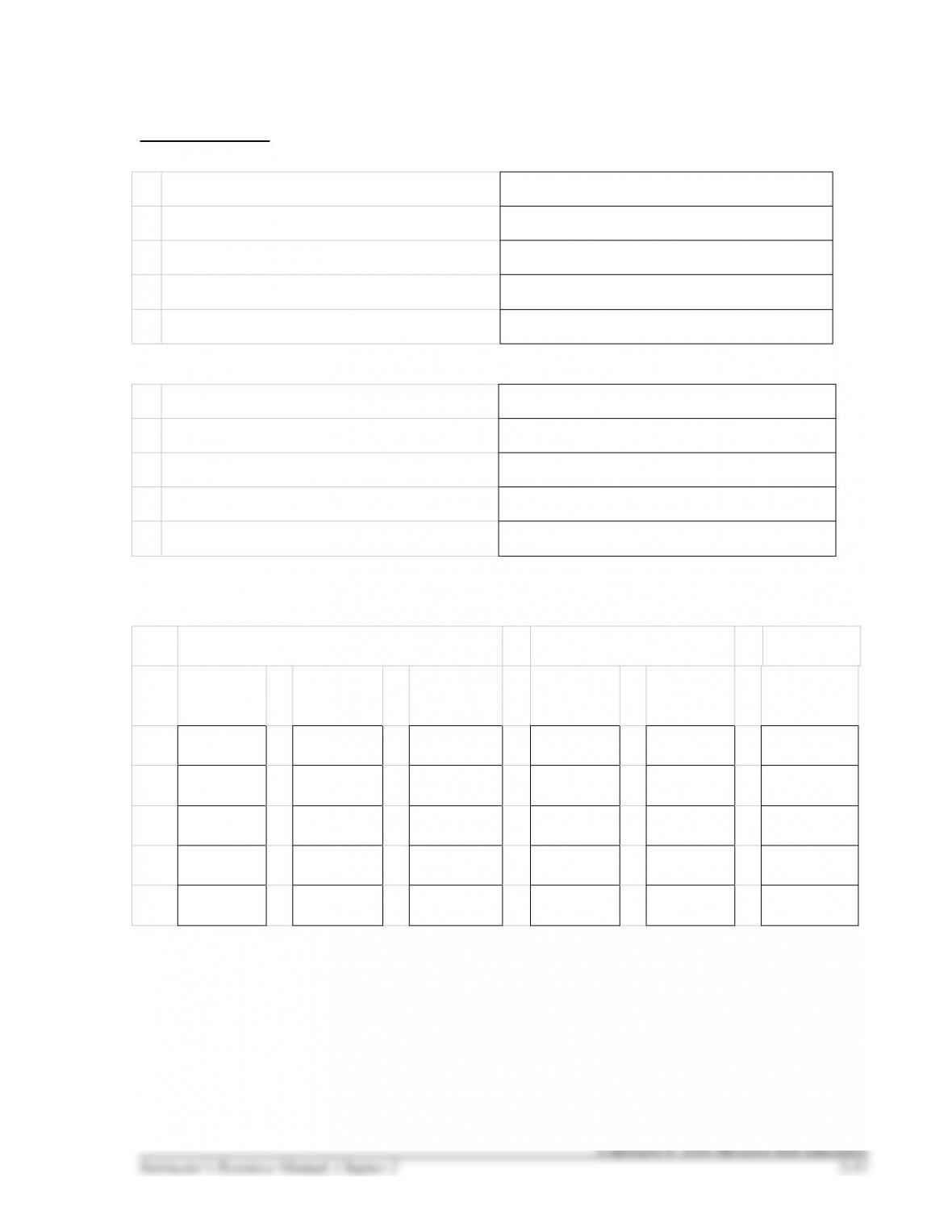
HANDOUT 2–1, continued
(d) Purchases $300 of supplies on account.
1.
Does a transaction exist?
2.
Examine it for accounts affected.
3.
Classify each account affected.
4.
Identify direction and amount.
5.
Ensure the equation still balances.
(e) Signs contract for first website design for $10,000.
1.
Does a transaction exist?
2.
Examine it for accounts affected.
3.
Classify each account affected.
4.
Identify direction and amount.
5.
Ensure the equation still balances.
Spreadsheet
Assets
=
Liabilities
+
SE
Ref.
Cash
+
Supplies
+
Property,
Plant &
Equipment
=
Accounts
Payable
+
Notes
Payable
+
Common
Stock
(a)
(b)
(c)
(d)
(e)

HANDOUT 2–1 SOLUTION, continued
ANALYZING TRANSACTIONS
Analyze each of the following transactions by answering each of the questions. Use the spreadsheet on
the following page to keep track of the amount in each account:
(a) Stockholder invests $10,000 into the business in exchange for common stock.
1.
Does a transaction exist?
Yes—received cash and gave stock.
2.
Examine it for accounts affected.
Cash and Common Stock
3.
Classify each account affected.
Cash is an Asset (A) and Common Stock is
Stockholders’ Equity (SE)
4.
Identify direction and amount.
Cash (A) + $10,000 = Stockholders’ Equity (SE) +
$10,000.
5.
Ensure the equation still balances.
Yes—see below.
(b) Company borrows $15,000 signing a note payable to the bank that is due in three months.
1.
Does a transaction exist?
Yes—received cash and gave a note payable.
2.
Examine it for accounts affected.
Cash and Notes Payable
3.
Classify each account affected.
Cash is an Asset (A) and Notes Payable is a Liability (L)
4.
Identify direction and amount.
Cash (A) + $15,000 = Notes payable + $15,000.
5.
Ensure the equation still balances.
Yes—see below.
(c) Receives and pays for a $15,000 truck and $5,000 of equipment.
1.
Does a transaction exist?
Yes—paid cash and received truck and equipment.
2.
Examine it for accounts affected.
Cash and Equipment
3.
Classify each account affected.
Cash is an Asset (A) and Equipment is an Asset (A)
4.
Identify direction and amount.
Cash (A) − $20,000 and Equipment (A) + 20,000
5.
Ensure the equation still balances.
Yes—see below.
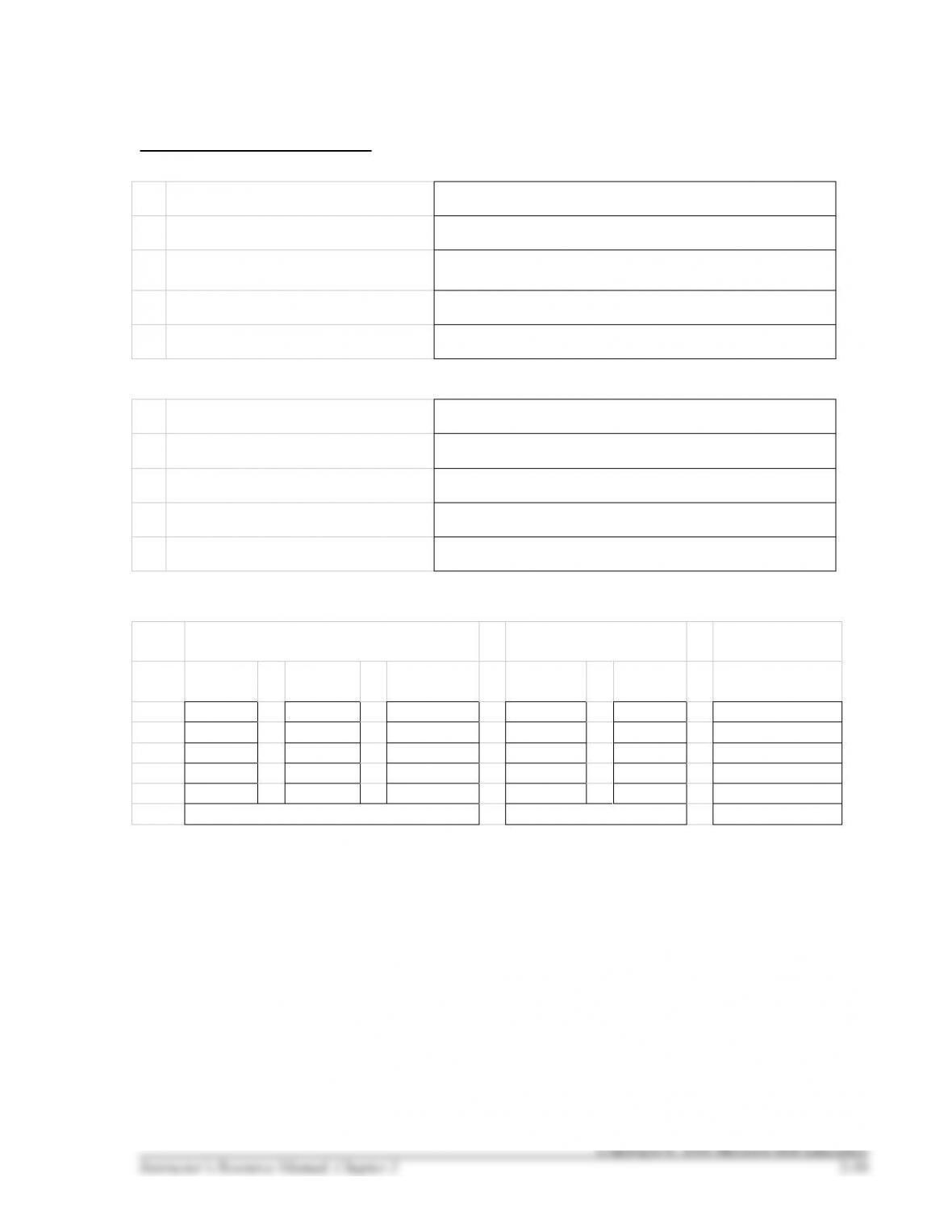
HANDOUT 2–1 SOLUTION, continued
(d) Purchases $300 of supplies on account.
1.
Does a transaction exist?
Yes—received supplies and obligated to pay for them.
2.
Examine it for accounts affected.
Supplies and Accounts Payable
3.
Classify each account affected.
Supplies is an Asset (A) and Accounts Payable is a
Liability (L)
4.
Identify direction and amount.
Supplies (A) + $300 and Accounts Payable (L) + $300.
5.
Ensure the equation still balances.
Yes—see below.
(e) Signs contract for first website design for $10,000.
1.
Does a transaction exist?
No—no exchange took place.
2.
Examine it for accounts affected.
3.
Classify each account affected.
4.
Identify direction and amount.
5.
Ensure the equation still balances.
Spreadsheet
Assets
=
Liabilities
+
Stockholders’
Equity
Ref.
Cash
+
Supplies
+
Equipment
=
Accounts
Payable
+
Notes
Payable
+
Common Stock
(a)
+10,000
=
+10,000
(b)
+15,000
=
+15,000
(c)
–20,000
+20,000
=
(d)
+300
=
+300
Total
5,000
300
20,000
300
15,000
10,000
$25,300
$15,300
$10,000
HANDOUT 2–2
ANALYZING TRANSACTIONS
Analyze the following transactions as set forth below. Use the spreadsheet on the next page to keep track
of the amount in each account:
(f) Pays $300 to the supplier in (d).
1.
Does a transaction exist?
2.
Examine it for accounts affected.
3.
Classify each account affected.
4.
Identify direction and amount.
5.
Ensure the equation still balances.
(g) Purchases and pays for $600 of supplies.
1.
Does a transaction exist?
2.
Examine it for accounts affected.
3.
Classify each account affected.
4.
Identify direction and amount.
5.
Ensure the equation still balances.
(h) Purchases and pays for equipment costing $1,000.
1.
Does a transaction exist?
2.
Examine it for accounts affected.
3.
Classify each account affected.
4.
Identify direction and amount.
5.
Ensure the equation still balances.
(i) Orders a $900 lawn mower, to be delivered next month.
1.
Does a transaction exist?
2.
Examine it for accounts affected.
3.
Classify each account affected.
4.
Identify direction and amount.
5.
Ensure the equation still balances.