E12–3
Req. 1
Cash ( ……………………………………………………………
325
Service Revenue ………………………………….
325
Salaries and Wages Payable …………………………..
Salaries and Wages Expense …………………………
15
85
Cash ………………………………………………….
100
Req. 2
The $225 increase in cash ($325 – $100) should be reported as net cash inflow from
operating activities.
Req. 3
The $325 of service revenue would be included along with salaries and wages expense
of $85, for a net income of $240.
Req. 4
Net income $240
Subtract: Decrease in wages payable (15)
Net cash flow from operating activities $225
The $15 is deducted because the salaries and wages paid in cash were $15 more than
the $85 salaries and wages expense already deducted from net income.
Req. 5
This simple example reveals a general rule: any time salaries and wages payable
decreases, subtract that decrease to convert net income to cash flow from operating
activities.
E12–4
Req. 1
Cash ( ……………………………………………………………
Accounts Receivable ………………………………………
120
30
Service Revenue ………………………………….
150
Depreciation Expense …………………………..………..
50
Accumulated Depreciation–Equipment …….
50
Req. 2
E12–5
Req. 1
Cash ( ……………………………………………………………
Accounts Receivable ………………………………………
200
100
Cost of Goods Sold ………………………………………..
125
Sales Revenue …………………………..………..
300
Inventory ……………………………………………..
125
Salaries and Wages Expense ………………………….
70
Cash ……………………………………………………
30
Salaries and Wages Payable ………………….
40
Req. 2
Net cash flow from operating activities would be $170, which equals the $200 received
from customers minus the $30 paid to employees.
Req. 3
Net income would be $105, which equals $300 of sales revenue minus expenses for
cost of goods sold ($125) and salaries and wages expense ($70).
Req. 4
Net income $105
Subtract: Increase in accounts receivable (100)
Add: Decrease in inventory 125
Add: Increase in salaries and wages payable 40
Net cash flow from operating activities $170
The $100 is deducted because net income includes the full $300 of sales revenue, yet
only $200 cash was received. The $100 difference is the amount that is “stuck” in
accounts receivable (and has not yet been received as cash). The $125 is added in the
calculation because it had been deducted when computing net income, but it did not
affect cash this period, so it must be added back. The $40 is added back because
salary and wages of $70 were subtracted when calculating net income, yet only $30
cash was actually paid out.
Req. 5
This simple example reveals three general rules to convert net income to cash flow from
operating activities: subtract increases in noncash current assets, add back decreases
in noncash current assets, and add increases in current liabilities.
E12–6
Req. 1
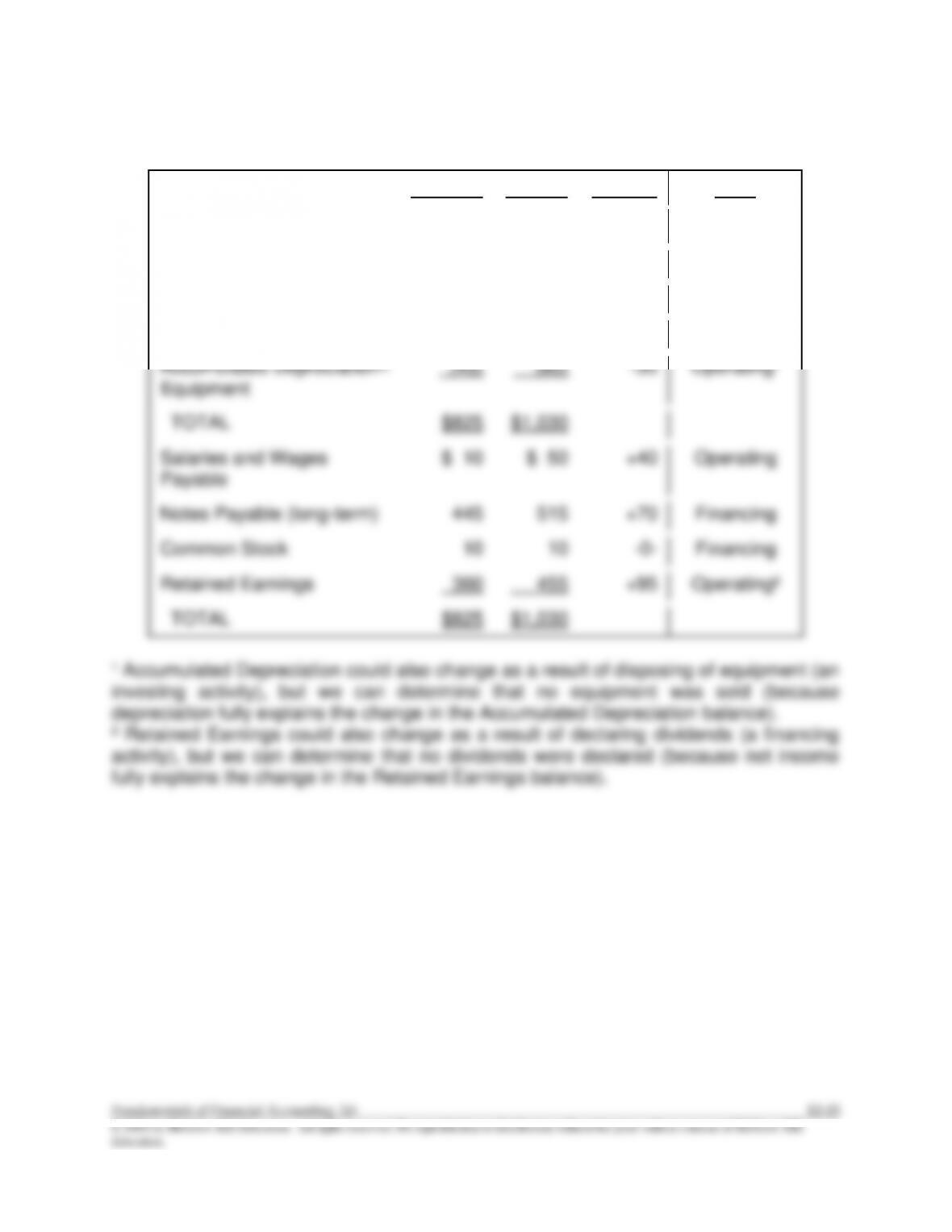
Cash Flows from Operating Activities
Net income $160
Subtract: Increase in accounts receivable (100)
E12–7
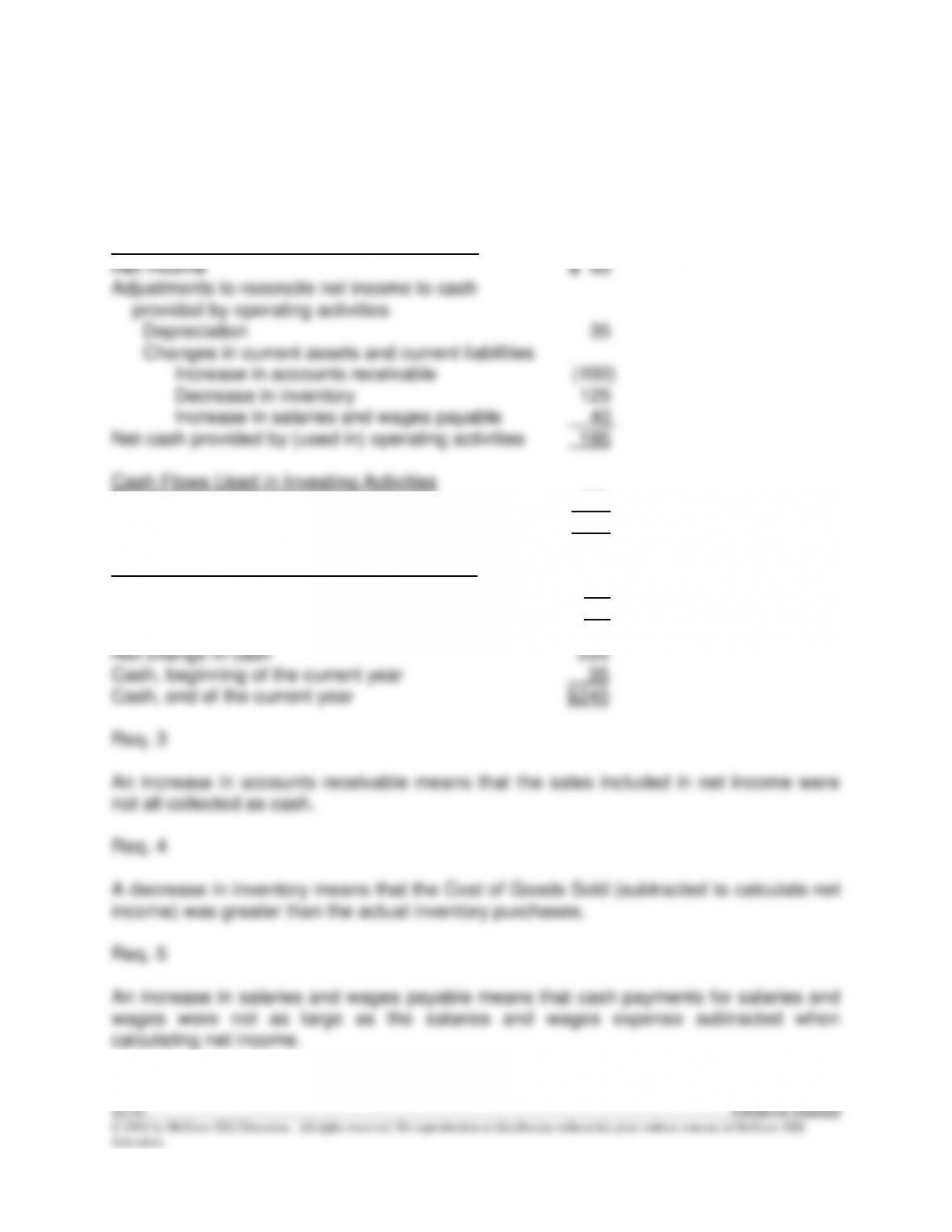
Req. 1
Previous
Current
Change
Type
Cash
$ 35
$240
+205
Cash
Accounts Receivable
75
175
+100
Operating
Inventory
260
135
–125
Operating
Equipment
500
560
+60
Investing
Accumulated Depreciation–
Equipment
(45)
(80)
–35
Operating¹
TOTAL
$825
$1,030
Salaries and Wages
Payable
$ 10
$ 50
+40
Operating
Notes Payable (long-term)
445
515
+70
Financing
Common Stock
10
10
-0-
Financing
Retained Earnings
360
455
+95
Operating²
TOTAL
$825
$1,030
¹ Accumulated Depreciation could also change as a result of disposing of equipment (an
investing activity), but we can determine that no equipment was sold (because
depreciation fully explains the change in the Accumulated Depreciation balance).
² Retained Earnings could also change as a result of declaring dividends (a financing
activity), but we can determine that no dividends were declared (because net income
fully explains the change in the Retained Earnings balance).
E12–7 (continued)
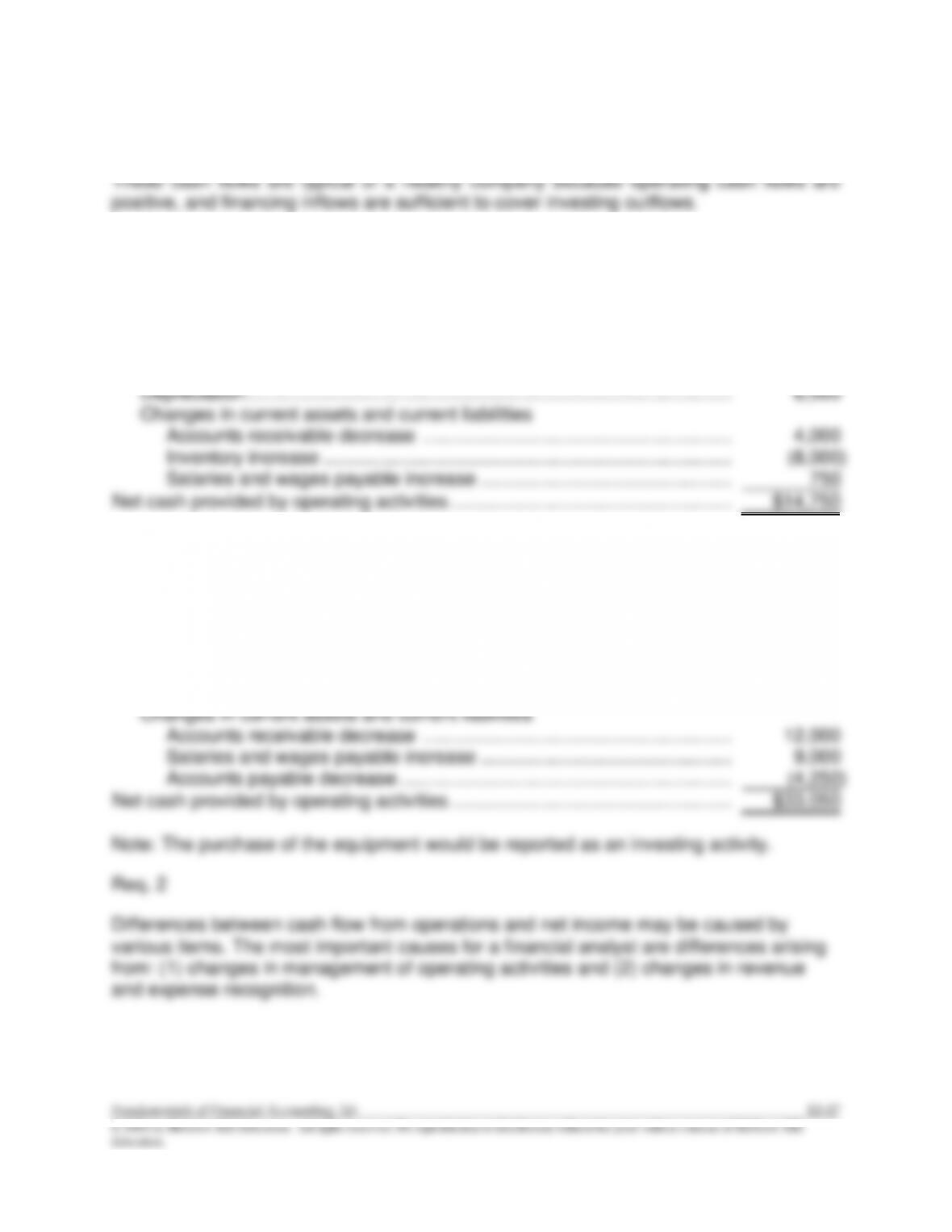
Req. 2 Goggle Company
Statement of Cash Flows
For the Year Ended December 31
Cash Flows Provided by Operating Activities
Equipment purchased (60)
Net cash provided by (used in) investing activities (60)
Cash Flows Provided by Financing Activities
Obtained bank loan 70
Net cash provided by (used in) financing activities 70
E12–7 (continued)
Req. 6
E12–8
Cash flows from operating activities—indirect method
Net income …………………………..…………………………………………………………..
$12,000
Adjustments to reconcile net income to cash provided by operating activities
Depreciation…………………………………………………………………………………
6,000
Changes in current assets and current liabilities
Accounts receivable decrease …………………………………………………..
4,000
Inventory increase ……………………………………………………………………
(8,000
)
Salaries and wages payable increase …………………………………………
750
Net cash provided by operating activities ………………………………………………
$14,750
E12–9
Req. 1
Cash flows from operating activities—indirect method
Net income …………………………..…………………………………………………………..
$9,000
Adjustments to reconcile net income to cash provided by operating activities
Depreciation…………………………………………………………………………………
7,300
Changes in current assets and current liabilities
Accounts receivable decrease …………………………………………………..
12,000
Salaries and wages payable increase …………………………………………
9,000
Accounts payable decrease ……………………………………………………….
(4,250
)
Net cash provided by operating activities ………………………………………………
$33,050
E12–10
Req. 1
Cash flows from operating activities—indirect method (in thousands)
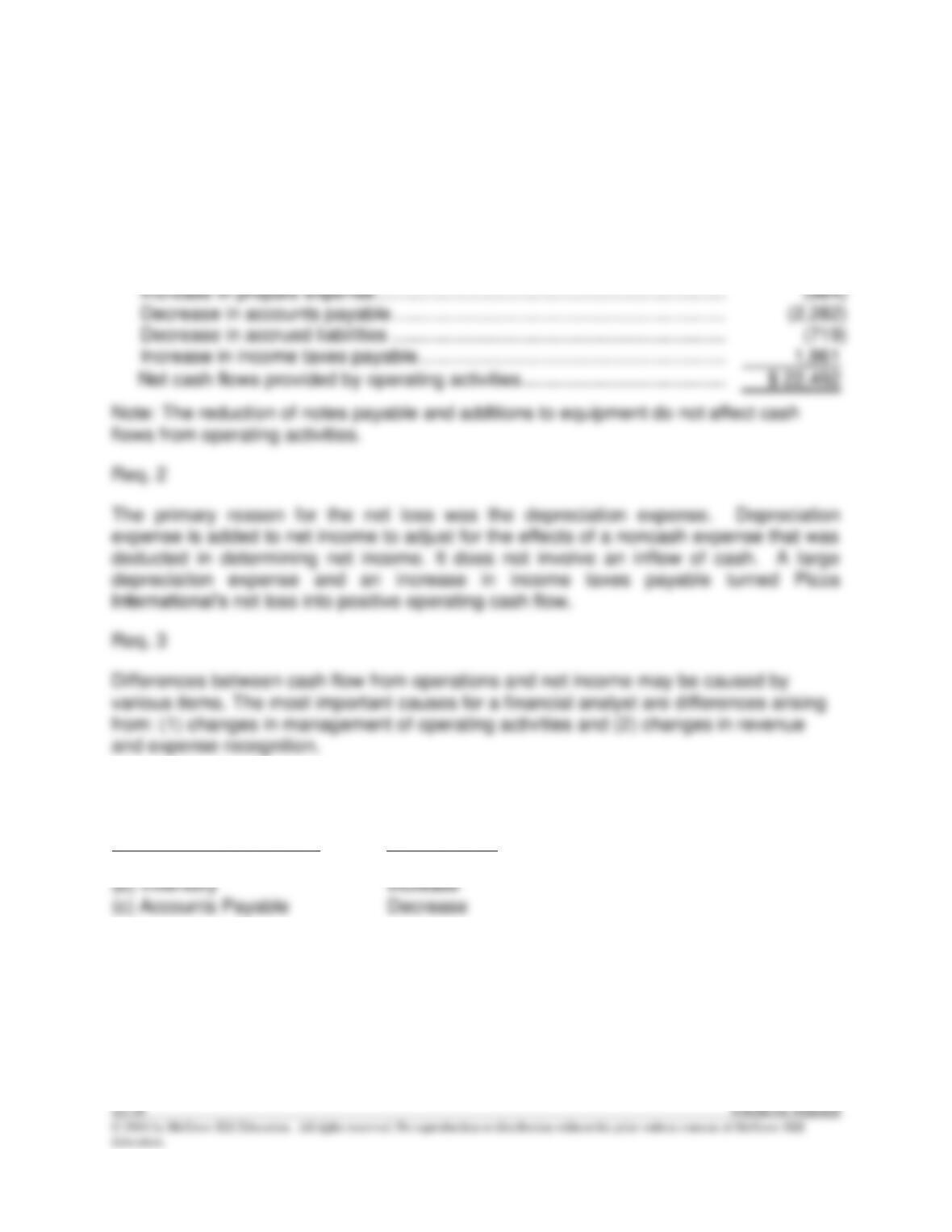
Net loss ………………………………………………………………………………………
$ (9,482
)
Depreciation………………………………………………………………………………..
33,305
Increase in accounts receivable ……………………………………………………..
(170
)
Decrease in inventory …………………………………………………………………..
643
Increase in prepaid expense ………………………………………………………….
(664
)
Decrease in accounts payable ……………………………………………………….
(2,282
)
Decrease in accrued liabilities ……………………………………………………….
(719
)
Increase in income taxes payable …………………………………………………..
1,861
Net cash flows provided by operating activities …………………………………
$ 22,492
E12–11
Account
Change
(a) Accounts Receivable
Decrease
(b) Inventory
Increase
(c) Accounts Payable
Decrease
E12–12
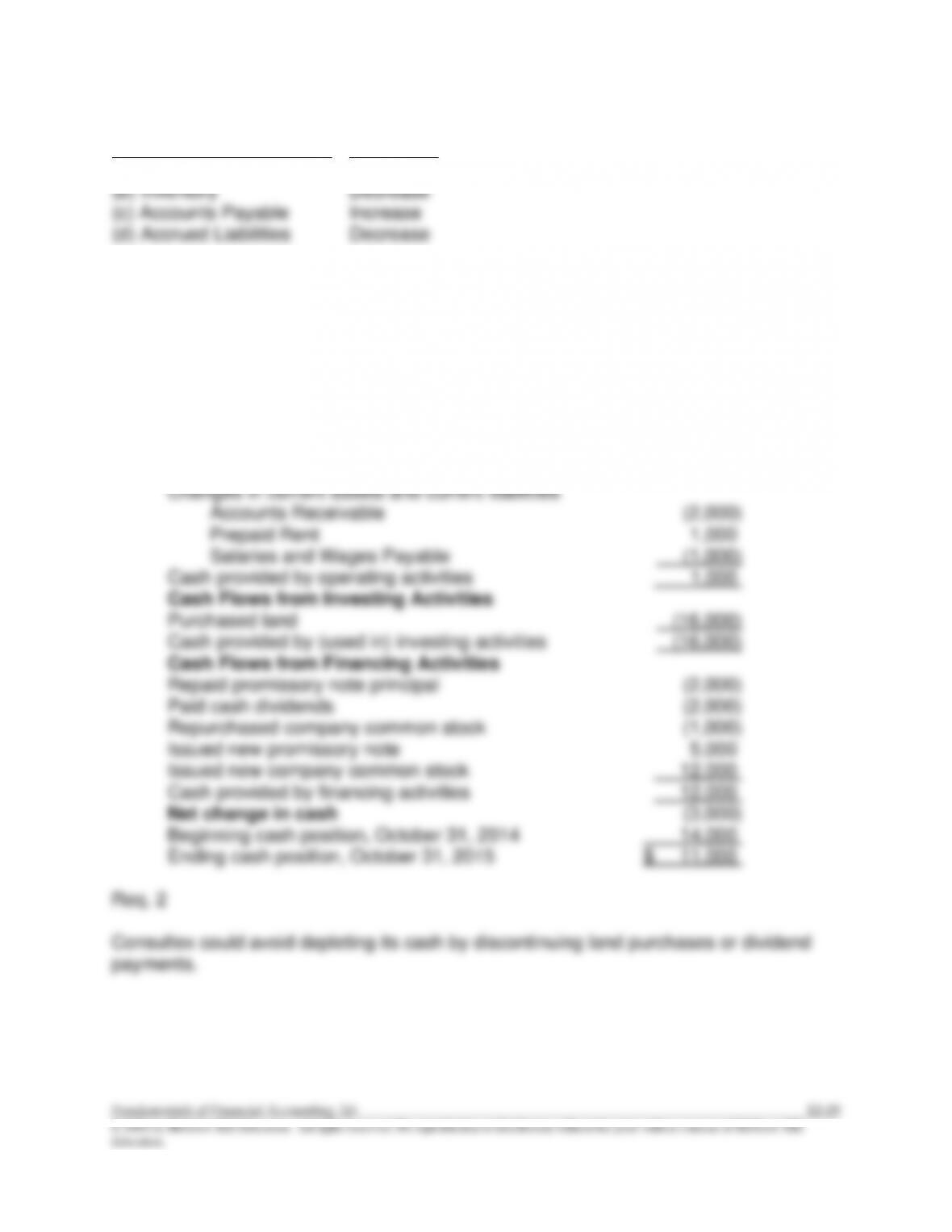
Account
Change
(a) Accounts Receivable
Increase
(b) Inventory
Decrease
(c) Accounts Payable
Increase
(d) Accrued Liabilities
Decrease
E12–13
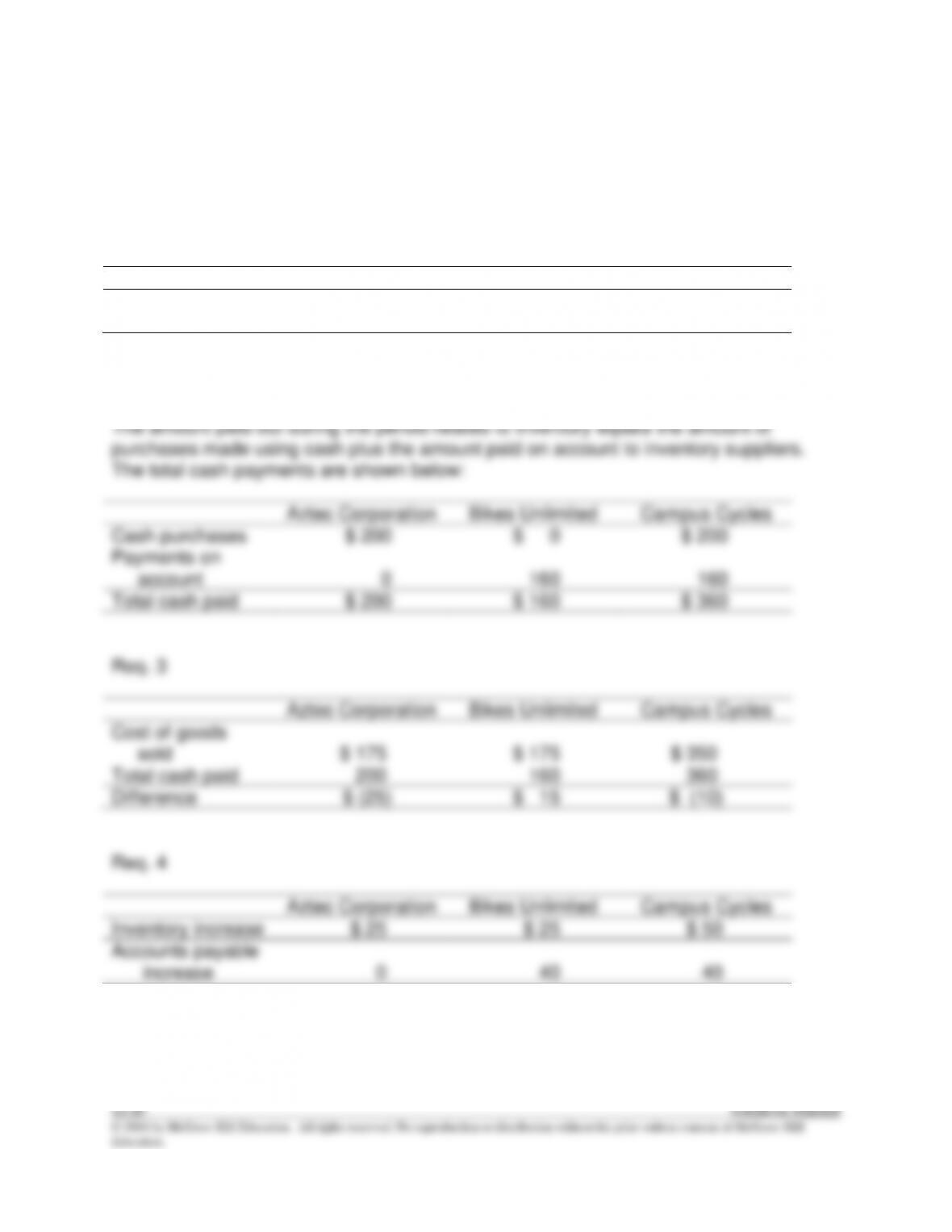
Req. 1 CONSULTEX, INC.
Statement of Cash Flows
For the Year Ended October 31, 2015
Cash Flows from Operating Activities
Net income $ 3,000
E12–14
Req. 1
The amount deducted on the income statement related to inventory is reported as cost
of goods sold. These amounts are shown below.
Aztec Corporation
Bikes Unlimited
Campus Cycles
Cost of goods
sold
$ 175
$ 175
$ 350
Req. 2
Aztec Corporation
Bikes Unlimited
Campus Cycles
Cash purchases
$ 200
$ 0
$ 200
Payments on
account
0
160
160
Total cash paid
$ 200
$ 160
$ 360
$ 175
$ 175
$ 350
Total cash paid
160
360
Difference
$ (25)
$ 15
Inventory increase
$ 25
$ 25
$ 50
Accounts payable
0
40
40