Chapter 12
1. The income statement reports revenues earned and expenses incurred during a
period of time. It is prepared on an accrual basis. The balance sheet reports the
2. The statement of cash flows reports cash receipts and cash payments from three
broad categories of business activities: operating, investing, and financing. While
the income statement reports operating activities, it reports them on the accrual
basis: revenues when earned, and expenses when incurred, regardless of the
3. Cash equivalents are short-term, highly liquid investments that are purchased
within three months of the maturity date. The statement of cash flows does not
4. The major categories of business activities reported on the statement of cash flows
are operating, investing, and financing activities. Operating activities of a business
5. Cash inflows from operating activities include cash sales, collections on accounts
and notes receivable arising from sales, dividends received on investments, and
6. The two methods of reporting cash flows from operating activities are the direct
method and the indirect method. The direct method reports the gross amounts of
cash receipts and cash payments arising from the revenues and expenses reported
of cash.
8. Cash expenditures for purchases and salaries and wages are not specifically
reported on a statement of cash flows prepared using the indirect method because
9. The $50,000 increase in inventory must be used in the statement of cash flows
calculations because it increases the outflow of cash (all else equal). Under the
10. Pressuring customers to pay overdue accounts could have a beneficial effect of
increasing cash flows from operations and reducing the extent of bad debts.
However, it might not yield sufficient cash flows and it might harm relationships with
those customers and jeopardize future sales. Delaying payment of accounts
11. The operating cash flow impact of increasing sales, receivables, and inventory,
depends on their relative dollar amounts. Generally speaking, sales increases
12. Cash inflows from investing activities include cash received from sale of
equipment, sale or maturity value of investments, and principal collections on non–
13. Cash inflows from financing activities include cash received from issuing stock and
14. Noncash investing and financing activities are activities that would normally be
classified as investing or financing activities, except no cash was received or paid.
15. When equipment is sold, it is considered an investing activity, and any cash
received is reported as a cash inflow from investing activities. When using the
indirect method, the gain on sale of equipment must be reported as a deduction
from net income, because the gain was included in net income, but did not provide
any cash from operating activities.
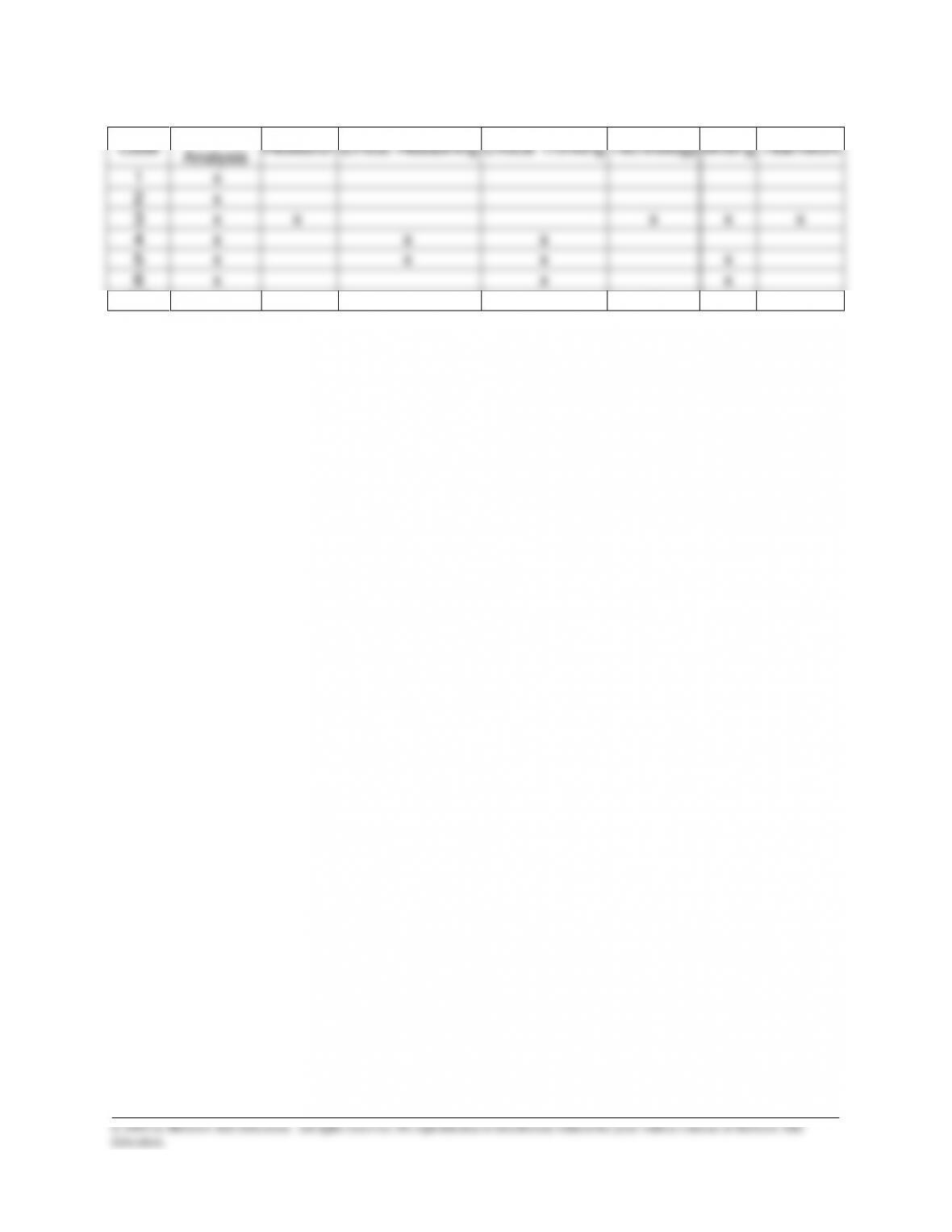
Authors’ Recommended Solution Time
(Time in minutes)
Mini-exercises
Exercises
Problems
Skills
Development
Cases*
Continuing
Case
No.
Time
No.
Time
No.
Time
No.
Time
No.
Time
1
5
1
10
CP1
15
1
10
1
20
2
5
2
10
CP2
30
2
10
2
5
3
5
3
12
CP3
50
3
30
4
5
4
12
CP4
30
4
25
5
8
5
15
CP5
30
5
25
6
8
6
15
CP6
30
6
20
7
5
7
20
CP7
35
7
30
8
5
8
15
PA1
15
8
30
9
5
9
20
PA2
30
9
20
10
6
10
20
PA3
50
11
5
11
10
PA4
30
12
5
12
15
PA5
30
13
5
13
25
PA6
30
14
20
PA7
35
15
20
PB1
15
16
25
PB2
30
17
20
PB3
50
18
20
PB4
30
19
20
PB5
30
20
20
PB6
30
21
20
22
20
23
40
* Due to the nature of cases, it is very difficult to estimate the amount of time students
Fundamentals of Financial Accounting, 5/e 12-5
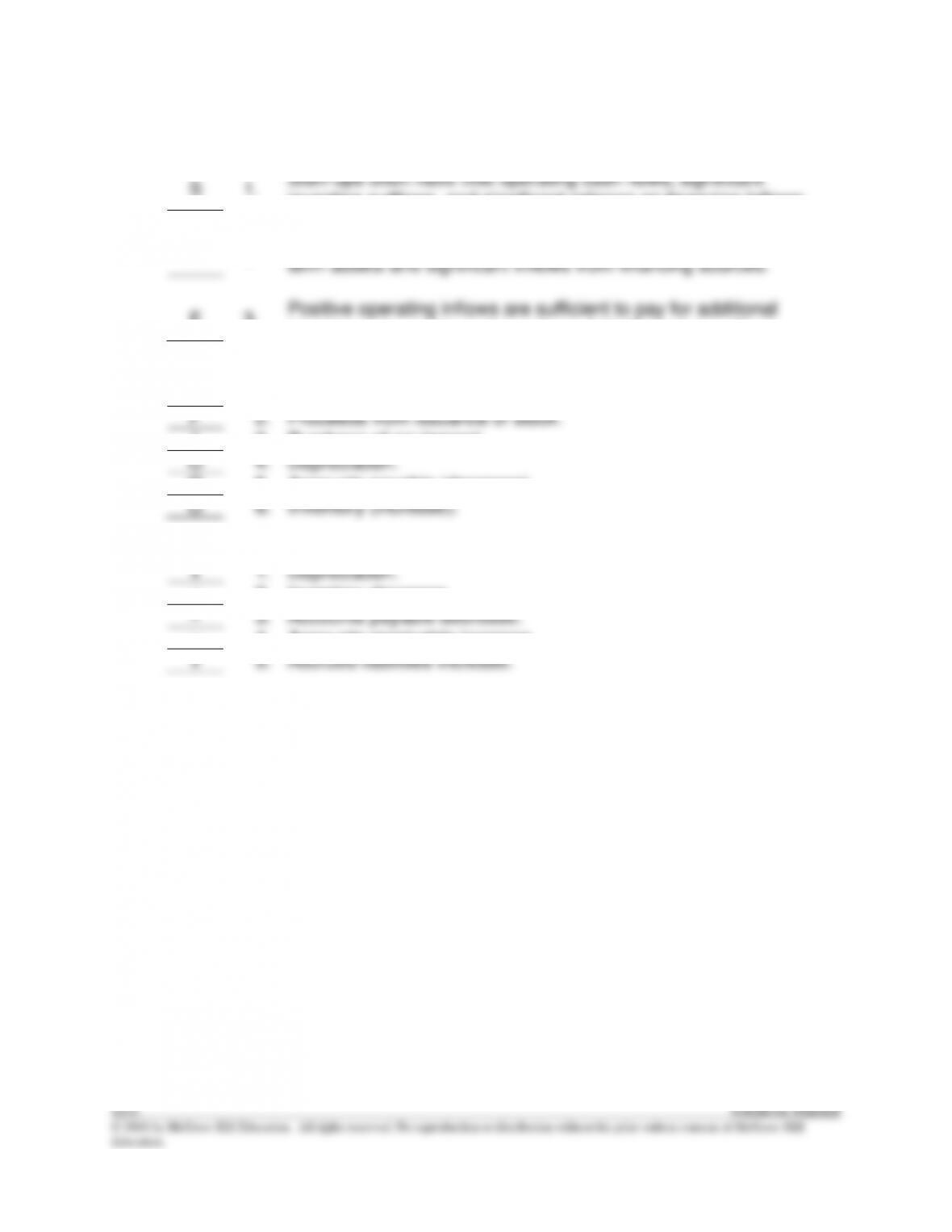
Case
Financial
Analysis
Research
Ethical Reasoning
Critical Thinking
Technology
Writing
Teamwork
1
x
2
x
3
x
x
x
x
x
4
x
x
x
5
x
x
x
x
6
x
x
x
7-9
x
x
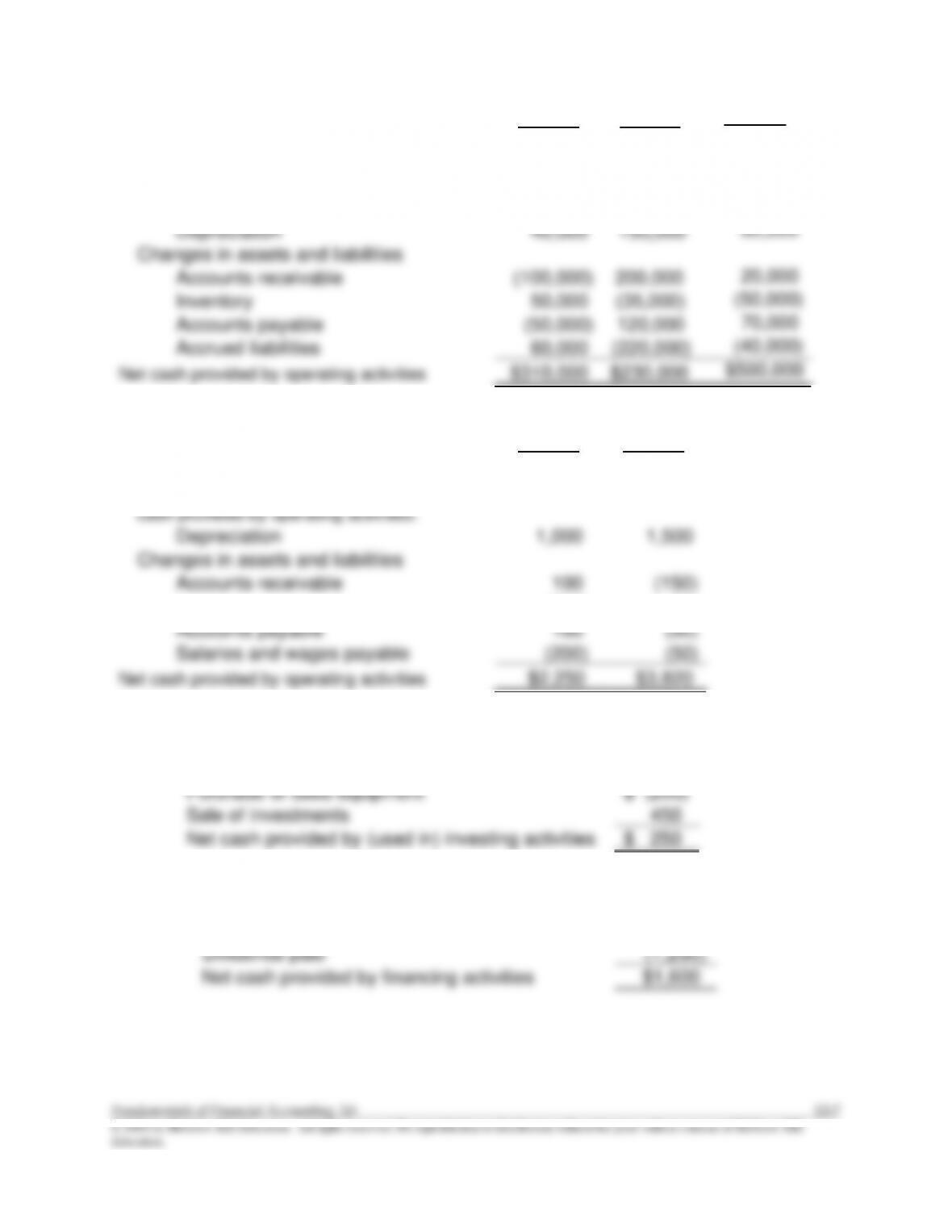
ANSWERS TO MINI-EXERCISES
M12–1
S
1.
Start-ups often have little operating cash flows, significant
investing outflows, and significant reliance on financing inflows.
F
2.
Negative operating cash flows, funded primarily from selling long-
term assets and significant inflows from financing sources.
E
3.
Positive operating inflows are sufficient to pay for additional
investment in assets and pay down debt (financing outflow).
M12–2
I
1.
Purchase of investments.
F
2.
Proceeds from issuance of stock.
I
3.
Purchase of equipment.
O
4.
Depreciation.
O
5.
Accounts payable (decrease).
O
6.
Inventory (increase).
M12–3
+
1.
Depreciation.
+
2.
Inventory decrease.
–
3.
Accounts payable decrease.
–
4.
Accounts receivable increase.
+
5.
Accrued liabilities increase.
M12–4
Case A
Case B
Case C
Net Income
$310,000
$15,000
$420,000
Adjustments to reconcile net income to net
cash provided by operating activities:
Depreciation
40,000
150,000
80,000
Changes in assets and liabilities
Accounts receivable
(100,000)
200,000
20,000
Inventory
50,000
(35,000)
(50,000)
Accounts payable
(50,000)
120,000
70,000
Accrued liabilities
60,000
(220,000)
(40,000)
Net cash provided by operating activities
$310,000
$230,000
$500,000
M12–5
Case A
Case B
Net Income
$ 1,500
$2,500
Adjustments to reconcile net income to net
cash provided by operating activities:
Depreciation
1,000
1,500
Changes in assets and liabilities
Accounts receivable
100
(150)
Inventory
(250)
70
Accounts payable
100
(50)
Salaries and wages payable
(200)
(50)
Net cash provided by operating activities
$2,250
$3,820
M12–6
Investing Activities
Purchase of used equipment
$ (200)
Sale of investments
450
Net cash provided by (used in) investing activities
$ 250
M12–7
Financing Activities
Additional borrowing from bank
$2,800
Dividends paid
(1,200)
Net cash provided by financing activities
$1,600
M12-8
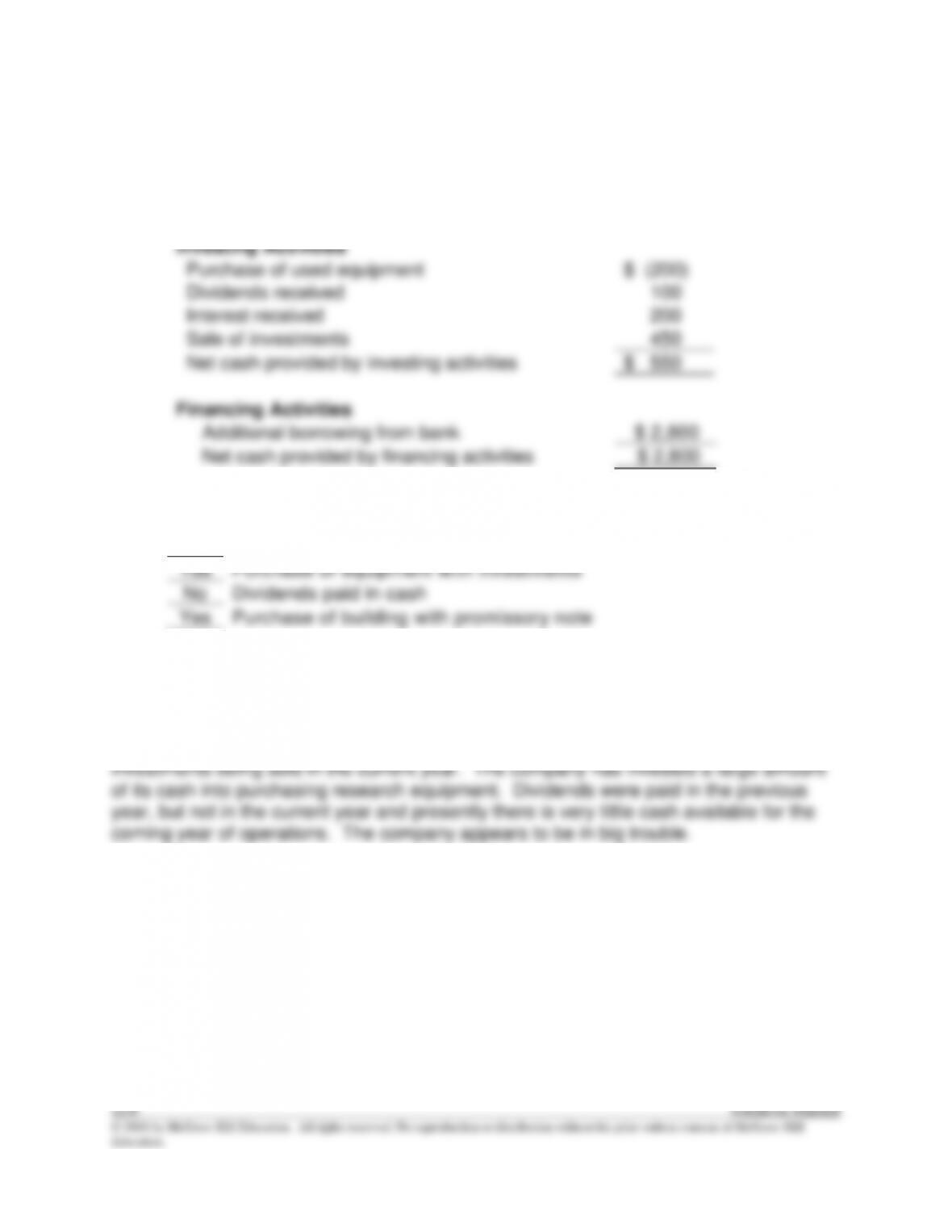
Under IFRS, dividends and interest received may be classified as investing rather than
GAAP’s classification as operating. Also under IFRS, dividends paid may be classified
as an operating outflow rather than a financing outflow. Using these alternative
classifications, the maximum cash inflows are:
Investing Activities
Purchase of used equipment
$ (200)
Dividends received
100
Interest received
200
Sale of investments
450
Net cash provided by investing activities
$ 550
Financing Activities
Net cash provided by financing activities
Additional borrowing from bank
Purchase of equipment with investments
Dividends paid in cash
Purchase of building with promissory note
M12–11
I
1.
Payment for equipment purchase.
F
2.
Repayments of bank loan.
F
3.
Dividends paid.
F
4.
Proceeds from issuance of stock.
O
5.
Interest paid.
O
6.
Receipts from customers.
M12–12
Case A
Case B
Case C
Cash collected from customers 1
$66,000
$51,000
$93,000
Cash payments to suppliers 2
(37,000)
(23,500)
(63,000)
Cash payments for salaries and wages 3
(3,500)
(15,000)
(7,000)
Net cash provided by operating activities
$25,500
$12,500
$23,000
Case A
Case B
Case C
1
$65,000 + $1,000
$55,000 – $4,000
$96,000 – $3,000
2
$35,000 + $2,000
$26,000 – $2,500
$65,000 – $3,000 + $1,000
3
$5,000 – $1,500
$13,000 + $2,000
$8,000 – $1,000
M12–13
Case A
Case B
Cash collected from customers 1
$11,100
$20,850
Cash payments to suppliers 2
(6,150)
(11,980)
Cash payments for salaries and wages 3
(2,700)
(5,050)
Net cash provided by operating activities
$2,250
$3,820
Case A
Case B
1
$11,000 + $400 – $300
$21,000 + $600 – $750
2
$6,000 + ($750 – $500) + ($700 – $800)
$12,000 + ($730 – $800) + ($850 – $800)
3
$2,500 + $1,200 – $1,000
$5,000 + $250 – $200
12-10 Solutions Manual
© 2016 by McGraw-Hill Education. All rights reserved. No reproduction or distribution without the prior written consent of McGraw-Hill
Education.
ANSWERS TO EXERCISES
E12–1
F
1.
Additions to long-term debt.
O
2.
Depreciation.
I
3.
Additions to equipment.
F
4.
Increase (decrease) in notes payable. (The amount is owed to
financial institutions.)
O
5.
(Increase) decrease in other current assets.
I
6.
Cash received from disposal of equipment.
F
7.
Reductions in long-term debt.
F
8.
Issuance of stock.
O
9.
(Increase) decrease in inventory.
O
10.
Net income.
E12–2
Req. 1
Cash) ……………………………………………………………
Accounts Receivable ………………………………………
110
70
Service Revenue ………………………………….
180
Req. 2
The $110 increase in cash is reported as net cash flow from operating activities.
Req. 3