Chapter Outline
Teaching Notes
H. Supplemental Disclosures
1. In addition to their cash flows, all companies are required
to report material investing and financing transactions
that did not have cash flow effects (called noncash
investing and financing activities).
2. These activities are not listed in the three main sections of
the statement of cash flows.
3. This important information is normally presented for users
in a supplementary schedule to the statement of cash
flows or in the financial statement notes.
4. Supplementary information must also report (for
companies using the indirect method) the amount of cash
paid for interest and for income taxes.
LO 12-5 Interpret cash flows from operating, investing, and financing activities using ratios.
III. Evaluate the Results
A. Free Cash Flow
1. An established, healthy company will show positive cash
flows from operations, which are sufficiently large to pay
for replacing existing property, plant, and equipment and
to pay dividends to stockholders.
2. Any additional cash (called free cash flow) can (a) be
used to expand the business through additional investing
activities, (b) be used for other financing activities, or (c)
simply build up the company’s cash balance.
B. Evaluating Cash Flows
2. Cash Flows from Operating Activities
a. When evaluating the operating activities section of the
statement of cash flows, consider the absolute amount
of cash, keeping in mind that operating cash flows
have to be positive over the long run for a company to
be successful.
The “Spotlight on Business
Decision” feature addresses
Lehman Brothers’ operating
cash flows and the financial
crisis
b. All other things being equal, when net income and
operating cash flows are similar, there is a high
likelihood that revenues are realized in cash and that
expenses are associated with cash outflows; any major
deviations should be investigated.
c. Four potential causes of deviations to consider
include:
i. Seasonality
ii. The corporate life cycle (growth in sales)
iii. Changes in revenue and expense recognition
iv. Changes in working capital management
Chapter Outline
Teaching Notes
3. Cash Flows from Investing Activities
a. Healthy companies tend to show negative cash flows
in the investing section of the statement of cash flows.
b. A negative total for this section means the company is
spending more to acquire new long-term assets than it
is taking in from selling its existing long-term assets.
c. Positive total cash flow in the investing activities
section can raise concerns because it could mean the
company is selling off its long-term assets just to
generate cash inflows.
4. Cash Flows from Financing Activities
a. The financing activities section does not have an
obvious expected direction for cash flows.
b. Detailed line items within this section need to be
considered to assess the company’s overall financing
strategy. (Is the company moving toward greater
reliance on risky debt financing?)
5. Overall Patterns of Cash Flows
a. Corporate lifecycle phases include:
Illustrated in Exhibit 12.8
i. An introductory phase when the company is being
established.
ii. A growth phase when the company’s presence
expands.
iii. A maturity phase when the company stabilizes.
iv. A decline phase when the company loses its way.
b. During each of these phases, a company is likely to
show different patterns of net cash flows from
operating, investing, and financing activities.
i. Introductory (start-up) phase—Most companies
experience negative net operating cash flows.
ii. Growth phase—Operating cash flows turn positive
because the company has improved its cash inflows
from customers.
iii. Maturity phase—The company generates positive
operating cash flows, but no longer has
opportunities for expanding the business, so it
stops spending cash on investing activities and
instead uses its cash for financing activities.
iv. Decline phase—A company’s operating cash flows
again become negative.
Chapter Outline
Teaching Notes
LO 12-6 Report and interpret cash flows from operating activities, using the direct method.
C. Reporting Operating Cash Flows with the Direct Method
✓ Activity #3
1. Direct method presents a summary of all operating
transactions that result in either a debit or a credit to cash.
Illustrated in Exhibit 12.9
2. Prepared by adjusting each revenue and expense on the
income statement from the accrual basis to the cash basis.
3. The following adjustments must commonly be made to
convert income statement items to the related operating
cash flow amounts:
a. Converting Sales Revenues to Cash Inflows:
Sales Revenue + Decrease in Accounts Receivable (A)
(or – Increase in Accounts Receivable (A)) =
Collections from customers.
b. Converting Cost of Goods Sold to Cash Paid to
Suppliers:
Cost of Goods Sold + Increase in Inventory (A) (or –
Decrease in Inventory (A)) – Increase in Accounts
Payable (L) (or + Decrease in Accounts Payable (L)) =
Payments to suppliers of inventory.
c. Converting Operating Expense to Cash Outflow:
Other Expenses + Increase in Prepaid Expenses (A)
(or – Decrease in Prepaid Expenses (A)) – Increase in
Accrued Expenses (L) (or + Decrease in Accrued
Expenses (L)) = Payments to suppliers of services
(e.g., rent, utilities, wages, interest).
IV. Supplement 12A: Report cash flows from Property, Plant, and
Equipment (Indirect Method)
LO 12-S1 Report cash flows from PPE disposals using the indirect method.
A. Whenever a company sells property, plant, and equipment
(PPE), it records three things:
1. Decreases in the PPE accounts for the assets sold,
2. An increase in the Cash account for the cash received on
disposal, and
3. A gain if the cash received is more than the book value of
the assets sold (or a loss if the cash received is less than
the book value of the assets sold).
B. The only part of this transaction that qualifies for the
statement of cash flows is the cash received on disposal.
1. This cash inflow is classified as an investing activity, just
like the original equipment purchase.
2. Since a gain on sale are included in net income, the gain
on sale is subtracted (or the loss is added) as an
adjustment to net income in the operating activities
section as an adjustment to net income in the operating
activities section.
3. The proceeds from the disposal or sale are listed as a cash
inflow in the investing activities section.
V. Supplement 12B: T-Account Approach (Indirect Method)
LO 12–S2 Use the T-account approach for preparing an indirect method statement of cash flows.
A. Cash T-account
1. Instead of creating separate schedules for each section of
the statement, many accountants prefer to prepare a single
large T-account to represent the changes that have taken
place in cash subdivided into the three sections of the
cash flow statement.
Illustrated in Panel A of
Exhibit 12B.1
2. The cash account in Panel A shows increases in cash as
debits and decreases in cash as credits; each section
matches the three schedules that we prepared for Under
Armour’s cash flows presented in Exhibits 12.4, 12.5, and
12.6.
3. Panel B includes the same T-accounts for the noncash
balance sheet accounts we used in our discussion of each
cash flow statement section in the body of the chapter;
each change in the noncash balance sheet accounts has a
number referencing the change in the cash account that it
accompanies.

Supplemental Enrichment Activities
Note: These activities would be suitable for individual or group activities.
1. Handout 12–1
Use Handout 12–1 for an in-class activity designed to review the reporting of various items in the
three cash flow statement categories. The solution follows the handout master.
2. Handout 12–2
Use Handout 12–2 for an in-class activity designed to review the preparation of the statement of cash
flows using the indirect method. The solution follows the handout master.
3. Handout 12–3
Use Handout 12–3 for an in-class activity designed to review the preparation of the statement of cash
flows using the direct method. The solution follows the handout master.
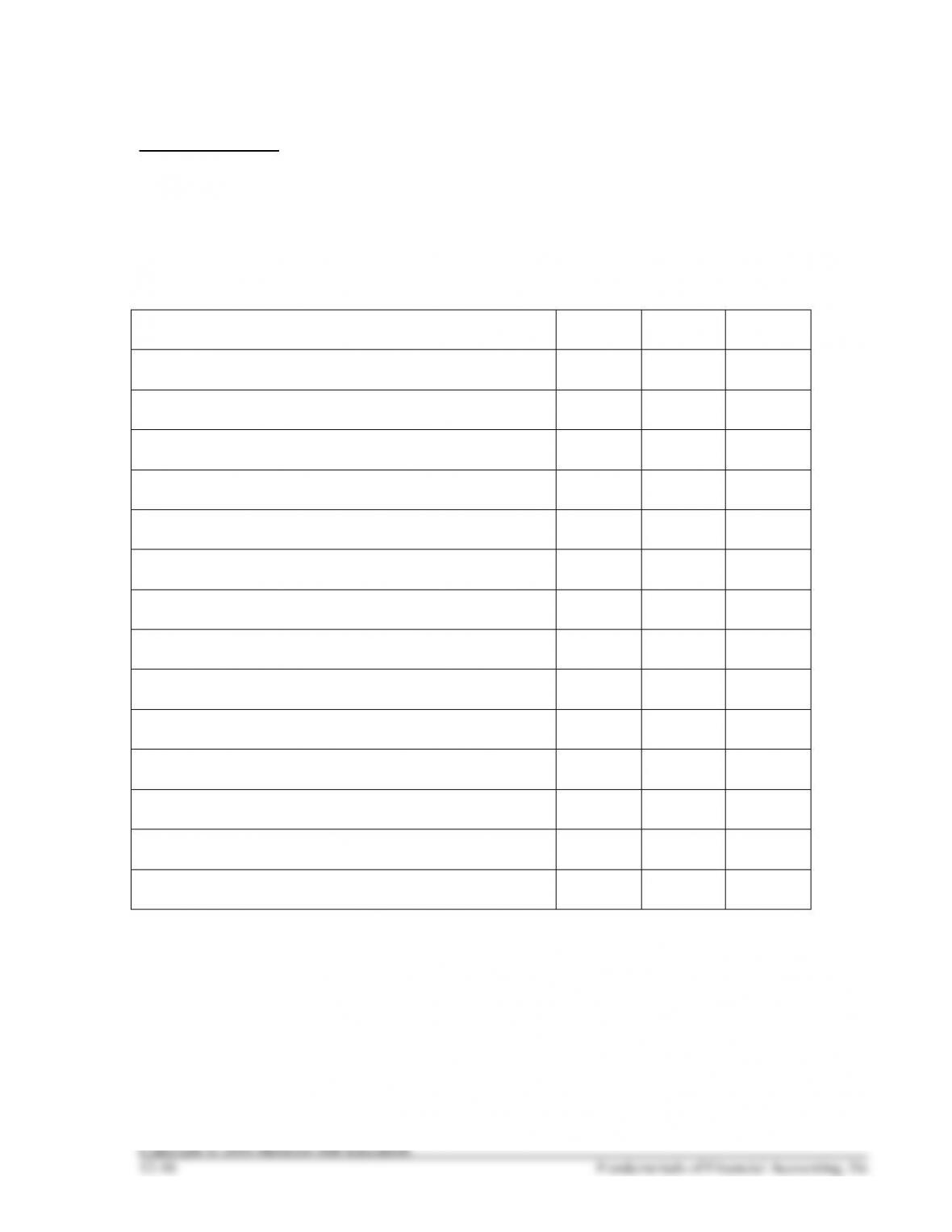
HANDOUT 12–1
CASH FLOW CATEGORIES
Maya Corporation reports the following items in its statement of cash flows prepared using the direct
method. Indicate whether each item is disclosed in the operating, investing, or financing activities section
of the statement.
Operating
Investing
Financing
Cash paid for salaries and wages
Cash paid to purchase property, plant, and equipment
Cash received from issuing common stock to owners
Cash paid for income taxes
Cash paid to purchase investments in securities
Dividends paid to owners
Interest paid on liabilities
Cash received from sale of property, plant, and equipment
Cash used for repaying principal to lenders
Cash used to repurchase stock from owners
Cash provided by dividends and interest on investments
Cash received from customers
Cash from sale or maturity of investments in securities
Cash provided by borrowing from a bank
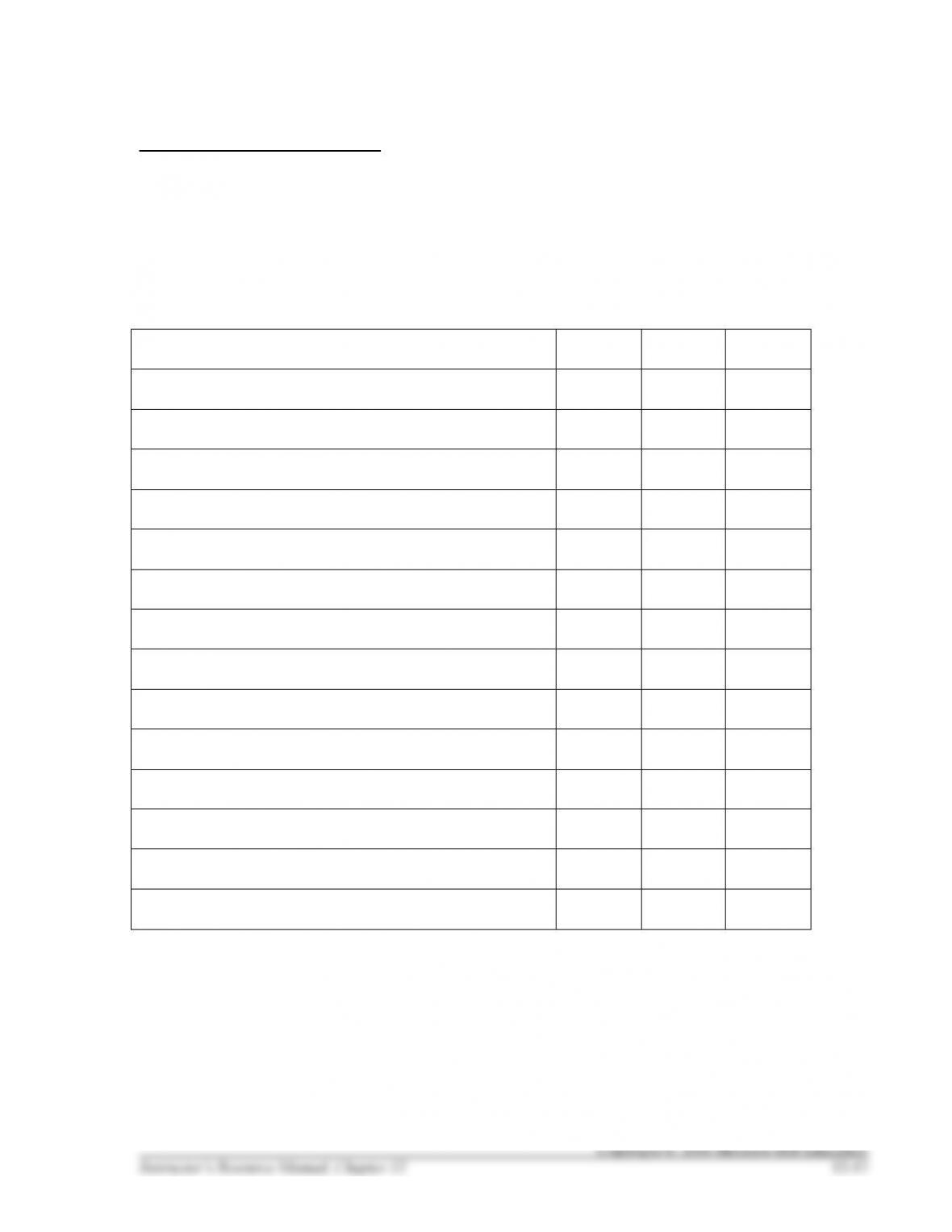
HANDOUT 12–1 SOLUTION
CASH FLOW CATEGORIES
Maya Corporation reports the following items in its statement of cash flows prepared using the direct
method. Indicate whether each item is disclosed in the operating, investing, or financing activities section
of the statement.
Operating
Investing
Financing
Cash paid for salaries and wages
X
Cash paid to purchase property, plant, and equipment
X
Cash received from issuing common stock to owners
X
Cash paid for income taxes
X
Cash paid to purchase investments in securities
X
Dividends paid to owners
X
Interest paid on liabilities
X
Cash received from sale of property, plant, and equipment
X
Cash used for repaying principal to lenders
X
Cash used to repurchase stock from owners
X
Cash provided by dividends and interest on investments
X
Cash received from customers
X
Cash from sale or maturity of investments in securities
X
Cash provided by borrowing from a bank
X

HANDOUT 12–2
STATEMENT OF CASH FLOWS (INDIRECT METHOD)
The Group, Inc.
Consolidated Balance Sheet
December 31
(in thousands)
Current
Year
Prior
Year
ASSETS
Cash and Cash Equivalents
$92,069
$72,634
Accounts Receivables, Net
55,947
75,492
Inventories
50,784
53,129
Prepaid Expenses
12,112
13,057
Equipment
145,444
134,312
Accumulated Depreciation
(50,515)
(36,689)
Total Assets
$305,841
$311,935
LIABILITIES AND STOCKHOLDERS’ EQUITY
Accounts Payable
$25,466
$34,879
Accrued Liabilities
40,574
40,722
Long-Term Debt
10,422
10,206
Common Stock
1,662
1,284
Retained Earnings
227,717
224,844
Total Liabilities And Stockholders’ Equity
$305,841
$311,935
Consolidated Statement of Income
Year Ended December 31
(in thousands)
Current
Year
Net Sales
$130,896
Cost of Sales
74,040
Gross Profit
56,856
Operating Expenses:
Selling, General & Administrative Expenses
33,211
Depreciation Expense
13,826
Total Operating Expenses
47,037
Operating Income
9,819
Interest Income
239
Income Before Income Taxes
10,058
Income Tax Expense
3,621
Net Income
$6,437