
Chapter Outline
Teaching Notes
ii. Small stock dividend
• Less than 25% of currently outstanding shares.
• Transfer is recorded at market value and, so,
decrease in Retained Earnings is greater than
increase in Common Stock.
• Excess of market value over par value is
recorded as Additional Paid-in Capital.
b. Regardless of size, stock dividends affect only
balances within stockholders’ equity; it does not
change total stockholders’ equity.
Impact on stockholders’
equity illustrated in Exhibit
11.4
c. Reasons for stock dividends:
i. Lower the market price per share of stock
ii. Demonstrate commitment to stockholders while
conserving cash during difficult times.
The “Spotlight on Business
Decisions” feature addresses
iii. Signal an expectation of significant future earnings.
choosing between stock
2. Stock Splits
dividends and stock splits.
a. Stock split––An increase in the total number of
authorized shares by a specified ratio; does not affect
retained earnings.
✓ Activity #5
b. Stock splits do not decrease retained earnings.
✓ Activity #6
c. Cash is not affected when the company splits its stock,
so the total resources of the company do not change.
d. Typically, a stock split involves revising the corporate
charter to reduce the per-share par value of all
authorized shares, so that the total par value across all
shares is unchanged.
Impact on stockholders’
equity illustrated in Exhibit
11.4
LO 11-4 Describe the characteristics of preferred stock and analyze transactions affecting preferred
stock.
E. Preferred Stock––Stock that has specified rights over
common stock.
1. Preferred stock differs from common stock:
a. Preferred stock allows different voting rights
(anywhere from zero to super-voting rights).
b. Dividends on preferred stock, if any, may be paid at a
fixed rate, specified as either a dollar amount or a
percentage per share.
c. Preferred stock carries priority over common stock.
i. Any dividends the corporation declares must be
paid to preferred stockholders before they can be
paid to common stockholders.
ii. If the corporation goes out of business, its assets
will be sold and used to pay creditors and then
preferred stockholders; common stockholders are
paid last from whatever assets remain after paying
preferred stockholders.

Chapter Outline
Teaching Notes
2. Preferred stock issuances for cash are recorded by
debiting Cash, crediting Preferred Stock (for the number
of shares sold times the par value per share), and crediting
Additional Paid- in Capital Preferred account (for the
cash received in excess of this amount).
The “Spotlight on The
World” feature addresses the
accounting for preferred
stock using GAAP and IFRS.
3. Preferred Stock Dividends
✓ Activity #4
a. Preferred stock offers dividend preferences.
i. Current dividend preference––The feature of
preferred stock that grants priority on preferred
dividends over common dividends.
• After the current dividend preference has been
met and if no other preference exists, dividends
can be paid to the common stockholders.
• The current dividend preference does not carry
over to later years unless the preferred stock is
designated as cumulative.
ii. Cumulative dividend preference––The preferred
stock feature that requires current dividends not
paid in full to accumulate for every year in which
they are not paid.
• Dividends in arrears––Cumulative unpaid
amounts that must be paid before any common
dividends are paid.
• Because dividends are not a liability until
declared, dividends in arrears are not reported
on the balance sheet.
• Instead, dividends in arrears are disclosed in
the notes to the financial statements.
F. Retained Earnings
1. Retained earnings represent the company’s total earnings
that have been retained in the business (rather than being
distributed to stockholders).
2. Account balance increases when the company reports net
income on the income statement and decreases when the
company reports a net loss (expenses greater than
revenues) or declares cash or stock dividends to
stockholders.
3. Should a company ever accumulate more net losses than
net income, it will report a negative (debit) balance in the
Retained Earnings account; this amount is:
a. Shown in parentheses in the stockholders’ equity
section of the balance sheet.
b. Deducted when computing total stockholders’ equity.
c. Typically called an Accumulated Deficit.
G. Statement of Stockholders’ Equity
Illustrated in Exhibit 11.5
1. Shows all changes in the stockholder equity accounts.
2. Has a column for each stockholder equity account.

Chapter Outline
Teaching Notes
III. Evaluate the Results
LO 11-5 Analyze the earnings per share (EPS), return on equity (ROE), and price/earnings (P/E)
ratios.
A. Earnings per Share (EPS)
Illustrated in Exhibit 11.6
1. The amount of income generated for each share of
common stock owned by stockholders.
2. Because preferred stock has priority over common stock,
any dividends on preferred stock are subtracted when
computing EPS.
3. EPS = (Net Income – Preferred Dividends) ÷ Average
Number of Common Shares Outstanding.
4. A higher ratio means greater profitability.
5. Reported on income statement immediately below Net
Income or in the notes to the financial statements.
6. Effective and widely used measure for comparing a
company with itself over time; not appropriate for
comparing across companies.
B. Return on Equity (ROE) Ratio
Illustrated in Exhibit 11.6
1. The amount of income earned for each dollar of
stockholders’ equity.
2. ROE = Net Income divided by Average Stockholders’
Equity.
Consider whether you wish to
cover footnote regarding
3. A higher ratio means stockholders are likely to enjoy
greater returns.
impact of preferred stock on
this ratio
4. Financial leverage––Rather than relying on equity
financing, a company relies on debt.
a. A company may be able to generate more profit from
using these borrowed funds than it incurred for interest
on that debt; this increases the company’s ROE.
b. Financial leverage isn’t always the best strategy; the
amount of interest expense may exceed the profit
generated from the borrowed funds.
C. Price/Earnings (P/E) Ratio
Illustrated in Exhibit 11.6
1. Measures how many times more than the current year’s
earnings investors are willing to pay for a company’s
common stock.
2. P/E ratio = Current Stock Price (per share) divided by
Earnings per Share (annual).
3. A higher number means investors anticipate an
improvement in the company’s future results.

Chapter Outline
Teaching Notes
IV. Supplement 11A: Owners’ Equity for Other Forms of Business
LO 11–S1 Account for owners’ equity in other forms of business.
A. Owner’s Equity for a Sole Proprietorship
1. Sole proprietorship––Unincorporated business owned by
one person.
2. Capital account––Records investments by the owner and
is used to accumulate periodic income or loss.
Accounting summarized in
Exhibit 11A.1
3. Drawing account––Used to record the owner’s
withdrawals of cash and other assets from the business.
Stress that it is similar to the
Dividends account
i. Closed to the capital account at the end of each
accounting period.
ii. After drawing account is closed, capital account
reflects the cumulative total of all investments by the
owner and all earnings of the business less all
withdrawals from the entity by the owner.
4. Financial statements of a sole proprietorship do not report
Income Tax Expense or Income Taxes Payable; instead,
the net income of a sole proprietorship is taxed when it is
included on the owner’s personal income tax return.
i. Statement of owner’s equity replaces the statement of
retained earnings or statement of stockholders’ equity.
ii. Do not report Income Tax Expense or Income Taxes
Payable; instead, the net income of a sole
proprietorship is taxed when it is included on the
owner’s personal income tax return.
iii. The owner’s salary is not recognized as an expense.
• An employer/employee contractual relationship
cannot exist with only one party involved.
• The owner’s salary is therefore accounted for as a
distribution of profits—a withdrawal—instead of
salary expense, as it would be in a corporation.
B. Owner’s Equity for a Partnership
1. Partnership––Defined by the Uniform Partnership Act as
“an association of two or more persons to carry on as co–
owners of a business for profit.”
2. A partnership is formed by two or more persons reaching
mutual agreement about the terms of the relationship.
3. Agreement should specify
a. Division of income
b. Management responsibilities
c. Transfer or sale of partnership interests
d. Disposition of assets upon liquidation
e. Procedures to be followed in case of the death of a
partner
4. If the partnership agreement does not specify these
matters, the laws of the resident state are binding.

Chapter Outline
Teaching Notes
5. Primary advantages of a partnership versus a corporation:
a. Ease of formation
b. Complete control by the partners
c. Lack of income taxes on the business itself
6. Primary disadvantage is unlimited liability of each partner
for the partnership’s debts.
7. Accounting for partners’ equity is same as for a sole
proprietorship, except that separate capital and drawings
accounts are established for each partner.
Accounting summarized in
Exhibit 11A.2
a. Investments by each partner are credited to that
partner’s Capital account and withdrawals are debited
to the respective Drawings account.
b. The net income of a partnership is divided among the
partners in accordance with the partnership agreement
and credited to the partner Capital accounts.
c. The respective Drawings accounts are closed to the
partner Capital accounts.
d. After the closing process, each partner’s Capital
account reflects the cumulative total of all that
partner’s investments plus that partner’s share of the
partnership earnings less all that partner’s
withdrawals.
C. Other Business Forms
1. Other forms of business blend features of the “pure”
organizational forms described to create hybrid
business.
a. S Corporations
b. Limited Liability Partnerships (LLPs
c. Limited Liability Companies (LLCs).
2. LLC, an increasingly common form of business,
combines legal characteristics of corporations with the
tax treatment of partnerships.
3. Accounting for these hybrid entities generally follows
the methods described above.

Chapter Outline
Teaching Notes
V. Supplement 11B: Recording Stock Dividends
LO 11-S2 Record journal entries for large and small stock dividends.
A. Stock Dividends
1. Recorded by transferring an amount from Retained
Earnings to Common Stock (and possibly other
contributed capital accounts).
✓ Activity #5
2. This transfer is called capitalizing retained earnings.
3. The amount transferred is either the stock’s par value
(for large dividends) or its market value (for small
dividends); distinction between large and small stock
dividends is generally 25% of outstanding shares.
B. Large Stock Dividends
1. A stock dividend is large when the issue is more than
25 percent of the outstanding shares.
2. A large stock dividend is recorded at the stock’s par
value.
C. Small Stock Dividends
1. A stock dividend is small when less than 25 percent of
the company’s outstanding shares are issued.
2. A small stock dividend is accounted for at the market
value of the company’s stock.
3. Because market value exceeds par value, the company
must record the excess as Additional Paid-In Capital.

Supplemental Enrichment Activities
Note: These activities would be suitable for individual or group activities.
1. Use the following for an in-class discussion of the concepts of authorized, issued, and outstanding.
Ask your students if they have ever attended an evening reception at which drink tickets were sold.
Typically, the host will have a roll of authorized tickets and will issue individual tickets as people buy
them. These drink tickets will be held by the people until they are exchanged with the bartender for
drinks. The returned drink ticket will then be either destroyed by the bartender or given back to the
host to reissue. At any time during the evening, there are likely to be some tickets on the roll available
for future sale, some still outstanding in people’s pockets, and some already returned to the host for
possible reuse. Ask your students to match the tickets in this story to the terms (1) authorized, (2)
issued, and (3) treasury.
Solution:
Just like the host with the initial roll of drink tickets, a corporation is authorized to issue a specific
number of shares. Shares will be “issued” to stockholders and will remain outstanding until they are
returned to the company’s treasury (usually in exchange for cash). This “treasury stock” will either be
destroyed or reissued just like the used drink tickets.
2. Handout 11–1
Use Handout 11–1 for an in-class activity designed to review the preparation of journal entries for
various stock transactions. The solution follows the handout master.
3. Handout 11–2
Use Handout 11–2 for an in-class activity designed to review the recording of cash dividends. The
solution follows the handout master.
4. Handout 11–3
Use Handout 11–3 for an in-class activity designed to review concepts relating to dividends on
preferred stock. The solution follows the handout master.
5. Handout 11–4
Use Handout 11–4 for an in-class activity designed to review the recording of stock dividends. The
solution follows the handout master.

Supplemental Enrichment Activities, continued
6. Use the following for an in-class discussion of the concepts of stock dividends and stock splits:
A company’s board of directors must choose between a large 100 percent stock dividend and a 2-for-
1 stock split. Both have the effects of doubling the number of shares outstanding and reducing the
per-share market price. What should the board consider in making this decision?
Solution:
The decision may be closely related to how stock dividends and splits are accounted for.
a. A stock dividend causes a reduction in Retained earnings, whereas a “true” stock split doesn’t.
b. A company that expects some financial struggles in the future will want to use a 2-for-1 stock split
because this doesn’t reduce Retained earnings, which means it doesn’t reduce its ability to declare
cash dividends in the future.
c. On the other hand, if the company is expecting financial success in the near future, it won’t care
that Retained earnings is reduced by a stock dividend because future earnings will build up
Retained earnings enough to allow cash dividends to be declared. In fact, it may want to use a
stock dividend just to show confidence that the company is expecting to do well in the near future.

HANDOUT 11–1
STOCK TRANSACTIONS
Prepare the journal entries required to record the following transactions and then post them to the related
T-accounts:
Strait Corp. sold 10,000 shares of $1 par value stock for $25 per share on May 1.
On December 1, Strait Corp. repurchased 1,000 shares of its stock on the market when it was trading for
$16 per share.
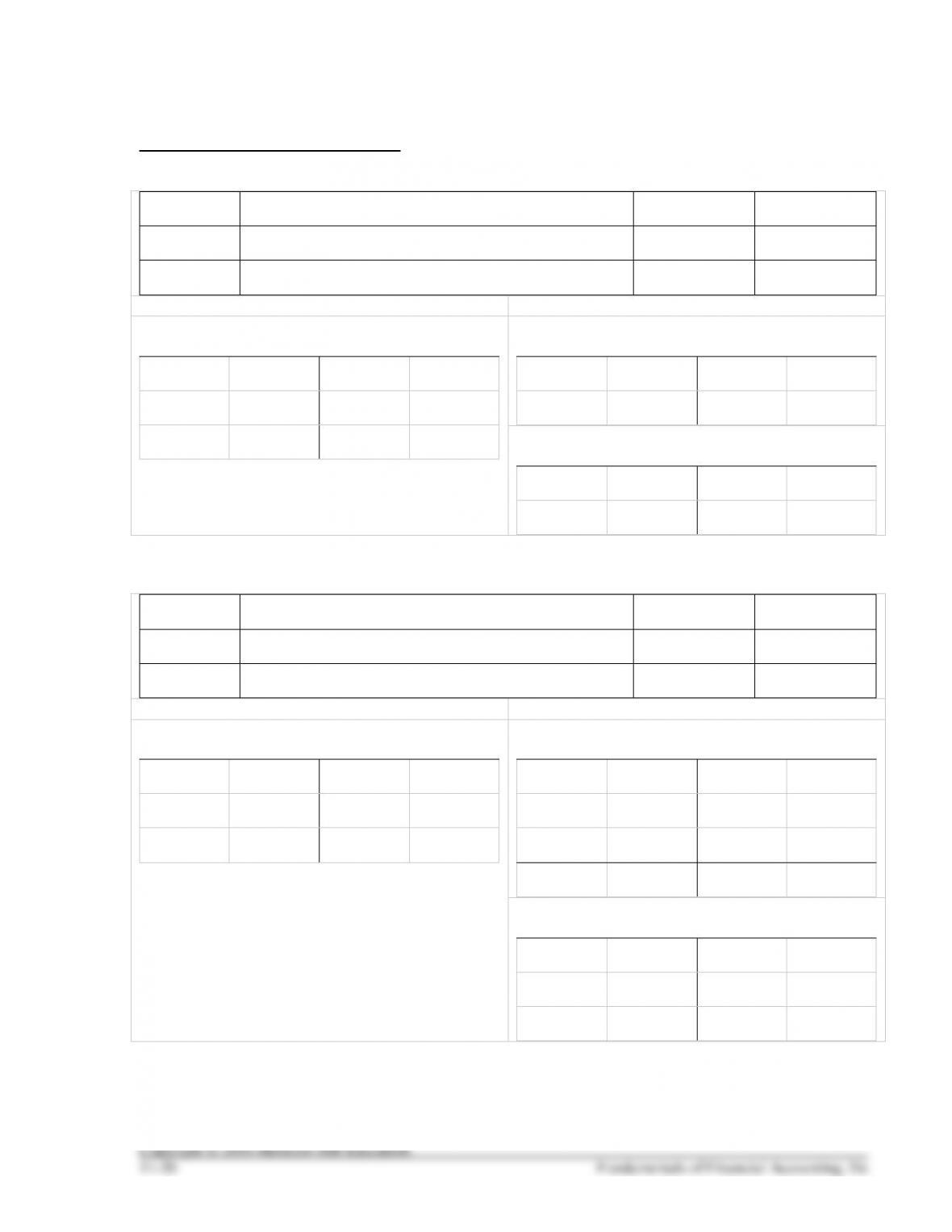
HANDOUT 11–1, CONTINUED
On December 15, Strait Corp. sold 500 of the treasury shares for $30 each.
On December 30, Strait Corp. sold 500 of the treasury shares for $15 each.