© 2016 by McGraw-Hill Education. All rights reserved. No reproduction or distribution without the prior written consent of McGraw-Hill
Education.
M10–13
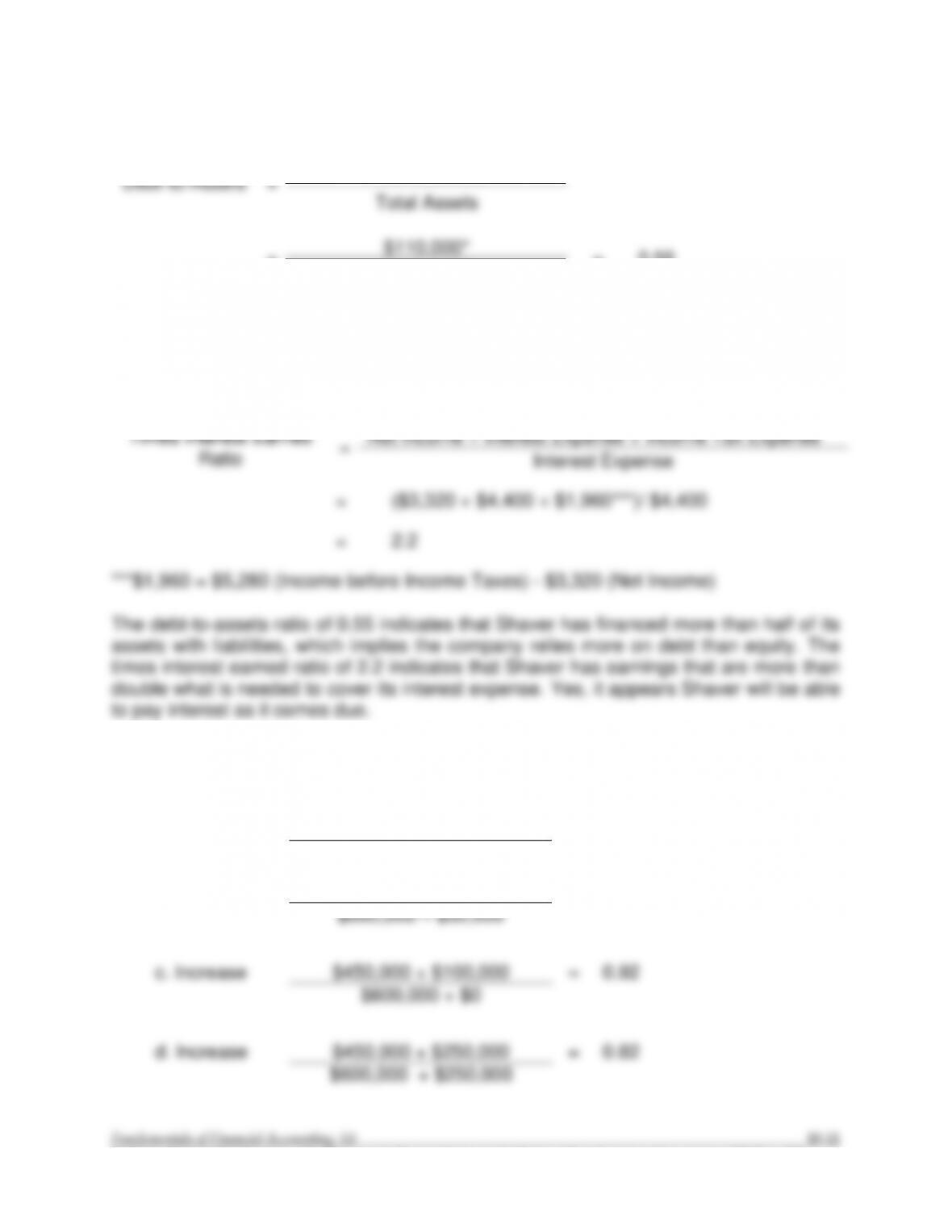
Debt-to–Assets
=
Total Liabilities
Total Assets
=
$110,000*
=
0.55
$200,000**
*$110,000 = $40,000 + $70,000
**$200,000 = $5,000 (Cash) + $10,000 (ST Investments) + $35,000 (Receivables) +
$40,000 (Inventory) + $10,000 (Prepaids) + $100,000 (Equipment)
Times Interest Earned
Ratio
=
Net Income + Interest Expense + Income Tax Expense
Interest Expense
= ($3,320 + $4,400 + $1,960***)/ $4,400
= 2.2
***$1,960 = $5,280 (Income before Income Taxes) – $3,320 (Net Income)
The debt–to-assets ratio of 0.55 indicates that Shaver has financed more than half of its
assets with liabilities, which implies the company relies more on debt than equity. The
times interest earned ratio of 2.2 indicates that Shaver has earnings that are more than
double what is needed to cover its interest expense. Yes, it appears Shaver will be able
to pay interest as it comes due.
M10–14
a. Increase
$450,000 + $20,000
=
0.76
$600,000 + $20,000
b. Decrease
$450,000 – $50,000
=
0.73
$600,000 – $50,000
c. Increase
$450,000 + $100,000
=
0.92
$600,000 + $0
d. Increase
$450,000 + $250,000
=
0.82
$600,000 + $250,000
M10–15
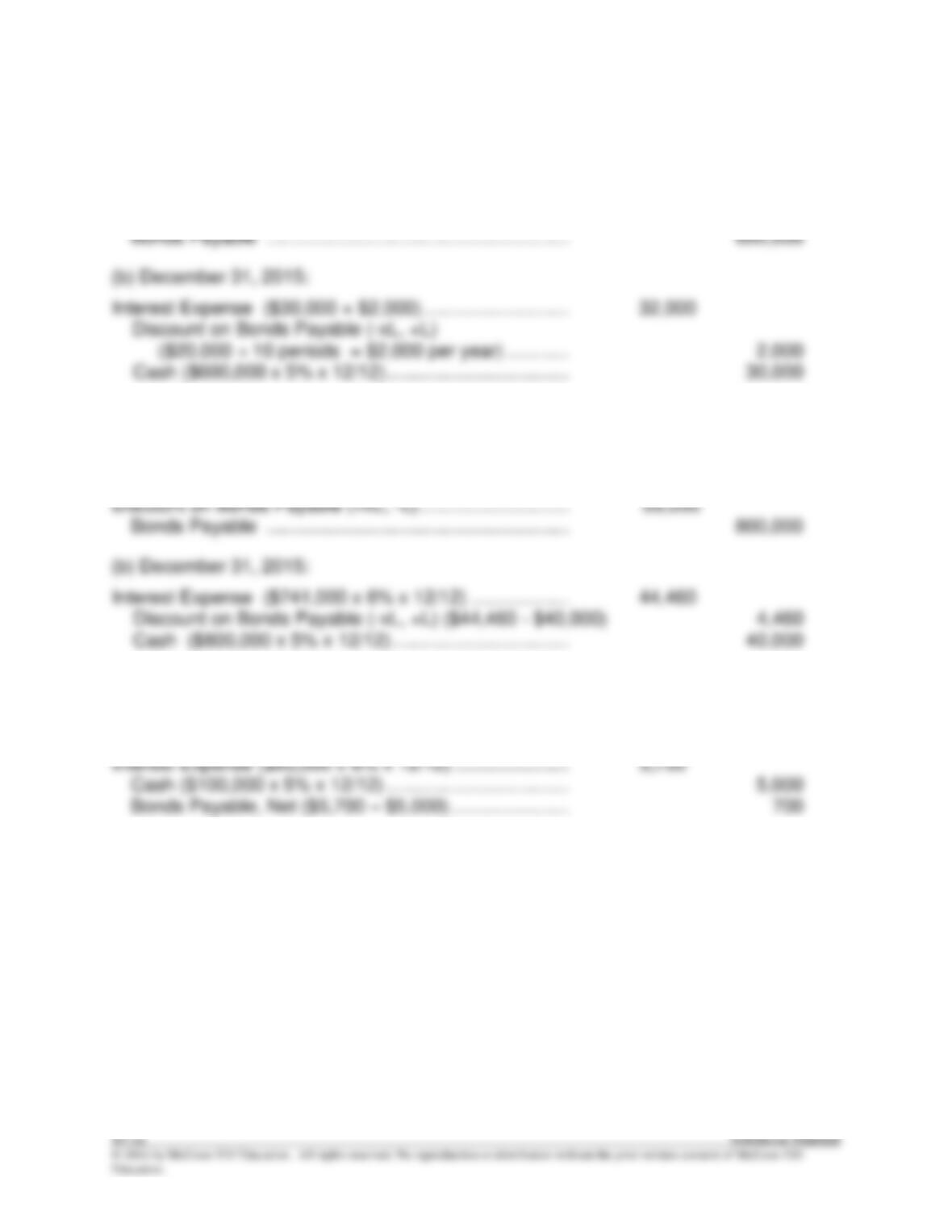
(a) January 1, 2015:
Cash ……………………………………………………………………
580,000
Discount on Bonds Payable (+xL, –L) ………………………..
20,000
Bonds Payable ………………………………………………….
600,000
(b) December 31, 2015:
Interest Expense ($30,000 + $2,000) ……………………….
32,000
Discount on Bonds Payable (-xL, +L)
($20,000 ÷ 10 periods = $2,000 per year) …………
2,000
Cash ($600,000 x 5% x 12/12) ……………………………..
30,000
M10–16
(a) January 1, 2015:
Cash ……………………………………………………………………
741,000
Discount on Bonds Payable (+xL, -L) ………………………..
59,000
Bonds Payable ………………………………………………….
800,000
Interest Expense ($741,000 x 6% x 12/12) ……………….
44,460
Discount on Bonds Payable (-xL, +L) ($44,460 – $40,000)
4,460
Cash ($800,000 x 5% x 12/12) …………………………….
40,000
M10–17
December 31, 2015:
Interest Expense ($95,000 x 6% x 12/12) ………………….
5,700
Cash ($100,000 x 5% x 12/12) ……………………………..
5,000
Bonds Payable, Net ($5,700 – $5,000) …………………..
700
© 2016 by McGraw-Hill Education. All rights reserved. No reproduction or distribution without the prior written consent of McGraw-Hill
Education.
ANSWERS TO EXERCISES
E10–1
Req. 1
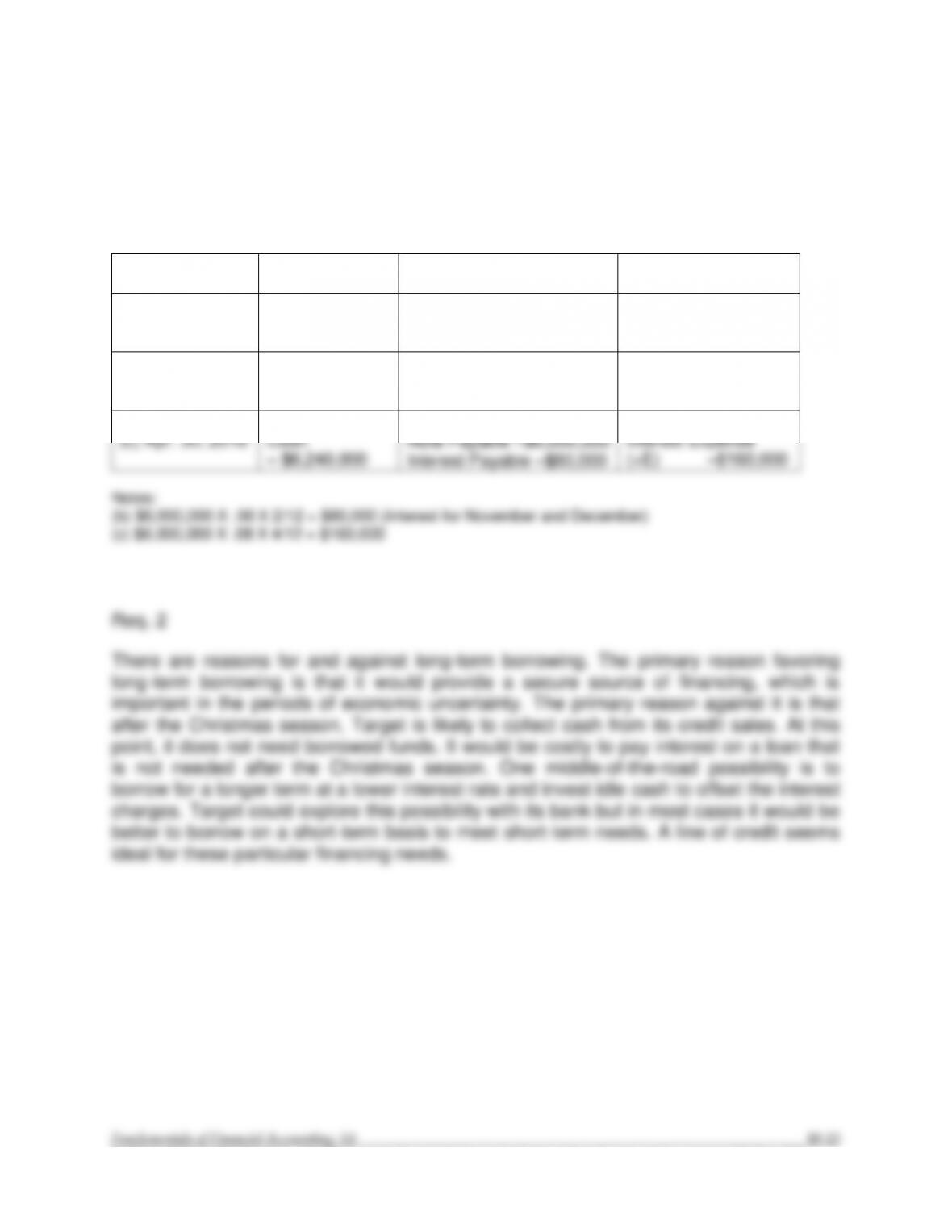
Date
Assets
Liabilities
Stockholders’ Equity
(a) Nov. 1, 2015
Cash
+ $6,000,000
Note Payable + $6,000,000
(b) Dec 31, 2015
Interest Payable +$80,000
Interest Expense
(+E) –$80,000
(c) Apr. 30, 2016
Cash
– $6,240,000
Note Payable –$6,000,000
Interest Payable –$80,000
Interest Expense
(+E) –$160,000
Notes:
(b) $6,000,000 X .08 X 2/12 = $80,000 (Interest for November and December)
(c) $6,000,000 X .08 X 4/12 = $160,000
Req. 2
There are reasons for and against long-term borrowing. The primary reason favoring
long-term borrowing is that it would provide a secure source of financing, which is
important in the periods of economic uncertainty. The primary reason against it is that
after the Christmas season, Target is likely to collect cash from its credit sales. At this
point, it does not need borrowed funds. It would be costly to pay interest on a loan that
is not needed after the Christmas season. One middle-of-the-road possibility is to
borrow for a longer term at a lower interest rate and invest idle cash to offset the interest
charges. Target could explore this possibility with its bank but in most cases it would be
better to borrow on a short-term basis to meet short-term needs. A line of credit seems
ideal for these particular financing needs.
E10–2
Req. 1
November 1, 2015:
Cash …………………………………………………………………..
6,000,000
Note Payable (short-term) ………………………………….
6,000,000
Borrowed on 6-month, 8%, note payable.
Req. 2
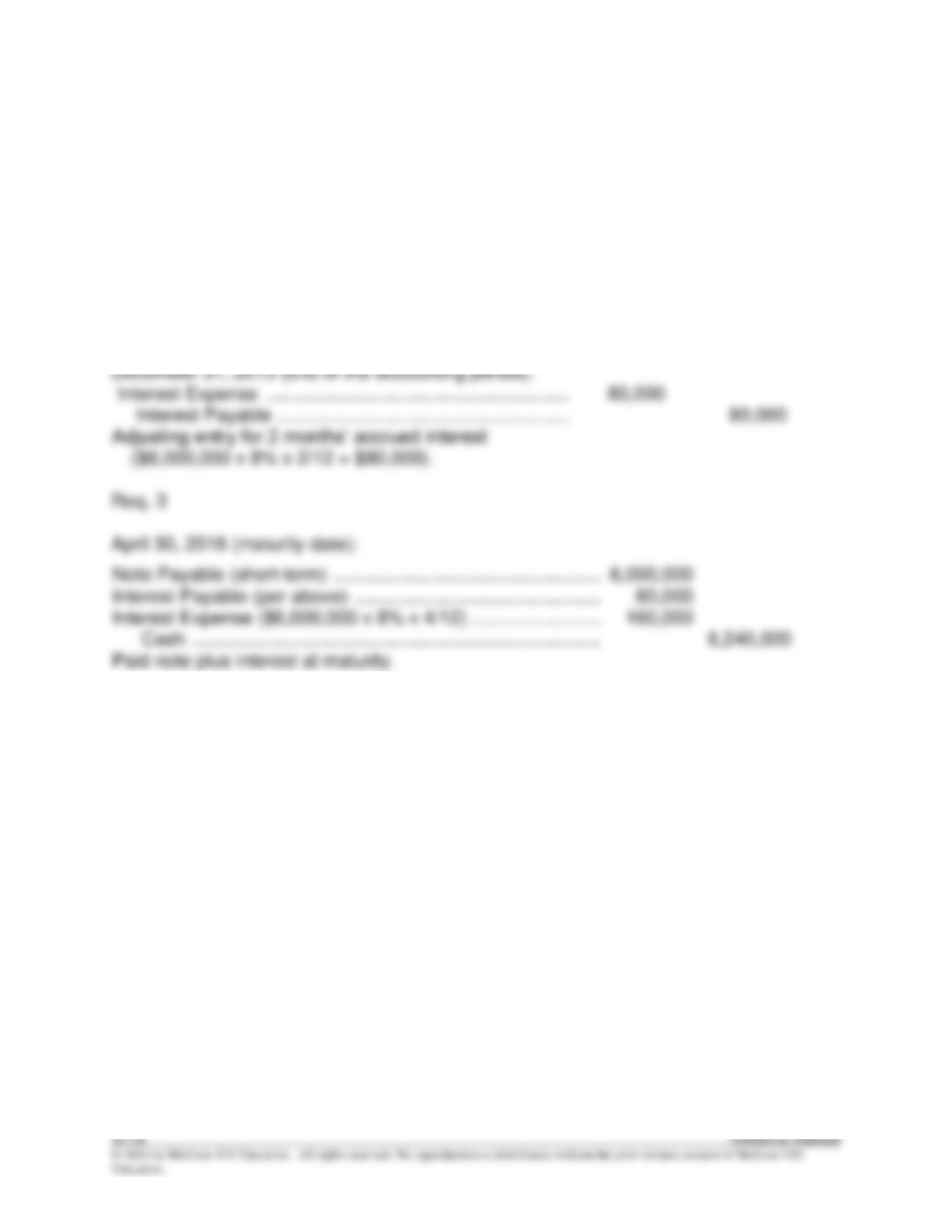
Interest Expense ………………………………………………….
80,000
Interest Payable ………………………………………………..
80,000
Adjusting entry for 2 months’ accrued interest
($6,000,000 x 8% x 2/12 = $80,000).
Req. 3
April 30, 2016 (maturity date):
Note Payable (short-term) ……………………………………………
6,000,000
Interest Payable (per above) ………………………………………..
80,000
Interest Expense ($6,000,000 x 8% x 4/12) …………………….
160,000
Cash ……………………………………………………………………
6,240,000
Paid note plus interest at maturity.
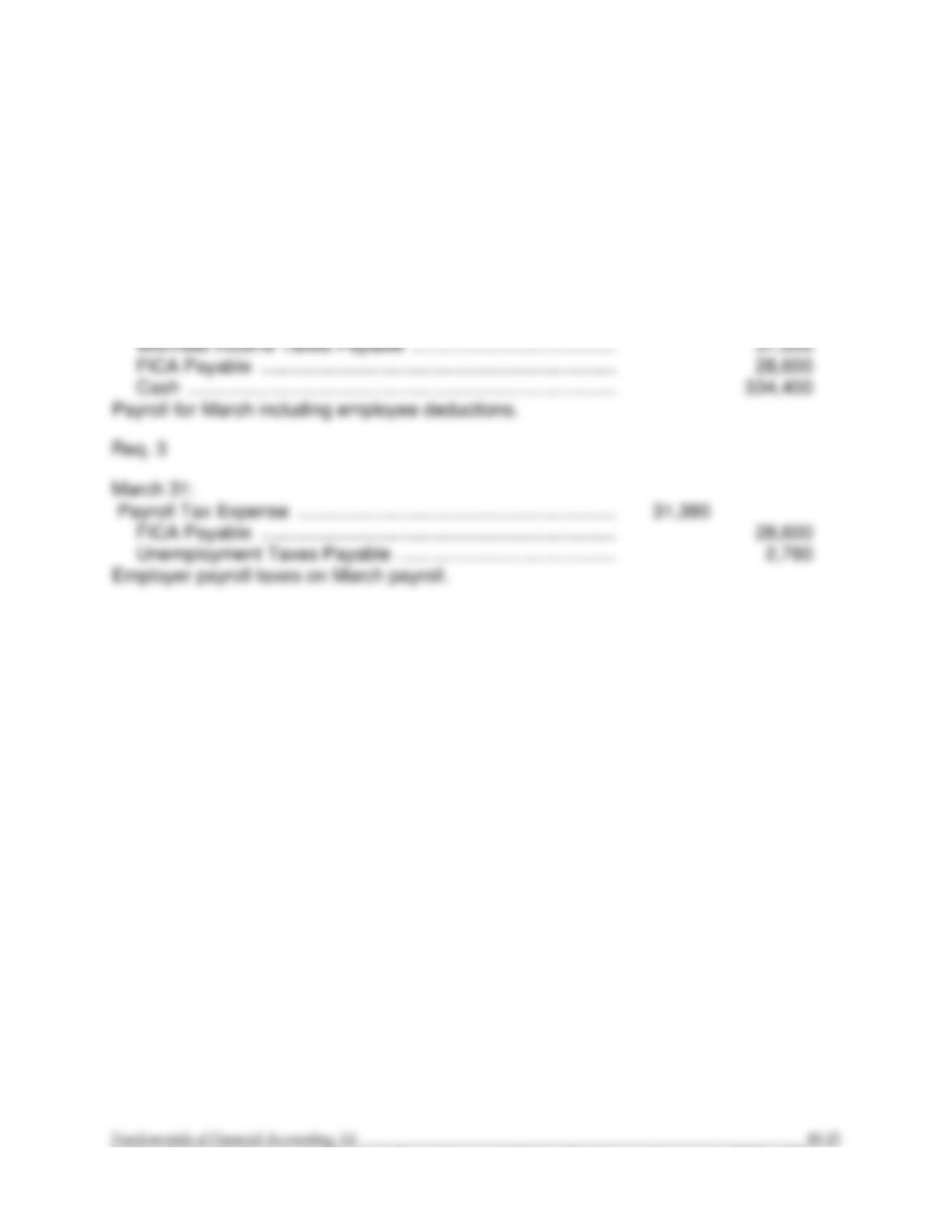
Payroll Tax Expense …………………………………………………….
FICA Payable …………………………………………………………..
28,600
Employer payroll taxes on March payroll.
E10–3
Req. 1
The total labor cost was $431,380, made up of the $400,000 in gross salaries and
wages plus the $28,600 for employer FICA taxes and $2,780 for unemployment taxes.
Req. 2
March 31:
Salaries and Wages Expense ………………………………………..
400,000
Withheld Income Taxes Payable …………………………………
37,000
FICA Payable …………………………………………………………..
28,600
Cash ……………………………………………………………………….
334,400
Payroll for March including employee deductions.
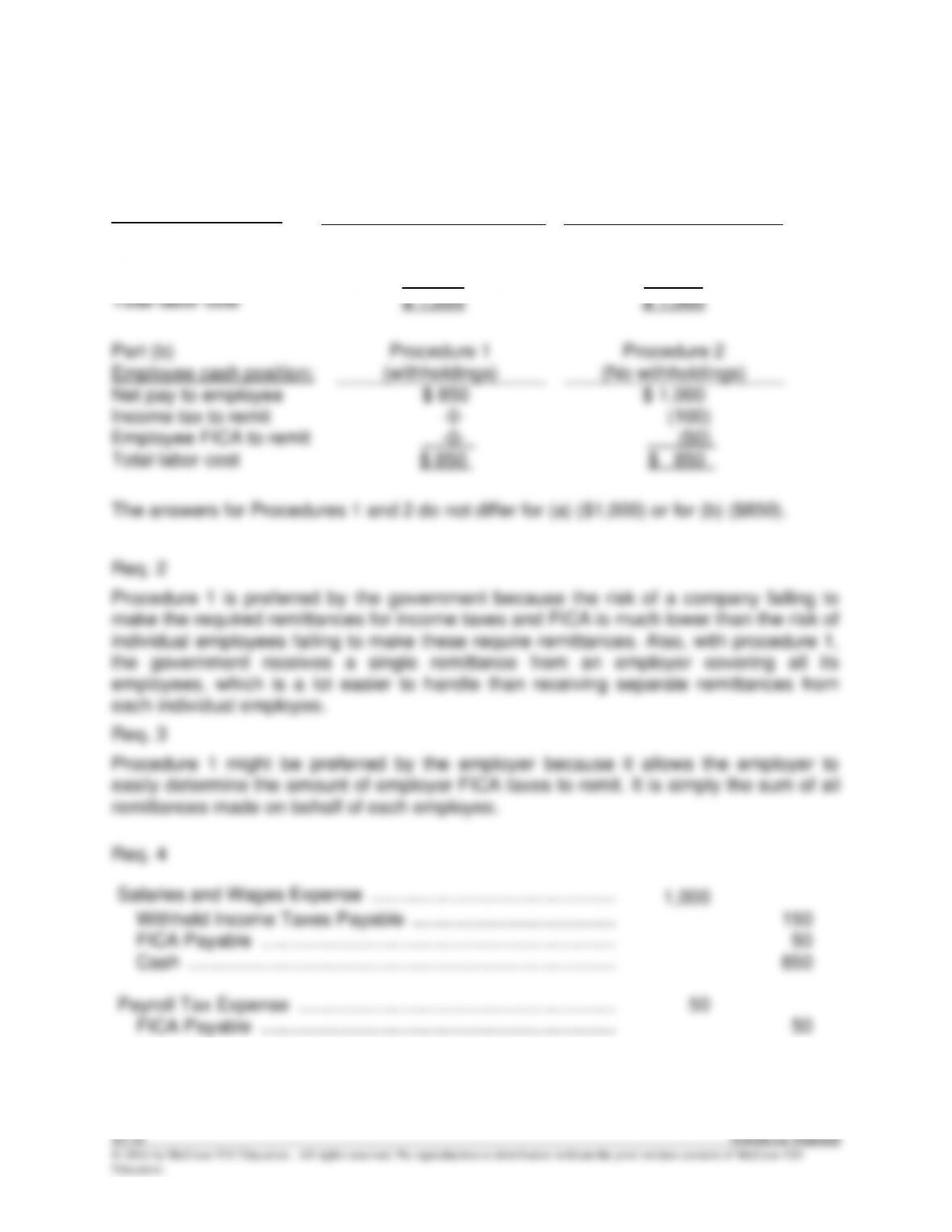
E10–4
Req. 1
Part (a)
Company payments:
Procedure 1
(withholdings)
Procedure 2
(No withholdings)
Net pay to employee
$ 850
$ 1,000
Income tax to remit
100
-0-
Employee FICA to remit
50
-0-
Total labor cost
$ 1,000
$ 1,000
Part (b)
Employee cash position:
Procedure 1
(withholdings)
Procedure 2
(No withholdings)
Net pay to employee
$ 850
$ 1,000
Income tax to remit
-0-
(100)
Employee FICA to remit
-0-
(50)
Total labor cost
$ 850
$ 850
The answers for Procedures 1 and 2 do not differ for (a) ($1,000) or for (b) ($850).
Req. 2
Procedure 1 is preferred by the government because the risk of a company failing to
make the required remittances for income taxes and FICA is much lower than the risk of
individual employees failing to make these require remittances. Also, with procedure 1,
the government receives a single remittance from an employer covering all its
employees, which is a lot easier to handle than receiving separate remittances from
each individual employee.
Req. 3
Procedure 1 might be preferred by the employer because it allows the employer to
easily determine the amount of employer FICA taxes to remit. It is simply the sum of all
remittances made on behalf of each employee.
Req. 4
Salaries and Wages Expense ………………………………………..
1,000
Withheld Income Taxes Payable …………………………………
150
FICA Payable …………………………………………………………..
50
Cash ……………………………………………………………………….
850
Payroll Tax Expense …………………………………………………….
50
FICA Payable …………………………………………………………..
50
© 2016 by McGraw-Hill Education. All rights reserved. No reproduction or distribution without the prior written consent of McGraw-Hill
Education.
E10–5
Req. 1
Date
Assets
Liabilities
Stockholders’
Equity
Jan. 10
Inventory + 18,000
Accounts Payable +18,000
March 1
Cash + 40,000
Note Payable + 40,000
Req. 2
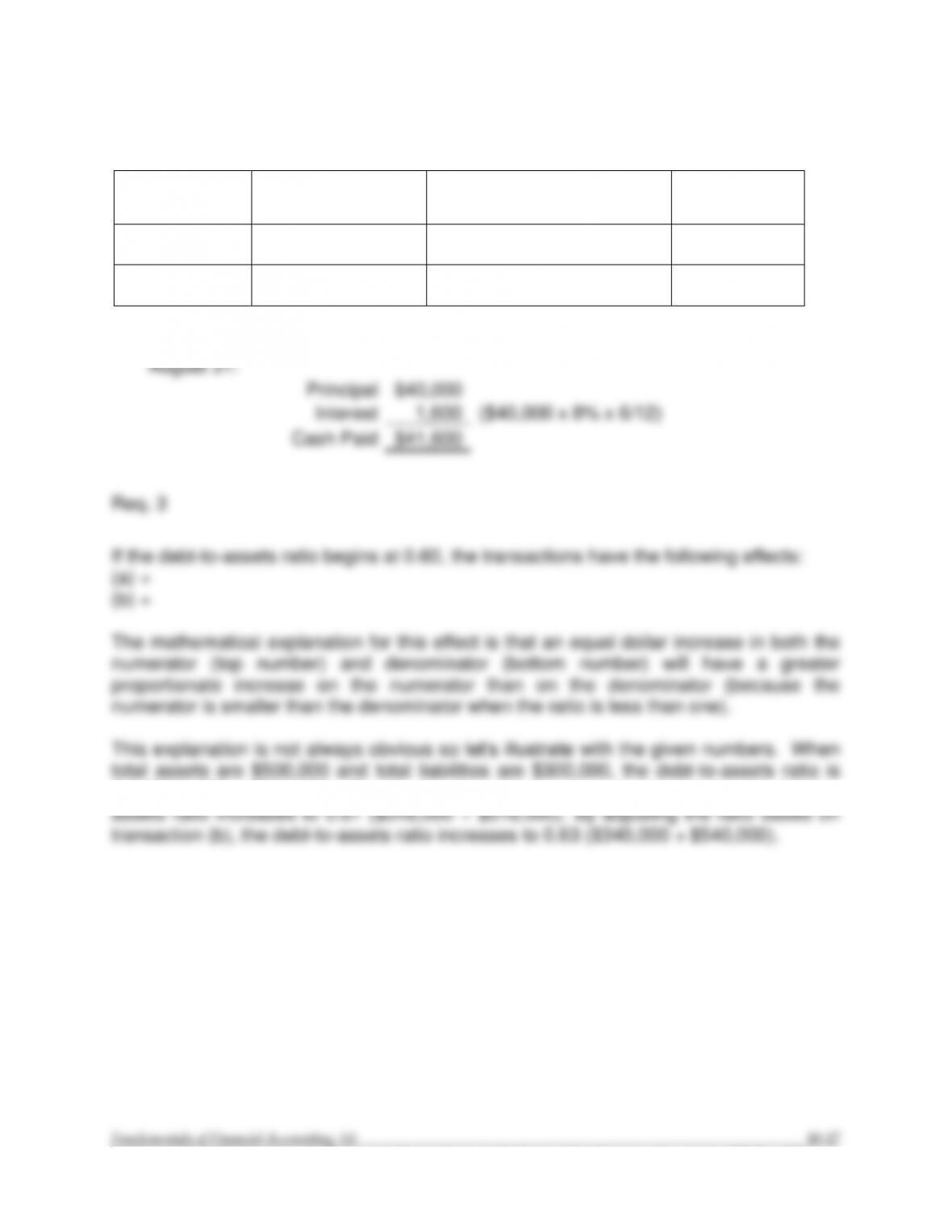
0.6 ($300,000 ÷ $500,000). By adjusting the ratio based on transaction (a), the debt–to–
E10–6
Req. 1
Assets
Liabilities
Stockholders’ Equity
(a)
Cash +420,000,000
Unearned Revenue +420,000,000
(b)
Unearned Revenue -204,000,000
Subscription Revenue
(+R) +204,000,000
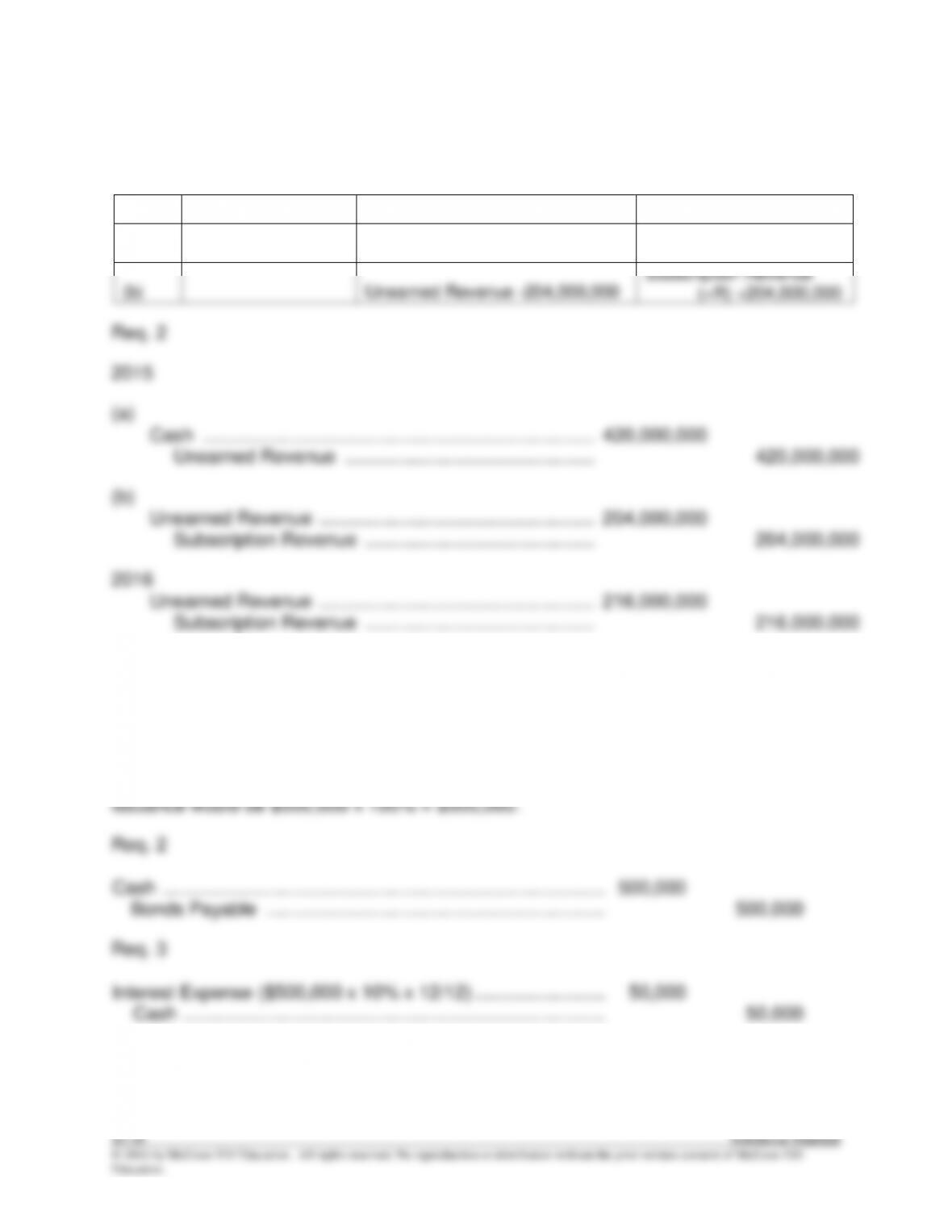
Req. 2
2015
(a)
Cash …………………………………………………………………..
420,000,000
Unearned Revenue …………………………………………..
420,000,000
(b)
Unearned Revenue ……………………………………………....
204,000,000
Subscription Revenue ……………………………………....
204,000,000
2016
Unearned Revenue ……………………………………………....
216,000,000
Subscription Revenue ……………………………………....
216,000,000
E10–7
Req. 1
Because the stated interest rate was equal to the market interest rate, the bond would
have been issued at face value, meaning a quoted price of 100. The amount received at
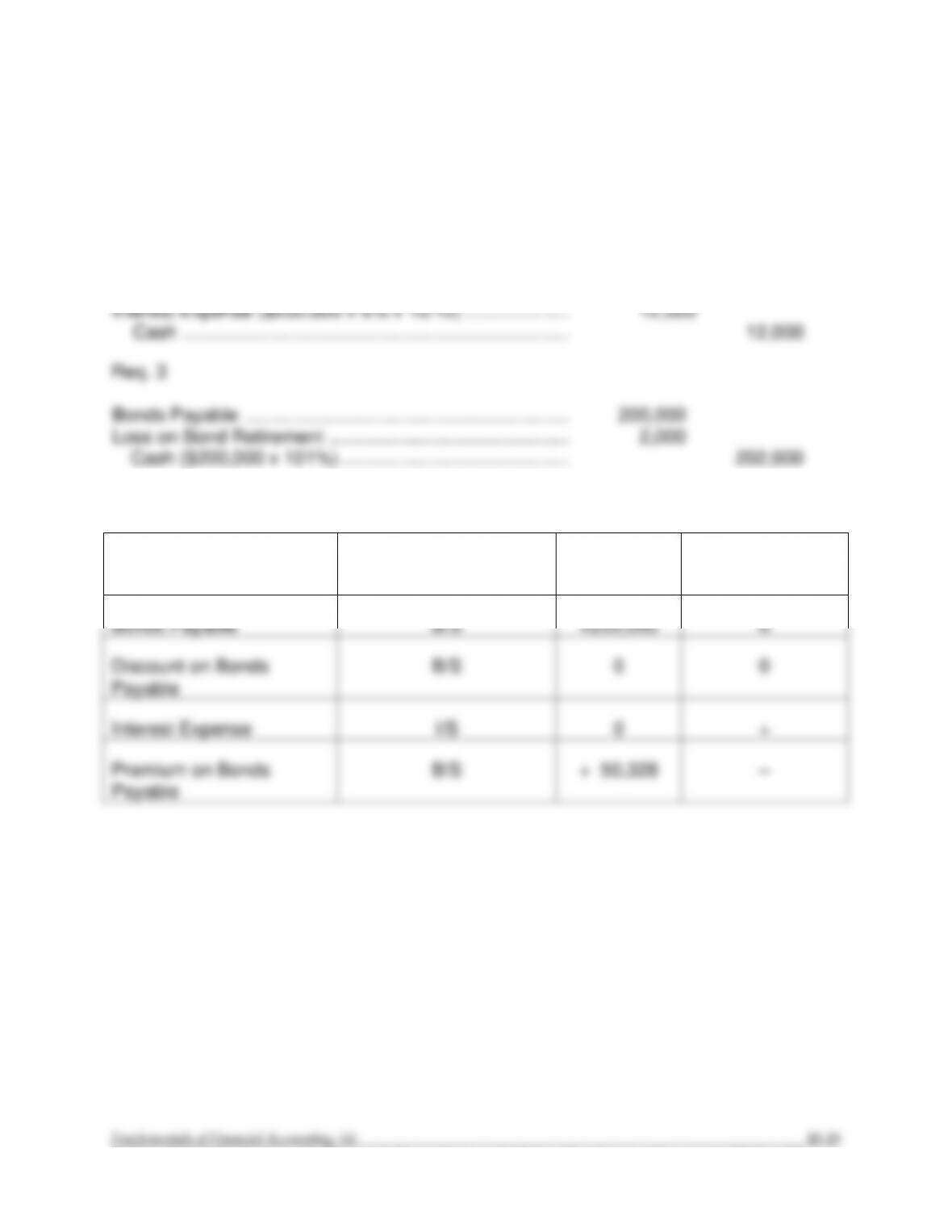
Cash ………………………………………………………………………….
Bonds Payable ………………………………………………………..
Interest Expense ($500,000 x 10% x 12/12) …………………….
© 2016 by McGraw-Hill Education. All rights reserved. No reproduction or distribution without the prior written consent of McGraw-Hill
Education.
E10–8
Req. 1
Cash ……………………………………………………………………
200,000
Bonds Payable ………………………………………………….
200,000
Req. 2
Interest Expense ($200,000 x 6% x 12/12) ………………..
12,000
Cash ………………………………………………………………..
12,000
Req. 3
Bonds Payable ……………………………………………………..
200,000
Loss on Bond Retirement ……………………………………….
2,000
Cash ($200,000 x 101%) ……………………………………..
202,000
E10–9
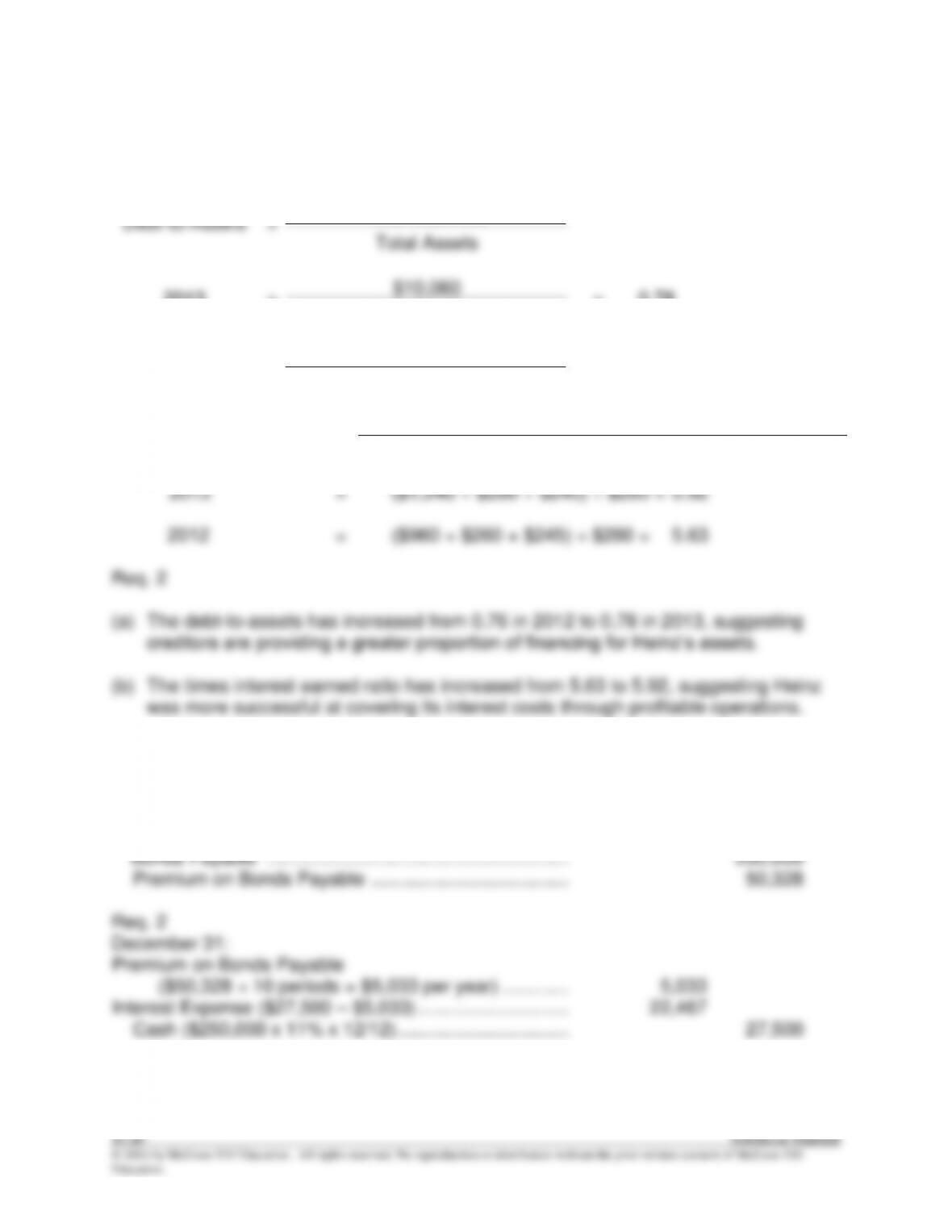
Account
(a) Financial
Statement
(b)
Issuance
(c) Interest Paid
Bonds Payable
B/S
+250,000
0
Discount on Bonds
Payable
B/S
0
0
Interest Expense
I/S
0
+
Premium on Bonds
Payable
B/S
+ 50,328
–
E10–10
Req. 1
Debt–to-Assets
=
Total Liabilities
Total Assets
2013
=
$10,060
=
0.78
$12,940
2012
=
$9,060
=
0.76
$12,000
Times Interest Earned
Ratio
=
Net Income + Interest Expense + Income Tax Expense
Interest Expense
E10–11
Req. 1
January 1:
Cash ……………………………………………………………………
300,328
Bonds Payable ………………………………………………….
250,000
Premium on Bonds Payable ………………………………..
50,328
Req. 2
December 31:
Premium on Bonds Payable
($50,328 ÷ 10 periods = $5,033 per year) ………….
5,033
Interest Expense ($27,500 – $5,033) ………………………..
22,467
Cash ($250,000 x 11% x 12/12) …………………………...
27,500
E10–12