© 2016 by McGraw-Hill Education. All rights reserved. No reproduction or distribution without the prior written consent of McGraw-Hill
Education.
Chapter 10
1. Liabilities are created when a company buys goods and services on credit, obtains
2. Liabilities are obligations that result from transactions that require future payment of
assets or the future performance of services. A liability usually has a definite
1) The initial amount of the liability. A liability is initially recorded at its cash
2) Additional amounts owed to the creditor. Liabilities are increased whenever
additional obligations arise, including interest charges that arise as time
passes.
4. An accrued liability is an expense that was incurred before the end of the current
period but has not been paid or recorded. Therefore, an accrued liability is
recognized when such a transaction is recorded. A typical example is wages
5. Unearned revenue is revenue that has been collected in advance of being earned.
6. An employer collects payroll taxes from its employees on behalf of the government.
When an employer withholds payroll taxes from its employees’ pay, the employer
7. Payroll deductions will reduce the amount paid to each employee, but they will not
reduce the total amount paid by the employer (because the employer must forward
deductions to the appropriate organization or government agency on behalf of the
8. (a) This year, the loan would be classified as a long-term liability. Only unpaid
9. A bond will issue at a discount or premium depending on whether lenders are
attracted to the bond’s features (primarily the interest rate). If the bond’s stated
10. The stated interest rate is the rate specified on the bond certificate, whereas the
11. (a) When a bond is issued at face value, the stated interest rate and the market
12. The carrying value of a bond payable is the bond liability on the issuer’s accounting
records owed at a specific date, after taking into account any unamortized bond
discount or premium. A bond issued at face value will have a carrying value equal

Interest Expense
=
Bonds Payable, Net
x
Interest Rate
x
Time
This same approach is used for bonds issued at either a discount or premium.
Education.
Authors’ Recommended Solution Time
(Time in minutes)
Mini-exercises
Exercises
Problems
Skills
Development
Cases*
Continuing Case
No.
Time
No.
Time
No.
Time
No.
Time
No.
Time
1
5
1
20
CP10-1
40
1
10
1
10
2
3
2
20
CP10-2
30
2
15
2
5
3
3
3
20
CP10-3
35
3
25
4
5
4
15
CP10-4
25
4
25
5
4
5
20
CP10-5
10
5
25
6
5
6
20
CP10-6
20
6
20
7
5
7
20
CP10-7
20
7
20
8
3
8
20
CP10-8
20
8
20
9
3
9
20
CP10-9
20
9
20
10
3
10
15
CP10–10
20
11
5
11
15
PA10-1
40
12
6
12
15
PA10-2
30
13
5
13
15
PA10-3
35
14
4
14
25
PA10-4
25
15
5
15
25
PA10-5
10
16
5
16
25
PA10-6
20
17
5
PA10-7
20
PA10-8
20
PB10-1
40
PB10-2
30
PB10-3
35
PB10-4
25
PB10-5
15
PB10-6
20
PB10-7
20
PB10-8
20
C10-1
25
* Due to the nature of cases, it is very difficult to estimate the amount of time students
will need to complete them. As with any open-ended project, it is possible for students
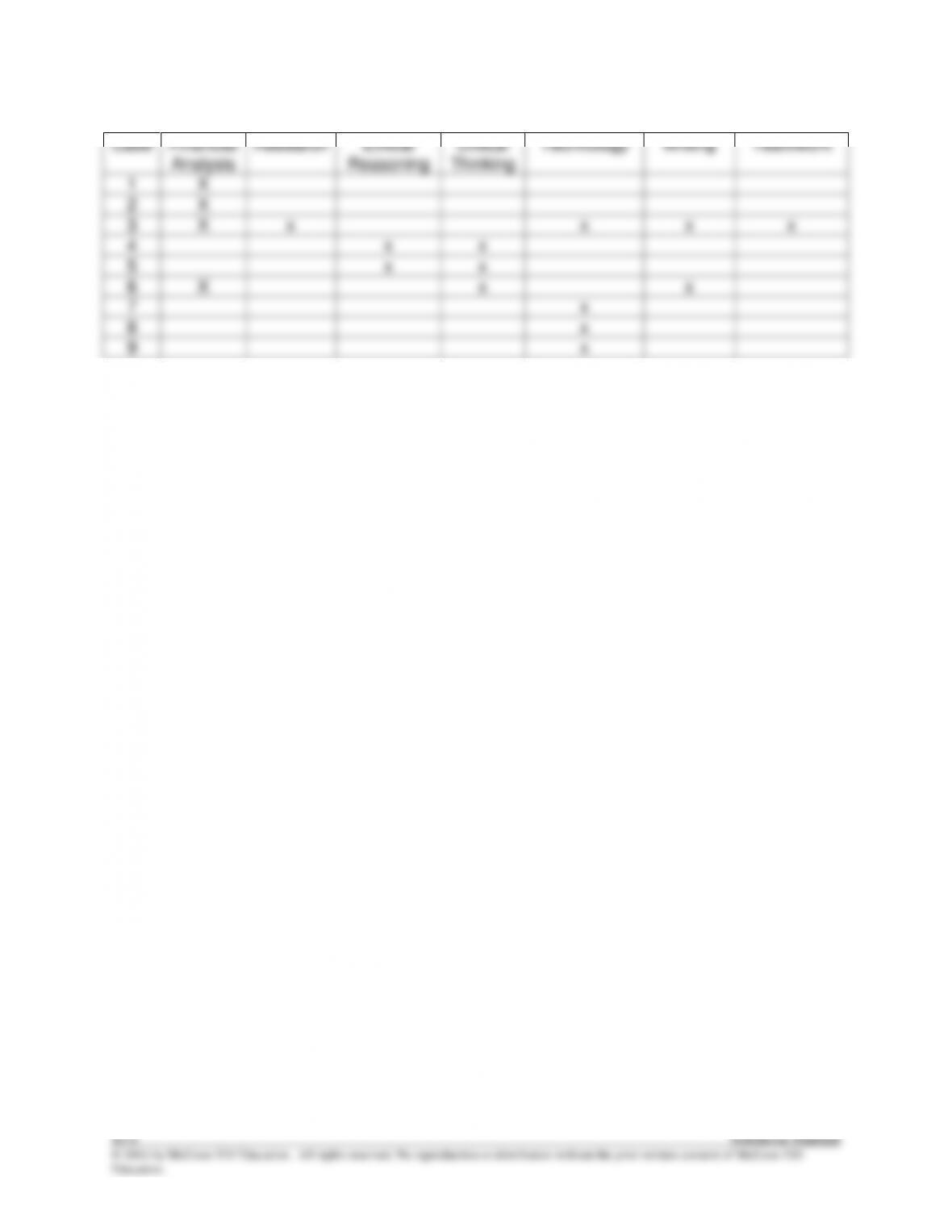
Case
Financial
Analysis
Research
Ethical
Reasoning
Critical
Thinking
Technology
Writing
Teamwork
1
X
2
X
3
X
x
x
x
x
4
x
x
5
x
x
6
X
x
x
7
x
8
x
9
x
© 2016 by McGraw-Hill Education. All rights reserved. No reproduction or distribution without the prior written consent of McGraw-Hill
Education.
ANSWERS TO MINI-EXERCISES
M10–1
Assets
Liabilities
Stockholders’ Equity
(a)
Cash + 375,000
Unearned Revenue + 375,000
(b)
Unearned Revenue – 37,500
Service
Revenue (+R) +37,500
(a) Before the first show:
Cash (1,500 x $250) ………………………………………….
375,000
Unearned Revenue ……………………………………..
375,000
(b) After the first show:
Unearned Revenue ($375,000 x 1/10 shows) ………..
37,500
Service Revenue ………………………………………..
37,500
M10–2
Assets
Liabilities
Stockholders’ Equity
Cash + 10,400
Inventory – 6,000
Sales Tax Payable + 400
Sales Revenue (+R) +10,000
CGS (+E) – 6,000
Cash ……………………………………………………………………
10,400
Sales Tax Payable ($10,000 x 4%) ……………………….
400
Sales Revenue ………………………………………………….
10,000
Cost of Goods Sold ……………………………………………….
6,000
Inventory ………………………………………………………….
6,000
M10–3
Gross salaries & wages $50,000
Employee income tax withheld (7,000)
=
+
=
+
M10–4
Salaries and Wages Expense …………………………………
50,000
Withheld Income Taxes Payable ………………………….
7,000
FICA Payable ……………………………………………………
2,625
Cash ………………………………………………………………..
40,375
Payroll Tax Expense …………………………..…………………
2,875
FICA Payable ……………………………………………………
2,625
Unemployment Taxes Payable …………………………….
250
M10–5
As of December 31
2016
2015
Current Liabilities:
Current Portion of Long-term Debt
$3,000
$ 2,000
Long-term Debt
10,000
13,000
Total Liabilities
$ 13,000
$ 15,000
M10–6
Assets
Liabilities
Stockholders’ Equity
(a)
Cash + 1,000,000
Note Payable (short) + 1,000,000
(b)
Interest Payable + 15,000
Interest
Expense (+E) -15,000
(a) November 1, 2015:
Cash ……………………………………………………………………
1,000,000
Note Payable (short-term) …………………………………..
1,000,000
(b) December 31, 2015:
Interest Expense ($1,000,000 x 9% x 2/12) ……………….
15,000
Interest Payable ………………………………………………..
15,000
M10–7
December 31, 2015
Current Liabilities:
=
+
© 2016 by McGraw-Hill Education. All rights reserved. No reproduction or distribution without the prior written consent of McGraw-Hill
Education.
M10–8
Because the bond quote price of 140.2 is greater than 100, we know the bonds are
M10–9
The bonds could be reported on the balance sheet using one of two alternative formats:
(1) show the discount being subtracted from the face value, as follows:
Long-term Liabilities
Bonds Payable
Discount on Bonds Payable
Carrying Value
$500,000
(15,000)
485,000
or (2) show only the net amount, as follows:
Long-term Liabilities
Bonds Payable, Net
$485,000
Note: The discount is calculated as the excess of the face value ($500,000) over the
issue price ($485,000 = 97% x $500,000).
M10–10
(1) show the premium being added to the face value, as follows:
Long-term Liabilities
Bonds Payable
Premium on Bonds Payable
Carrying Value
$500,000
10,000
510,000
or (2) show only the net amount, as follows:
Long-term Liabilities
Bonds Payable, Net
$510,000
Note: The premium is calculated as the excess of the issue price ($510,000 = 102% x
$500,000) over the face value ($500,000).
M10–11
Assets
Liabilities
Stockholders’ Equity
(a)
Cash + 2,500,000*
Bonds Payable + 2,500,000
(b)
Cash – 125,000
Interest
Expense (+E) -125,000
(a) January 1:
Cash ……………………………………………………………………
2,500,000*
Bonds Payable ………………………………………………….
2,500,000
(b) December 31:
Interest Expense ($2,500,000 x 5% x 12/12) ……………..
125,000
Cash ……………………………………………………….……….
125,000
* 25,000 bonds x $100 face value per bond
M10–12
2013 Buzz must disclose in a note that a potential liability exists because the
liability is possible.
2014 Buzz must disclose the liability in a note because the trial judgment makes
=
+