S1-3
S1-4
Req. 1
The accounting concept that the Rigas family is accused of violating is the separate
entity assumption.
Req. 2
Based on the limited information available, it is difficult to categorize particular dealings
as appropriate or inappropriate. Dealings would clearly be inappropriate if they involved
Adelphia paying for items for the owners’ personal use or to unfairly transfer some of
S1-5
Req. 1
You should take the position that an independent annual audit of the financial
statements is an absolute must. This is the best way to ensure that the financial
statements are complete, are free from bias, and conform with GAAP. You should be
S1-6
Req. 1
A balance sheet lists items owned (assets) and owed (liabilities) at a particular point in
time, producing a “net worth” that represents the excess of assets over liabilities. Two
balance sheets are presented below, one based on historical costs (similar to GAAP)
and one based on fair values (similar to a personal financial planning approach). Notes
S1-6 (continued):
Req. 1 (continued)
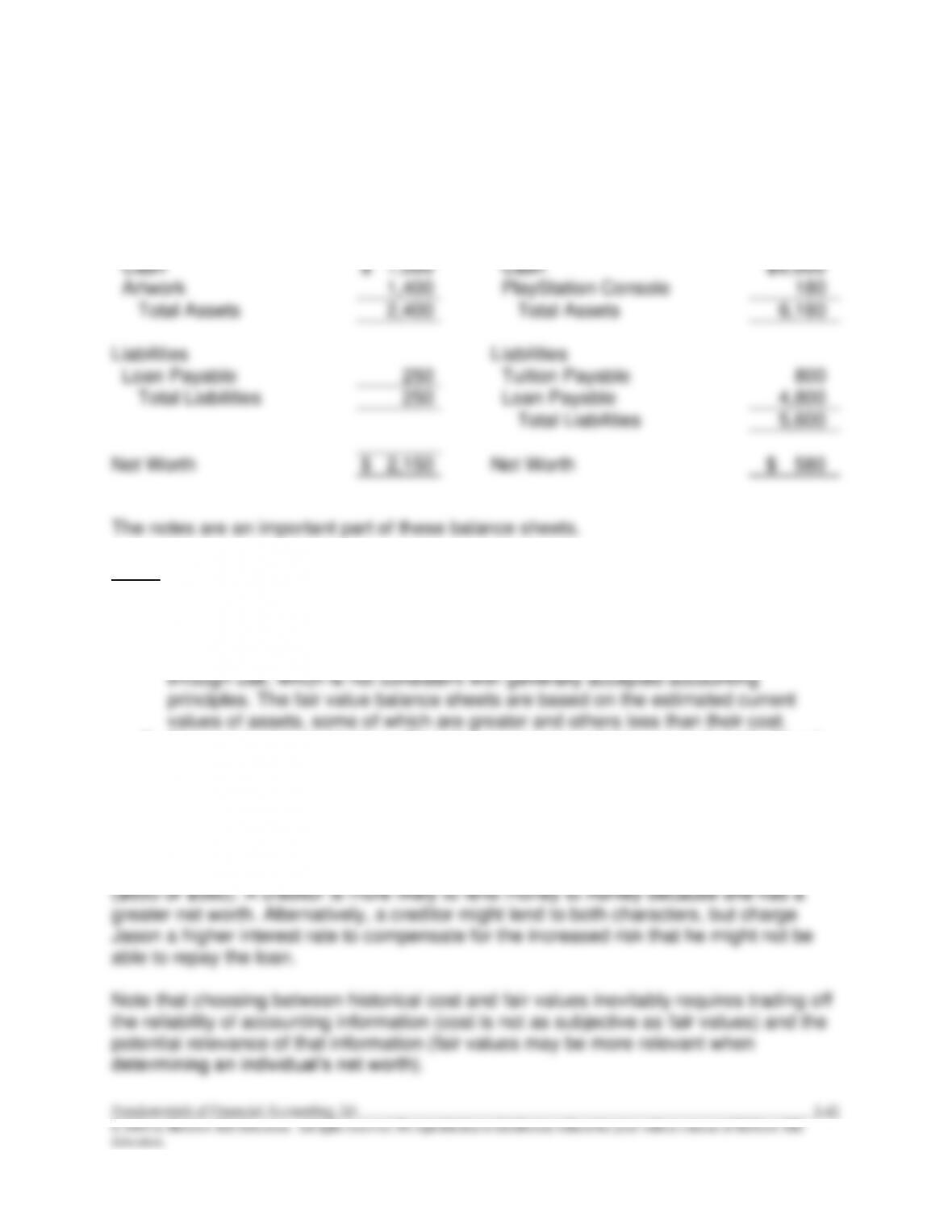
Based on fair value:
Ashley
Jason
Assets
Assets
Cash
$ 1,000
Cash
$ 6,000
Artwork
1,400
PlayStation Console
180
Total Assets
2,400
Total Assets
6,180
Liabilities
Liabilities
Loan Payable
250
Tuition Payable
800
Total Liabilities
250
Loan Payable
4,800
Total Liabilities
5,600
Net Worth
$ 2,150
Net Worth
$ 580
The notes are an important part of these balance sheets.
Notes:
1) The goal in preparing these balance sheets is to estimate each individual’s net
worth, represented as the excess of assets over liabilities.
2) Use of historical cost is consistent with generally accepted accounting principles.
Note that these asset values have not been adjusted for “value” consumed
3) Some potential assets (e.g., Porsche) are not recorded because their likelihood
of occurrence is not certain.
Req. 2
Based on the calculations of net worth and underlying assumptions indicated above,
Ashley is “better off” because her net worth ($1,550 or $2,150) is greater than Jason’s
S1-6 (continued):
Req. 3
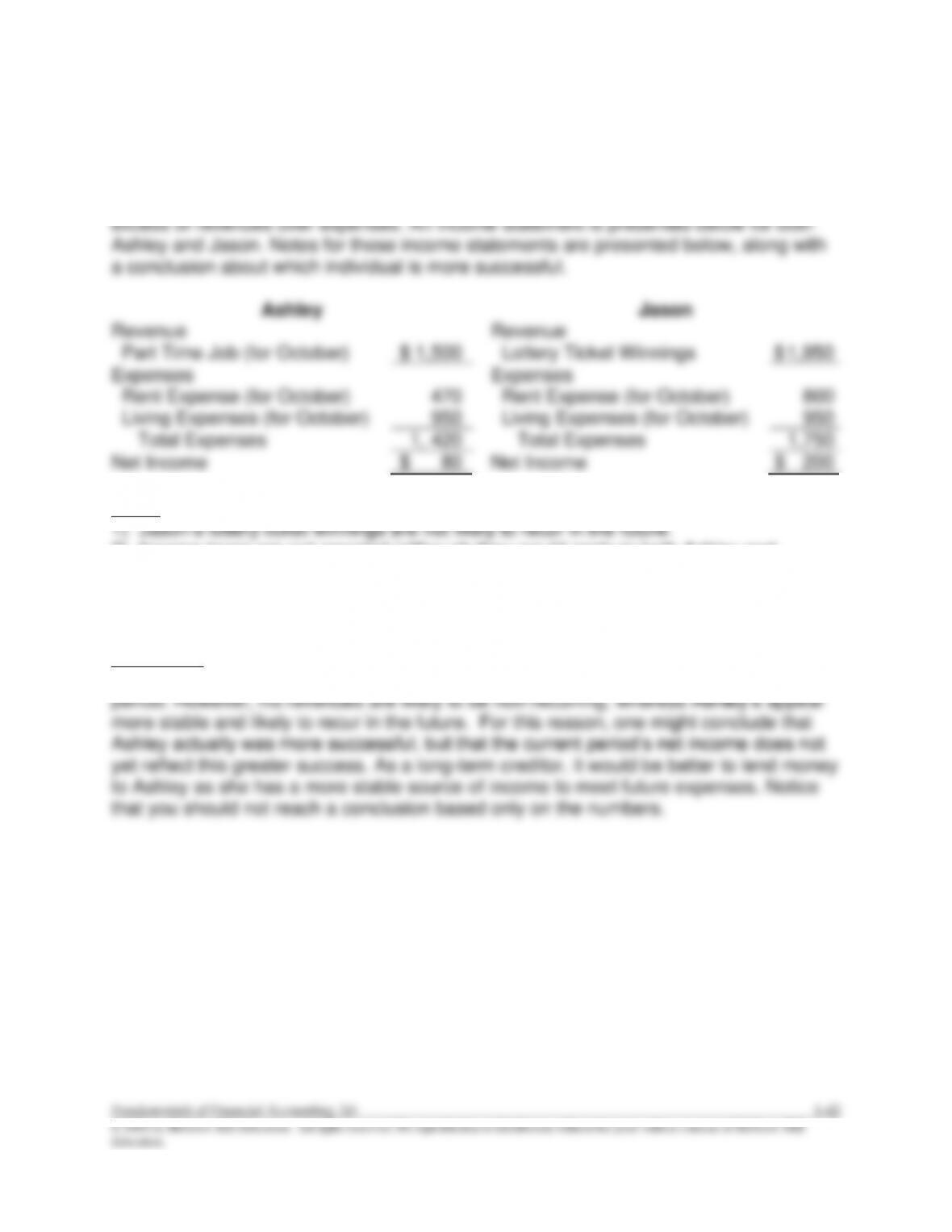
An income statement lists the amounts earned (revenues) and costs incurred
(expenses) during a particular period of time, producing “net income” that represents the
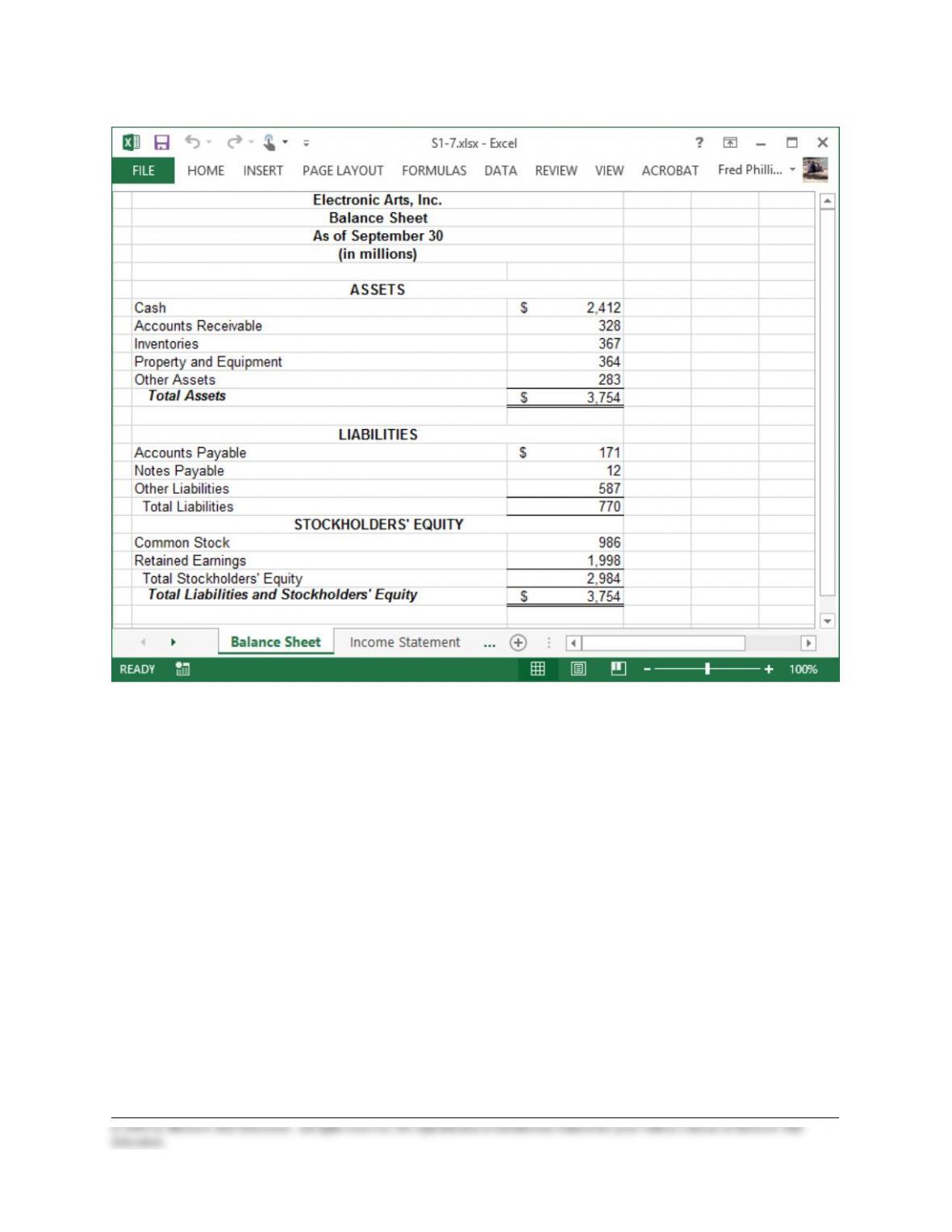
Fundamentals of Financial Accounting, 5/e 1-43
S1-7
Fundamentals of Financial Accounting, 5/e 1-44
© 2016 by McGraw-Hill Education. All rights reserved. No reproduction or distribution without the prior written consent of McGraw–Hill
Education.
S1-7 (continued)
ANSWERS TO CONTINUING CASE
CC1-1
Req. 1
NICOLE’S GETAWAY SPA
Income Statement (forecasted)
For the Year Ended December 31, 2015
Revenues:
Sales Revenue
$ 40,000
Expenses:
Salaries and Wages Expense
24,000
Supplies Expense
7,000
Office Expenses
5,000
Income Tax Expense
1,600
Total Expenses
37,600
Net Income
$ 2,400
CC1-1 (continued)
Req. 2
NICOLE’S GETAWAY SPA
Statement of Retained Earnings (forecasted)
For the Year Ended December 31, 2015
Retained Earnings, January 1, 2015
$ 0
Add: Net Income
Subtract: Dividends
2,400
(2,000)
Retained Earnings, December 31, 2015
$ 400
Req. 3
NICOLE’S GETAWAY SPA
Balance Sheet (forecasted)
At December 31, 2015
Assets:
Cash
Accounts Receivable
Building and Equipment
Total Assets
$ 2,150
1,780
70,000
$73,930
Liabilities:
Accounts Payable
Notes Payable
Total Liabilities
$ 4,660
38,870
43,530
30,000
400
30,400
Stockholders’ Equity:
Common Stock
Retained Earnings
Total Stockholders’ Equity
Total Liabilities and Stockholders’ Equity
$73,930
Req. 4
As of December 31, 2015, more financing is expected to come from creditors ($43,530)
than from stockholders ($30,400).