Chapter 1
Business Decisions and Financial Accounting
ANSWERS TO QUESTIONS
2. An advantage of operating as a sole proprietorship, rather than a corporation, is that
it is easy to establish. Another advantage is that income from a sole proprietorship
3. Financial accounting focuses on preparing and using the financial statements that
are made available to owners and external users such as customers, creditors, and
4. Financial reports are used by both internal and external groups and individuals. The
5. The business itself, not the individual stockholders who own the business, is viewed
as owning the assets and owing the liabilities on its balance sheet. A business’s
6. (a) Operating – These activities are directly related to earning profits. They include
buying supplies, making products, serving customers, cleaning the premises,
advertising, renting a building, repairing equipment, and obtaining insurance
coverage.
7. The heading of each of the four primary financial statements should include the
following:
8. (a) The purpose of the balance sheet is to report the financial position (assets,
liabilities and stockholders’ equity) of a business at a point in time.
(b) The purpose of the income statement is to present information about the
9. The income statement, statement of retained earnings, and statement of cash flows
would be dated “For the Year Ended December 31, 2015,” because they report the
10. Net income is the excess of total revenues over total expenses. A net loss occurs if
total expenses exceed total revenues.
11. The accounting equation for the balance sheet is: Assets = Liabilities +
Stockholders’ Equity. Assets are the economic resources controlled by the
12. The equation for the income statement is Revenues – Expenses = Net Income.
Revenues are increases in a company’s resources, arising primarily from its
13. The equation for the statement of retained earnings is: Beginning Retained
Earnings + Net Income – Dividends = Ending Retained Earnings. It begins with
14. The equation for the statement of cash flows is: Cash flows from operating activities
+ Cash flows from investing activities + Cash flows from financing activities =
Change in cash for the period. Change in cash for the period + Beginning cash
15. Currently, the Financial Accounting Standards Board (FASB) is given the primary
responsibility for setting the detailed rules that become Generally Accepted
16. The main goal of accounting rules is to ensure that companies produce useful
financial information for present and potential investors, lenders, and other creditors
Fundamentals of Financial Accounting, 5/e 1-4
17. An ethical dilemma is a situation where following one moral principle would result in
violating another. Three steps that should be considered when evaluating ethical
dilemmas are:
18. Accounting frauds and cases involving academic dishonesty are similar in many
respects. Both involve deceiving others in an attempt to influence their actions or
decisions, often resulting in temporary personal gain for the deceiver. For example,
when an accounting fraud is committed, financial statement users may be misled
into making decisions they wouldn’t have made had the fraud not occurred (e.g.,
adverse long-term consequences for the perpetrator. Fraudsters may be fined,
imprisoned, and encounter an abrupt end to their careers. Students who cheat may
be penalized through lower course grades or expulsion, and might find it impossible
to obtain academic references for employment applications.
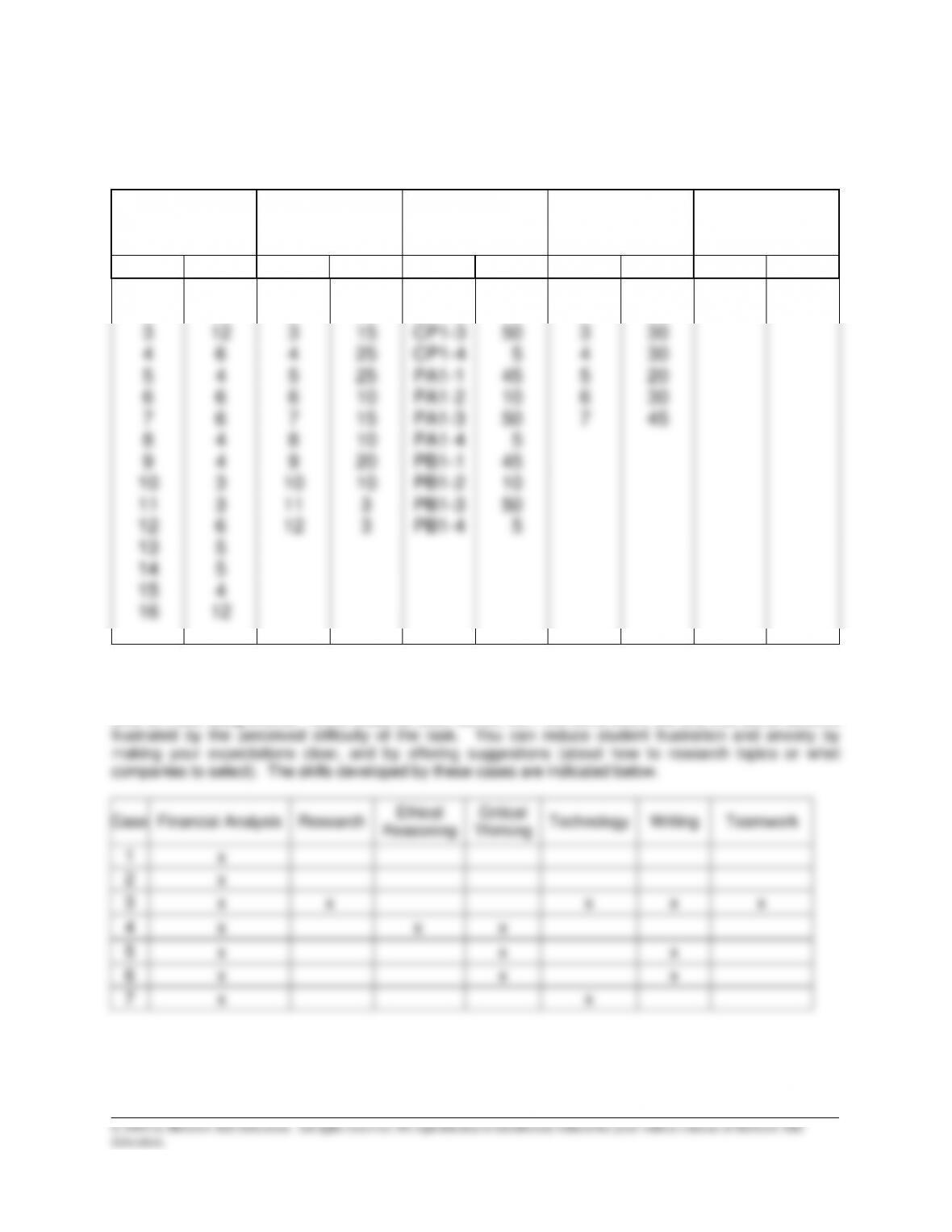
Authors’ Recommended Solution Time
(Time in minutes)
Mini-exercises
Exercises
Problems
Skills
Development
Cases*
Continuing Case
No.
Time
No.
Time
No.
Time
No.
Time
No.
Time
1
3
1
10
CP1-1
45
1
20
1
45
2
12
2
10
CP1-2
10
2
20
3
12
3
15
CP1-3
50
3
30
4
6
4
25
CP1-4
5
4
30
5
4
5
25
PA1-1
45
5
20
6
6
6
10
PA1-2
10
6
30
7
6
7
15
PA1-3
50
7
45
8
4
8
10
PA1-4
5
9
4
9
20
PB1-1
45
10
3
10
10
PB1-2
10
11
3
11
3
PB1-3
50
12
6
12
3
PB1-4
5
13
5
14
5
15
4
16
12
* Due to the nature of cases, it is very difficult to estimate the amount of time students will need to
complete them. As with any open-ended project, it is possible for students to devote a large amount of
time to these assignments. While students often benefit from the extra effort, we find that some become
ANSWERS TO MINI-EXERCISES
M1–1
Abbreviation
Full Designation
(1)
CPA
Certified Public Accountant
(2)
GAAP
Generally Accepted Accounting Principles
(3)
FASB
Financial Accounting Standards Board
(4)
SEC
Securities and Exchange Commission
(5)
IFRS
International Financial Reporting Standards
M1–2
I
F
D
E
A
C
J
G
B
L
K
H
(1)
(2)
(3)
(4)
(5)
(6)
(7)
(8)
(9)
(10)
(11)
(12)
SEC
Investing activities
Private company
Corporation
Accounting
Partnership
FASB
Financing activities
Unit of measure
GAAP
Public company
Operating activities
A. A system that collects and processes financial
information about an organization and reports that
information to decision makers.
B. Measurement of information about a business in the
monetary unit (dollars or other national currency).
C. An unincorporated business owned by two or more
persons.
D. A company that sells shares of its stock privately and is
not required to release its financial statements to the
public.
E. An incorporated business that issues shares of stock
as evidence of ownership.
F. Buying and selling productive resources with long lives.
G. Transactions with lenders (borrowing and repaying
cash) and stockholders (selling company stock and
paying dividends).
earn profit.
J. Financial Accounting Standards Board.
investors on established stock exchanges .
Fundamentals of Financial Accounting, 5/e 1-7
M1–3
Term Definition
F
C
E
A
B
H
D
G
(1)
(2)
(3)
(4)
(5)
(6)
(7)
(8)
Relevance
Faithful Representation
Expenses
Separate Entity
Assets
Liabilities
Stockholders’ Equity
Revenues
A. The financial reports of a business are assumed
to include the results of only that business’s
activities.
B. The resources owned by a business.
C. Financial information that depicts the economic
substance of business activities.
D. The total amounts invested and reinvested in the
business by its owners.
E. The costs of business necessary to earn
revenues.
F. A feature of financial information that allows it to
influence a decision.
G. Earned by selling goods or services to
customers.
H. The amounts owed by the business.
M1–4
Statement
Account Type
Cash (Example)
B/S
A
(1) Accounts Payable
B/S
L
(2) Accounts Receivable
B/S
A
(3) Income Tax Expense
I/S
E
(4) Sales Revenue
I/S
R
(5) Notes Payable
B/S
L
(6) Retained Earnings
B/S
SE
M1–5
Statement
Account Type
(1) Accounts Receivable
B/S
A
(2) Sales Revenue
I/S
R
(3) Equipment
B/S
A
(4) Supplies Expense
I/S
E
(5) Cash
B/S
A
(6) Advertising Expense
I/S
E
(7) Accounts Payable
B/S
L
(8) Retained Earnings
B/S
SE
Fundamentals of Financial Accounting, 5/e 1-8
M1–6
Type
Statement
(1) Accounts Receivable
A
B/S
(2) Office Expenses
E
I/S
(3) Cash
A
B/S
(4) Equipment
A
B/S
(5) Advertising Expense
E
I/S
(6) Sales Revenue
R
I/S
(7) Notes Payable
L
B/S
(8) Retained Earnings
SE
B/S
(9) Accounts Payable
L
B/S
M1–7
Type
Statement
(1) Accounts Payable
L
B/S
(2) Common Stock
SE
B/S
(3) Equipment
A
B/S
(4) Accounts Receivable
A
B/S
(5) Notes Payable
L
B/S
(6) Cash
A
B/S
(7) Retained Earnings
SE
B/S
(8) Office Expenses
E
I/S
(9) Sales Revenue
R
I/S
(10) Supplies
A
B/S
M1–8
Type
Statement
(1) Dividends
D
SRE
(2) Common Stock
SE
B/S
(3) Sales Revenue
R
I/S
(4) Equipment
A
B/S
(5) Cash
A
B/S
(6) Note Payable
L
B/S
(7) Accounts Payable
L
B/S
(8) Retained Earnings, Beginning of Year
SE
SRE
Fundamentals of Financial Accounting, 5/e 1-9
M1–9
Element
Financial Statement
D
(1) Cash Flows from Financing Activities
A. Balance Sheet
B
(2) Expenses
B. Income Statement
D
(3) Cash Flows from Investing Activities
C. Statement of Retained Earnings
A
(4) Assets
D. Statement of Cash Flows
C
(5) Dividends
B
(6) Revenues
D
(7) Cash Flows from Operating Activities
A
(8) Liabilities
M1–10
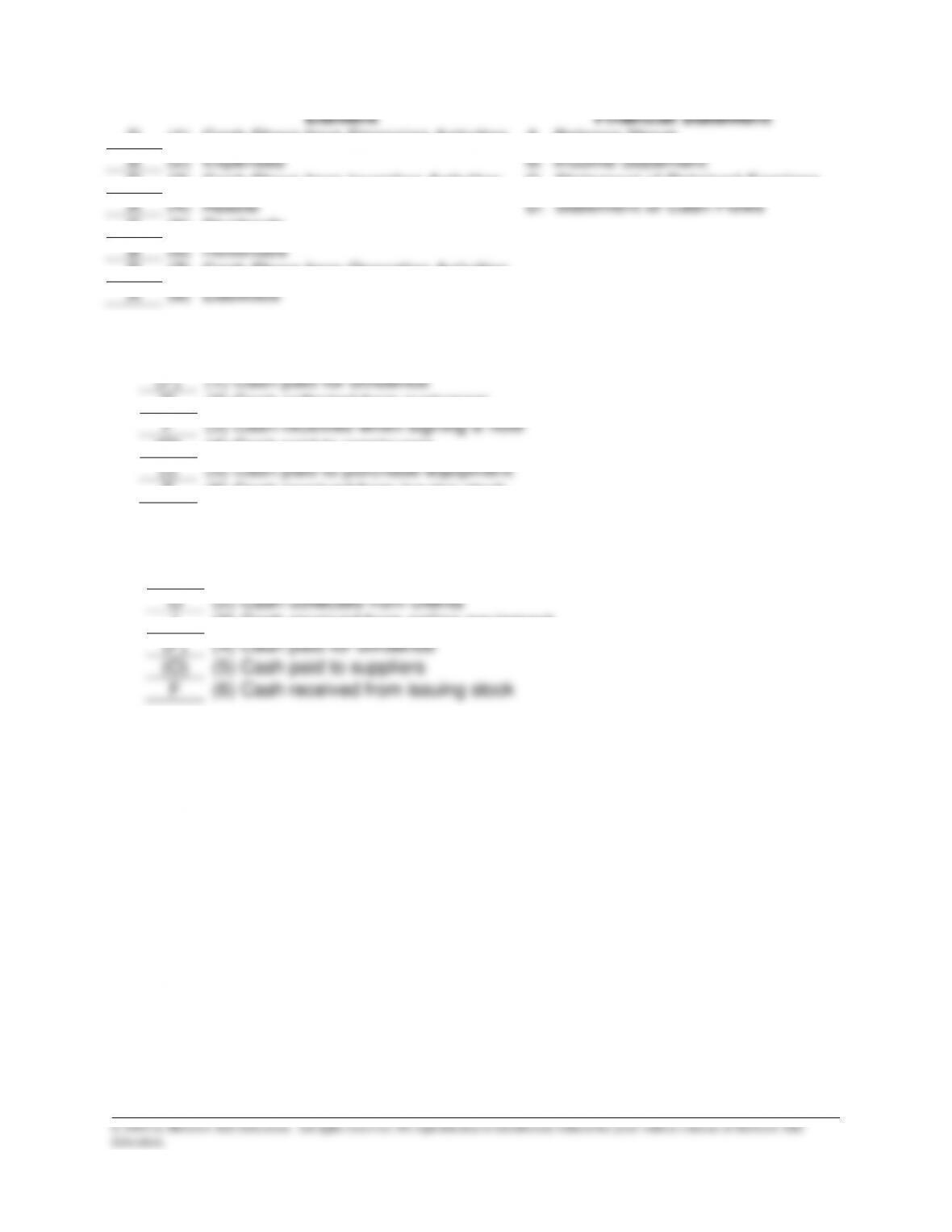
(F)
(1) Cash paid for dividends
O
(2) Cash collected from customers
F
(3) Cash received when signing a note
(O)
(4) Cash paid to employees
(I)
(5) Cash paid to purchase equipment
F
(6) Cash received from issuing stock
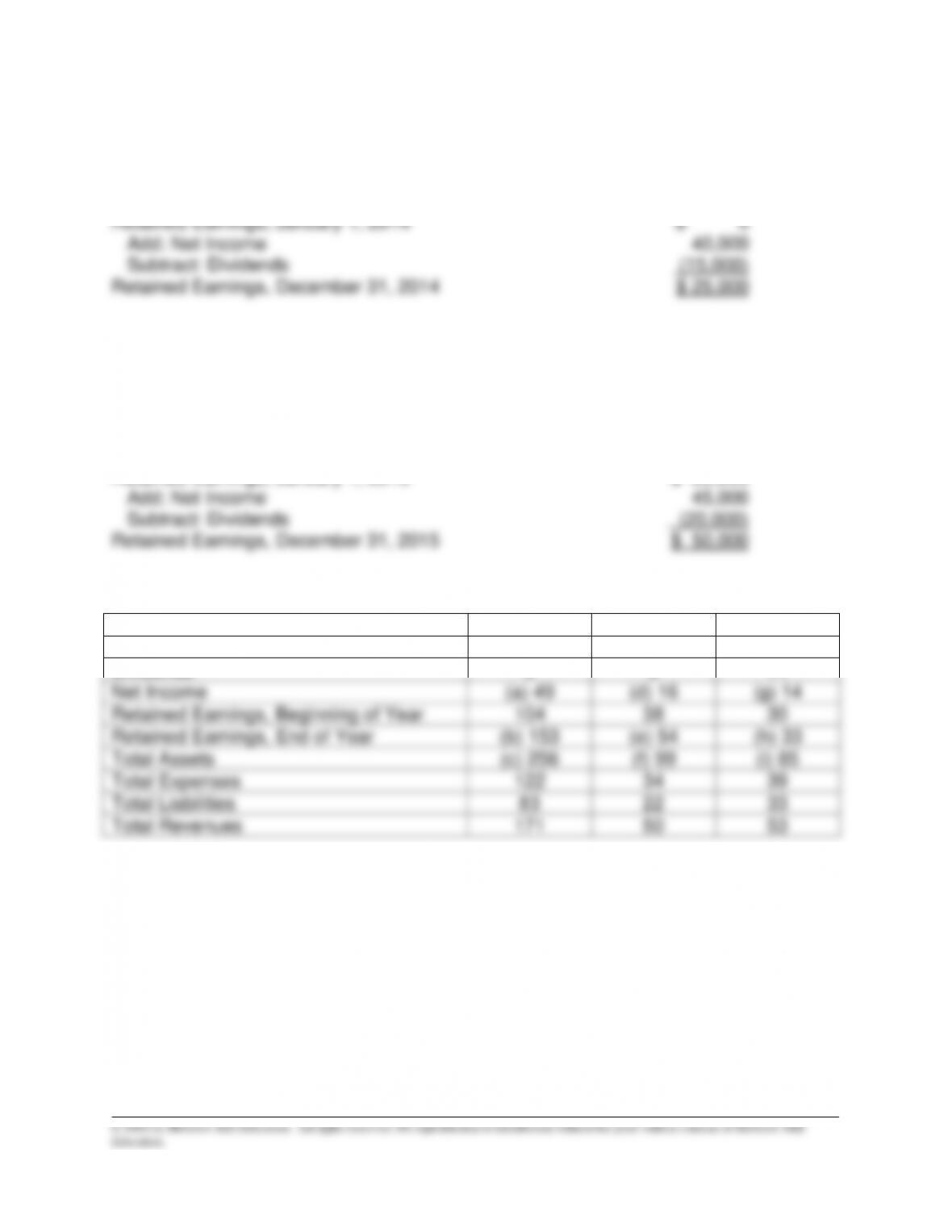
M1–11
(I)
(1) Cash paid to purchase land
O
(2) Cash collected from clients
I
(3) Cash received from selling equipment
(F)
(4) Cash paid for dividends
(O)
(5) Cash paid to suppliers
F
(6) Cash received from issuing stock
Fundamentals of Financial Accounting, 5/e 1-10
M1–12
STONE CULTURE CORPORATION
Statement of Retained Earnings
For the Year Ended December 31, 2014
STONE CULTURE CORPORATION
Statement of Retained Earnings
For the Year Ended December 31, 2015
Retained Earnings, January 1, 2015 $ 25,000
M1–13
Apple, Inc.
Google, Inc.
Intel Corp.
Common Stock
$20
$23
$19
Dividends
0
0
11
Net Income
(a) 49
(d) 16
(g) 14
Retained Earnings, Beginning of Year
104
38
30
Retained Earnings, End of Year
(b) 153
(e) 54
(h) 33
Total Assets
(c) 256
(f) 99
(i) 85
Total Expenses
122
34
39
Total Liabilities
83
22
33
Total Revenues
171
50
53