Chapter 08 – Reporting and Analyzing Long-Term Assets
Chapter 8
1. A plant asset is tangible; it is used in the production or sale of other assets or services;
2. The cost of a plant asset includes all normal and reasonable expenditures necessary to
3. Land is an asset with an unlimited life and, therefore, is not subject to depreciation.
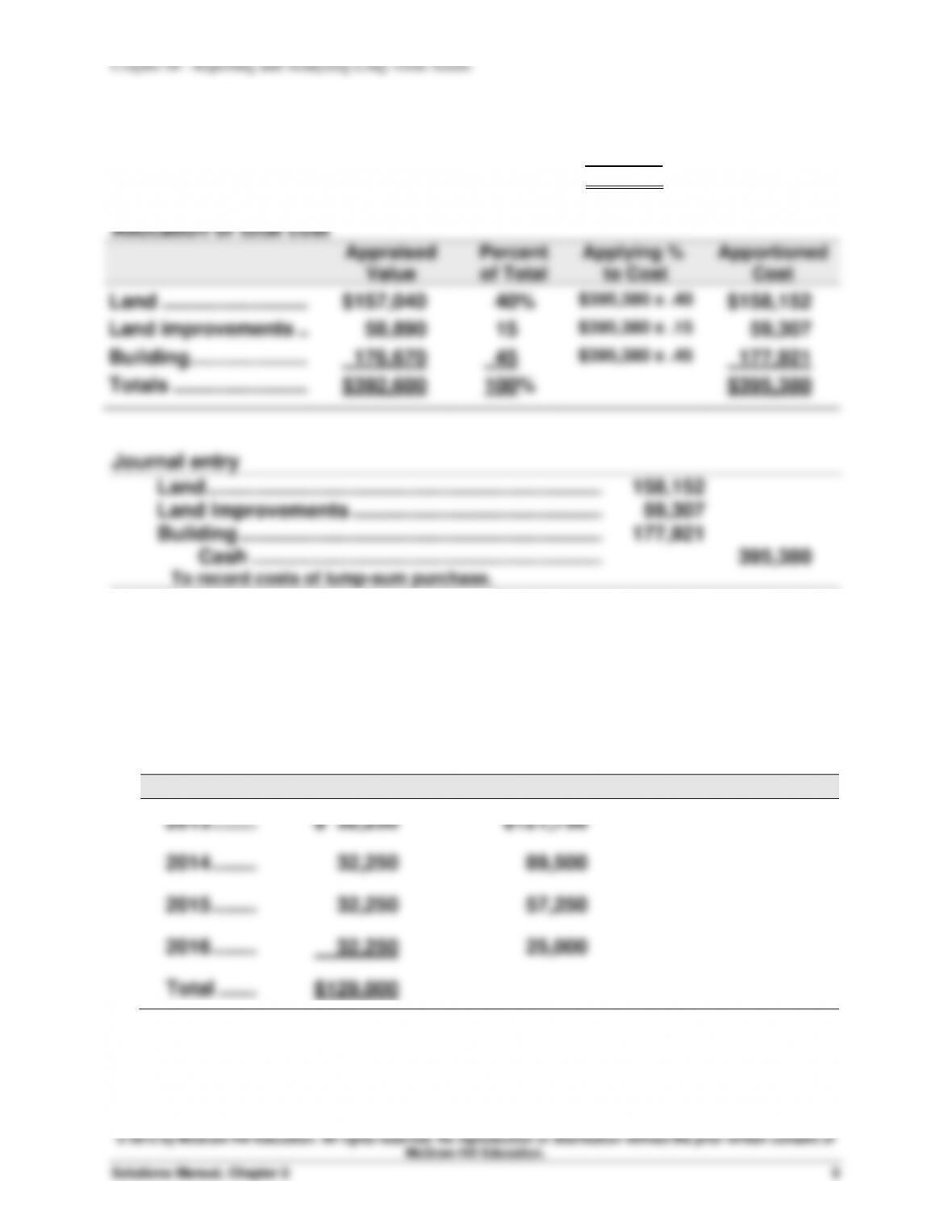
4. Often the lump-sum or basket purchase includes assets with different lives that must be
5. The Accumulated Depreciation—Machinery account is a contra asset account with a
credit balance that cannot be used to buy anything. The balance of the Accumulated
6. The Modified Accelerated Cost Recovery System is not generally acceptable for financial
7. The materiality constraint justifies charging low-cost plant asset purchases to expense
8. Ordinary repairs are made to keep a plant asset in normal, good operating condition, and
9. A company might sell or exchange an asset when it reaches the end of its useful life, or
10. The process of allocating the cost of natural resources to expense over the periods
11. No, depletion expense should be calculated on the units that are extracted (similar to the
12. An intangible asset: (1) has no physical existence; (2) derives value from the unique
13. Intangible assets are generally recorded at their cost and amortized over their predicted
useful life. (However, some costs are not included, such as the research and
14. A company has goodwill when its value exceeds the value of its individual assets and
15. No; this type of goodwill would not be amortized. Instead, the FASB (SFAS 142) requires
that goodwill be annually tested for impairment. If the book value of goodwill does not
16. Total asset turnover is calculated by dividing net sales by average total assets.
17. The word “net” means that Apple is reporting its property and equipment after deducting
18. Google lists “Property and equipment, net” on the balance sheet. The net book value of
19. Samsung titles its plant assets “Property, plant and equipment.” The book value of its
20. Samsung reports the following long-term assets that are discussed in this chapter:
21. (a) The main difference between plant assets and current assets is that current assets
are consumed or converted into cash within a short period of time, while plant assets
have a useful life of more than one accounting period.
© 2015 by McGraw-Hill Education. All rights reserved. No reproduction or distribution without the prior written consent of
McGraw-Hill Education.
Solutions Manual, Chapter 8
3
Quick Study 8-1 (10 minutes)
1. Expensed
2. Capitalized—Equipment
3. Capitalized—Equipment (Reduce the cost of)
4. Capitalized—Land
5. Expensed
6. Expensed
7. Capitalized—Building
8. Capitalized—Building
Quick Study 8-2 (10 minutes)
Quick Study 8-3 (10 minutes)
Quick Study 8-4 (10 minutes)
($65,800 – $2,000) / 200 concerts = $ 319 depreciation per concert
Quick Study 8-5 (10 minutes)
$65,800
Cost
– 15,950
Accumulated depreciation (first year)
49,850
Book value at point of revision
– 2,000
Salvage value
47,850
Remaining depreciable cost
÷ 2
Years of life remaining
$23,925
Depreciation per year for years 2 and 3
Quick Study 8-6 (10 minutes)
Note: Double-declining-balance rate = (100% / 8 years) x 2 = 25%
First year:
Quick Study 8-7 (10 minutes)
Impairment Loss …………………………………………………....
1,250
Accumulated Depreciation—Equipment …………..
1,250
To record impairment of equipment.
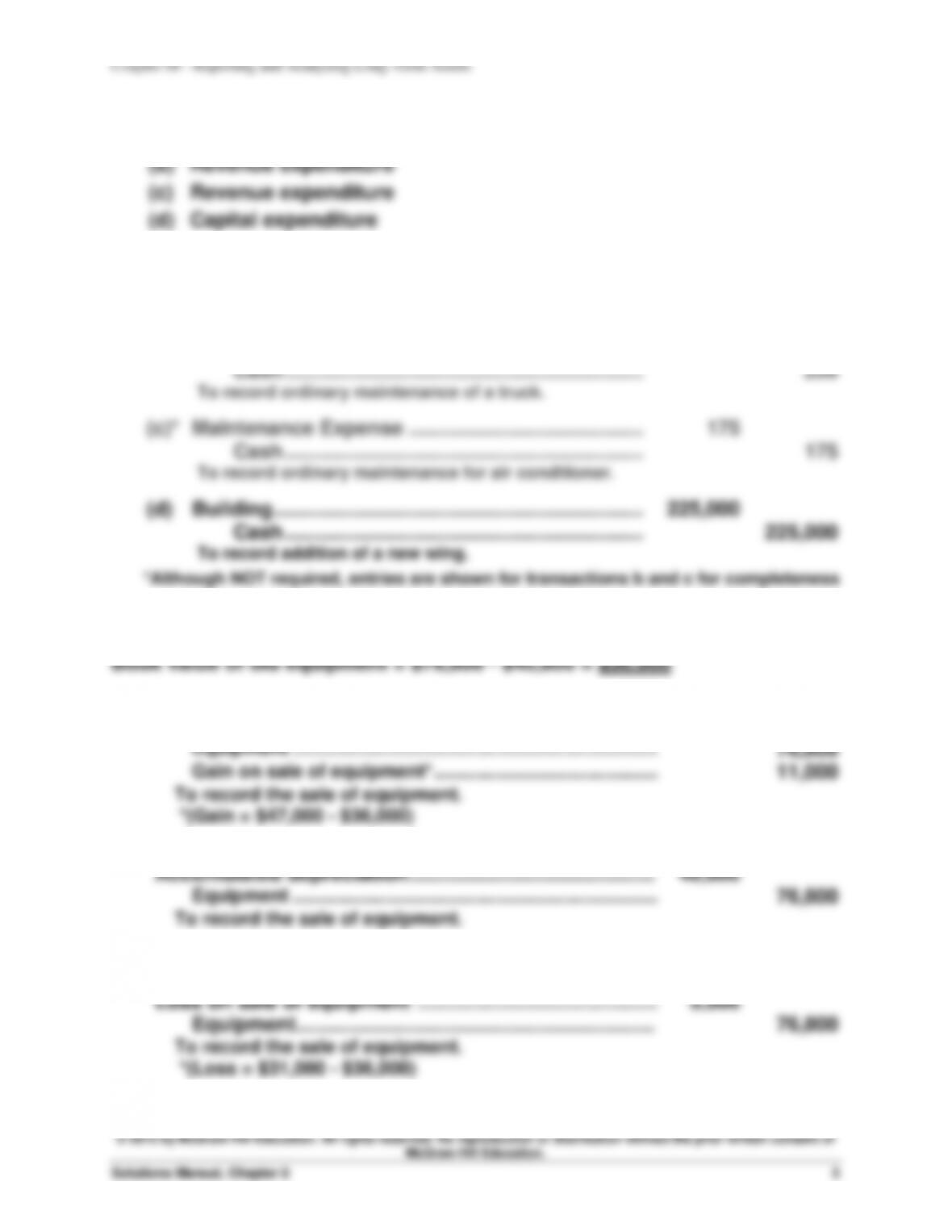
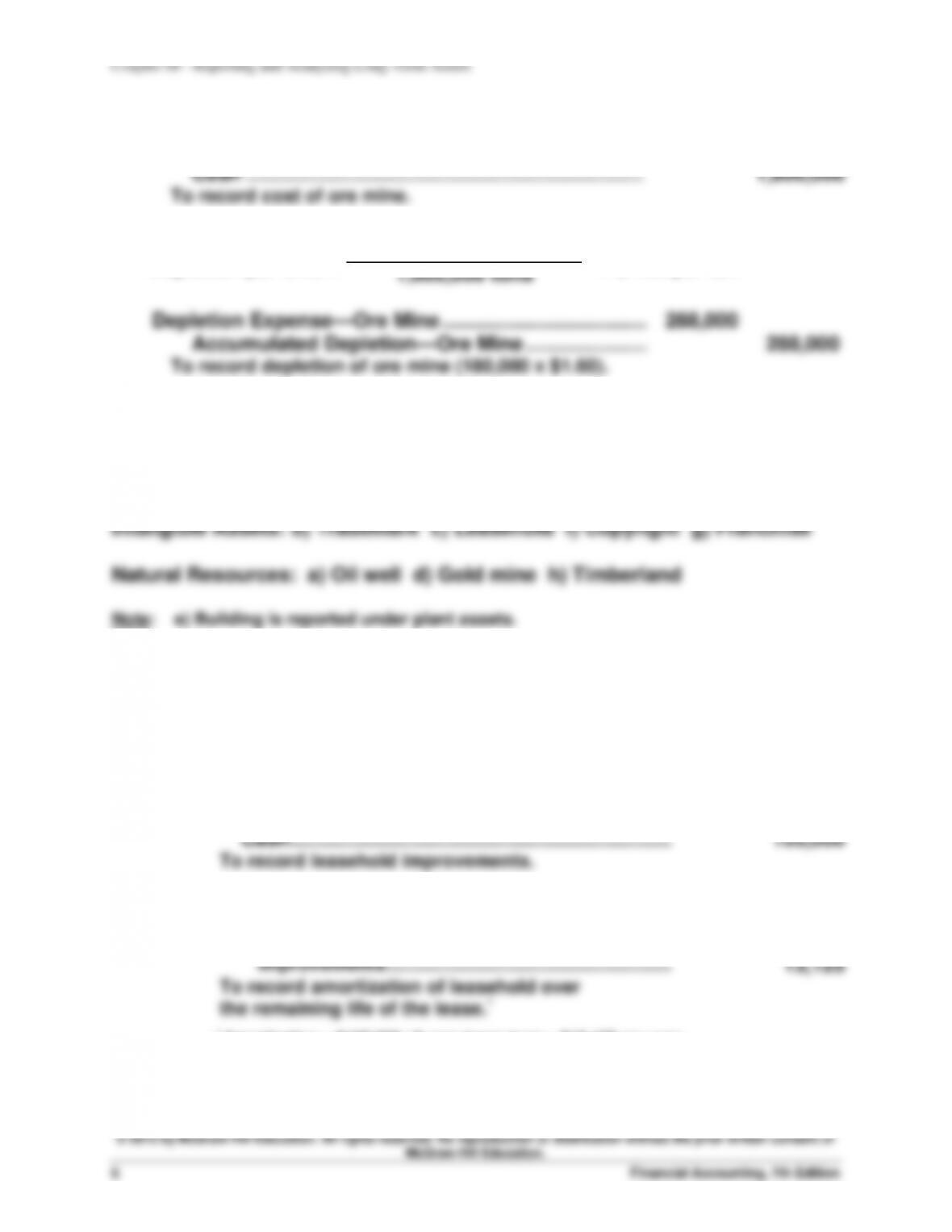
Quick Study 8-10 (10 minutes)
1.
Ore Mine ………………………………………………………………..
1,800,000
Cash ……………………………………………………………....
1,800,000
To record cost of ore mine.
2.
Depletion per unit = = $1.60 per ton
Depletion Expense—Ore Mine ………………………………..
288,000
Accumulated Depletion—Ore Mine …………………..
288,000
To record depletion of ore mine (180,000 x $1.60).
Quick Study 8-11 (10 minutes)
Quick Study 8-12 (10 minutes)
1.
Jan. 4
Leasehold Improvements …………………………………..……
105,000
Cash …………………………………………………………..……
105,000
To record leasehold improvements.
2.
Dec. 31
Amortization Expense–Leasehold Improvements …………
13,125
Accumulated Amortization—Leasehold
Improvements …………………………………………………
13,125
To record amortization of leasehold over
the remaining life of the lease.*
* Amortization = $105,000 / 8-year-lease-term = $13,125 per year.
$1,800,000 – $200,000
1,000,000 tons
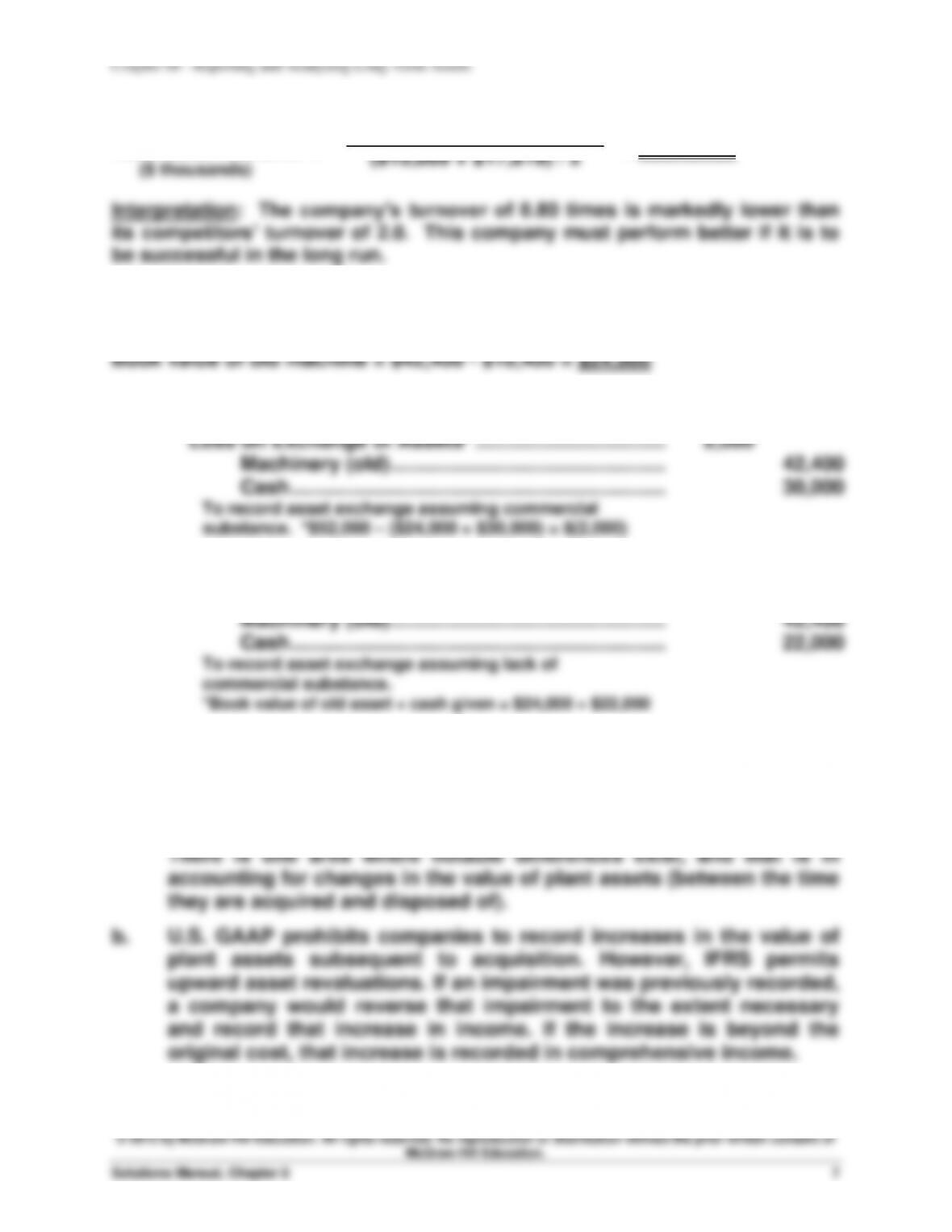
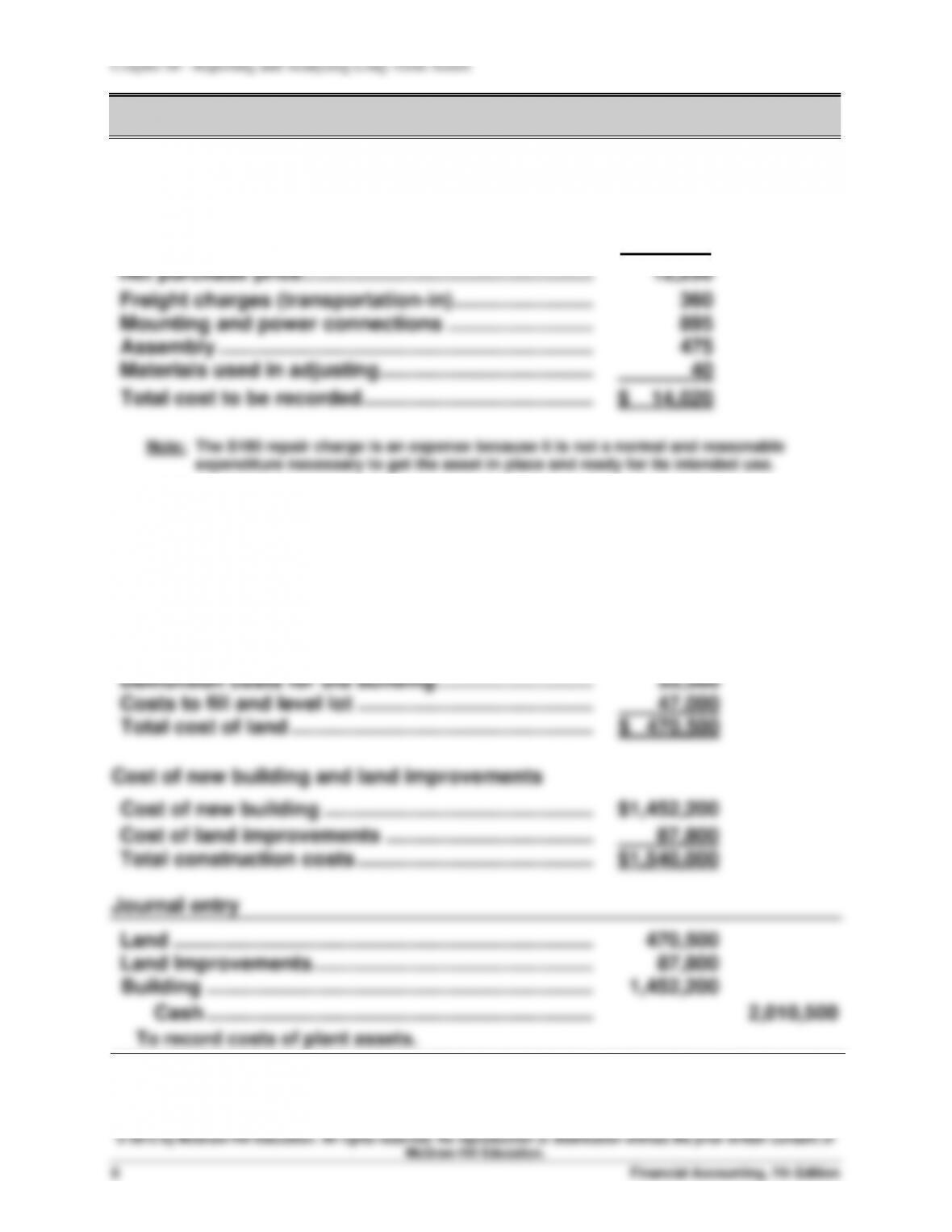
EXERCISES
Exercise 8-1 (15 minutes)
Invoice price of machine …………………………………….…………..
$ 12,500
Less discount (.02 x $12,500) ……………………………..…………..
(250)
Net purchase price……………………………………………..………..
12,250
Freight charges (transportation–in) ……………………..……
360
Mounting and power connections …………………………..
895
Assembly …………………………………………………………..…………..
475
Materials used in adjusting ……………………………………………..
40
Total cost to be recorded ………………………………………………..
$ 14,020
Note: The $180 repair charge is an expense because it is not a normal and reasonable
expenditure necessary to get the asset in place and ready for its intended use.
Exercise 8-2 (15 minutes)
Cost of land
Purchase price for land …………………………………………………..
$ 280,000
Purchase price for old building …………………………..
110,000
Demolition costs for old building ………………………..…
33,500
Costs to fill and level lot …………………………………….…………..
47,000
Total cost of land ……………………………………………….………
$ 470,500
Cost of new building and land improvements
Cost of new building ………………………………………….…………..
$1,452,200
Cost of land improvements ………………………………..…………..
87,800
Total construction costs …………………………..………..…………..
$1,540,000
Journal entry
Land ………………………………………………………………….….
470,500
Land Improvements ……………………………………………….
87,800
Building …………………………………………………………….….
1,452,200
Cash …………………………………………………………….….
2,010,500
To record costs of plant assets.
Exercise 8-5 (20 minutes)
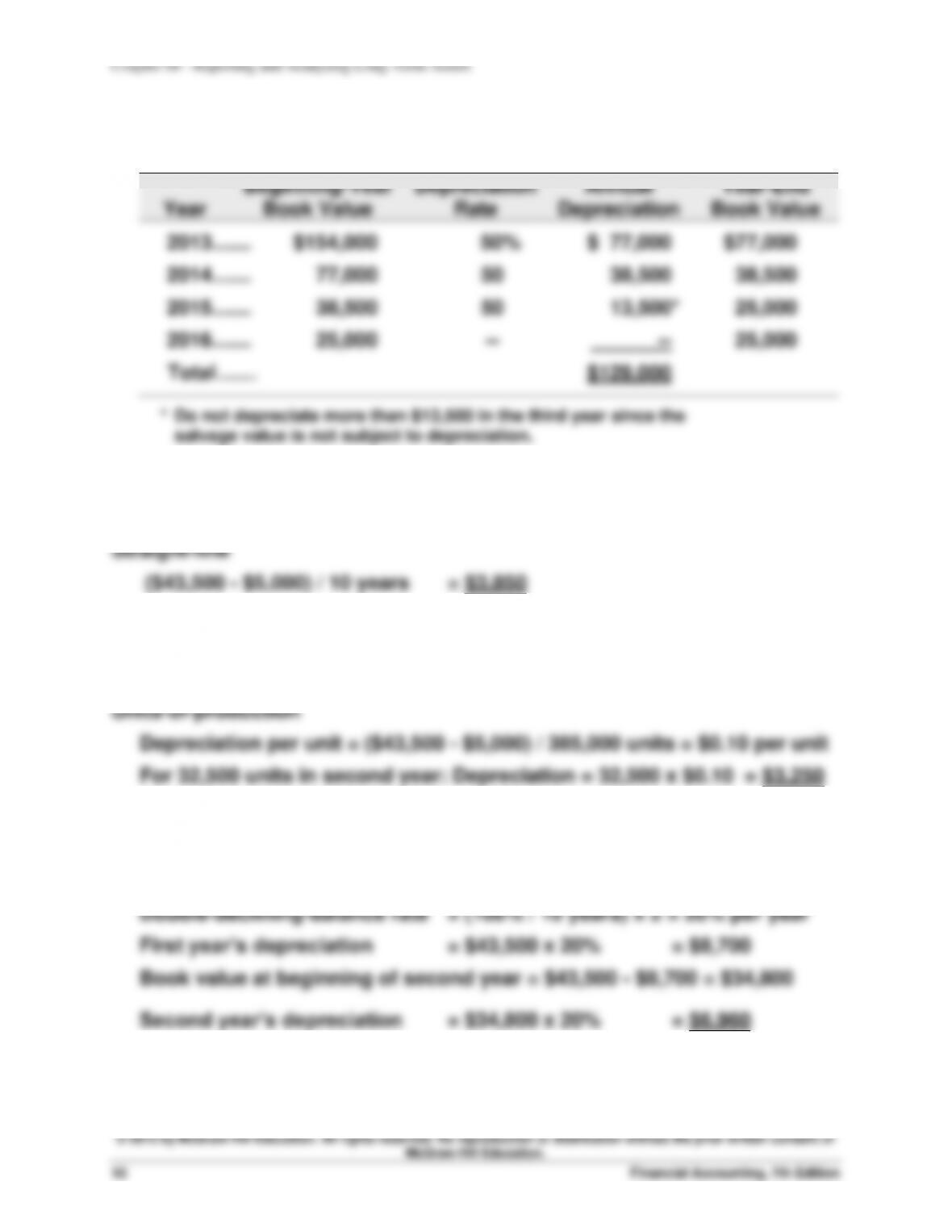
Double-declining-balance depreciation
Depreciation rate: 100% / 4 years = 25% x 2 = 50%
Year
Beginning-Year
Book Value
Depreciation
Rate
Annual
Depreciation
Year-End
Book Value
2013 …….
$154,000
50%
$ 77,000
$77,000
2014 …….
77,000
50
38,500
38,500
2015 …….
38,500
50
13,500*
25,000
2016 …….
25,000
—
—
25,000
Total …….
$129,000
* Do not depreciate more than $13,500 in the third year since the
salvage value is not subject to depreciation.
Exercise 8-6 (10 minutes)
Exercise 8-7 (10 minutes)
Exercise 8-8 (15 minutes)
Double-declining-balance