Chapter 07 – Reporting and Analyzing Receivables
1. a. Bad debts expense is recorded as 1% of total revenues:
$43,853 x .01 = $438.53 which is $439 rounded to nearest dollar.
2014
Mar. 31
Bad Debts Expense ………………………………………..
439
Allowance for Doubtful Accounts……………...
439
To record estimated bad debts.
1. b. Bad debts expense is recorded as 2% of accounts receivable:
$22,720 x .02 = $454.40 which is $454 rounded to the nearest dollar.
2014
Mar. 31
Bad Debts Expense ………………………………………..
454
Allowance for Doubtful Accounts……………...
454
To record estimated bad debts.
Instructor note: It might help to stress that the beginning balance for the Allowance for
Doubtful Accounts is zero, which is unusual and exists because this is the first period that the
company applies the allowance method.
2. Allowance Balance as of 3/31/14 ………………. $454 Cr.
Less: Account written off ………………………… (100) Dr.
Allowance for Doubtful Accounts……………...
To record estimated bad debts.
© 2015 by McGraw-Hill Education. All rights reserved. No reproduction or distribution without the prior written consent of
McGraw-Hill Education.
Solutions Manual, Chapter 7
31
1. Apple’s receivables at September 29, 2012, are $10,930 million.
2. Accounts receivable turnover for 2012 ($ millions)
3. Average collection period = 365/ Turnover = 365 / 19.20 = 19.01 days
4. Liquid assets as a percent of current liabilities ($ millions)
Sep. 29, 2012: = 106.0%
5. Note 1 to Apple’s financial statements describes its accounting
6. Solution depends on the financial statement information obtained.
$156,508
($10,930+ $5,369)/2
$9,815 + $16,137 + $5,369 + $776
$10,746 + $18,383 + $10,930 + $791
$38,542
1. Accounts Receivable Turnover ($ millions)
= 19.20 times
Apple (Prior Year):
2. Average Collection Period (or “Average Days’ Sales Uncollected”)
Apple (Current Year): 365 days / 19.20 times = 19.01 days
Apple (Prior Year): 365 days / 19.90 times = 18.34 days
3. Both companies appear reasonably efficient in collecting accounts
receivable. Apple collects them over a shorter period of time in both
$108,249
($5,427 + $4,252)/2
$156,508
($10,930 + $5,369)/2
© 2015 by McGraw-Hill Education. All rights reserved. No reproduction or distribution without the prior written consent of
McGraw-Hill Education.
Solutions Manual, Chapter 7
33
1. If the estimate for bad debts is reduced then less Bad Debts Expense
will be recognized on the income statement resulting in a higher net
2. Accounting procedures often allow for alternate methods or require the
use of estimates. Therefore, managers have some leeway in their
3. An informed owner or an effective board of directors will be aware of
alternate accounting methods and how estimates can affect the
financial statements. The owner or board should review the
reasonableness of the manager’s and accountant’s estimate for bad
debts expense. Also, if the company is audited, the auditors will review
© 2015 by McGraw-Hill Education. All rights reserved. No reproduction or distribution without the prior written consent of
McGraw-Hill Education.
Financial Accounting, 7th Edition
34
collections until the following period. Of course, some credit sales
eventually prove to be uncollectible. The fact that some accounts will
become uncollectible is what gives rise to bad debts expense and the
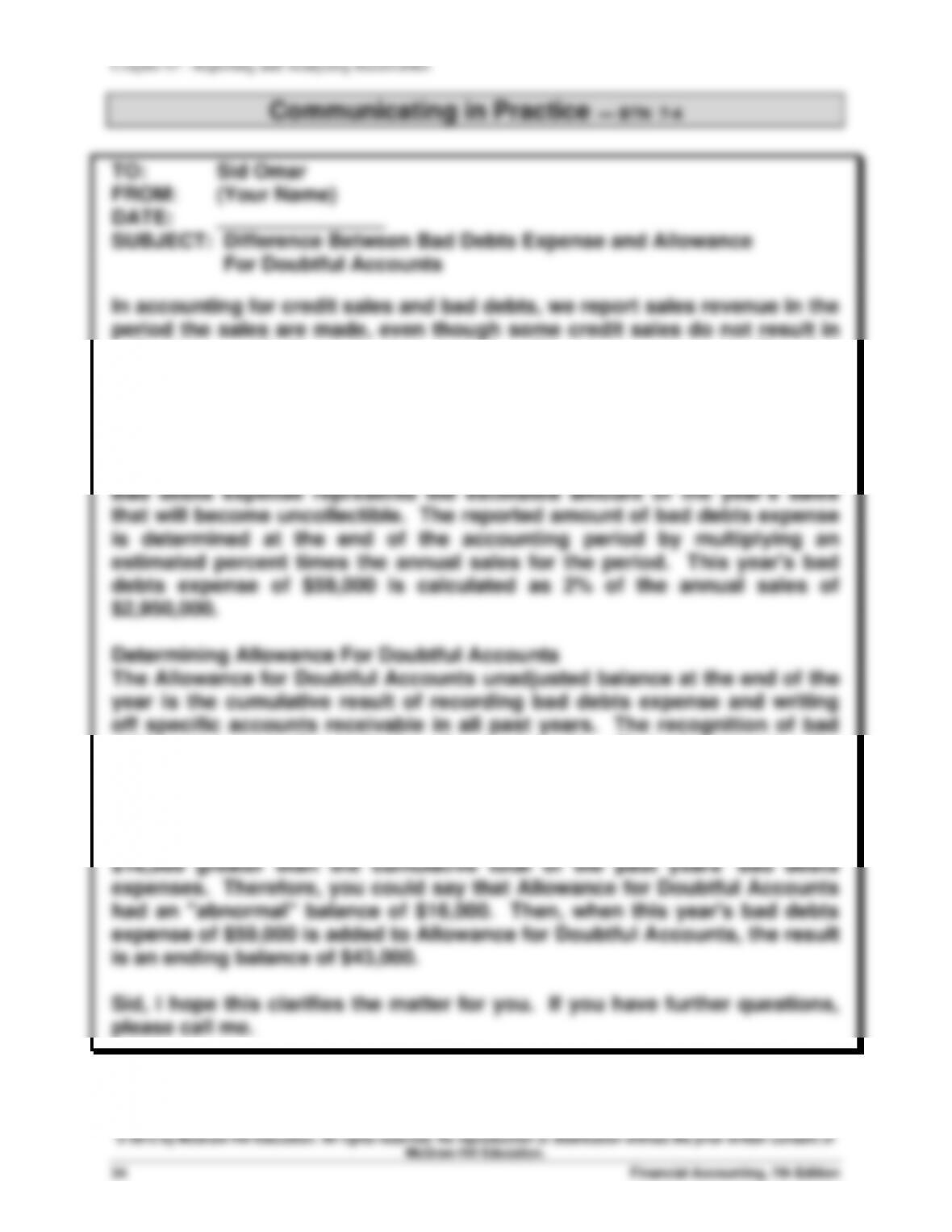
allowance for doubtful accounts.
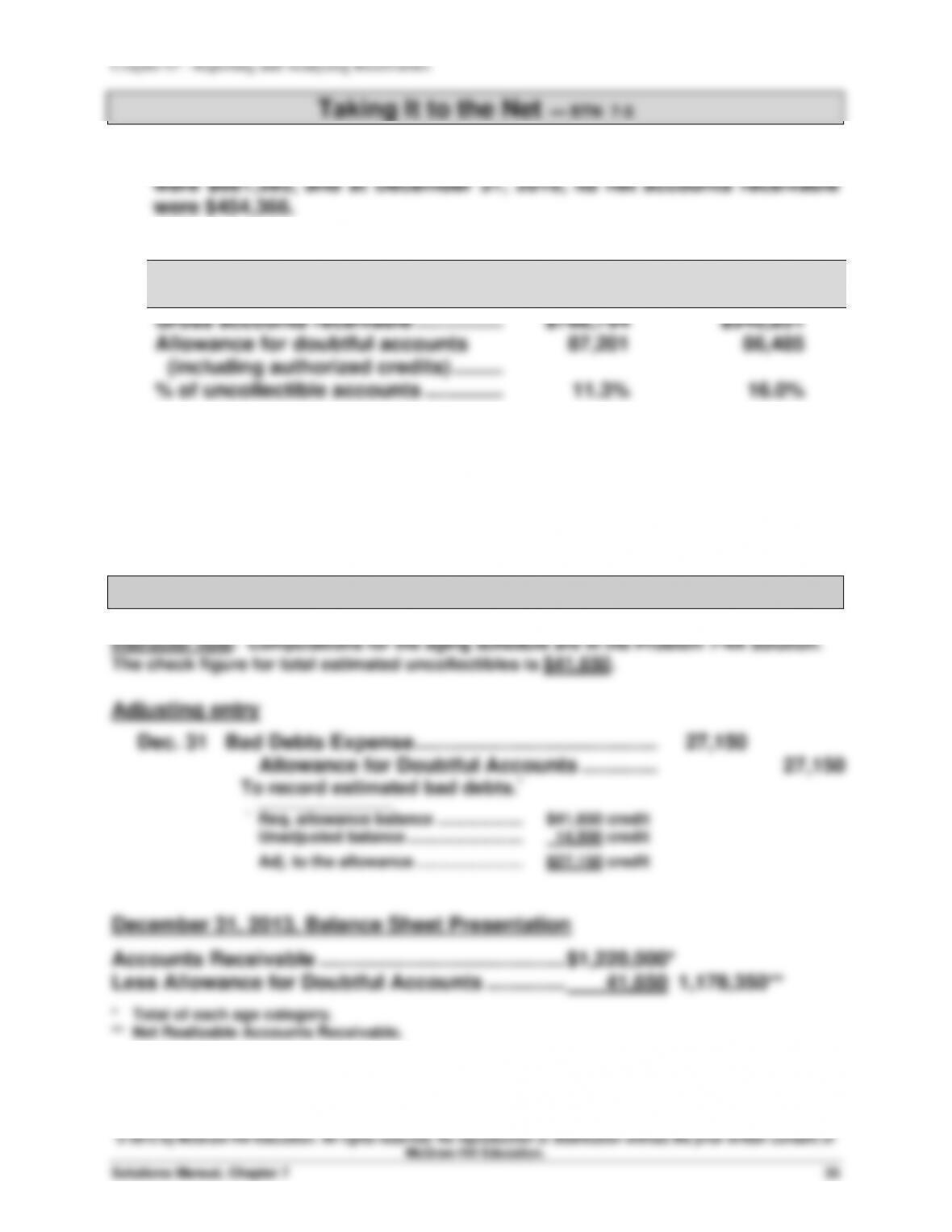
Determining Bad Debts Expense
debts expense at the end of each year has the effect of increasing the
Allowance for Doubtful Accounts balance. However, when specific
accounts receivable are written off, they decrease the Allowance for
Doubtful Accounts balance. Prior to this year’s bad debts expense
calculation, the cumulative total of writing off specific accounts was
Bad Debts Expense ……………………………………....
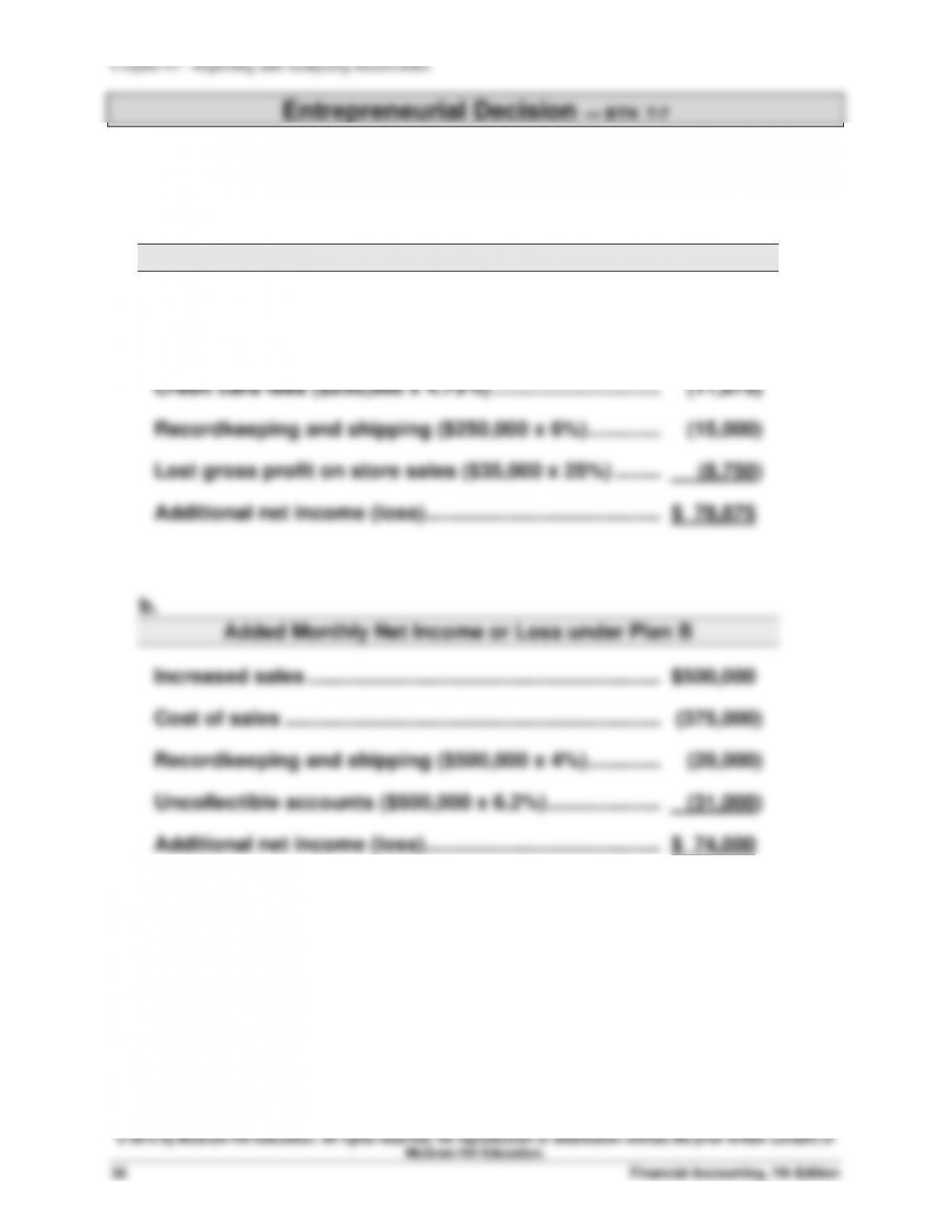
1. At December 31, 2011, eBay’s ($ thousands) net accounts receivable
2.
$ thousands
December 31,
2011
December 31,
2010
Gross accounts receivable …………….…….
$768,794
$540,851
Allowance for doubtful accounts
(including authorized credits) …………….
87,201
86,485
% of uncollectible accounts …………..…….
11.3%
16.0%
3. These percentages seem high compared to other companies, but
eBay’s operations are all online, and the risk of fraudulent transactions
is likely higher than other companies. eBay’s prior experience has
apparently caused them to estimate this high amount of uncollectible
accounts.
Teamwork in Action — BTN 7-6
© 2015 by McGraw-Hill Education. All rights reserved. No reproduction or distribution without the prior written consent of
McGraw-Hill Education.
Financial Accounting, 7th Edition
36
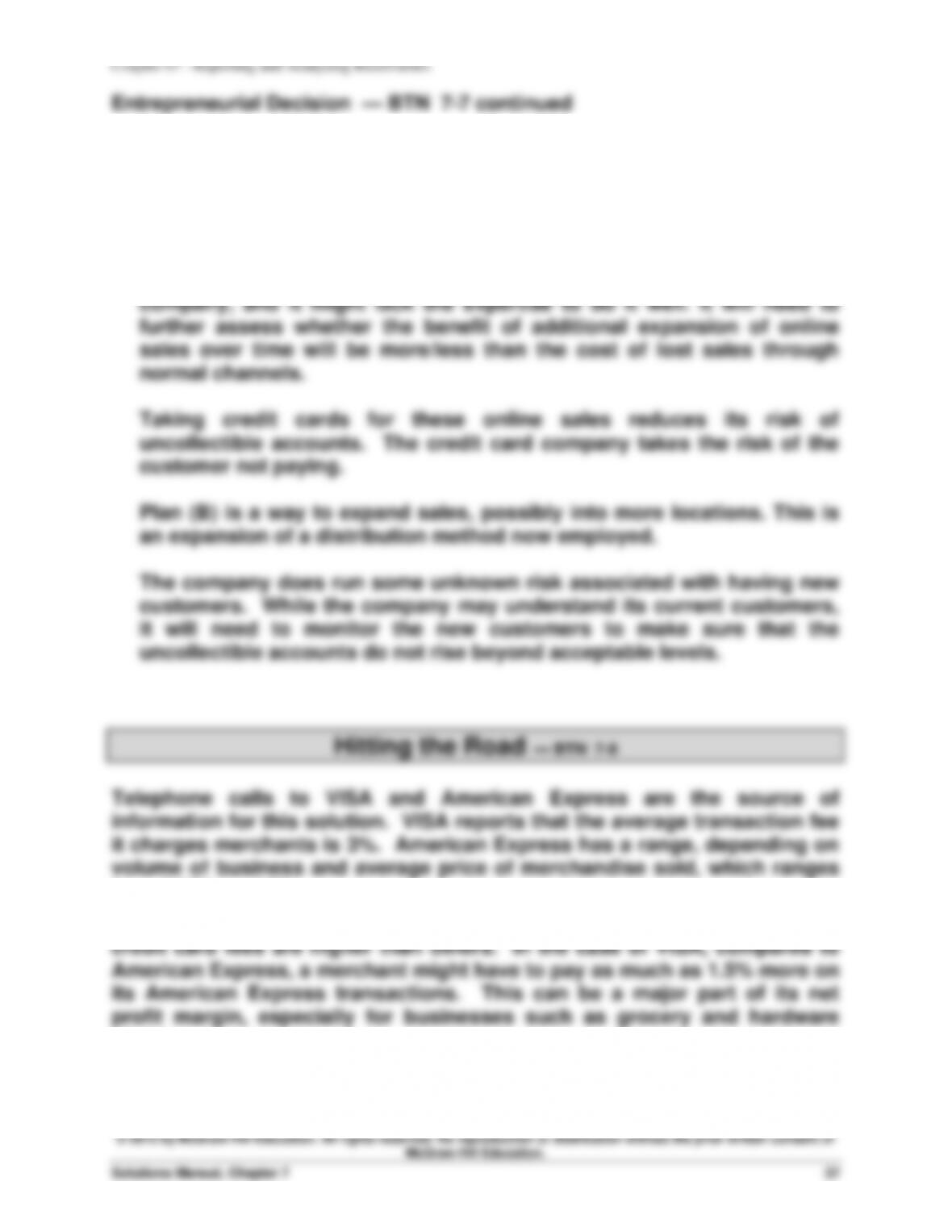
1. Computation of added annual net income or loss
a. Added Monthly Net Income or Loss under Plan A
Increased sales ……………………………………………………… $250,000
Cost of sales …………………………………………………………. (135,500)
© 2015 by McGraw-Hill Education. All rights reserved. No reproduction or distribution without the prior written consent of
McGraw-Hill Education.
Solutions Manual, Chapter 7
37
2. Plan (A) provides a slightly higher income, so if the company can only
pursue one plan now, based purely on the financial aspect, it should
choose Plan (A).
Plan (A) might expand its product into new markets, and could increase
sales over time. However, this is a new distribution method for the
from 2.95% to 4.5%.
Some merchants often choose not to accept certain cards because the
stores.
© 2015 by McGraw-Hill Education. All rights reserved. No reproduction or distribution without the prior written consent of
McGraw-Hill Education.
Financial Accounting, 7th Edition
38
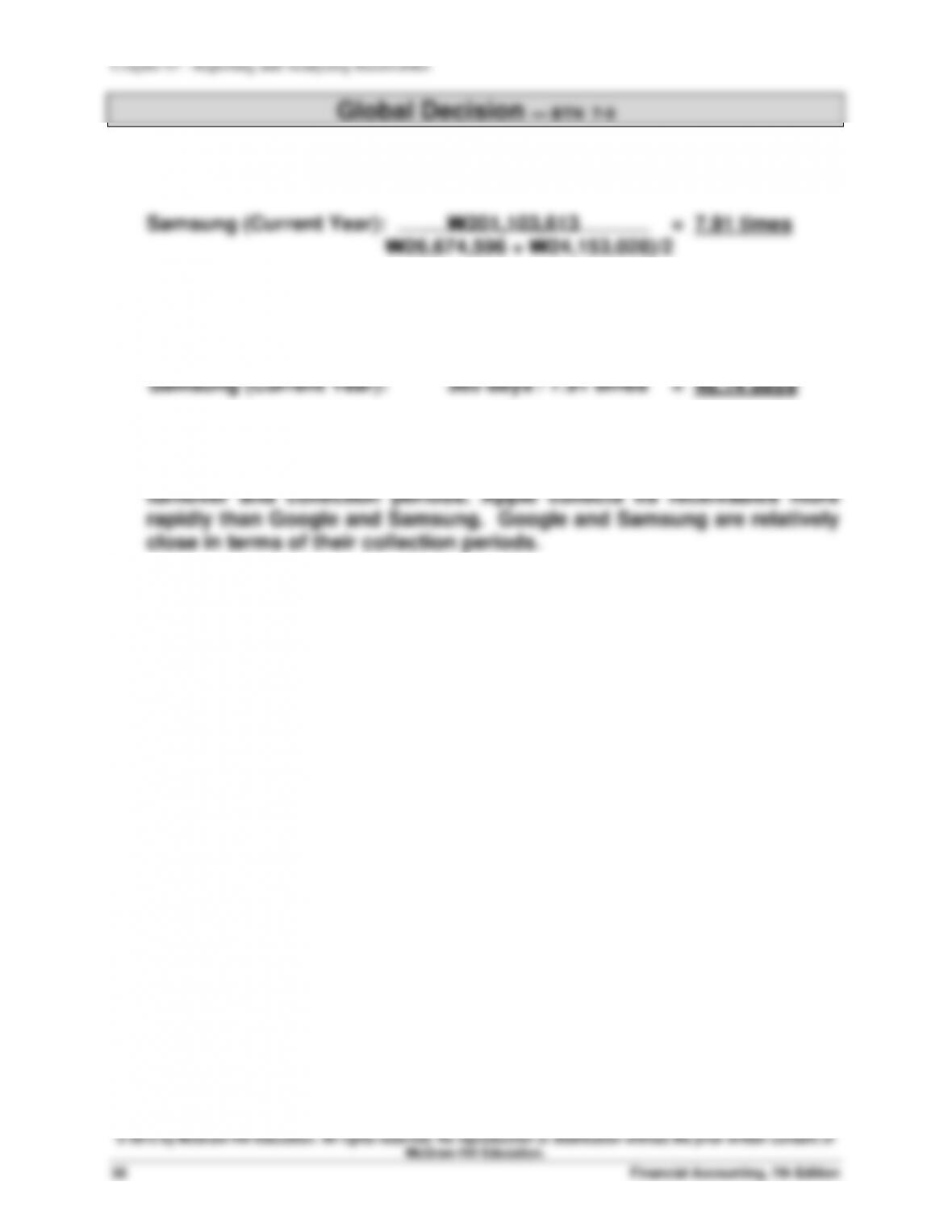
1. Accounts Receivable Turnover (KRW in millions)
2. Average Collection Period (or “Average Days’ Sales Uncollected”)
3. Samsung’s results are between Apple and Google in terms of its