Chapter 06 – Reporting and Analyzing Cash and Internal Controls
1.
($ in millions)
Balance
September
29, 2012
Cash and
equivalents
as % of:
Balance
September
24, 2011
Cash and
equivalent
s as % of:
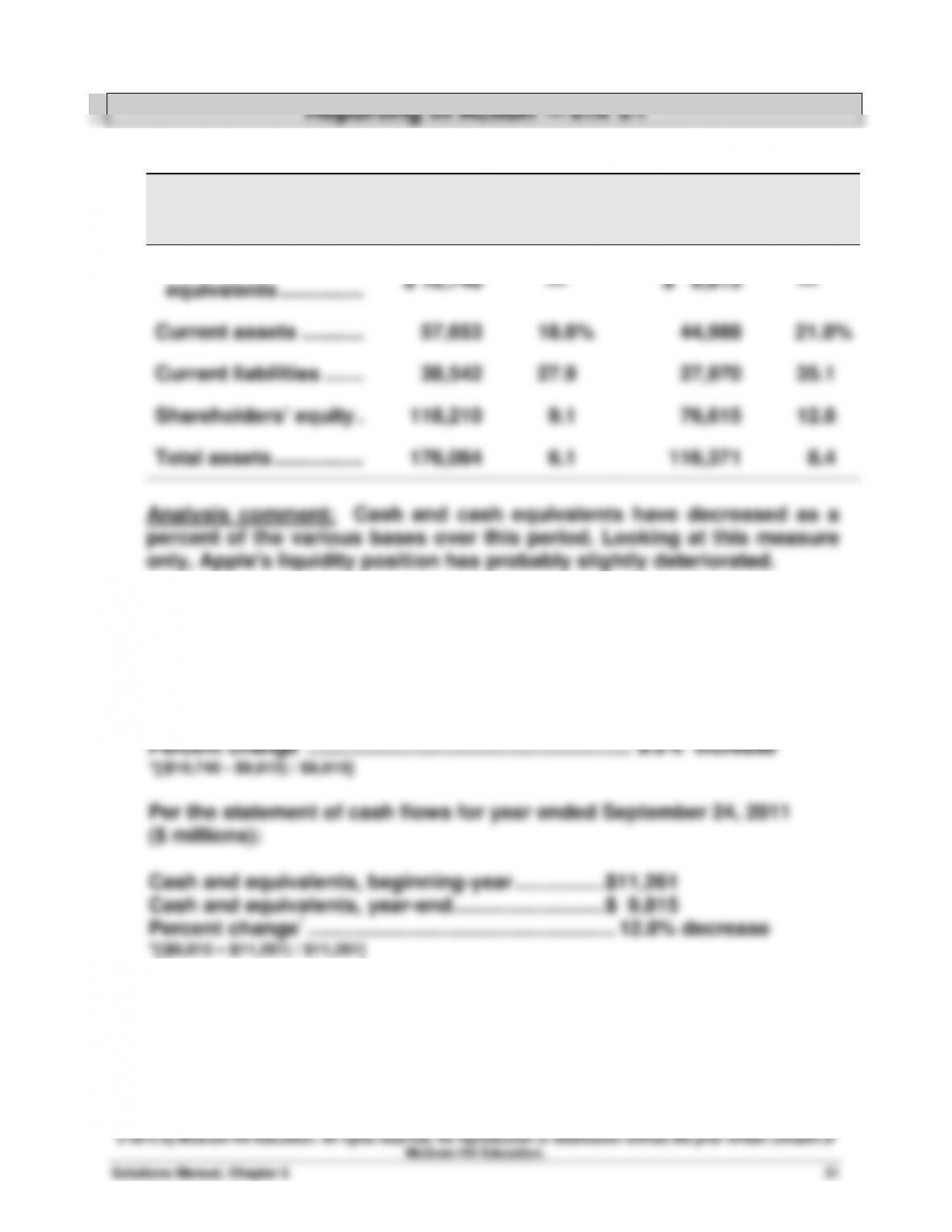
Cash and cash
equivalents ……………
$ 10,746
—
$ 9,815
—
Current assets ………..
57,653
18.6%
44,988
21.8%
Current liabilities …….
38,542
27.9
27,970
35.1
Shareholders’ equity .
118,210
9.1
76,615
12.8
Total assets …………….
176,064
6.1
116,371
8.4
Analysis comment: Cash and cash equivalents have decreased as a
percent of the various bases over this period. Looking at this measure
only, Apple’s liquidity position has probably slightly deteriorated.
2. Per the statement of cash flows for year ended September 29, 2012
($ millions):
Cash and equivalents, beginning-year …………… $ 9,815
Cash and equivalents, year-end ……………………… $10,746
© 2015 by McGraw-Hill Education. All rights reserved. No reproduction or distribution without the prior written consent of
McGraw-Hill Education.
Financial Accounting, 7th Edition
32
3. Days’ Sales Uncollected ($ millions)
Days’ sales uncollected = x 365
4. Solution depends on the annual report information obtained.
Accounts receivable
Net sales
Chapter 06 – Reporting and Analyzing Cash and Internal Controls
Comparative Analysis — BTN 6-2
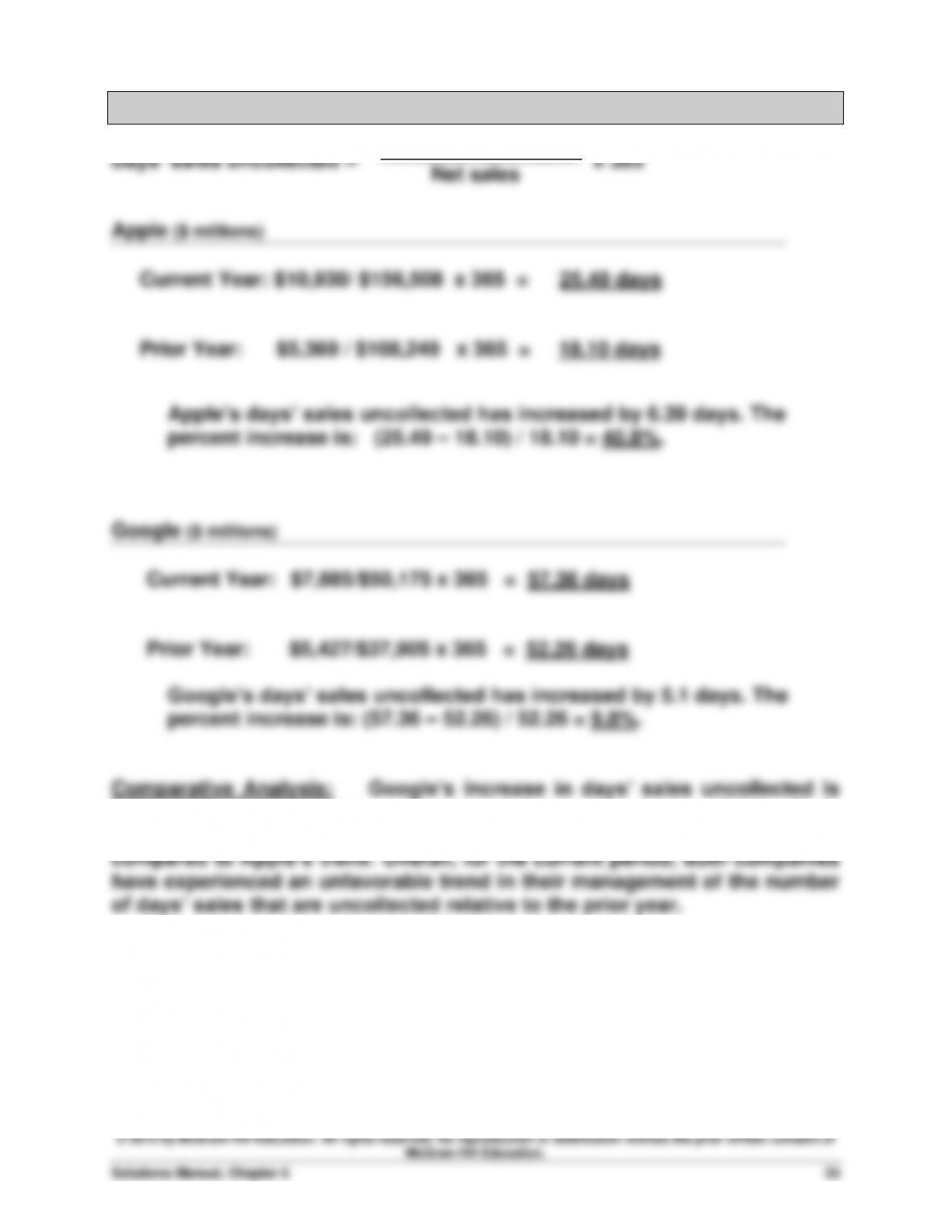
9.8%, while Apple’s increase in days’ sales uncollected is 40.8%. Both
trends are unfavorable. However, Google’s trend is less unfavorable as
Accounts receivable
© 2015 by McGraw-Hill Education. All rights reserved. No reproduction or distribution without the prior written consent of
McGraw-Hill Education.
Financial Accounting, 7th Edition
34
1. In a small business office it is very important that the owner of the
2. Unfortunately, due to collusion of the employees, the bank
3. Despite the collusion, the scheme is not foolproof. For example, some
ways in which the scheme might be uncovered or prevented include the
following:
• A bank employee may become suspicious and call Dr. Conrad and
4. Dr. Conrad should review her salary schedules for employees to make
sure that she is at least offering market pay. She may want to consider
bonding her employees to insure herself against material losses. Dr.
Conrad should probably reconcile the bank statement herself as well as
make it a practice to review the daily posting log for miscellaneous
© 2015 by McGraw-Hill Education. All rights reserved. No reproduction or distribution without the prior written consent of
McGraw-Hill Education.
Solutions Manual, Chapter 6
35
recommend the net method of recording purchases. It should explain how this method
results in the recording of “Discounts Lost,” which will flow through to the income
statement, thus providing the information desired. The memo might look something like
the following.]
The net method gives management an advantage in controlling and
This practice gives management better control over persons responsible
for paying bills on time to take advantage of favorable discounts. This also
means it’s less likely that favorable discounts are lost.

Chapter 06 – Reporting and Analyzing Cash and Internal Controls
Taking It to the Net — BTN 6-5
1. The median loss caused by occupational frauds was $160,000.
2. Nearly one-quarter of fraud cases involved losses of at least $1 million
3. Companies lose 5% of their annual revenues to fraud; this 5% figure
4. The typical length of fraud schemes was 18 months from the time the
5. Less than 30% of victim organizations conducted surprise audits,
6. Asset misappropriation schemes were most common at 90% of cases
7. Financial statement fraud schemes made up less than 5% of cases with
8. Corruption schemes comprised 33% of cases with a median loss of
9. Less than 15% of the perpetrators had convictions prior to committing
their frauds.
© 2015 by McGraw-Hill Education. All rights reserved. No reproduction or distribution without the prior written consent of
McGraw-Hill Education.
Solutions Manual, Chapter 6
37
1. Door locks and roll–down screens for after-hours lock-up.
2. Electronic detection devices stationed at entrances or anti-theft
3. Security cameras.
4. Security guards.
5. Cash registers.
6. Separate cash drawers or transaction codes to identify clerks at
7. Bar coding on merchandise.
8. Limited number of apparel items allowed in a dressing room.
9. Dressing room attendants.
10. A security safe on the premises.
11. Time-clocks.
© 2015 by McGraw-Hill Education. All rights reserved. No reproduction or distribution without the prior written consent of
McGraw-Hill Education.
Financial Accounting, 7th Edition
38
1. Seven principles of internal control along with examples are:
a. Establish responsibilities. The clerks at the counter should be
responsible for handling cash. The other employees should be
responsible for preparing the orders and helping customers. There
also should be employees assigned responsibilities such as
2. As the business grows, controls will become more important. The
owner will have more employees and will have to delegate more
responsibilities. Strong controls will be important to make sure that
© 2015 by McGraw-Hill Education. All rights reserved. No reproduction or distribution without the prior written consent of
McGraw-Hill Education.
Solutions Manual, Chapter 6
39
1. Door locks and roll–down screens for after-hours lock-up.
2. Electronic detection devices stationed at entrances or anti-theft devices
3. Security cameras.
4. Security guards.
5. Cash registers.
6. Bar coding on products and assets.
7. A security safe on the premises.
1.
(KRW millions)
Current
year
balance
Cash as
percent
of:
Prior
year
balance
Cash as
percent
of:
Cash (and equivalents) …………
18,791,460
—
14,691,761
—
\
Current assets …………..………
87,269,017
21.5%
71,502,063
20.5%
Total assets ……………….………
181,071,570
10.4
155,800,263
9.4
Current liabilities ……….………
46,933,052
40.0
44,319,014
33.2
Total equity………………..………
121,480,206
15.5
101,313,630
14.5
Analysis comment: Cash has increased as a percent of the various
bases compared to the prior year. Looking at this measure only,
Samsung’s liquidity position has probably slightly improved.
© 2015 by McGraw-Hill Education. All rights reserved. No reproduction or distribution without the prior written consent of
McGraw-Hill Education.
Financial Accounting, 7th Edition
40
2. Cash, beginning-year (KRW millions) ………………………………….. 14,691,761
3. Days’ Sales Uncollected Formula (KRW millions)
Days’ sales uncollected = x 365
24,153,028
Accounts receivable
Net sales
26,674,596