Chapter 05 – Reporting and Analyzing Inventories
© 2015 by McGraw-Hill Education. All rights reserved. No reproduction or distribution without the prior written consent of
McGraw-Hill Education.
Solutions Manual, Chapter 5
1
Chapter 5
Reporting and Analyzing Inventories
QUESTIONS
1. (a) FIFO: The cost of the first (earliest) items purchased in inventory flow to cost of
2. Merchandise inventory is disclosed on the balance sheet as a current asset. It is
3. Incidental costs sometimes are ignored in computing the cost of inventory because
the expense of tracking such costs on a precise basis can outweigh the benefits
4. LIFO will result in the lower cost of goods sold when costs are declining because it
5. The full-disclosure principle requires that the nature of the accounting change, the
6. No; changing the inventory method each period would violate the accounting
7. No; the consistency concept does not preclude changes in accounting methods
8. Many people make important business decisions based on period-to-period
fluctuations in a company’s financial numbers, including gross profit and net
9. An inventory error that causes an understatement (or overstatement) for net income
in one accounting period, if not corrected, will cause an overstatement (or
10. Market usually means replacement cost of inventory when applied in the LCM.
11. The accounting constraint of conservatism guides preparers of accounting reports
12. Factors that contribute to inventory shrinkage are breakage, loss, deterioration,
13.B For interim reporting, companies can estimate costs of goods sold and ending
14. On December 31, 2012, inventory as a percent of current assets is ($ millions):
15. Cost of goods available for sale equals ending inventory plus cost of sales. As of
16. Cost of goods available for sale equals ending inventory plus cost of sales. As of
17. Merchandise inventory (in KRW millions) comprises 20.3% (computed as
and 22.0% (computed as ₩15,716,715 / ₩71,502,063) of its current assets as of
Quick Study 5-1 (10 minutes)
FIFO—Perpetual
Date
Goods Purchased
Cost of Goods Sold
Inventory Balance
1/1
320 @ $3.00
= $ 960.00
1/9
80 @ $3.20
320 @ $3.00
80 @ $3.20
= $1,216.00
1/25
100 @ $3.34
320 @ $3.00
80 @ $3.20
= $1,550.00
100 @ $3.34
1/26
320 @ $3.00 =$ 960.00
30 @ $3.20 = 96.00
50 @ $3.20
$1,056.00
100 @ $3.34
= $ 494.00
Alternate solution format
FIFO:
100
@ $3.34 =
$ 334.00
50
@ $3.20 =
160.00
150
$ 494.00
Ending inventory cost
Quick Study 5-2 (10 minutes)
LIFO—Perpetual
Date
Goods Purchased
Cost of Goods Sold
Inventory Balance
1/1
320 @ $3.00
= $ 960.00
1/9
80 @ $3.20
320 @ $3.00
80 @ $3.20
= $1,216.00
1/25
100 @ $3.34
320 @ $3.00
80 @ $3.20
= $1,550.00
100 @ $3.34
1/26
100 @ $3.34 =$ 334.00
80 @ $3.20 = 256.00
170 @ $3.00 = 510.00
150 @ $3.00
= $ 450.00
$1,100.00
}
}
}
}
}
Quick Study 5-3 (10 minutes)
Weighted Average—Perpetual
Date
Goods Purchased
Cost of Goods Sold
Inventory Balance
1/1
320 @ $3.00
= $ 960.00
1/9
80 @ $3.20
320 @ $3.00
80 @ $3.20
= $1,216.00
(avg. cost is $3.04)
1/25
100 @ $3.34
320 @ $3.00
80 @ $3.20
= $1,550.00
100 @ $3.34
(avg. cost is $3.10)
1/26
350 @ $3.10 = $1,085.00
150 @ $3.10
= $ 465.00
Alternate solution format
Weighted average:
320
@ $3.00 =
$ 960.00
80
@ $3.20 =
256.00
100
@ $3.34 =
334.00
500
$1,550.00
Cost of goods available for sale
$1,550.00/500 = $3.10 weighted average cost per unit
150 units @ $3.10 = $ 465.00 Ending inventory cost
Quick Study 5-4A (10 minutes)
Ending Cost of
Quick Study 5-5A (10 minutes)
Ending Cost of
}
}
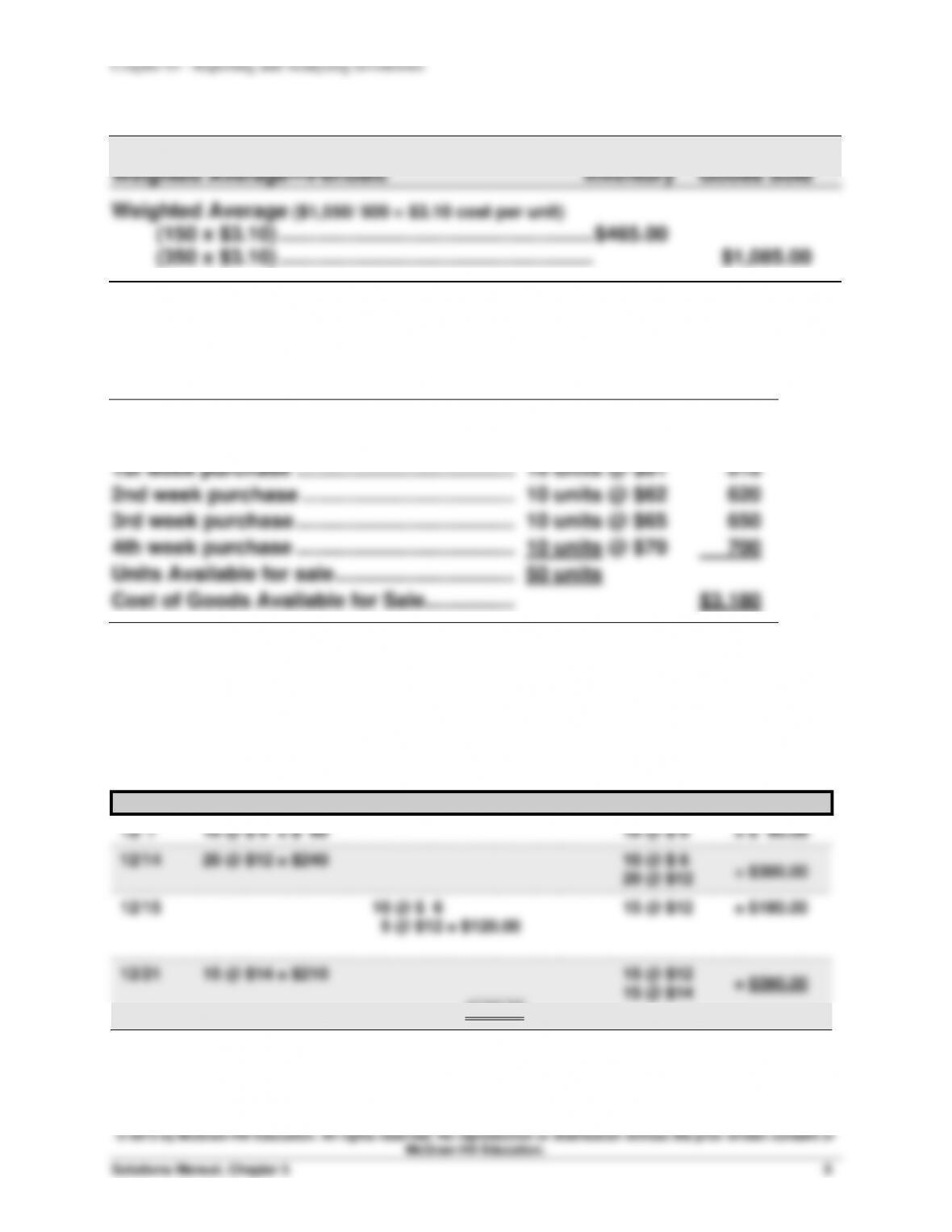
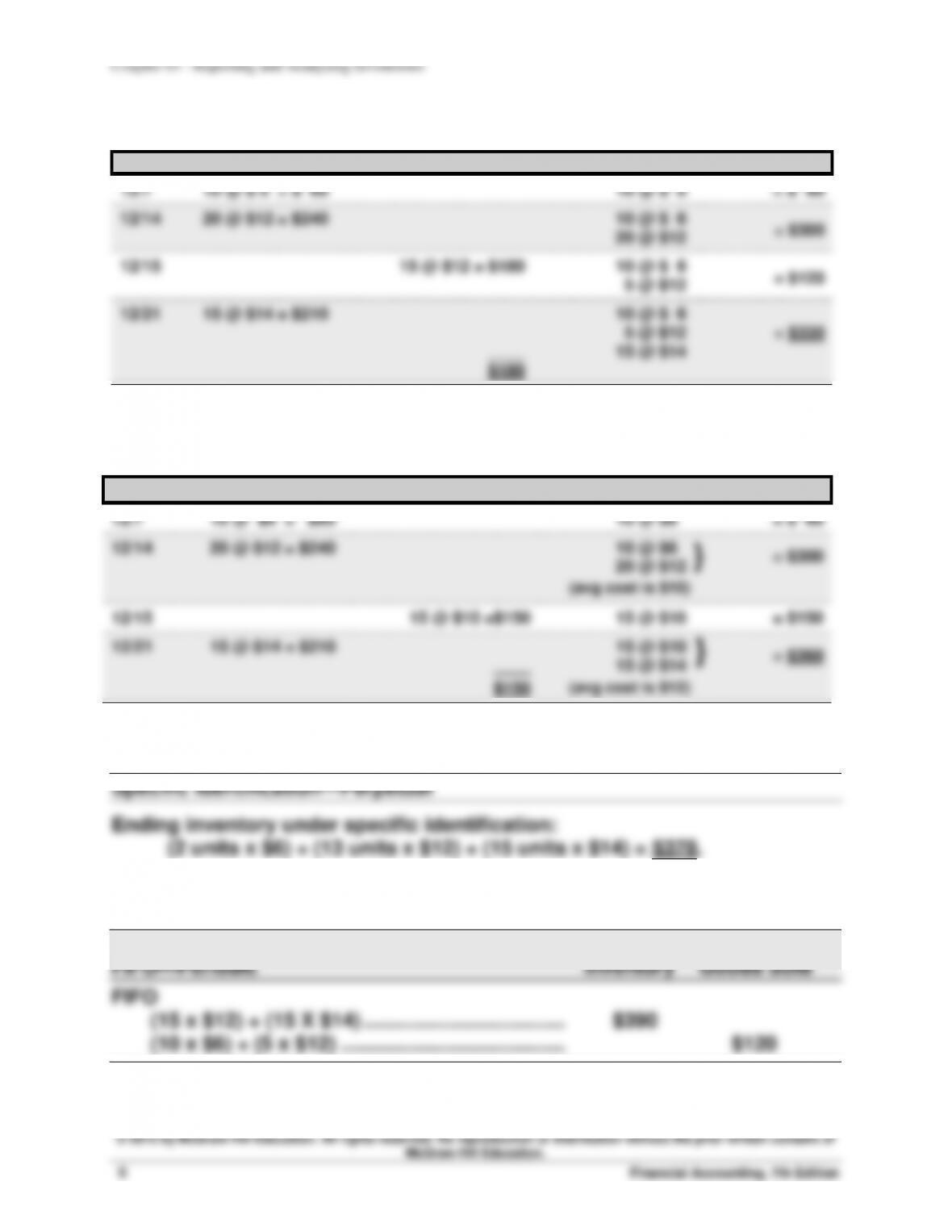
Quick Study 5-9
LIFO—Perpetual
Date
Goods Purchased
Cost of Goods Sold
Inventory Balance
12/7
10 @ $ 6 = $ 60
10 @ $ 6
= $ 60
12/14
20 @ $12 = $240
10 @ $ 6
= $300
20 @ $12
12/15
15 @ $12 = $180
10 @ $ 6
= $120
5 @ $12
12/21
15 @ $14 = $210
10 @ $ 6
5 @ $12
= $330
____
15 @ $14
$180
Quick Study 5-10
Weighted Average—Perpetual
Quick Study 5-11
Quick Study 5-12A (10 minutes)
Ending Cost of
Date
Goods Purchased
Cost of Goods Sold
Inventory Balance
12/7
10 @ $6 = $60
10 @ $6
= $ 60
12/14
20 @ $12 = $240
10 @ $6
= $300
20 @ $12
(avg cost is $10)
12/15
15 @ $10 =$150
15 @ $10
= $150
12/21
15 @ $14 = $210
15 @ $10
= $360
____
15 @ $14
$150
(avg cost is $12)
}
}
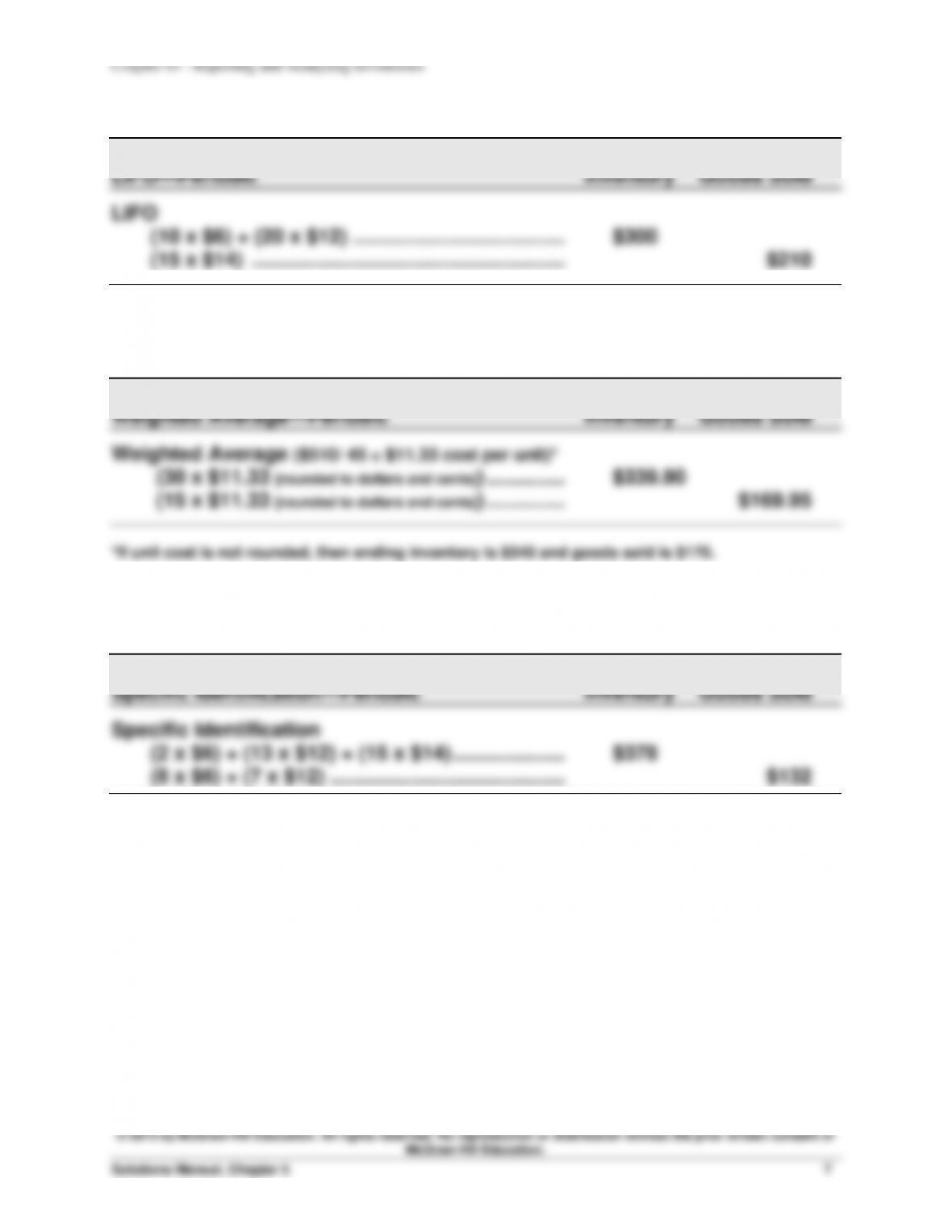
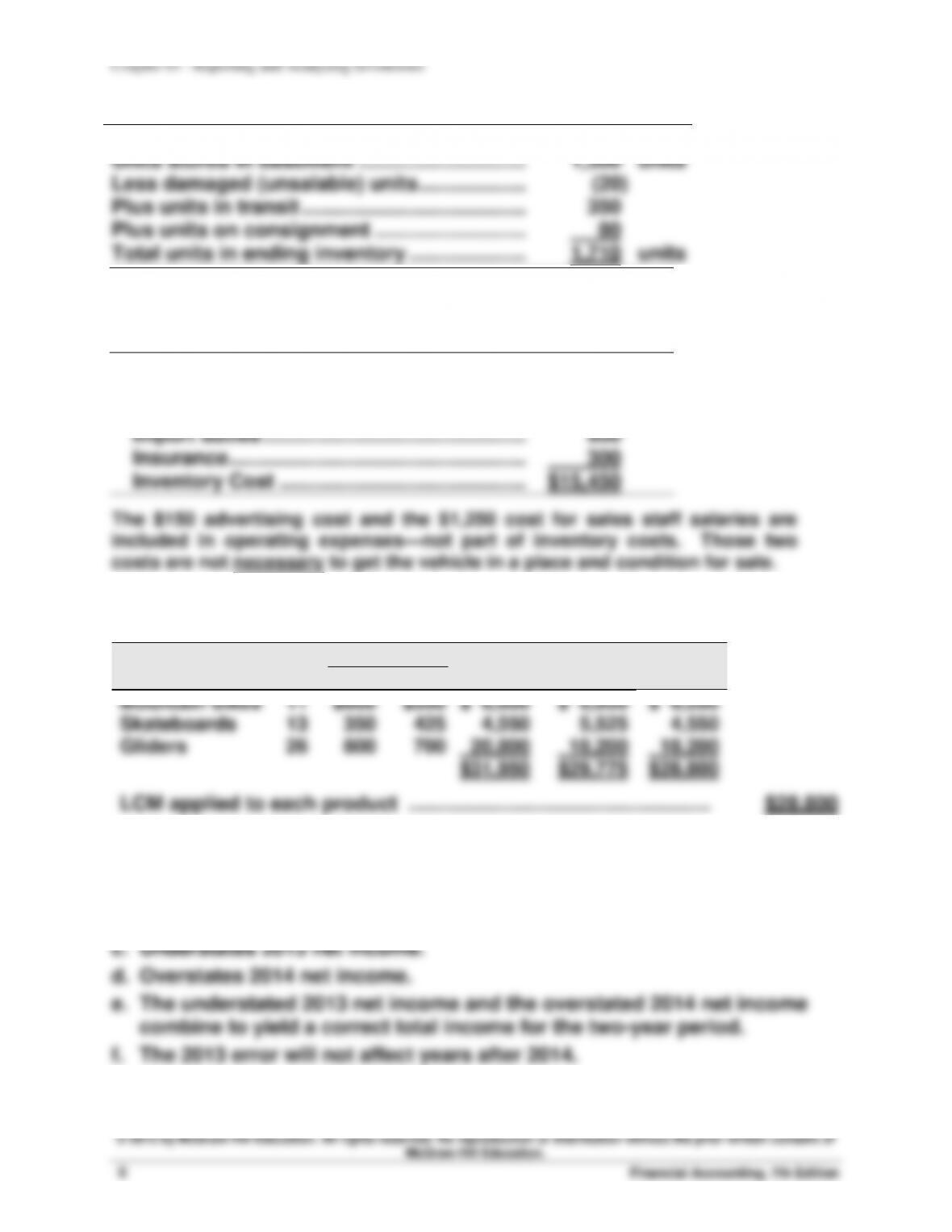
Quick Study 5-17 (10 minutes)
Units in ending inventory
Units stored in basement …………………………..
1,300
units
Less damaged (unsalable) units ……………….……
(20)
Plus units in transit ………………………………….……
350
Plus units on consignment …………………………..
80
Total units in ending inventory ………………………
1,710
units
Quick Study 5-18 (10 minutes)
Cost ……………………………………………………….……
$14,000
Plus
Transportation-in ………………………………….……
250
Import duties ………………………………………..……
900
Insurance ……………………………………………..……
300
Inventory Cost ……………………………………..……
$15,450
The $150 advertising cost and the $1,250 cost for sales staff salaries are
included in operating expenses—not part of inventory costs. Those two
costs are not necessary to get the vehicle in a place and condition for sale.
Quick Study 5-19 (20 minutes)
Per Unit
Total
Total
LCM –
Items
Inventory Items
Units
Cost
Market
Cost
Market
Mountain bikes
11
$600
$550
$ 6,600
$ 6,050
$ 6,050
Skateboards
13
350
425
4,550
5,525
4,550
Gliders
26
800
700
20,800
18,200
18,200
$31,950
$29,775
$28,800
LCM applied to each product ………………………………………………
$28,800
Quick Study 5-20 (15 minutes)
a. Overstates 2013 cost of goods sold.
b. Understates 2013 gross profit.
EXERCISES
Exercise 5-1 (10 minutes)
1. The consignor is Harris Company. The consignee is Harlow Company.
2. The title will pass at “destination” which is Harlow Company’s receiving
Exercise 5-2 (10 minutes)
Cost of inventory (estate’s contents)
Price …………………………………………………………………………….
$75,000
Transportation–in ………………………………………………………….
2,400
Insurance on shipment ………………………………………………….
300
Cleaning and refurbishing ……………………………………………..
980
Total cost of inventory …………………………………………………..
$78,680
Exercise 5-3 (45 minutes)
a. Specific identification