Chapter 04 – Reporting and Analyzing Merchandising Operations
© 2015 by McGraw-Hill Education. All rights reserved. No reproduction or distribution without the prior written consent of
McGraw-Hill Education.
Solutions Manual, Chapter 4
1
Chapter 4
Reporting and Analyzing
Merchandising Operations
QUESTIONS
1. Merchandising companies report Merchandise Inventory on the balance sheet;
do not.
2. Additional accounts of a merchandising company likely include Merchandise
3. A company can have a net loss if its expenses (absent cost of goods sold) are
4. A cash discount can be offered to encourage customers to promptly pay. This
5. For a perpetual inventory system, inventory shrinkage is determined by taking a
6. Cash discounts are granted in return for early payment and reduce the amount paid
below the negotiated price. Cash discounts are recorded in the accounting records
7. Sales discount is a term used by a seller to describe a cash discount granted to a
8. A manager is concerned about the quantity of its purchase returns because the
9. The sender (maker) of a debit memorandum records a debit in an account of the
10. The single-step income statement format presents cost of goods sold and expenses
in one list, totals the list, and subtracts the total from net sales in one step. The
11. Apple calls its inventory account “Inventories.” A detailed calculation of cost of
12. Google titles its cost of sales accounts as “Cost of revenues” Google presents
13. Samsung titles its cost of goods sold account “Cost of sales.”
14. Samsung reports a separate gross margin figure on its consolidated income
15. A buyer should attempt to negotiate the shipping terms FOB destination. In this
Quick Study 4-1 (10 minutes)
1. G. 6. H.
2. B. 7. I.
3. A. 8. F.
4. J. 9. C.
5. E. 10. D.
Quick Study 4-2 (5 minutes)
Quick Study 4-5 (10 minutes)
(a)
(b)
(c)
(d)
Sales ………………………………….….
$150,000
$550,000
$38,700
$255,700
Sales discounts ………………….….
(5,000)
(17,500)
(600)
(4,800)
Sales returns and allowances …….
(20,000)
(6,000)
(5,100)
(900)
Net sales …………………………….….
125,000
526,500
33,000
250,000
Cost of goods sold ……………..….
(79,750)
(329,589)
(24,453)
(126,500)
Gross profit ………………………..…
$ 45,250
$196,911
$ 8,547
$123,500
Gross margin ratio:
(Gross profit / Net sales) …….. 36.2% 37.4% 25.9% 49.4%
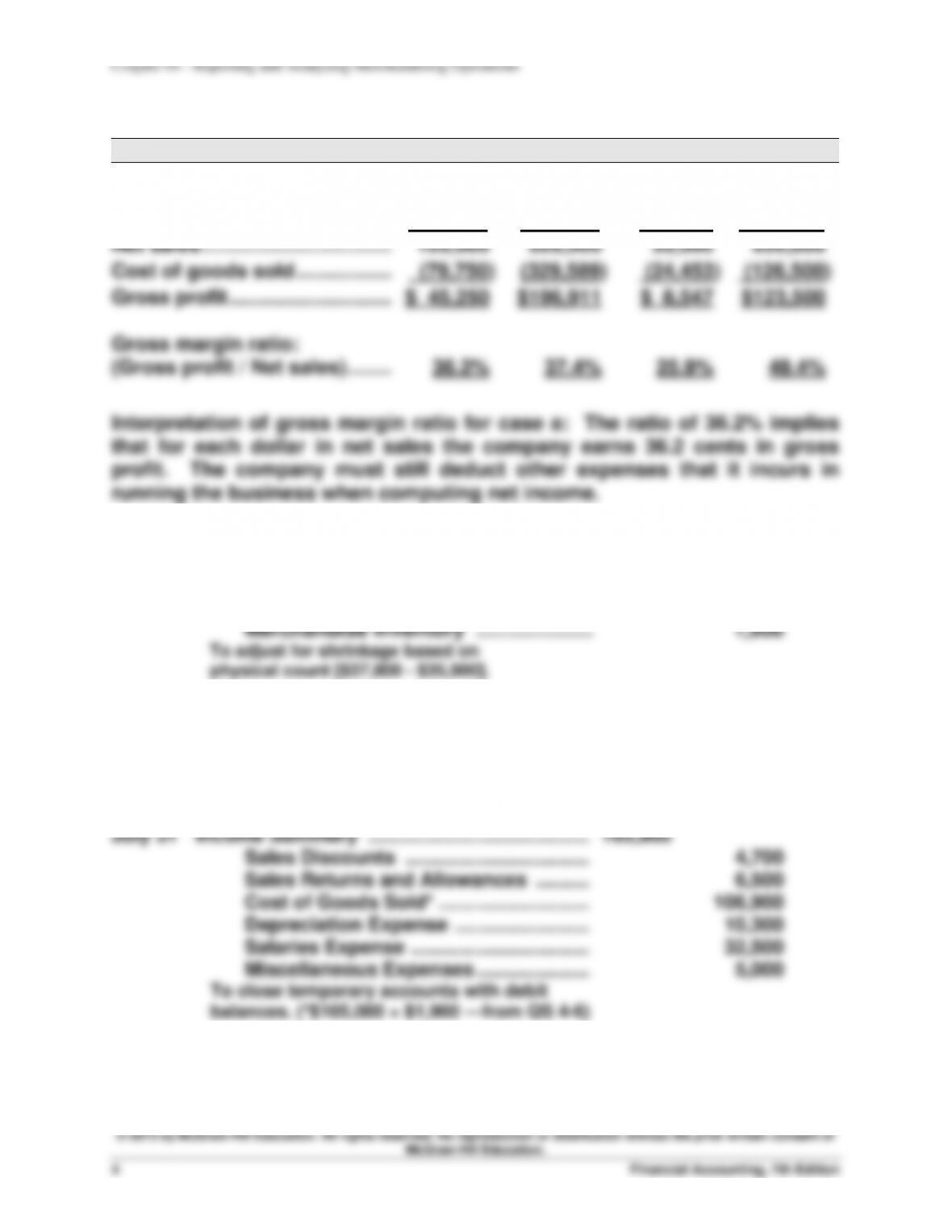
Interpretation of gross margin ratio for case a: The ratio of 36.2% implies
that for each dollar in net sales the company earns 36.2 cents in gross
profit. The company must still deduct other expenses that it incurs in
running the business when computing net income.
Quick Study 4-6 (10 minutes)
July 31 Cost of Goods Sold ……………………………… 1,900
Quick Study 4-7 (10 minutes)
July 31 Sales …………………………………………………….. 160,200
Income Summary …………………………... 160,200
To close temporary accounts with credit balances.
Quick Study 4-12A (10 minutes)
Nov. 5 Purchases ………………………………………………….. 6,000
Accounts Payable ……………………………….. 6,000
Quick Study 4-13A (10 minutes)
Apr. 1 Accounts Receivable …………………………………. 3,000
Sales …………………………………………………. 3,000
To record credit sale.
Quick Study 4-15 (10 minutes)
a. Both U.S. GAAP and IFRS include broad and similar guidance for the
Quick Study 4-16 (10 minutes)
a)
Aug. 1 Merchandise Inventory …………………………..…… 60,000
Accounts Payable ……………………………….. 60,000
Quick Study 4-17 (10 minutes)
a)
Sept. 15 Merchandise Inventory ……………………………….. 35,000
EXERCISES
Exercise 4-1 (10 minutes)
Operating cycle of a merchandiser with credit sales follows (chronological):