Chapter 04 Reporting and Analyzing Merchandising Operations
4-1
Chapter 04
Reporting and Analyzing Merchandising Operations
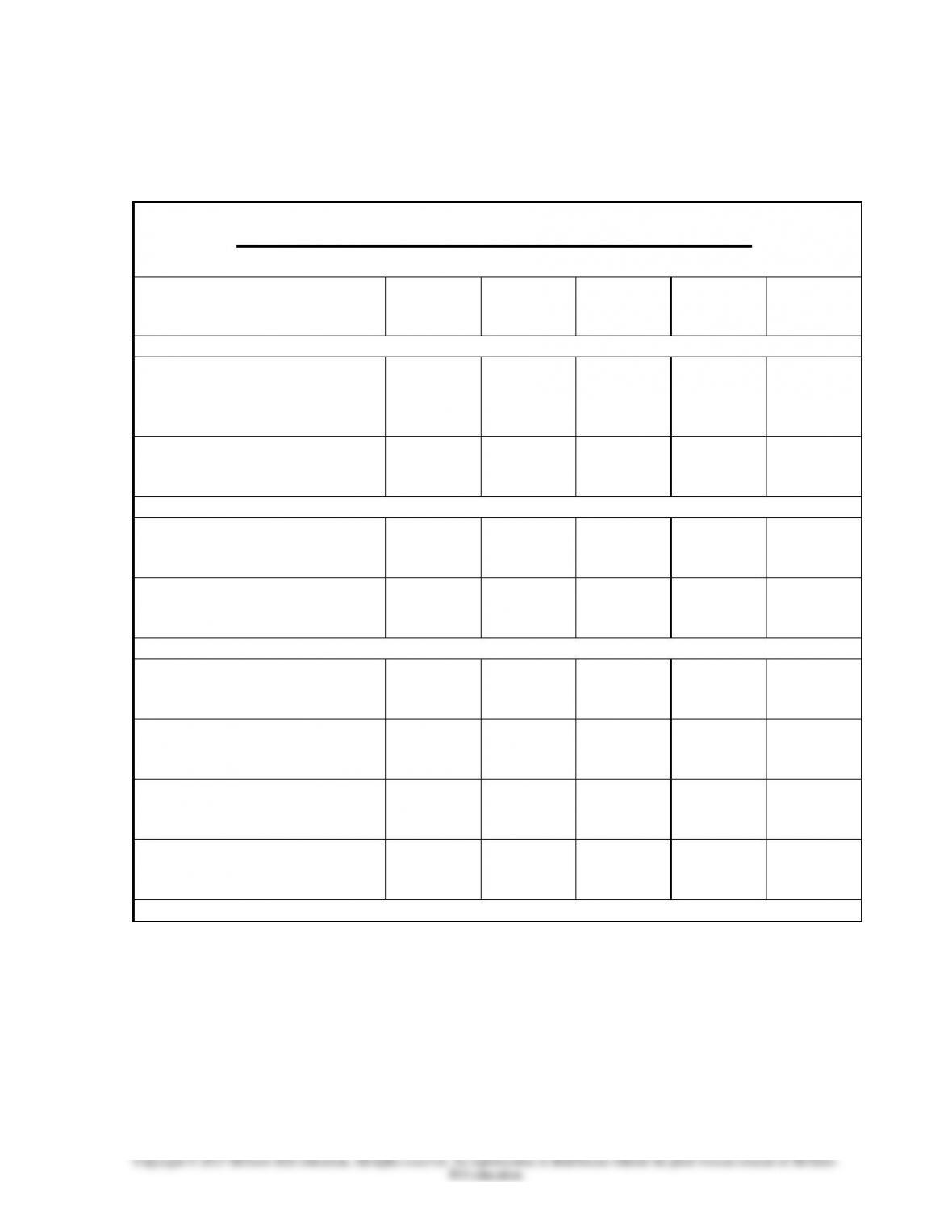
Student Learning Objectives and Related Assignment Materials*
Student Learning Objectives
Discussion
Questions
Quick
Studies
Exercises
Problems
(A &B set)**
Beyond the
Numbers
Conceptual objectives:
C1. Describe merchandising
activities and identify income
components for a
merchandising company.
1, 2, 3
4-1, 4-15
4-6, 4-10
EC, TTN,
TIA, ED,
HTR
C2. Identify and explain the
inventory asset and cost flows
of a merchandising company.
1, 2
4-2, 4-18
4-1, 4-10
4-4, 4-5
CIP, TIA,
ED
Analytical objectives:
A1. Compute the acid-test ratio
and explain its use to assess
liquidity.
4-8, 4-9
4-11, 4-13
4-3
RIA
A2. Compute the gross margin ratio
and explain its use to assess
profitability.
14
4-5
4-12
4-3
CA, TTN,
GD
Procedural objectives:
P1. Analyze and record transactions
for merchandise purchases
using a perpetual system.
6, 7, 9
4-3, 4-16,
4-17
4-2, 4-3, 4-5,
4-7, 4-8, 4-7,
4-14
4-1, 4-2
P2. Analyze and record transactions
for merchandise sales using
a perpetual system.
4, 6, 7, 8, 9,
15
4-4
4-3, 4-4, 4-7,
4-8, 4-14
4-1, 4-2
EC
P3. Prepare adjustments and close
accounts for a merchandising
company.
4-6, 4-7
4-9
4-3, 4-5, 4-6
CIP
P4. Define and prepare multiple-
step and single-step income
statements.
3, 10, 11, 12,
13, 14
4-10, 4-14
4-15, 4-20
4-3, 4-4
ED, GD
Grid continues on next page.
Chapter 04 Reporting and Analyzing Merchandising Operations
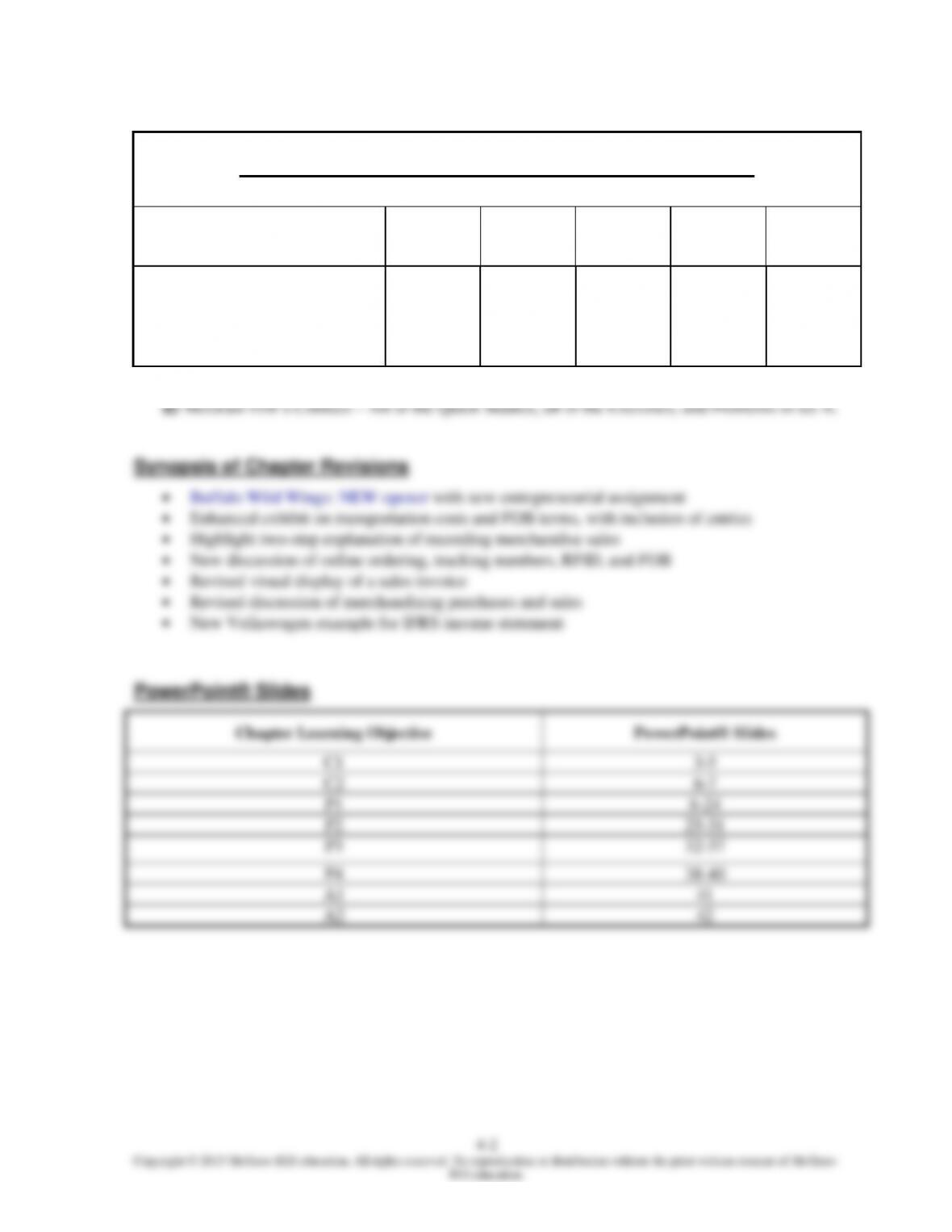
Student Learning Objectives and Related Assignment Materials
Student Learning Objectives
Questions
Quick
Studies
Exercises
Problems
(A &B set)*
Beyond the
Numbers
P5. Record and compare
merchandising transactions
using both periodic and
perpetual inventory systems.
(Appendix 4A)
5
4-11, 4-12,
4-13
4-16, 4-17,
4-18, 4-19
CIP
* Assignment materials that can be completed by students using:

Chapter 04 Reporting and Analyzing Merchandising Operations
4-3
Chapter Outline
Notes
I. Merchandising Activities
Products that a company acquires to resell to customers are referred to
as merchandise (also called goods). A merchandiser earns net
income by buying and selling merchandise. A wholesaler is an
intermediary that buys products from manufacturers or other
wholesalers and sells them to retailers or other wholesalers.
A. Reporting Income for a Merchandiser
Revenue (net sales) from selling merchandise minus the cost of
goods sold (the expense of buying and preparing the merchandise)
to customers is called gross profit (also called gross margin). This
amount minus expenses (generally called operating expenses)
determines the net income or loss for the period.
B. Reporting Inventory for a Merchandiser
1. A merchandiser’s balance sheet is the same as a service
business with the exception of one additional current asset,
merchandise inventory, or simply inventory.
2. The cost of this asset includes the cost incurred to buy the
goods, ship them to the store, and make them ready for sale.
C. Operating Cycle for a Merchandiser
A merchandising company’s operating cycle begins by purchasing
merchandise and ends by collecting cash from selling the
merchandise. Companies try to keep their operating cycles short
because assets tied up in inventory and receivables are not
productive.
D. Inventory Systems
1. Merchandise available for sale consists of beginning inventory
and what it purchases (net purchases). The merchandise
available is either sold (cost of goods sold) or kept for future
sales (ending inventory).
2. Two alternative inventory systems are used to collect
information about cost of goods sold and the cost of inventory:
a. Perpetual inventory system—continually updates
accounting records for merchandise transactions,
specifically, for those records of inventory available for
sale and inventory sold.
b. Periodic inventory system—updates the accounting
records for merchandise transactions only at the end of a
period.
c. Some companies use a hybrid system where the perpetual
system is used for tracking units available and the periodic
system is used to compute cost of sales.

Chapter 04 Reporting and Analyzing Merchandising Operations
4-4
Chapter Outline
Notes
The following sections of this outline use the perpetual inventory system.
Appendix 4A uses the period system (with perpetual results on the side). An
instructor can choose to cover either one or both inventory systems.
II. Accounting for Merchandise Purchases
The invoice serves as a source document for this event.
A. Purchase Discounts
Credit terms for a purchase include the amounts and timing of
payments from a buyer to a seller. The amount of time before full
payment is due is called the credit period.
1. Sellers can grant a cash discount to encourage the buyer to
pay earlier. A seller views a cash discount as a sales discount
and a buyer views a cash discount as a purchase discount.
This reduced payment applies only for the discount period.
2. Example: credit terms, 2/10 n/30, offers a 2 % discount if the
invoice is paid within 10 days of invoice date.
3. Entry for buyer for purchase of merchandise on credit: debit
Merchandise Inventory, credit Accounts Payable.
4. Entry for buyer to record payment within discount period:
debit Accounts Payable (full invoice amount), credit Cash
(amount paid = invoice – discount), credit Merchandise
Inventory (amount of discount).
B. Purchase Returns and Allowances
1. Purchase returns refer to merchandise a buyer acquires but
then returns to the seller.
2. A purchase allowance is a reduction in the cost of defective or
unacceptable merchandise that a buyer acquires.
3. The buyer issues a debit memorandum to inform the seller of
a debit made to the supplier’s account.
4. Entry for buyer to record purchase return or allowance: debit
Accounts Payable or Cash (if refund given) and credit
Merchandise Inventory.
5. When goods are returned, a buyer can take a purchase
discount on only the remaining balance of the invoice.

Chapter 04 Reporting and Analyzing Merchandising Operations
4-5
Chapter Outline
Notes
C. Transportation Costs and Ownership Transfer
The buyer and seller must agree on who is responsible for paying
any freight costs and who bears the risk of loss during transit for
merchandising transactions. The point of transfer is called the
FOB (free on board) point.
1. FOB shipping point—buyer accepts ownership when goods
depart sellers’ place of business; buyer pays shipping costs.
a. Shipping costs increase the cost of merchandise acquired
(cost principle).
b. Entry for buyer to record shipping costs: Debit
Merchandise Inventory, credit Cash or Accounts Payable
(if to be paid with merchandise later).
2. FOB destination—ownership of goods transfers to buyer when
goods arrive at buyer’s place of business; seller pays shipping
costs.
a. Shipping costs are an operating (selling) expense for seller
b. Entry for seller to record shipping costs: Debit Delivery
Expense (or Transportation-Out or Freight-Out), credit
Cash.
III. Accounting for Merchandise Sales
A. Sales of Merchandise
Each sales transaction involves two parts and will therefore
require two entries:
1. Recognize revenue received —entry for seller to record: debit
Accounts Receivable (or cash), credit Sales (for the invoice
amount).
2. Recognize cost of merchandise sold— entry for seller to
record: debit Cost of Goods Sold, credit Merchandise
Inventory (for the cost of the merchandise sold).
B. Sales Discounts
Sales discounts are usually not recorded until a customer actually
pays with the discount period.
1. Entry for seller to record collection after discount period—
Debit Cash, Credit Accounts Receivable (full invoice amount).
2. Entry for seller to record collection within discount period—
debit Cash (invoice amount less discount), debit Sales
Discounts (discount amount), credit Accounts Receivable
(invoice amount).
3. Sales Discounts is a contra-revenue account; it is subtracted
from Sales when computing a company’s net sales.
4. Sales discounts are monitored to assess the effectiveness and
cost of its discount policy.

Chapter 04 Reporting and Analyzing Merchandising Operations
4-6
Chapter Outline
Notes
C. Sales Returns and Allowances
1. Sales returns—merchandise that a customer returns to the
seller after a sale.
2. Sales allowances—reductions in the selling price of
merchandise sold to customers (usually for damaged or
defective merchandise that a customer is willing to keep at a
reduced price).
3. Entry for seller to record sales returns or allowances: debit
Sales Returns and Allowances and credit Accounts
Receivable; additional entry if returned merchandise is
salable: debit Merchandise Inventory, credit Cost of Goods
Sold.
4. Seller prepares a credit memorandum to inform buyer of the
seller’s credit to the buyer’s Accounts Receivable (on the
seller’s books).
IV. Completing the Accounting Cycle
A. Adjusting Entries for Merchandisers
Generally same as discussed in chapter 3 for a service business.
1. Additional adjustment needed to update inventory to reflect
any loss of merchandise, including theft and deterioration, is
referred to as shrinkage.
2. Shrinkage is determined by comparing a physical count of the
inventory with recorded quantities.
3. Entry to record shrinkage: debit Cost of Goods Sold, credit
Merchandise Inventory.
B. Preparing Financial Statements
The financial statement for a merchandiser are similar to those for
a service company described in chapters 2 and 3.
1. The income statement mainly differs by the inclusion of cost
of goods sold and gross profit. Net sales is affected by
discounts, returns, and allowances, and some additional
expenses are possible such as delivery expense and loss from
defective merchandise.
2. The balance sheet mainly differs by the inclusion of
merchandise inventory as part of current assets.
C. Closing Entries for Merchandisers
Closing entries are similar to a service business except that some
new temporary accounts that arise from merchandising activities
must be closed (e.g., Sales Discount, Sales Returns and
Allowances, and Cost of Goods Sold). These debit balance
accounts are closed with the expense accounts to Income
Summary.

Chapter 04 Reporting and Analyzing Merchandising Operations
4-7
Chapter Outline
Notes
V. Financial Statement Formats—No specific format is required in
practice. Two common income statement formats:
A. Multiple-Step Income Statement
1. A multiple-step income statement has three main parts:
a. Gross profit—net sales minus cost of goods sold),
b. Income from operations—gross profit less operating
expenses, and
c. Net income—income from operations adjusted for
nonoperating items.
2. Operating expenses are classified into two sections:
a. Selling expenses—the expenses of promoting sales,
making sales, and delivering goods to customers, and
b. General and administrative expenses—expenses related
to accounting, human resource management, and financial
management.
3. Nonoperating activities—consist of other expenses, revenues,
losses, and gains that are unrelated to a company’s operations;
reported in two sections:
a. Other revenues and gains—interest revenue, dividend
revenue, rent revenue, and gains from asset disposals.
b. Other expenses and losses—interest expense, losses from
asset disposals, and casualty losses.
B. Single-Step Income Statement
A single-step income statement includes cost of goods sold as an
operating expense and shows only one subtotal for total expenses,
one subtraction to arrive at net income.
C. Classified Balance Sheet
The merchandiser’s classified balance sheet reports merchandise
inventory as a current asset, usually after accounts receivable.
VI. Global View
A. Accounting and Reporting for Merchandising Purchases and
Sales – Both GAAP and IFRS include similar guidance in
accounting for merchandise purchases and sales. All of the
transactions presented in this chapter, including the closing process,
are accounted for identically under the two systems.
B. Income Statement Presentation – IFRS tends to use the term profit
more than any other term. GAAP statements use neet income the
most. Both GAAP and IFRS income statements begin with net sales
(or net revenue) followed by cost of goods sold for
merchandisers/manufacturers.
1. GAAP offers little guidance about the presentation or order of
expenses. IFRS requires separate disclosures for