Chapter 12 – Reporting and Analyzing Cash Flows
© 2015 by McGraw-Hill Education. All rights reserved. No reproduction or distribution without the prior written consent of
McGraw-Hill Education.
Solutions Manual, Chapter 12
1
Chapter 12
Reporting and Analyzing Cash Flows
QUESTIONS
1. The purpose of the cash flow statement is to report all major cash receipts (inflows) and
cash payments (outflows) during a period. It helps users to answer questions such as:
2. On a statement of cash flows, investing activities include cash outflows from purchases
of long-term investments such as stocks and bonds, from purchases of plant assets
3. On a statement of cash flows, financing activities include cash inflows such as those
that result from issuing preferred or common stock, and from borrowing by issuing
4. The direct method of reporting cash flows from operating activities itemizes the major
expenses.
5. On a statement of cash flows prepared according to the direct method, operating
activities generally include cash receipts from the sale of goods and services, cash
6. The indirect method of reporting cash flows from operating activities begins with net
7. Payments of cash dividends should be reported on the statement of cash flows as
8. The amount of the land purchase that was paid for in cash ($400,000) should be reported
on the statement of cash flows as an investing activity. Also, a schedule of noncash
9. Since this cash inflow results from borrowing money, it is reported on the statement of
10. Yes; even though a company reports positive net income for the year, it may still show a
net cash outflow from operating activities. When net income is reconciled to the net
11. Depreciation is not a source or a use of cash, even though it must be added to net
12. (a) Indirect method. (b) The increase in accounts (trade) receivable represents an
amount by which the company had cash tied up in accounts (trade) receivable versus
13. Google’s statement of cash flows shows several major financing activities for the year
ended December 31, 2012 ($ millions):
14. Samsung’s net cash (all is KRW millions) from operating activities is ₩37,972,809; its
15. Samsung’s investing activities yielding cash outflows and inflows for the year ended
December 31, 2012, follow. Its cash outflows are listed in parentheses (₩ in millions):
Net decrease (increase) in short-term financial instruments …………………………... ₩ (5,965,611)
Net decrease (increase) in short-term available-for-sale financial assets ……….. (589,072)
© 2015 by McGraw-Hill Education. All rights reserved. No reproduction or distribution without the prior written consent of
McGraw-Hill Education.
Solutions Manual, Chapter 12
3
Quick Study 12-1 (20 minutes)
1. (e) Noncash activity
2. (d) Financing activity
3. (a) Statement of cash flows
4. (f) Net change in cash balance
Quick Study 12-2 (10 minutes)
1. Investing 6. Financing
2. Operating 7. Operating
3. Operating 8. Operating
4. Operating 9. Investing*
5. Financing 10. Operating
Quick Study 12-3 (10 minutes)
Cash flows from operating activities
Net income …………………………………………………………………….…
$18,200
Adjustments to reconcile net income to operating cash flow
Depreciation ………………………………………………………………..…
$36,000
Accounts receivable decrease ……………………………………..…
7,000
Inventory increase ……………………………………………………….…
(5,900)
Accounts payable increase ………………………………………….…
4,700
Income taxes payable decrease ………………………………………
(150)
41,650
Net cash provided from operating activities ………………………
$59,850
Quick Study 12-4 (10 minutes)
Computation of cash inflow from sale of furniture
Cost of furniture sold (given) ……………………………………………...
$52,500
Accumulated depreciation at beginning of year (given) ……….
$110,700
Increase from depreciation expense (given) ………………………..
18,000
Total “expected” accumulated depreciation ………………………..
128,700
Actual accumulated depreciation at end of year (given) ……...
(88,700)
Accumulated depreciation on sold furniture ……………………….
40,000
Cash received from sale of furniture at book value ……………..
$12,500
Quick Study 12-5 (10 minutes)
Part 1
Computation of cash received from the sale of common stock
Increase in Common stock ($105,000 – $100,000) …………………………….……
$ 5,000
Increase in Paid-in capital in excess of par ($567,000-$342,000) ……………
225,000
Cash received from the sale of common stock ……………………………..……
$230,000
Part 2
Computation of cash paid for dividends
Beginning retained earnings ………………………………………………………..……
$287,500
Net income …………………………………………………………………………………...
48,000
Total “expected” retained earnings……………………………………………………
335,500
Actual ending retained earnings …………………………………………………..…..
(313,500)
Cash paid for dividends ……………………………………………………………….……
$ 22,000
Quick Study 12-9B (10 minutes)
1. Cash received from customers = Sales + Accounts receivable decrease
2. Net increase in cash = $94,800 – $24,000 = $70,800
Quick Study 12–10B (10 minutes)
1. Cash paid for merchandise
2. Cash paid for operating expenses
= Operating expenses (excluding depreciation)
Quick Study 12–11B (10 minutes)
Cash flows from operating activities
Receipts from sales to customersa ………………………………..
$ 498,000
Payments for merchandise inventoryb …………………………..
(310,000)
Payments for other expensesc ……………………………………...
(86,300)
Payments for taxesd ……………………………………………………..
(18,500)
Net cash provided by operating activities ………………………..
$ 83,200
a From QS 12-9B
b From QS 12–10B
c From QS 12–10B
d $17,300 (income tax expense) + $1,200 (decrease in income taxes payable)
Quick Study 12-16 (15 minutes)
Financing Activities
Additional short-term borrowings ……………………………………………….…….
$20,000
Cash dividends paid …………………………………………………………………..…….
(16,000)
Cash provided by financing activities ……………………………………………….
$ 4,000
Quick Study 12-17 (25 minutes)
Part 1
MONTGOMERY, INC.
Statement of Cash Flows (Indirect Method)
For Year Ended December 31, 2014
Cash flows from operating activities
Net income ……………………………………………………….
$ 10,500
Adjustments to reconcile net income to net cash
provided by operating activities
Decrease in accounts receivable ……………………..……
2,100
Increase in inventory ……………………………………….………………
(19,950)
Decrease in accounts payable …………………………..
(1,500)
Decrease in salaries payable ………………………………………………
(100)
Depreciation expense ……………………………………………………….
7,200
Net cash used in operating activities ……………….………….
$ (1,750)
Cash flows from investing activities
Cash paid for equipment (Note 1) …………………….…….
(8,400)
Net cash used in investing activities ………………..…………
(8,400)
Cash flows from financing activities
Cash received from stock issuance ………………….……….
10,000
Net cash used in financing activities ………………..…………
10,000
Net decrease in cash ………………………………………….……………
$ (150)
Cash balance at beginning of year ……………………..……
30,550
Cash balance at end of year ……………………………….…………………
$ 30,400
EXERCISES
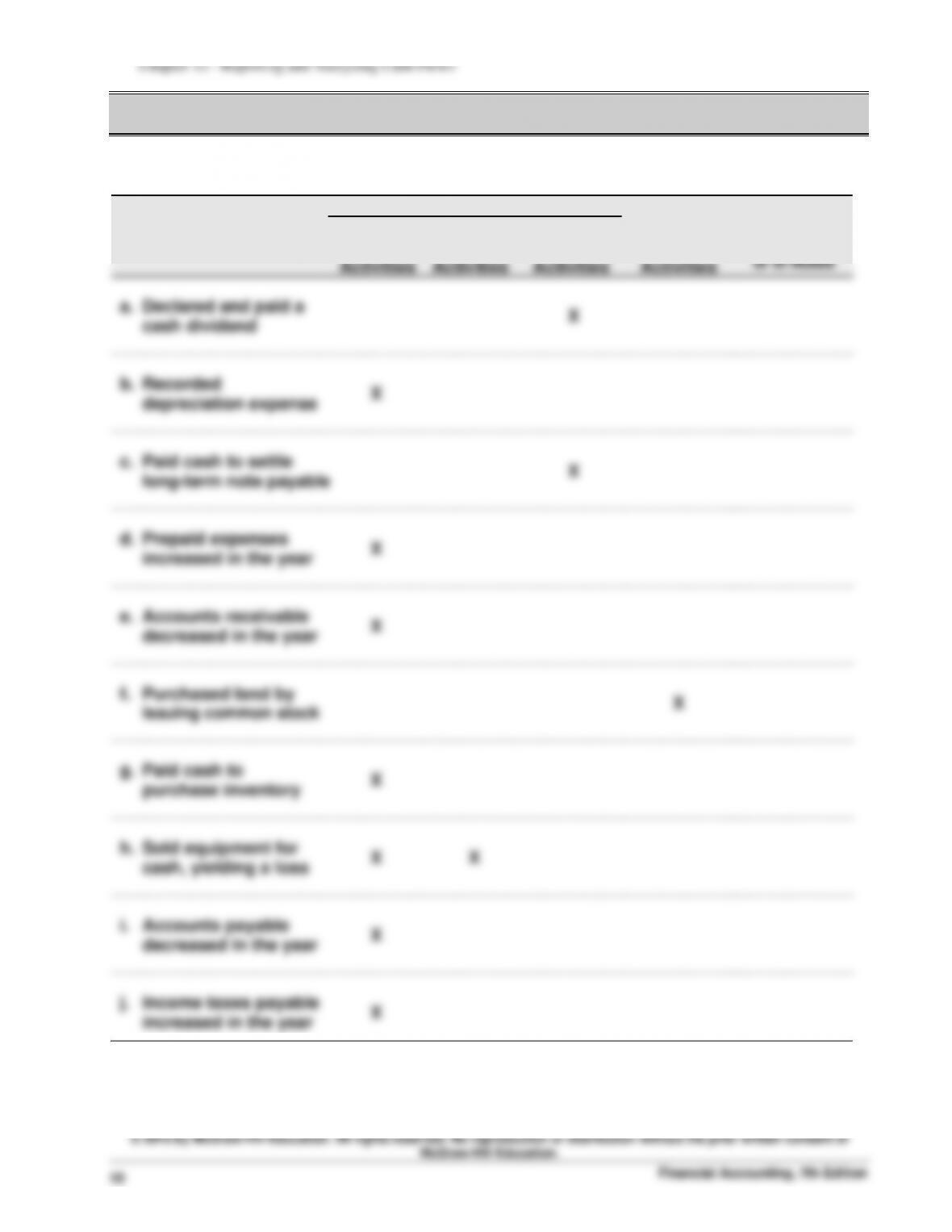
Exercise 12-1 (25 minutes)
Statement of Cash Flows
Noncash
Operating
Activities
Investing
Activities
Financing
Activities
Investing &
Financing
Activities
Not Reported
on Statement
or in Notes
a. Declared and paid a
cash dividend
X
b. Recorded
depreciation expense
X
c. Paid cash to settle
long-term note payable
X
d. Prepaid expenses
increased in the year
X
e. Accounts receivable
decreased in the year
X
f. Purchased land by
issuing common stock
X
g. Paid cash to
purchase inventory
X
h. Sold equipment for
cash, yielding a loss
X
X
i. Accounts payable
decreased in the year
X
j. Income taxes payable
increased in the year
X