Chapter 11 – Reporting and Analyzing Equity
© 2015 by McGraw-Hill Education. All rights reserved. No reproduction or distribution without the prior written consent of
McGraw-Hill Education.
Solutions Manual, Chapter 11
1
Chapter 11
Reporting and Analyzing Equity
QUESTIONS
1. Organization expenses (costs) are incurred in creating a corporation. Examples include:
2. Organization expenses (costs) are reported as expenses when incurred—as part of operating
3. The board of directors of a corporation is responsible for directing the corporation’s affairs.
4. Authorized shares represent the maximum number of shares that a corporation’s charter
5. The preemptive right of common stockholders is the right to maintain their relative
6. The general rights of common stockholders include: (1) the right to vote in stockholders’
meetings, (2) the right to sell or otherwise dispose of stock, (3) the preemptive right, (4) the
7. The market value per share of stock is the price at which a share of stock is bought or sold.
8. The par value is an arbitrary value placed on a share of stock when it is authorized. The call
9. Convertible preferred stock is potentially attractive because it offers the safety of a regular
10. The three important dates governing dividends are:
a. date of declaration⎯the date the directors vote to pay a dividend.
11. Cash dividends debited against paid-in capital accounts are called liquidating dividends
12. Declaring a stock dividend has no effect on assets, liabilities, or total equity. Also, the
13. A stock dividend results in a distribution of additional shares to stockholders and the
capitalization of retained earnings. A stock split calls in the old shares and replaces them
14. A stock dividend should not be considered income because it does not transfer any assets
15. A treasury stock purchase reduces total assets and total equity by equal amounts.
16. Treasury stock purchases affect the corporate assets and stockholders’ equity just like a
17. With a simple capital structure, earnings per share is calculated by first subtracting any
18. A stock option is the right to purchase common stock at a fixed price over a specified period.
19. When a corporation has no preferred stock, book value per share is calculated by dividing
20. Apple discloses on its fiscal 2012 balance sheet that it has 1,800,000 common shares
21. The par value for Google’s preferred stock is reported to be $0.001. A low par value can be
22. From a review of its statement of cash flows, Samsung did not report any cash outlay in
2012 to repurchase treasury stock. However, the Company reported disposal of treasury
© 2015 by McGraw-Hill Education. All rights reserved. No reproduction or distribution without the prior written consent of
McGraw-Hill Education.
Solutions Manual, Chapter 11
3
Quick Study 11-1 (10 minutes)
Quick Study 11-2 (5 minutes)
a.
Cash …………………………………………………………………………
1,827,000
Common Stock, No-Par Value …………………………..
1,827,000
Issued no-par value stock for cash. (63,000 x $29)
b.
Land …………………………………………………………………………
1,827,000
Common Stock, No-Par Value …………………………..
1,827,000
Issued no-par value stock for land.
Quick Study 11-3 (5 minutes)
a.
Cash ………………………………………………………………..
375,000
Common Stock, $5 Par Value ……………………….
375,000
Issued par value stock for cash. (75,000 x $5)
b.
Cash* ……………………………………………………………….
450,000
Common Stock, $5 Par Value ……………………….
375,000
Paid-In Capital in Excess of Par Value,
Common Stock ………………………………………...
75,000
Issued par value stock for cash. *(75,000 x $6)
Quick Study 11-4 (5 minutes)
a.
Cash* ……………………………………………………………….
648,000
Common Stock, $2 Par Value** …………………….
72,000
Paid-In Capital in Excess of Par Value,
Common Stock*** ……………………………………..
576,000
Issued par value stock for cash.
*36,000 x $18 = $648,000
**36,000 x $2 = $72,000
***$648,000 – $72,000 = $576,000
b.
Cash* ……………………………………………………………….
648,000
Common Stock, $2 Stated Value** ………………..
72,000
Paid-In Capital in Excess of Stated Value,
Common Stock*** ……………………………………..
576,000
Issued stated value stock for cash.
*36,000 x $18 = $648,000
**36,000 x $2 = $72,000
***$648,000 – $72,000 = $576,000
Quick Study 11-5 (15 minutes)
(a) Mar. 1
Cash …………………………………………………………..……
297,500
Common Stock, $4 Par Value ………………….……
170,000
Paid-In Capital in Excess of Par Value,
Common Stock …………………………………………
127,500
Issued par value stock for cash.
(b) Apr. 1
Cash …………………………………………………………..……
70,000
Common Stock, No-Par Value ………………………
70,000
Issued no-par value stock for cash.
(c) Apr. 6
Inventory …………………………………………………….…
45,000
Machinery …………………………………………………..…..
145,000
Note Payable ………………………………………….……
94,000
Common Stock, $25 Par Value ………………..……
50,000
Paid-In Capital in Excess of Par Value,
Common Stock …………………………………………
46,000
Issued stock for inventory, machinery, and note.
Quick Study 11-9 (10 minutes)
Jun Company
Stockholders’ Equity
April 2 (after stock dividend)
Common stock⎯$5 par value, 375,000 shares
authorized, 220,000 shares issued and outstanding …………….
$1,100,000
Paid-in capital in excess of par value, common stock……………..
900,000
Total paid-in capital ………………………………………………………………
2,000,000
Retained earnings …………………………………………………………………
433,000
Total stockholders’ equity …………………………………………………….
$2,433,000
Supporting work
Apr. 2
Retained Earnings ………………………………………………...
400,000
Common Stock* ……………………………………………....
100,000
Paid-In Capital in Excess of Par Value,
Common Stock** …………………………………………...
300,000
To record declaration and distribution
of a 10% common stock dividend.
* 200,000 shares x 10% x $5 par value = $100,000
**200,000 shares x 10% x ($20 market value –
$5 par value) = $300,000
Quick Study 11–10 (10 minutes)
Total cash dividend ………………………………………………………………...
$110,000
To preferred shareholders ……………………………………………………....
64,000*
Remainder to common shareholders ……………………………………....
$ 46,000
*80,000 shares x $5 par x .08 x 2 years = $64,000.
Quick Study 11-14 (10 minutes)
Quick Study 11-15 (10 minutes)
Quick Study 11-16 (10 minutes)
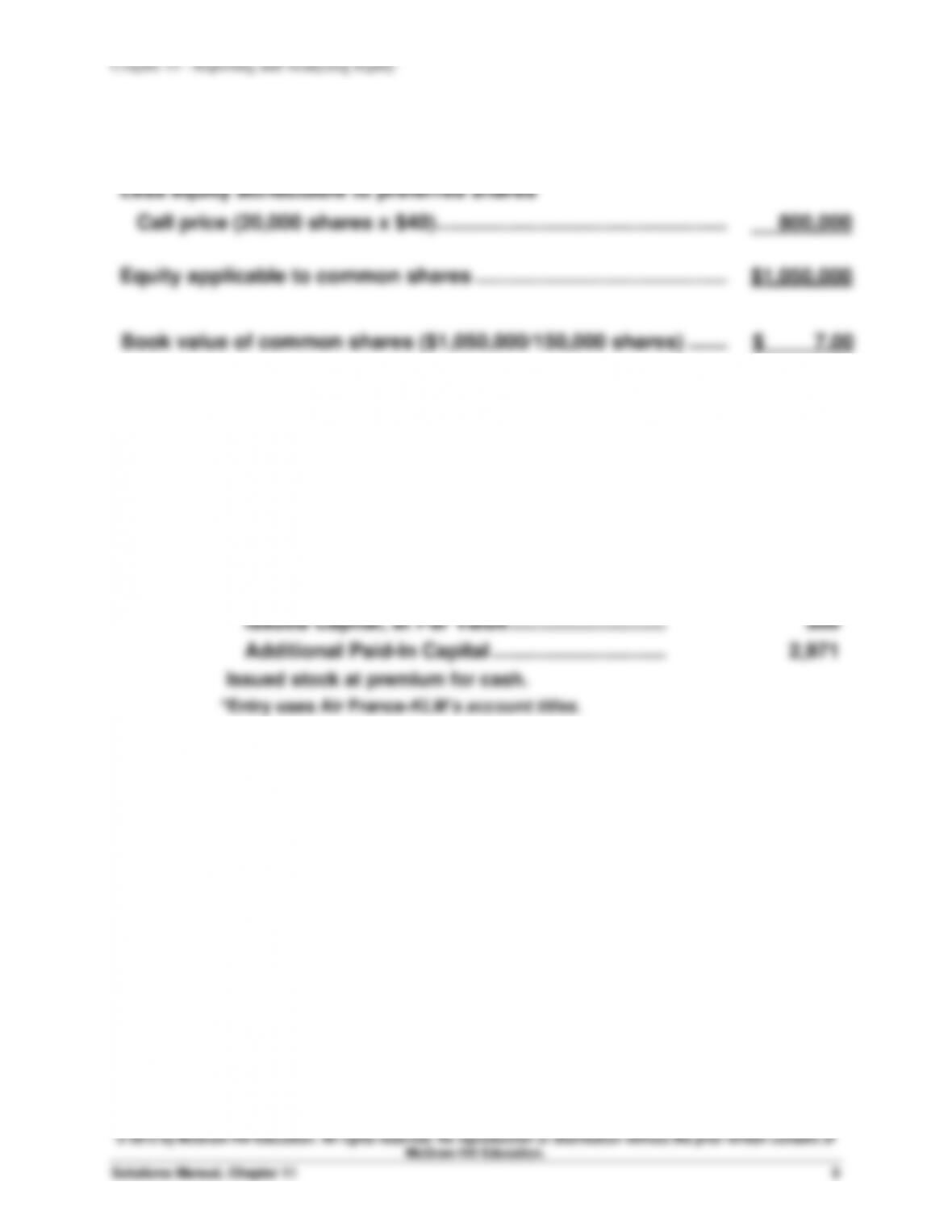
Price-earnings ratio = = 5.2
Quick Study 11-17 (10 minutes)
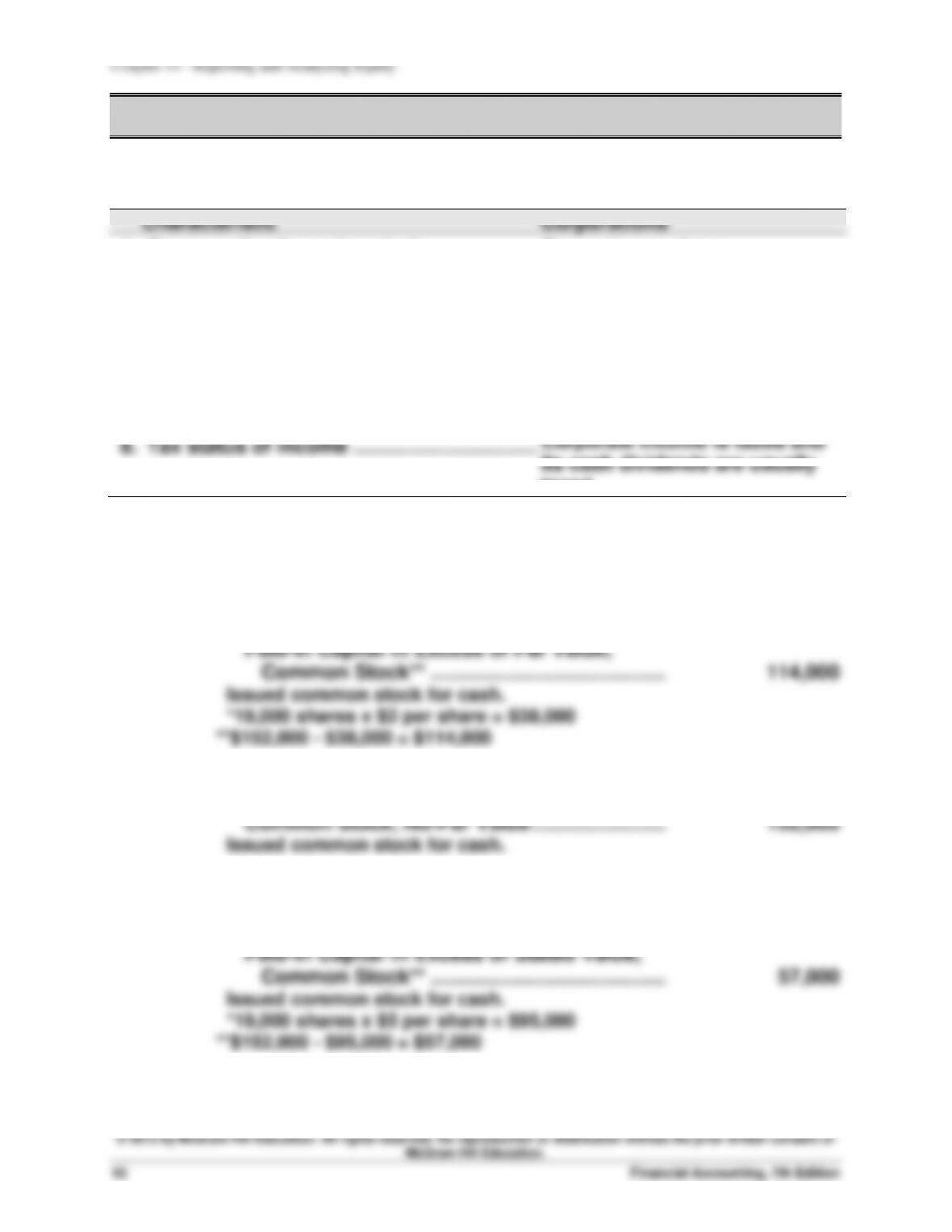
Dividend yield = = = 7.2%
Analysis: The company’s dividend yield of 7.2% indicates that it should be
classified as an income stock. That is, the company annually pays out
Market value per share
Earnings per share
Net income – Preferred dividends
Net income – Preferred dividends
$20.54
$3.95
$2.34
$32.50
Annual cash dividends per share
Market value per share
EXERCISES
Exercise 11-1 (15 minutes)
Characteristic
Corporations
1.
Owner authority and control ………………….
One vote per share
2.
Ease of formation ………………………………….
Requires government approval
3.
Transferability of ownership ………………….
Readily transferred
4.
Ability to raise large amounts of capital …..
High ability
5.
Duration of life ………………………………………
Unlimited
6.
Owner liability ……………………………………….
Limited
7.
Legal status ………………………………………….
Separate legal entity
8.
Tax status of income …………………………….
Corporate income is taxed and
its cash dividends are usually
taxed
Exercise 11-2 (15 minutes)
1.
Feb. 20
Cash ………………………………………………………………..
152,000
Common Stock, $2 Par Value* …………………....
38,000
Paid-In Capital in Excess of Par Value,
Common Stock** ……………………………………..
114,000
Issued common stock for cash.
*19,000 shares x $2 per share = $38,000
**$152,000 – $38,000 = $114,000
2.
Feb. 20
Cash ………………………………………………………………..
152,000
Common Stock, No-Par Value ……………………..
152,000
Issued common stock for cash.
3.
Feb. 20
Cash ………………………………………………………………..
152,000
Common Stock, $5 Stated Value* ………………..
95,000
Paid-In Capital in Excess of Stated Value,
Common Stock** ……………………………………..
57,000
Issued common stock for cash.
*19,000 shares x $5 per share = $95,000
**$152,000 – $95,000 = $57,000