Chapter 10 – Reporting and Analyzing Long-Term Liabilities
SERIAL PROBLEM — SP 10
Serial Problem — SP 10, Success Systems (75 minutes)
Part 1
Total equity = $129,034
Thus, total liabilities can be no more than its total equity x 0.8, or
due.
© 2015 by McGraw-Hill Education. All rights reserved. No reproduction or distribution without the prior written consent of
McGraw-Hill Education.
Solutions Manual, Chapter 10
61
1. Apple does not report any long-term debt as of September 29, 2012.
2. The interest that Apple must pay on $100 million of 4.25% convertible
3. Assuming that Apple had $100 million carrying value of convertible
bonds that convert into 20,000 shares of stock, the following entry
4. Answer depends on the financial statement information obtained.
© 2015 by McGraw-Hill Education. All rights reserved. No reproduction or distribution without the prior written consent of
McGraw-Hill Education.
Financial Accounting, 7th Edition
62
1. Apple’s current year debt-to–equity ratio = $57,584 /$118,210 = 0.49
2. For both years, Apple’s debt-to-equity ratio is above that of the industry
average of 0.44. This implies that its debt levels are more risky than that
1. The ethics of the Traverse County officials are questionable. The
financial impact of the leasing arrangement is the same as bond
financing in that the county has a debt obligation requiring the
repayment of principal and interest over time. Taxes may need to be
2. Because the lease requires payments of a non-binding nature, investors
who purchased the tax-exempt securities from the bank are holding an
investment that is more risky than the conventional municipal bonds of
Traverse County.
Chapter 10 – Reporting and Analyzing Long-Term Liabilities
© 2015 by McGraw-Hill Education. All rights reserved. No reproduction or distribution without the prior written consent of
McGraw-Hill Education.
Financial Accounting, 7th Edition
64
1. Home Depot’s long-term liabilities include:
Long-Term Debt, excluding current installments…………
$10,758 million
Other Long-Term Liabilities ………………………………………..
2,146 million
Deferred Income Taxes ………………………………………………
340 million
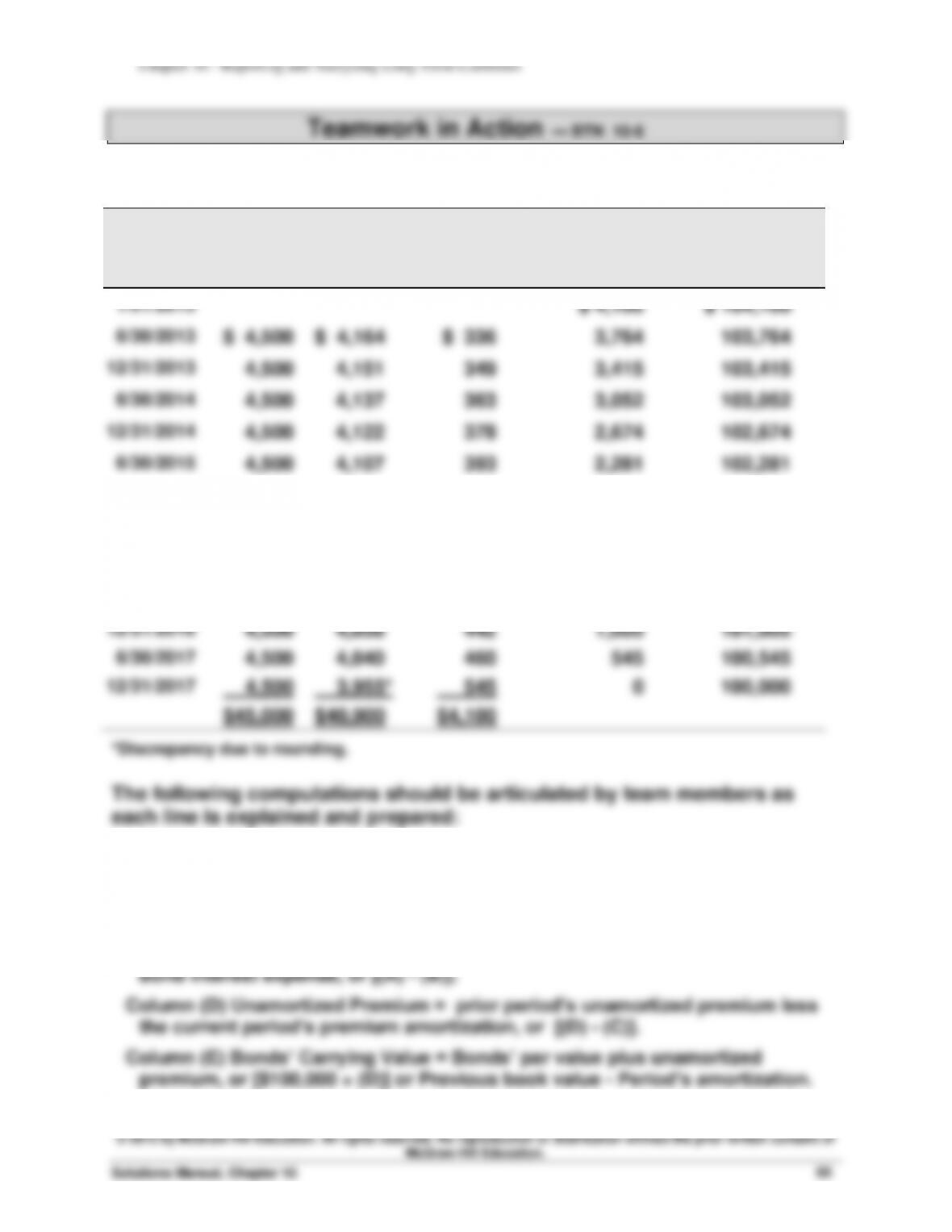
2 a. These Home Depot notes offer a 5.875% interest rate. If the interest
© 2015 by McGraw-Hill Education. All rights reserved. No reproduction or distribution without the prior written consent of
McGraw-Hill Education.
Solutions Manual, Chapter 10
65
Parts 1 and 2
Effective Interest Amortization of Bond Premium
Semi-
annual
Period-end
(A)
Cash
Interest
Paid
(B)
Bond
Interest
Expense
(C)
Premium
Amortization
(D)
Unamortized
Premium
(E)
Carrying
Value
1/01/2013
$ 4,100
$ 104,100
6/30/2013
$ 4,500
$ 4,164
$ 336
3,764
103,764
12/31/2013
4,500
4,151
349
3,415
103,415
6/30/2014
4,500
4,137
363
3,052
103,052
12/31/2014
4,500
4,122
378
2,674
102,674
6/30/2015
4,500
4,107
393
2,281
102,281
Since teams generally have 4 or 5 members, the team solution will likely end about
here. The remainder of the table is shown for help in answering part 3.
12/31/2015
4,500
4,091
409
1,872
101,872
6/30/2016
4,500
4,075
425
1,447
101,447
12/31/2016
4,500
4,058
442
1,005
101,005
6/30/2017
4,500
4,040
460
545
100,545
12/31/2017
4,500
3,955*
545
0
100,000
$45,000
$40,900
$4,100
*Discrepancy due to rounding.
The following computations should be articulated by team members as
each line is explained and prepared:
Column (A) Cash Interest Paid = Bonds’ par value ($100,000) x Semiannual
contract rate (4.5%).
Column (B) Bond interest expense = Bonds’ prior period carrying value x
Semiannual market rate (4%).
Column (C) Premium Amortization = difference between cash interest paid and
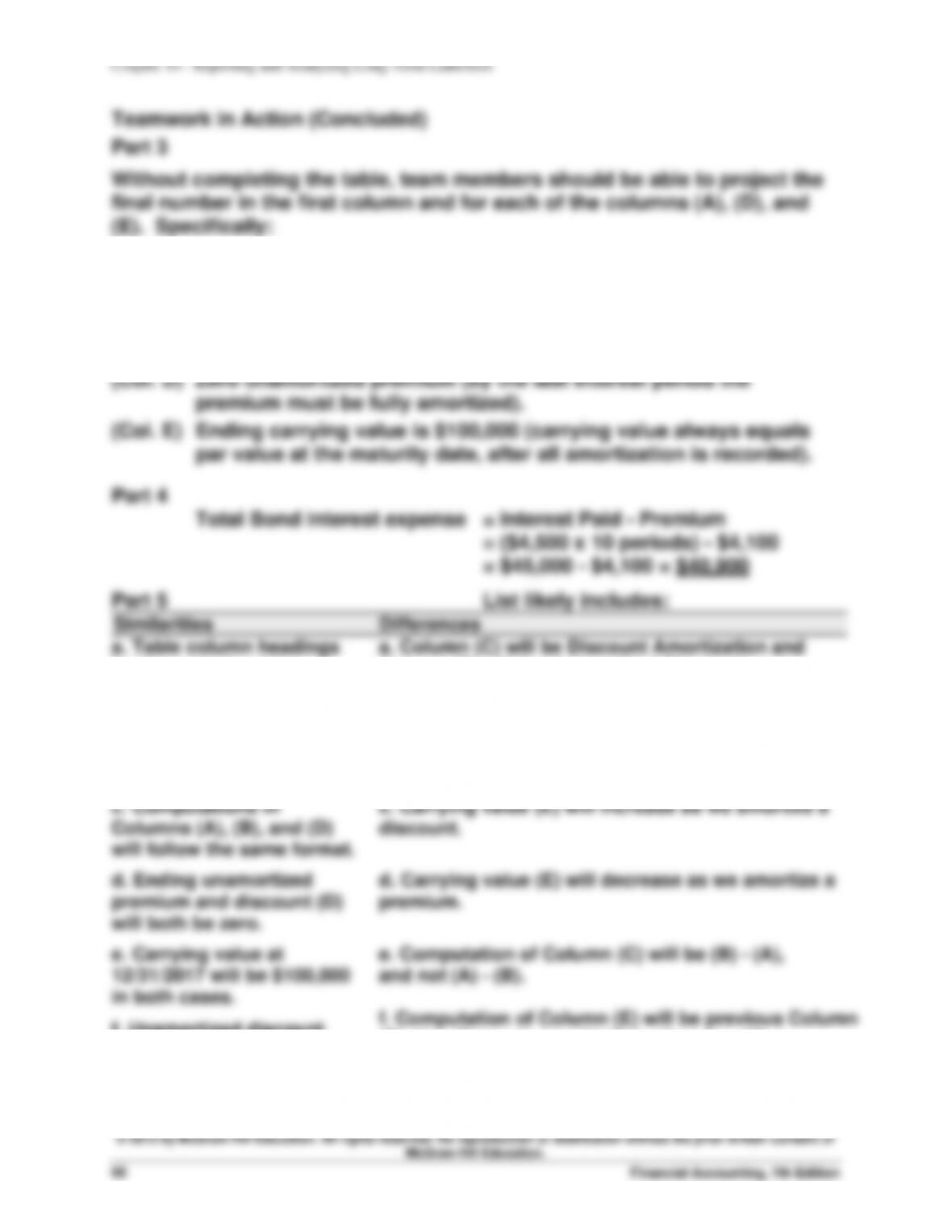
(Col. 1) Last interest period date is 12/31/2017 because this is a five-year
bond, issued 1/1/2013, with semiannual interest payments made
on 6/30 and 12/31 of each year.
(Col. A) Interest paid of $4,500 (every interest period has the same amount
of interest paid).
© 2015 by McGraw-Hill Education. All rights reserved. No reproduction or distribution without the prior written consent of
McGraw-Hill Education.
Solutions Manual, Chapter 10
67
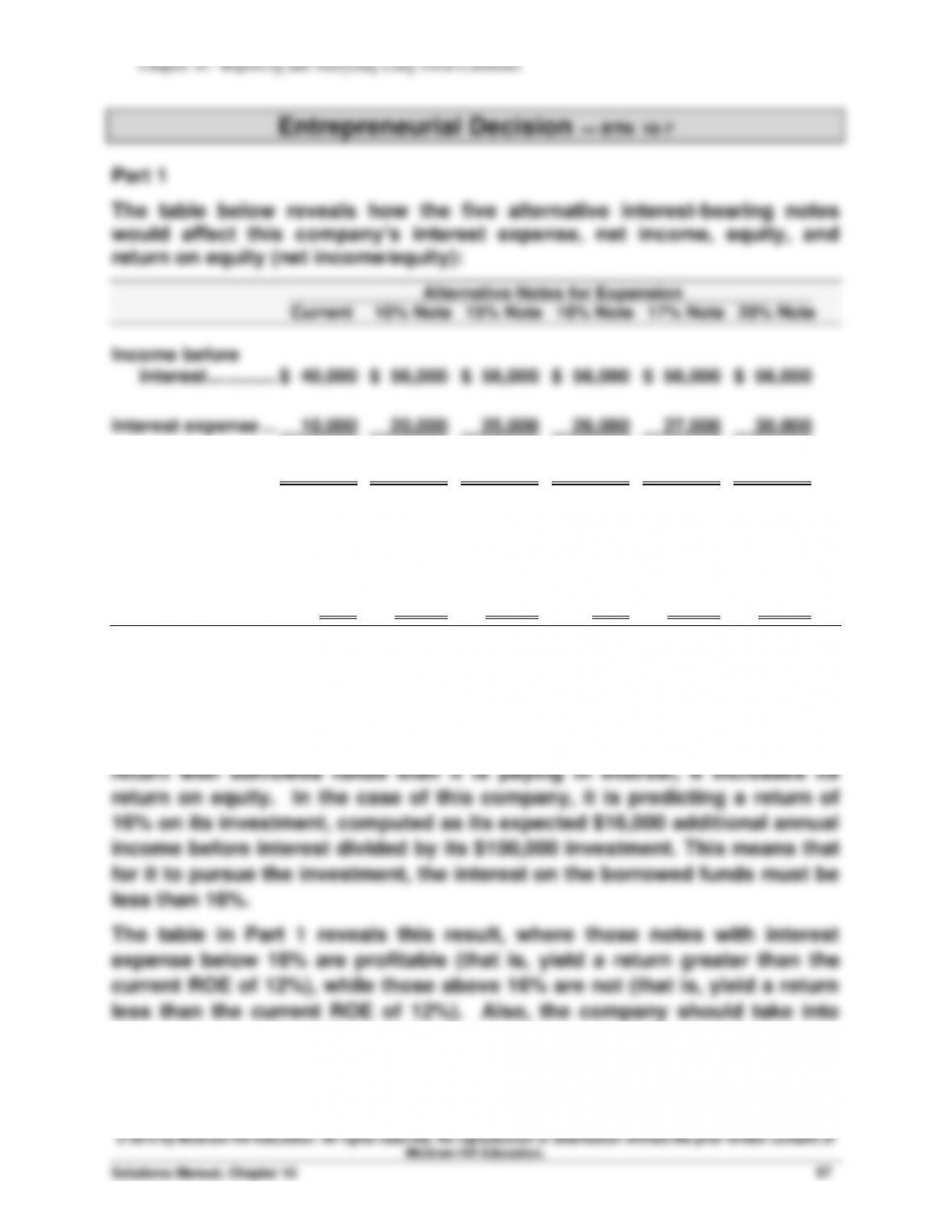
Net income ………… $ 30,000 $ 36,000 $ 31,000 $ 30,000 $ 29,000 $ 26,000
Equity ……………….. $250,000 $250,000 $250,000 $250,000 $250,000 $250,000
Return on equity … 12% 14.4% 12.4% 12% 11.6% 10.4%
Part 2
The analysis in Part 1 illustrates the general rule (called “financial
leverage” or “trading on the equity”): When a company earns a higher
account any potential variability in its income predictions because any
downturn in income that results in return on equity lower than the interest
rate paid on the notes would be unprofitable.
Chapter 10 – Reporting and Analyzing Long-Term Liabilities
Hitting the Road — BTN 10-8
1. Samsung’s current year debt–to-equity ratio (in KRW millions):
2. Samsung’s debt–to-equity ratio decreased slightly from the prior year to
the current year. However, for the current year, Samsung’s debt–to–