Chapter 01 – Introducing Financial Accounting
Problem 1-8A (Concluded)
Part 3—continued
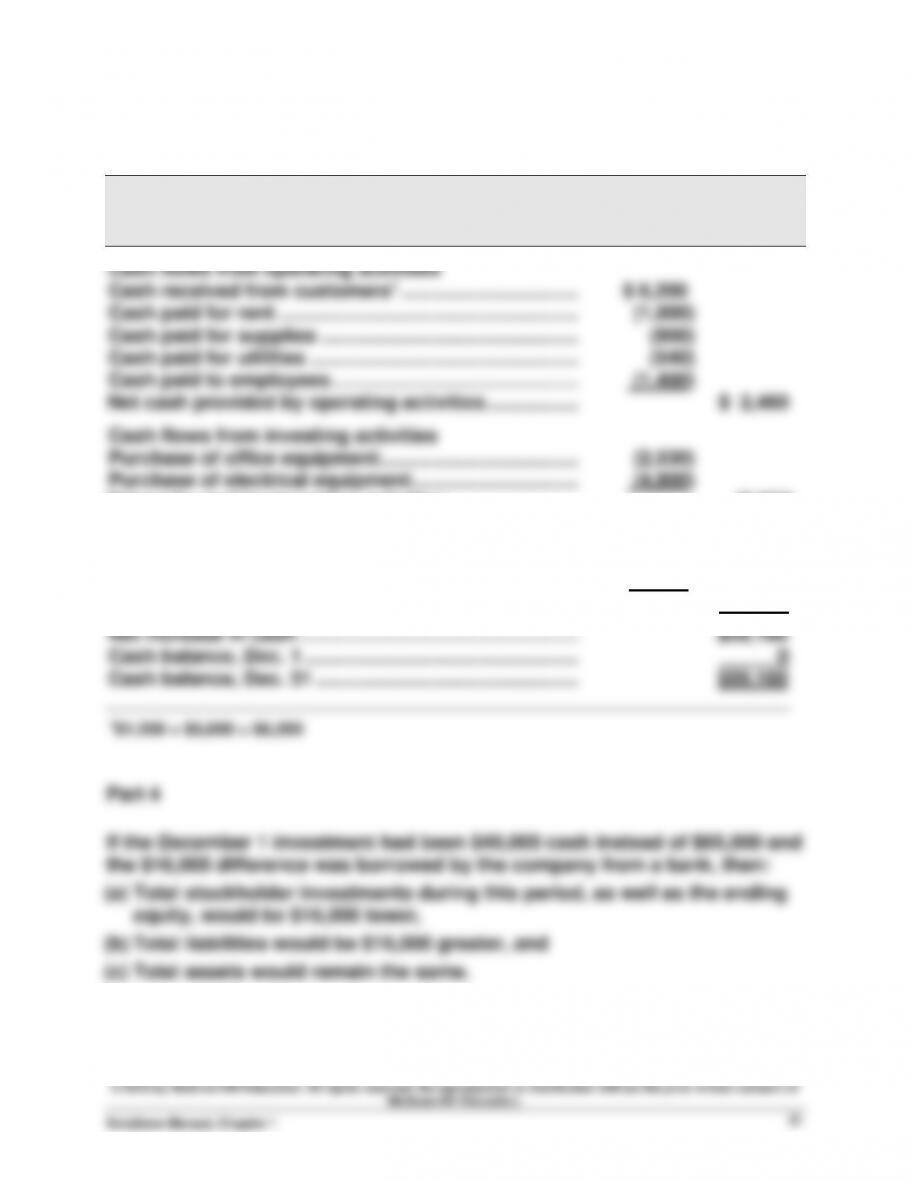
Ander Electric
Statement of Cash Flows
For Month Ended December 31
Cash flows from operating activities
Cash received from customers1 …………………………...
$ 6,200
Cash paid for rent ………………………………………………..
(1,000)
Cash paid for supplies …………………………………………
(800)
Cash paid for utilities …………………………………………..
(540)
Cash paid to employees ……………………………………….
(1,400)
Net cash provided by operating activities ……………..
$ 2,460
Cash flows from investing activities
Purchase of office equipment ……………………………….
(2,530)
Purchase of electrical equipment ………………………….
(4,800)
Net cash used by investing activities ……………………
(7,330)
Cash flows from financing activities
Investments by stockholder …………………………………
65,000
Dividends to stockholder ……………………………………..
(950)
Net cash provided by financing activities ……………..
64,050
Net increase in cash …………………………………………….
$59,180
Cash balance, Dec. 1 ……………………………………………
0
Cash balance, Dec. 31 ………………………………………….
$59,180
1$1,200 + $5,000 = $6,200
Part 4
If the December 1 investment had been $49,000 cash instead of $65,000 and
the $16,000 difference was borrowed by the company from a bank, then:
(a) Total stockholder investments during this period, as well as the ending
equity, would be $16,000 lower,
(b) Total liabilities would be $16,000 greater, and
(c) Total assets would remain the same.
Problem 1-9A (60 minutes) Parts 1 and 2
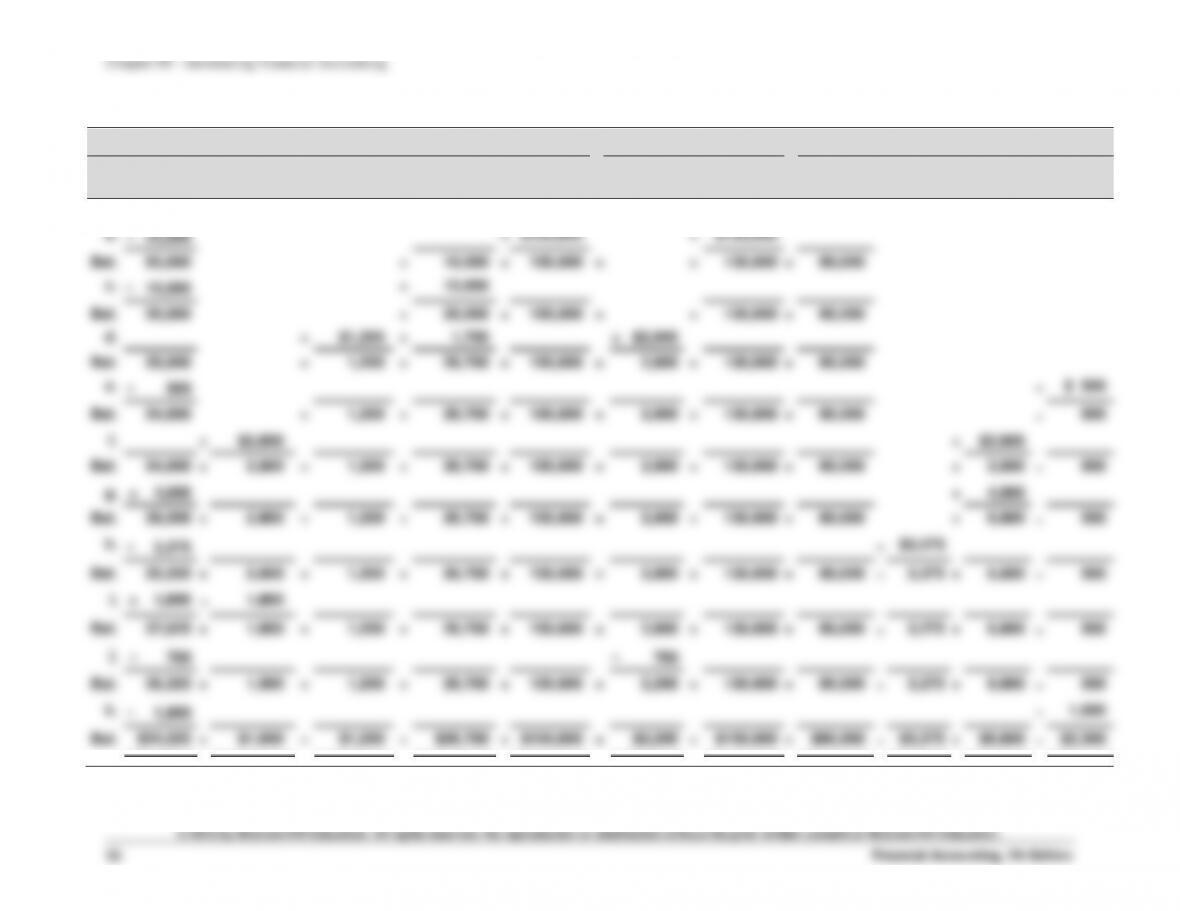
Assets
=
Liabilities
+
Equity
Cash
+
Accounts
Receivable
+
Office
Supplies
+
Office
Equipment
+
Building
=
Accounts
Payable
+
Notes
Payable
+
Common
Stock
–
Dividends
+
Reve-
nues
–
Expen-
ses
a.
+$70,000
+
$10,000
+
$80,000
b.
– 20,000
+
$150,000
+
$130,000
Bal.
50,000
+
10,000
+
150,000
=
+
130,000
+
80,000
c.
– 15,000
+
15,000
Bal.
35,000
+
25,000
+
150,000
=
+
130,000
+
80,000
d.
+
$1,200
+
1,700
+ $2,900
Bal.
35,000
+
1,200
+
26,700
+
150,000
=
2,900
+
130,000
+
80,000
e.
– 500
–
$ 500
Bal.
34,500
+
1,200
+
26,700
+
150,000
=
2,900
+
130,000
+
80,000
–
500
f.
+
$2,800
+
$2,800
Bal.
34,500
+
2,800
+
1,200
+
26,700
+
150,000
=
2,900
+
130,000
+
80,000
+
2,800
–
500
g.
+ 4,000
+
4,000
Bal.
38,500
+
2,800
+
1,200
+
26,700
+
150,000
=
2,900
+
130,000
+
80,000
+
6,800
–
500
h.
– 3,275
–
$3,275
Bal.
35,225
+
2,800
+
1,200
+
26,700
+
150,000
=
2,900
+
130,000
+
80,000
–
3,275
+
6,800
–
500
i.
+ 1,800
–
1,800
Bal.
37,025
+
1,000
+
1,200
+
26,700
+
150,000
=
2,900
+
130,000
+
80,000
–
3,275
+
6,800
–
500
j.
– 700
– 700
Bal.
36,325
+
1,000
+
1,200
+
26,700
+
150,000
=
2,200
+
130,000
+
80,000
–
3,275
+
6,800
–
500
k.
– 1,800
–
1,800
Bal.
$34,525
+
$1,000
+
$1,200
+
$26,700
+
$150,000
=
$2,200
+
$130,000
+
$80,000
–
$3,275
+
$6,800
–
$2,300
Problem 1-11A (15 minutes)
1. Return on assets is net income divided by the average total assets.
2. Return on assets seems satisfactory for the risk involved in the
3. We know that revenues less expenses equal net income. Taking the
4. We know from the accounting equation that total financing (liabilities
Problem 1-12AA (20 minutes)
Case 1 Return: 5% interest or $100/year.
Case 2 Return: Expected winnings from your bet.
Case 3 Return: Expected return on your stock investment (both
Case 4 Return: Expected increase in career earnings and other
rewards from an accounting degree (less all costs).
Chapter 01 – Introducing Financial Accounting
PROBLEM SET B
Problem 1-1B (40 minutes)
Part 1
Company V
(a) and (b)
Calculation of equity: 12/31/2012 12/31/2013
Assets ………………………..
$54,000
$59,000
Liabilities ……………………
(25,000)
(36,000)
Equity …………………………
$29,000
$23,000
(c) Calculation of net income for 2013:
Equity, December 31, 2012 …………………… $29,000
Plus stock issuances …………………………... 5,000
Plus net income …………………………………… ?
Less dividends to owner(s) ………………….. (5,500)
Equity, December 31, 2013 …………………… $23,000
Therefore, the net loss must have been $(5,500).
Part 2
Company W
(a) Calculation of equity at December 31, 2012:
Assets …………………………………………………. $80,000
Liabilities …………………………………………….. (60,000)
Equity …………………………………………………. $20,000
(b) Calculation of equity at December 31, 2013:
Equity, December 31, 2012 …………………… $20,000
Plus stock issuances …………………………... 20,000
Plus net income …………………………………… 40,000
Less dividends to owner(s) ………………….. (2,000)
Equity, December 31, 2013 …………………… $78,000
(c) Calculation of the amount of liabilities at December 31, 2013:
Assets ………………………………………………….$100,000
Equity …………………………………………………. (78,000)
Liabilities …………………………………………….. $ 22,000
Problem 1-1B (Concluded)
Part 5
Company Z
First, calculate the balance of equity as of December 31, 2013:
Assets …………………………………………………. $170,000
Liabilities …………………………………………….. (42,000)
Problem 1-4B (15 minutes)
TLC Company
Balance Sheet
December 31, 2013
Problem 1-5B (15 minutes)
HalfLife Co.
Statement of Cash Flows
Problem 1-6B (15 minutes)
ATV Company
Statement of Retained Earnings