Chapter 01 – Introducing Financial Accounting
Exercise 1-4 (20 minutes)
a. Situations involving ethical decision making in coursework include
performing independent work on examinations and individually
completing assignments/projects. It can also extend to promptly
returning reference materials so others can enjoy them, and to
Exercise 1-5 (10 minutes)
Code
Description
Principle/Assumption
E
1.
Usually created by a pronouncement from an
authoritative body.
Specific accounting
principle
G
2.
Financial statements reflect the assumption that
the business continues operating.
Going-concern
assumption
A
3.
Derived from long-used and generally accepted
accounting practices.
General accounting
principle
C
4.
Every business is accounted for separately from
its owner or owners.
Business entity
assumption
D
5.
Revenue is recorded only when the earnings
process is complete.
Revenue recognition
principle
B
6.
Information is based on actual costs incurred in
transactions.
Cost principle
F
7.
A company records the expenses incurred to
generate the revenues reported.
Matching (expense
recognition) principle
H.
8.
A company reports details behind financial
statements that would impact users’ decisions.
Full disclosure
principle
Exercise 1-6 (10 minutes)
1.
C
4.
A
2.
F
5.
G
3.
D
Exercise 1-7 (10 minutes)
a.
Corporation
e.
Sole proprietorship
b.
Sole proprietorship
f.
Sole proprietorship
c.
Corporation
g.
Corporation
d.
Partnership
Exercise 1-9 (10 minutes)
Assets
=
Liabilities
+
Equity
(a) $ 65,000
=
$ 20,000
+
$45,000
$100,000
=
$ 34,000
+
(b) $66,000
$154,000
=
(c) $114,000
+
$40,000
Exercise 1-10 (15 minutes)
Examples of transactions that fit each case include:
a. Cash dividends (or some other asset) paid to the stockholder(s) of the
business; OR, the business incurs an expense paid in cash.
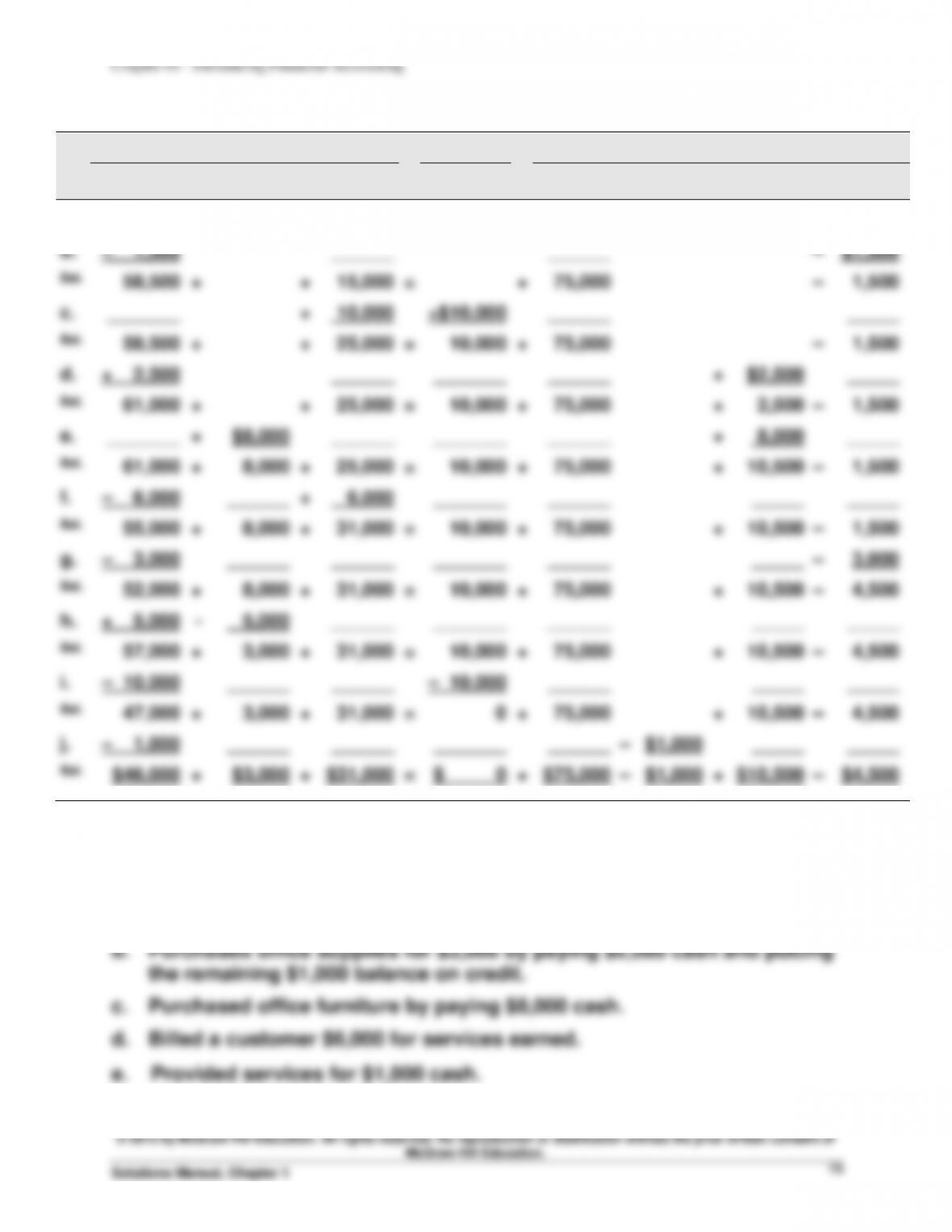
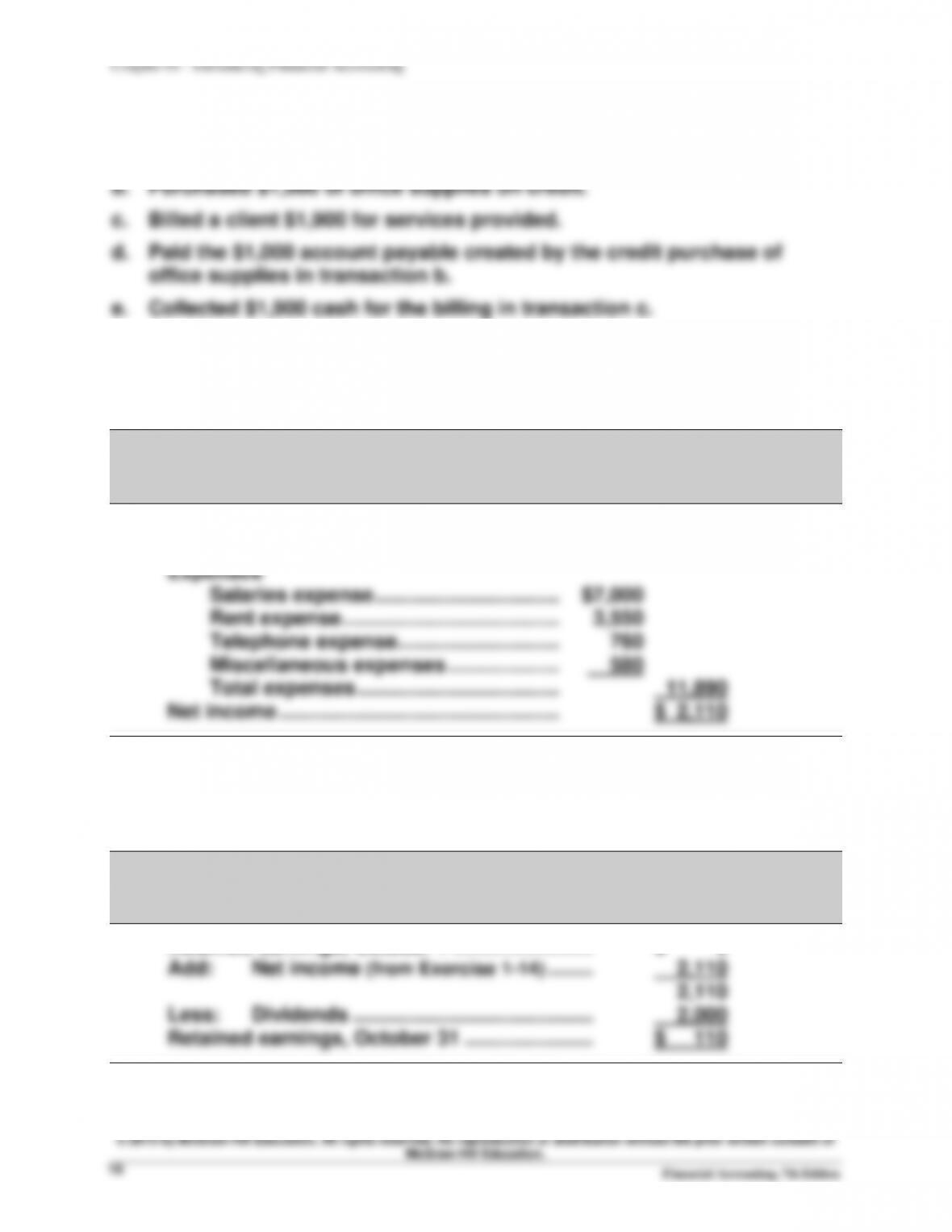
Exercise 1-13 (20 minutes)
a. Purchased land for $4,000 cash.
Exercise 1-14 (15 minutes)
REAL ANSWERS
Income Statement
For Month Ended October 31
Revenues
Consulting fees earned …………………. $14,000
Exercise 1-15 (15 minutes)
REAL ANSWERS
Statement of Retained Earnings
For Month Ended October 31
Retained earnings, October 1 ……………………. $ 0
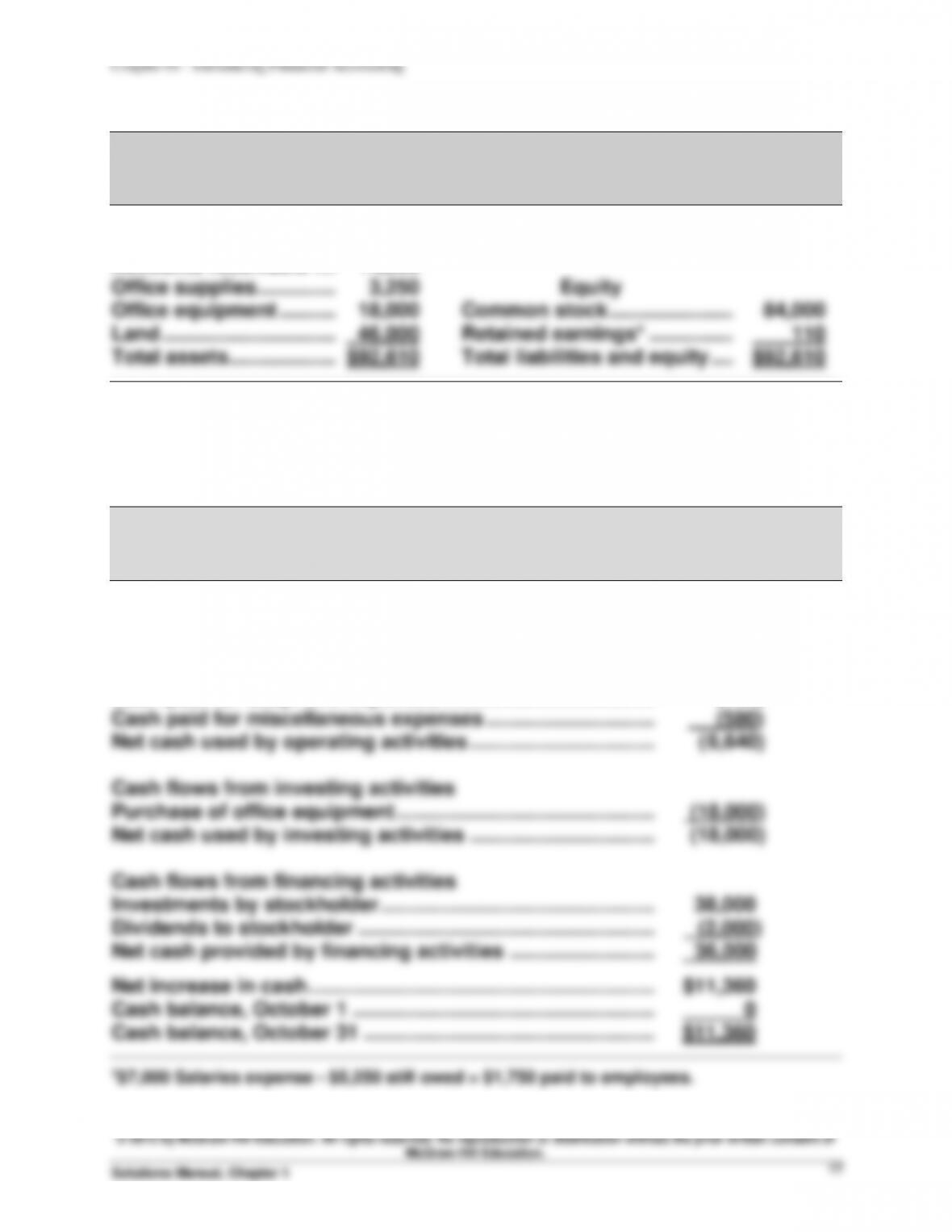
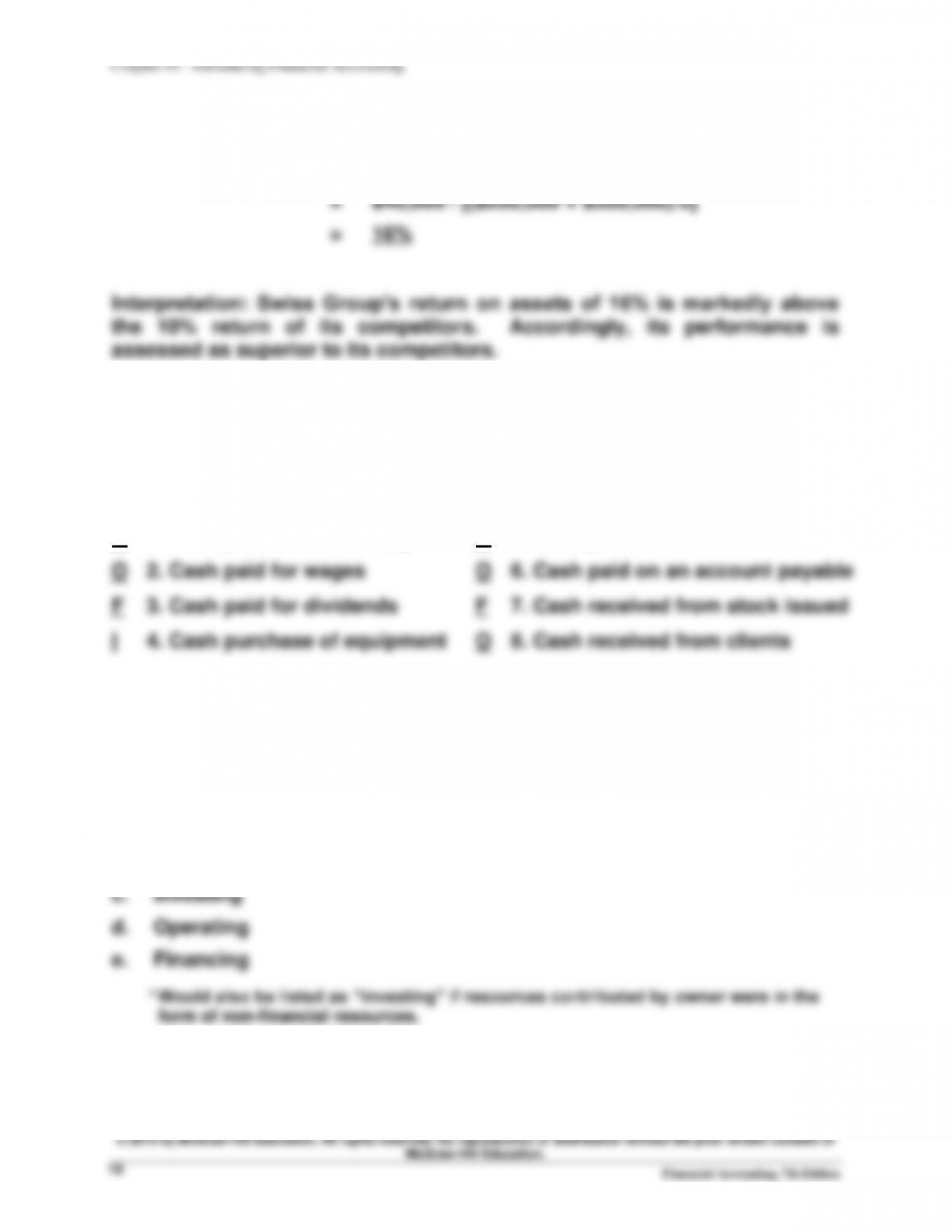
Exercise 1-18 (10 minutes)
Return on assets
=
Net income / Average total assets
=
$40,000 / [($200,000 + $300,000)/2]
=
16%
Interpretation: Swiss Group’s return on assets of 16% is markedly above
the 10% return of its competitors. Accordingly, its performance is
assessed as superior to its competitors.
Exercise 1-19 (10 minutes)
O 1. Cash paid for advertising O 5. Cash paid for rent
Exercise 1-20B (10 minutes)
a. Financing*
b. Investing
Chapter 01 – Introducing Financial Accounting
PROBLEM SET A
Problem 1-1A (40 minutes)
Part 1
Company A
(a) Equity on December 31, 2012:
Assets …………………………………………………. $55,000
Liabilities …………………………………………….. (24,500)
Equity …………………………………………………. $30,500