
Chapter 01 – Introducing Financial Accounting
1-1
Chapter 01
Introducing Financial Accounting
Student Learning Objectives and Related Assignment Materials*
Student Learning Objectives
Discussion
Questions
Quick
Studies
Exercises
Problems**
(A & B set)
Beyond the
Numbers
Conceptual objectives:
C1. Explain the purpose and
importance of accounting.
1, 2, 6, 9
1-1,
1-2, 1-6
TIA
C2. Identify users and uses of, and
opportunities in accounting.
3, 4, 5, 7, 8,
10, 12, 35
1-2,
1-1, 1-3, 1-6
CIP, HTR
C3. Explain why ethics are crucial
to accounting.
11
1-3,
1-4, 1-6
EC
C4. Explain generally accepted
accounting principles, and
define and apply several
accounting principles.
13, 14, 15,
19
1-4, 1-5, 1-6,
1-16
1-5, 1-7
1-7, 1-8, 1-9
EC
C5. Identify and describe the three
major activities of
organizations. (Appendix 1B)
16, 30, 31
1-20
1-13, 1-14
Analytical objectives:
A1. Define and interpret the
accounting equation and each of
its components.
17, 18, 20,
21
1-7, 1-8, 1-9
1-8, 1-9
1-1, 1-2, 1-9,
1-11
RIA, CA,
CIP, ED, GD
A2. Compute and interpret return
on assets.
1-15
1-18
1-10, 1-11
RIA, CA,
TTN, GD
A3. Explain the relation between
return and risk. (Appendix 1A)
28, 29
1-12
RIA, CA,
GD
Procedural objectives:
P1. Analyze business transactions
using the accounting equation.
1-10, 1-11
1-8, 1-10,
1-11, 1-12,
1-13
1-1, 1-2, 1-7,
1-8, 1-9
ED
P2. Identify and prepare basic
financial statements and explain
how they interrelate.
22, 23, 24,
25, 26, 27,
32, 33, 34,35
1-12,1-13, 1-
14
1-14, 1-15,
1-16, 1-17,
1-19, 1-21
1-3, 1-4, 1-5,
1-6, 1-7, 1-8,
1-9
Notes appear on next page.
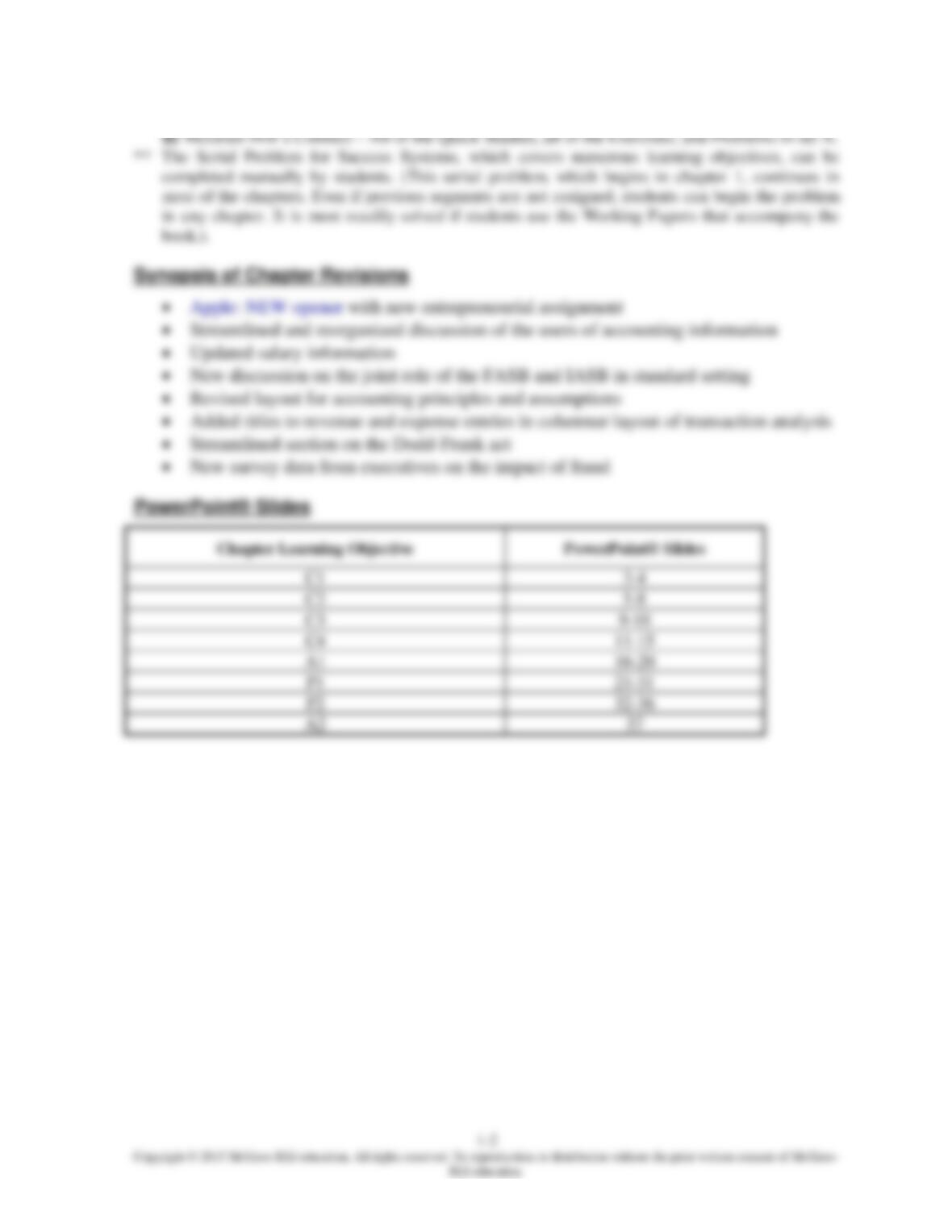
Chapter 01 – Introducing Financial Accounting
* Assignment materials that can be completed by students using:
Chapter 01 – Introducing Financial Accounting
Chapter Outline
Notes
I. Importance of Accounting
Accounting is an information and measurement system that identifies,
records and communicates relevant, reliable, and comparable
information about an organization’s business activities.
Recordkeeping, or bookkeeping, which includes just one function of
accounting, is the recording of transactions and events, either
manually or electronically. Technology is a key part of modern
business and has changed the way we store, process, and summarize
large masses of data. Technology has allowed accounting to expand
to include consulting, planning and other financial services.
A. Users of Accounting Information
Accounting is the language of business because all organizations
set up an accounting information system to communicate data to
help people make better decisions.
1. External information users are not directly involved in
running the organization; they include shareholders, lenders,
directors, customers, suppliers, regulators, lawyers, brokers,
and the press. External users have limited access to an
organization’s information but they must receive information
that is relevant, reliable and comparable. Financial
accounting is the area of accounting aimed at serving external
users by providing them with general-purpose financial
statements.
2. Internal information users are those directly involved in
managing and operating an organization. They use the
information to help improve the efficiency and effectiveness
of an organization. Managerial accounting is the area of
accounting that serves the decision-making needs of internal
users. Internal users and the information they require include:
a. Research and development managers need data on current
and projected costs and revenues to decide whether to
pursue or continue research and development projects.
b. Purchasing managers need data on quality and quantity of
merchandise and materials purchases.
c. Human resource managers need data on current payroll
costs, employee benefits, performance and compensation.
d. Production managers need data on costs and quality of
production processes.
e. Distribution managers need data on quantity and delivery
schedules.
f. Marketing managers need data on sales and costs to
effectively target consumers and set prices.

Chapter 01 – Introducing Financial Accounting
1-4
Chapter Outline
Notes
g. Service managers need data on warranties and
maintenance information to provide a valuable product to
its customers.
B. Opportunities in Accounting
1. The four broad areas of opportunities in accounting include
financial accounting, managerial accounting, taxation, and
accounting-related careers.
2. The majority of opportunities are in private accounting as
employees working for businesses. Public accounting
providing services such as auditing and tax advice to
businesses, offers the next largest number of opportunities
while still other opportunities exist in government and not-for-
profit agencies, including business regulation and
investigation of law violations.
3. The professional standing of accounting specialists are
denoted by a certificate such as certified public accountant
(CPA), certified management accountant (CMA), certified
internal auditor (CIA), certified bookkeeper (CB), certified
payroll professional (CPP), personal financial specialist (PFS),
certified fraud examiner (CFE) and certified forensic
accountant (CrFA).
II. Fundamentals of Accounting
A. Ethics – A Key Concept
Ethics are beliefs that distinguish right from wrong; they are
accepted standards of good and bad behavior.
1. Ethical behavior is important in all successful organizations.
Users must be able to trust accounting information. Good
ethics are good business.
2. The AICPA and IMA have set up ethical codes of conduct.
B. Fraud Triangle
1. The fraud triangle asserts that three factors must exist for a
person to commit fraud: opportunity, pressure, and
rationalization.
2. Both internal and external users rely on internal controls to
reduce the likelihood of fraud. Internal controls are
procedures designed to protect company property, ensure
reliable reports, promote efficiency, and encourage adherence
to company policies.
C. Generally Accepted Accounting Principles
Financial accounting is governed by rules known as generally
accepted accounting principles, GAAP. GAAP aims to make
accounting information relevant, reliable and comparable. The
Securities and Exchange Commission (SEC) has legal authority to
set GAAP.

Chapter 01 – Introducing Financial Accounting
1-5
Chapter Outline
Notes
1. Setting Accounting Principles
a. The SEC has delegated the task of setting GAAP to the
Financial Accounting Standards Board (FASB), a private
group that sets both broad and specific principles.
D. International Standards. The International Accounting
Standards Board (IASB) issues International Financial Reporting
Standards (IFRS) that identify preferred accounting practices. The
FASB and IASB are pursuing a convergence process aimed to
achieve a single-set of accounting standards for global use.
Currently, there are two sets of accepted accounting principles in the
U.S.: U.S. GAAP for U.S. SEC registrants and IFRS for non-U.S.
SEC registrants. FASB will begin to incorporate IFRS standards into
U.S. GAAP over a period of 5 years or so.
E. Conceptual Framework and Convergence. The FASB and IASB
are attempting to converge the conceptual framework. The
framework consists of:
Objectives – providing useful information to investors,
creditors, and others.
Qualitative Characteristics – requires that information be
relevant, reliable, and comparable.
Elements – defines items that financial statements can
contain.
Recognition and Measurement – sets criteria that an item
must meet for it to be recognized as an element, and how to
measure that element.
1. Principles and Assumptions of Accounting
Accounting principles (and assumptions) are both general (basic
assumptions, concepts and guidelines for preparing financial
statements) and specific (detailed rules used in reporting
transactions). The principles, assumptions and constraints
discussed in this chapter are:
a. Measurement principle or Cost principle—accounting
information is based on actual costs incurred in business
transactions. Cost is measured on a cash or equal–to–cash
basis.
b. Revenue recognition principle—provides guidance on
when a company must recognize revenue; to recognize
means to record it. Revenue is recognized when earned.
c. Expense recognition or matching principle—a business
records expenses incurred to generate the revenue reported.
d. Full disclosure principle—requires a company to report the
details behind financial statements that would impact users’
decisions.
e. Going-concern assumption—accounting information
reflects a presumption that the business will continue
operating instead of being closed or sold

Chapter 01 – Introducing Financial Accounting
1-6
Chapter Outline
Notes
f. Monetary unit assumption—transactions and events are
expressed in monetary, or money, units (generally the
currency of the country in which the business operates).
g. Time period assumption—presumes that the life of a
company can be divided into time periods and that useful
reports can be prepared for those periods.
h. Business entity assumption—a business is accounted for
separately and distinctly from its owner(s). A business
entity can take one of three legal forms:
i. Sole proprietorship is a business owned by one person
that has unlimited liability. Requires no special legal
requirements. The business is not subject to an income
tax but the owner is responsible for personal income tax
on the net income of the entity.
ii. Partnership is a business owned by two or more people,
called partners, who are subject to unlimited liability. No
special legal requirements must be met. The only
requirement is an oral or written agreement between the
partners which usually outlines how profits and losses
are to be shared. The business is not subject to an
income tax, but the owners are responsible for personal
income tax on their individual share of the net income of
the entity.
iii. Corporation is a business that is a separate legal entity
whose owners are called shareholders or stockholders.
These owners have limited liability because the business
is legally responsible for its own actions and debts. The
entity is responsible for a business income tax and the
owners are responsible for personal income tax on
profits that are distributed to them in the form of
dividends.
i. Accounting Constraints – the two constraints include
Materiality constraint – only information that would
influence the decisions of a reasonable person need be
disclosed and
Cost-benefit constraint – only information with benefits
of disclosures greater than the costs of providing it need be
disclosed.
F. Sarbanes-Oxley (SOX) is an act which requires documentation and
verification of internal controls. The goal of this act is to provide
more transparency, accountability and truthfulness in reporting
transactions. Auditors also must verify the effectiveness of internal
controls.
G. Dodd-Frank – is an act which promotes accountability and
transparency in the financial system, attempts to end the notion of
“too big to fail”, protect taxpayers by ending bailouts, and protect

Chapter 01 – Introducing Financial Accounting
1-7
Chapter Outline
Notes
consumers from abusive financial services.
III. Transaction Analysis and the Accounting Equation
A. Accounting Equation – accounting system reflects two basic aspects
of a company: what it owns and what it owes.
1. Assets are resources a company owns or controls.
2. Liabilities are creditors’ claims on assets.
3. Equity is the owner’s claim on assets.
4. The relation of assets, liabilities and equity is reflected in the
accounting equation: Assets = Liabilities + Equity
5. A corporation’s equity—often called stockholders’ or
shareholders’ equity—has two parts: contributed capital and
retained earnings:
a. Contributed capital, refers to the amount that stockholders
invest in the company—included under the title common
stock.
b. Retained earnings refer to income (revenues less expenses)
that is not distributed to stockholders. The distribution of
assets to stockholders is called dividends, which reduce
retained earnings. Revenues increase retained earnings via
net income from a company’s earnings activities. Expenses
decrease retained earnings and are the cost of assets or
services used to earn revenues.
6. The above breakdown of equity yields the expanded accounting
equation: A= L + Contributed Capital + Retained Earnings
A = L + Common Stock – Dividends + Revenues – Expenses
7. Net income occurs when revenues exceed expenses. A net loss
occurs when expenses exceed revenues, which decreases equity.
B. Transaction Analysis
Business activities can be described in terms of transactions and
events. External transactions are exchanges of value between two
entities, which yield changes in the accounting equation. Internal
transactions are exchanges within an entity; they can also affect the
accounting equation. Events refer to those happenings that affect an
entity’s accounting equation and can be reliably measured. The next
section uses the accounting equation to analyze eleven selected
transactions and events. Transactions leave the accounting equation
in balance; assets always equal the sum of liabilities and equity.
Transaction 1: Investment by Owner
+ Assets (Cash) = + Equity (Common Stock)
After this transaction, cash (an asset) and stockholders’ equity equal
the amount invested. The source of the increase in equity is the
owner’s investment (stock issuance), which is included in Common
Stock.

Chapter 01 – Introducing Financial Accounting
1-8
Chapter Outline
Notes
Transaction 2: Purchase supplies for cash
+Assets (Supplies) = – Assets (Cash)
This transaction changes the form of assets from cash to supplies;
the decrease in cash is exactly equal to the increase in supplies.
Transaction 3: Purchase Equipment for Cash
+ Assets (Equipment) = – Assets (Cash)
Like Transaction 2, this transaction is an exchange of one asset,
cash, for another asset, equipment; the equipment is an asset because
of its expected future benefits.
Transaction 4: Purchase Supplies on Credit
+Assets (Supplies) = + Liability (Account Payable)
The supplies are acquired in exchange for a promise to pay for them
later; the liability created is referred to as accounts payable.
Transaction 5: Provide Services for Cash
+ Assets (Cash) = + Equity (Revenues)
The company earns revenues by providing services to its clients; the
increase in equity is included in revenues because the cash received
from clients is earned by providing services.
Transactions 6 and 7: Payment of Expenses in Cash
– Assets (Cash) = – Equity (Expenses)
These two transactions involve the payment of cash for this month’s
rent and employee salary; the costs of both rent and salary are
expenses, as opposed to assets, because their benefits are used in the
current month (they have no further benefits after the current
month). Both transactions decrease equity which is included in the
column titled Expenses.
Transaction 8: Provide Services and Facilities for Credit
+ Assets (Accts Receivable) = + Equity (Revenues)
The company earns revenues by providing services to its clients; the
clients are billed for the services. This transaction results in an asset,
called accounts receivable, which is the amount owed by this client,
and also yields an increase in equity reflected in the column titled
Revenues.
Transaction 9: Receipt of Cash from Accounts Receivable
+ Assets (Cash) = – Assets (Accounts Receivable)
The client pays the company the amount that it was billed for the
services provided in Transaction 8. This transaction does not change
the total amount of assets and does not affect liabilities or equity; it
converts the receivable (an asset) to cash (an asset). It does not
create new revenue. The revenue was recognized in Transaction 8.
Transaction 10: Payment of accounts payable
– Assets (Cash) = – Liability (Accounts Payable)
The company made a partial payment to the vendor for the supplies
acquired in Transaction 4. This transaction decreases cash and
decreases its liability to the vendor. Equity does not change; this
event does not create an expense. The expense will be recorded in
the future when the company derives the benefits from these supplies
by using them.