
Chapter 05 – Accounting for General Capital Assets and Capital Projects
5-1
CHAPTER 5: ACCOUNTING FOR GENERAL CAPITAL ASSETS AND
CAPITAL PROJECTS
OUTLINE
Number
Topic
Type/Task
Status
(re: 16/e)
Questions:
5-1
Defining and reporting general capital assets
Define and explain
Same
5-2
Capital asset disclosures
Explain
Same
5-3
Capital asset valuation
Explain
New
5-4
Capital lease accounting
Describe
Same
5-5
Intangible assets
Describe
Same
5-6
Modified approach for infrastructure assets
Compare
5-3
5-7
Encumbrances
Explain
Same
5-8
Construction work in progress
Explain
New
5-9
Performance bonds and retained percentages
Explain
New
5-10
Service concession arrangements
Explain
Same
Cases:
5-11
Modified approach for infrastructure assets
Evaluate, write
5-1
5-12
Criteria for intangible asset recognition
Evaluate, explain
New
5-13
Recording and reporting damaged capital
assets
Evaluate, explain
New
5-14 Service concession arrangements Evaluate, explain
5-4
Exercises/Problems:
5-15
Examine the CAFR
Examine
5-1 revised
5-16
Various
Multiple Choice
Items 2, 3, 7,
and 10 are
new
5-17
General capital assets
Journal entries
5-3
5-18
Capital asset disclosure schedule
Financial statement
5-4 revised
5-19
Lease classification and accounting
Calculate; JEs
New
5-20
Asset impairment
JEs; reporting
5-6
5-21
Capital projects fund
JEs
5-7
5-22
Statement of revenues and expenditures
FS; explain
New
5-23
Multi-project construction fund
JEs & FS
5-9
5-24
Capital project transactions
JEs & FS
5-10
Chapter 05 – Accounting for General Capital Assets and Capital Projects
5-2
CHAPTER 5: ACCOUNTING FOR GENERAL CAPITAL ASSETS AND
CAPITAL PROJECTS
Answers to Questions
5-1. General capital assets are those assets acquired with the resources of governmental
funds. They are reported as assets in the Governmental Activities column of the
government-wide financial statements at historical cost. Those capital assets identified as
depreciable are shown net of accumulated depreciation. The resources used by the
5-2. Capital asset disclosures required by the GASB include descriptions of policies for
capitalizing assets and for estimating the useful lives of depreciable assets. In addition,
the disclosures should include: (1) beginning-of-year and end-of-year balances showing
accumulated depreciation separate from historical cost, (2) capital acquisitions during the
Chapter 05 – Accounting for General Capital Assets and Capital Projects
5-3
Ch. 5, Answers (Cont’d)
5-3. In general, the valuation principles used in governmental and for-profit accounting are
very similar. Assets acquired should be valued at historical cost when possible, and the
definition of historical cost is basically the same for both. However, governments are
more likely to receive capital assets through donation or to have acquired assets in the
5-4. If the lease meets one or more of the criteria prescribed in Codification Section L20, the
lease must be reported as a capital lease. If the lease is deemed to be a capital lease, the
governmental fund journal entry on the date of inception will include a debit to
5-5. Under both GASB and FASB standards intangible assets are defined as assets that lack
physical substance. Intangible assets held by a government might include easements,
water, timber, or mineral rights, patents, trademarks, and computer software. The GASB
considers intangible assets to be a type of general capital asset; therefore, intangibles are
Chapter 05 – Accounting for General Capital Assets and Capital Projects
5-4
Ch. 5, Answers (Cont’d)
5-6. Under the modified approach to accounting for infrastructure assets adjusting entries
recognizing depreciation expense and accumulated depreciation are not required. Rather
the government reports, as an expense, the costs of maintaining the infrastructure assets
at an established level or condition. By doing this the book value of the infrastructure
Topic: Infrastructure Assets
Bloom’s Taxonomy: Understand
Accreditation Skills tag: AACSB: Communication, AICPA: FN Reporting
Level of Difficulty: Medium
5-7. To facilitate preparation of financial statements at the end of the fiscal year, all operating
accounts should be closed; however, since the project is still underway and contractual
commitments still exist to pay contractors when billed, it is essential that Encumbrances
be maintained. (If a government chooses to close encumbrance accounts at year end,
Chapter 05 – Accounting for General Capital Assets and Capital Projects
5-5
Ch. 5, Answers (Cont’d)
5-8. The use of a capital projects fund allows administrators to ensure that funds designated
for a specific project are used in accordance with any requirements or conditions placed
upon the use of the funds. The capital projects fund uses the encumbrance mechanism,
whereas the governmental activities ledger does not. The resources used by the capital
5-9. When large-scale contracts are established, governments are usually protected by both a
performance bond and the practice of maintaining a retained percentage of construction
billings as a liability. The performance bond protects in the case of a contractor’s failure
to comply with the terms and specifications of the agreement, and serves to guard against
5-10. Under a service concession arrangement, a government transfers the rights and
obligations of a capital asset to another legally-separate governmental or private sector
Chapter 05 – Accounting for General Capital Assets and Capital Projects
5-6
Ch. 5, Answers, Question 5-10 (Cont’d)
General Problem Information: Service concession arrangements
Learning Objective: 5-1
Topic: Service Concession Arrangements
Bloom’s Taxonomy: Understand
Accreditation Skills tag: AACSB: Communication, AICPA: FN Reporting
Level of Difficulty: Medium
5-11. a. Discuss with students various methods of obtaining financial statements and getting
“benchmark” data to make comparisons across entities. Professional associations
such as the Government Finance Officers Association; National Association of State
Auditors, Controllers and Treasurers; and Association of Government Accountants
Level of Difficulty: Medium
5-12. a. Governmental accounting is guided by the Governmental Accounting Standards
Board (GASB), an authoritative standard-setting body which issued guidelines for the
Chapter 05 – Accounting for General Capital Assets and Capital Projects
5-7
Ch. 5, Solutions, Case 5-12, part a. (Cont’d)
GASB provided the definition of an asset in Concepts Statement No. 4. An asset is “ a
resource with present service capacity that the government presently controls.” Two
important terms in this definition are “resource” and “present service capacity.” A
b. Given these definitions, does the government’s power to tax meet the definition of an
intangible asset? Consider the three characteristics of an intangible asset. First, the
power to tax has no physical substance. Second, the power to tax is non-financial in
General Problem Information: Intangible assets
Learning Objective: 5-1
Topic: Intangible assets
Bloom’s Taxonomy: Analyze
Accreditation Skills tag: AACSB: Analytical Thinking, AICPA: FN Decision Making
Level of Difficulty: Medium
Chapter 05 – Accounting for General Capital Assets and Capital Projects
5-8
Ch. 5, Answers (Cont’d)
5-13. a. In determining whether an impairment has occurred the city will need to determine
whether there was a significant and unexpected decline in service utility. If it is
determined that an impairment has occurred, the restorative approach to measuring
b. In all cases identified (wiring, walls, flooring) the work appears to be a combination
of enhancement and replacement. As such, the town will probably want to remove
any capital costs allocated to the items listed and replace them with the new costs.
c. The description of the furniture as surplus that is being replaced suggests that it was
old and possibly fully-depreciated. If fully depreciated, no impairment would be
recognized. Any historical cost and accumulated depreciation would be removed
Chapter 05 – Accounting for General Capital Assets and Capital Projects
5-9
Ch. 5, Solutions, Case 5-13 (Cont’d)
General Problem Information: Recording and reporting damaged capital assets
Learning Objective: 5-2
Topic: Asset Impairments and Insurance Recoveries
Bloom’s Taxonomy: Analyze
Accreditation Skills tag: AACSB: Knowledge Application, AICPA: FN Reporting
Level of Difficulty: Medium
5-14. a. Some relevant questions might include:
Are there any alternative uses for the parking operations that the town might like to
exercise in the next 20 years?
Who retains any risk associated with the parking operations?
b. On a short-term basis, the proposal appears favorable. The town receives a cash
infusion that may help to alleviate current budget woes. Citizens will be relieved that
c. It depends. In the case of Chicago and the State of Arizona, bond rating agencies
downgraded bond ratings, because they viewed such arrangements as one-time cash
Chapter 05 – Accounting for General Capital Assets and Capital Projects
5–10
Ch. 5, Solutions, Case 5-14 (Cont’d)
General Problem Information: Service concession arrangements
Learning Objective: 5-1
Topic: Service Concession Arrangements
Bloom’s Taxonomy: Analyze
Accreditation Skills tag: AACSB: Knowledge Application, AICPA: FN Reporting
Level of Difficulty: Medium
Solutions to Exercises and Problems
5-15. Each student will have a different annual report, so he or she will have different answers
General Problem Information: Examine the CAFR
Learning Objective: 5-5
Topic: Various
Bloom’s Taxonomy: Analyze
Accreditation Skills tag: AACSB: Knowledge Application, AICPA: FN Reporting
Level of Difficulty: Medium
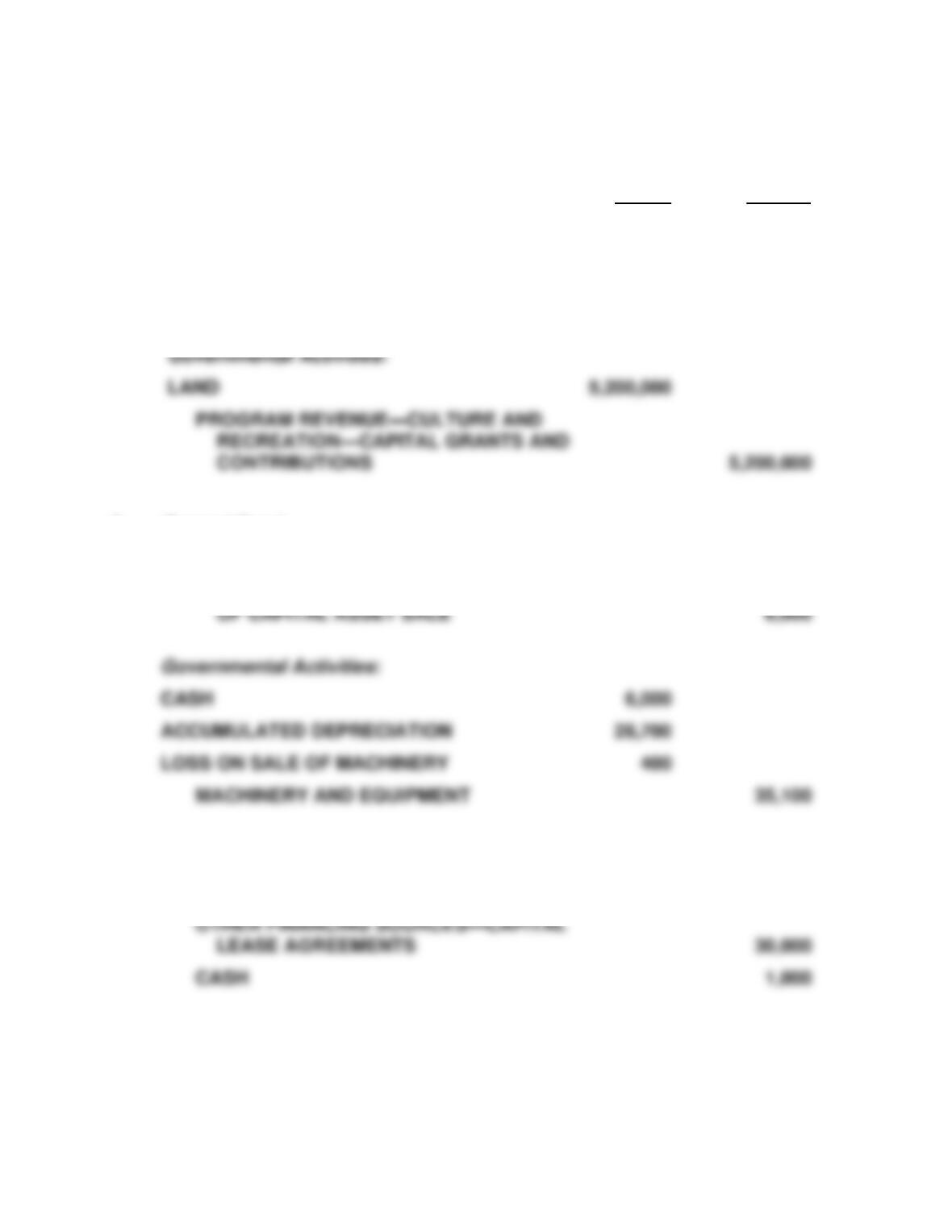
5-16. 1. b. 6. a.
General Problem Information: Various
Learning Objective: 5-2
Learning Objective: 5-3
Learning Objective: 5-4
Topic: Various chapter topics
Bloom’s Taxonomy: Remember
Accreditation Skills tag: AACSB: Communication, AICPA: FN Reporting
Level of Difficulty: Remember
Chapter 05 – Accounting for General Capital Assets and Capital Projects
5–11
Ch. 5, Solutions (Cont’d)
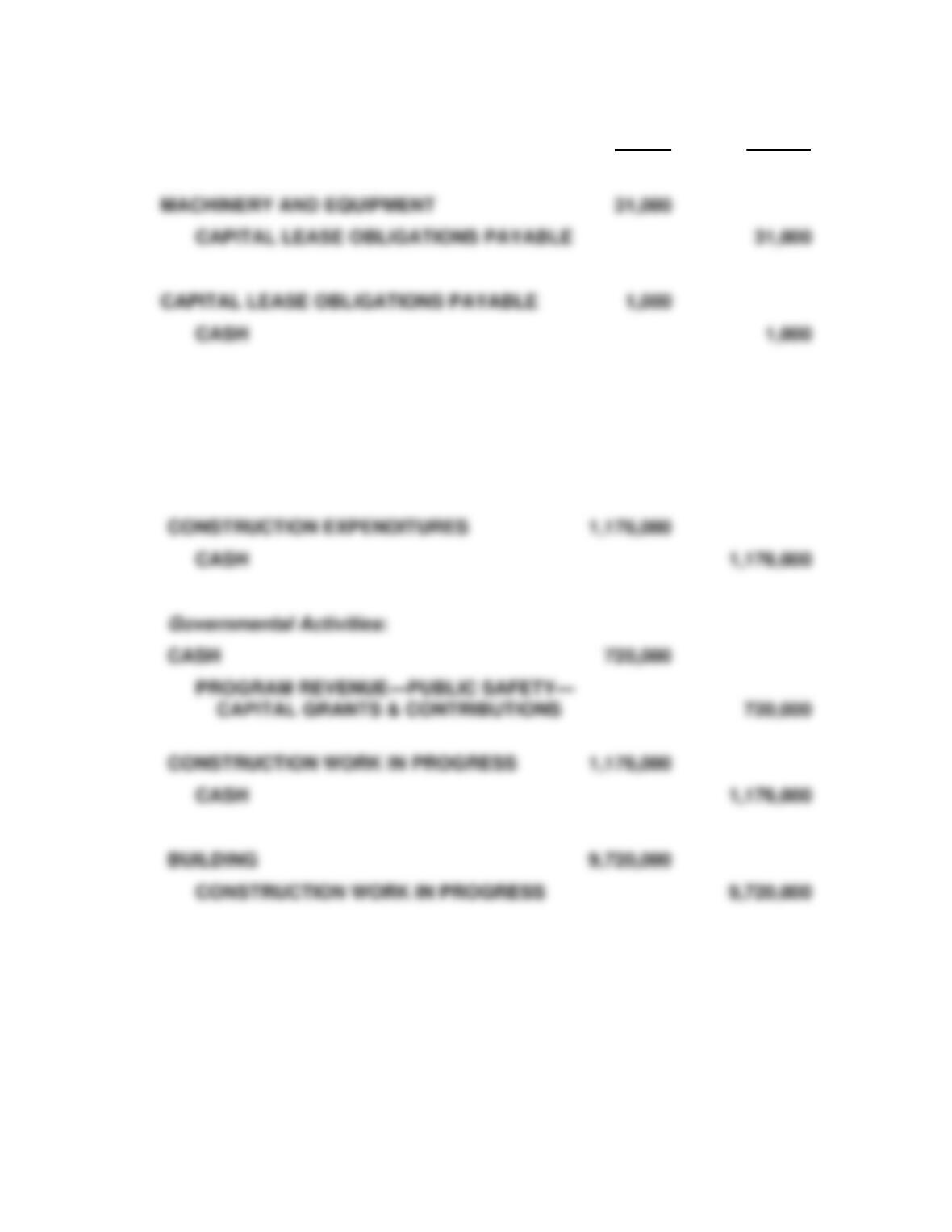
5-17. CITY OF LOVELAND
Debits Credits
1. General Fund:
THERE WOULD BE NO ENTRY SINCE THERE IS NO FLOW OF FINANCIAL
RESOURCES.
2. General Fund:
CASH 6,000
OTHER FINANCING SOURCES—PROCEEDS
3. General Fund:
EXPENDITURES—GENERAL GOVERNMENT 31,000
Chapter 05 – Accounting for General Capital Assets and Capital Projects
5–12
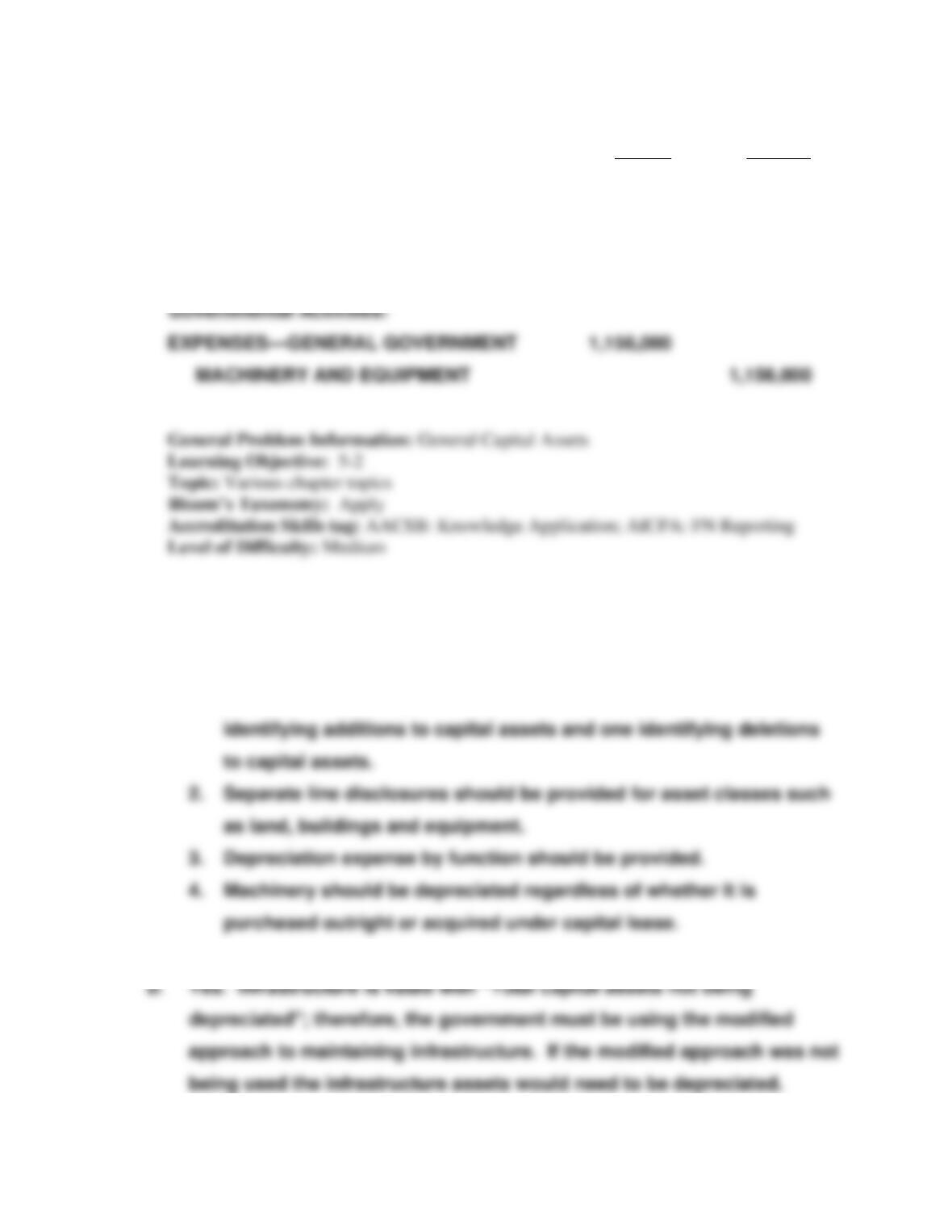
Ch. 5, Solutions, 5-17 (Cont’d)
Debits Credits
Governmental Activities:
4. Capital Projects Fund:
CASH 720,000
REVENUE 720,000
Chapter 05 – Accounting for General Capital Assets and Capital Projects
5–13
Ch. 5, Solutions, 5-17 (Cont’d)
Debits Credits
5. General Fund:
THERE WOULD BE NO ENTRY SINCE THERE IS NO FLOW OF FINANCIAL
RESOURCES.
5-18. a. No, the note does not comply with GASB requirements. The following
changes would help bring the note into compliance.
1. Instead of one change column there should be two columns—one
Chapter 05 – Accounting for General Capital Assets and Capital Projects
5–14
Ch. 5, Solutions, 5-18 (Cont’d)
General Problem Information: Capital asset disclosure schedule
Learning Objective: 5-1
Topic: Required Disclosures about Capital Assets
Bloom’s Taxonomy: Analyze
Accreditation Skills tag: AACSB: Knowledge Application; AICPA: FN Reporting
Level of Difficulty: Medium
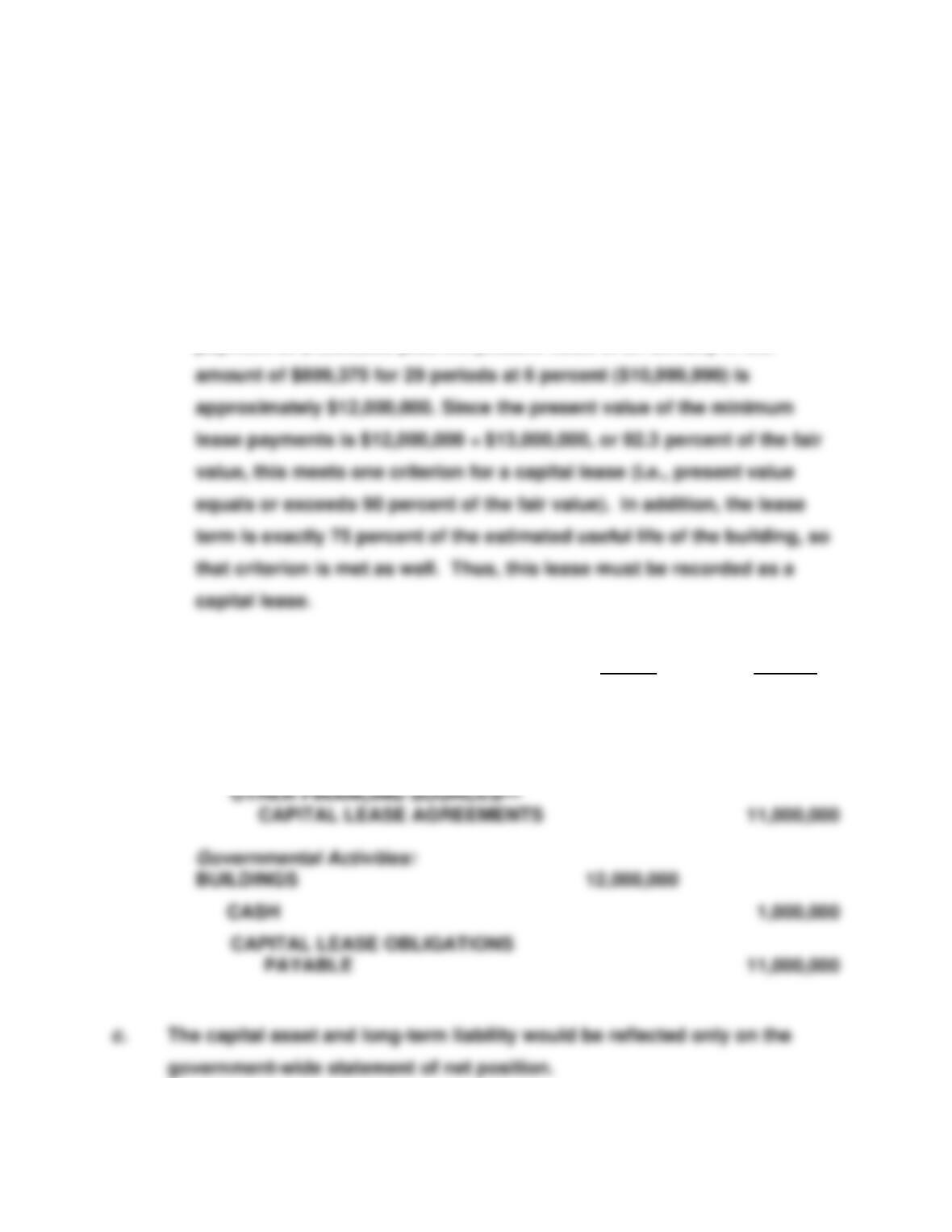
5-19. a. The present value of Rochester’s minimum lease payments is the initial
payment of $1,000,000 plus the present value of an annuity in the
b. Debits Credits
Capital Projects Fund:
EXPENDITURES 12,000,000
CASH 1,000,000
Chapter 05 – Accounting for General Capital Assets and Capital Projects
5–15
Ch. 5, Solutions, 5-19 (Cont’d)
General Problem Information: Lease classification and accounting
Learning Objective: 5-2
Learning Objective: 5-3
Topic: General Capital Assets Acquired under Capital Lease Agreements
Bloom’s Taxonomy: Apply
Accreditation Skills tag: AACSB: Knowledge Application; AICPA: FN Reporting
Level of Difficulty: Hard
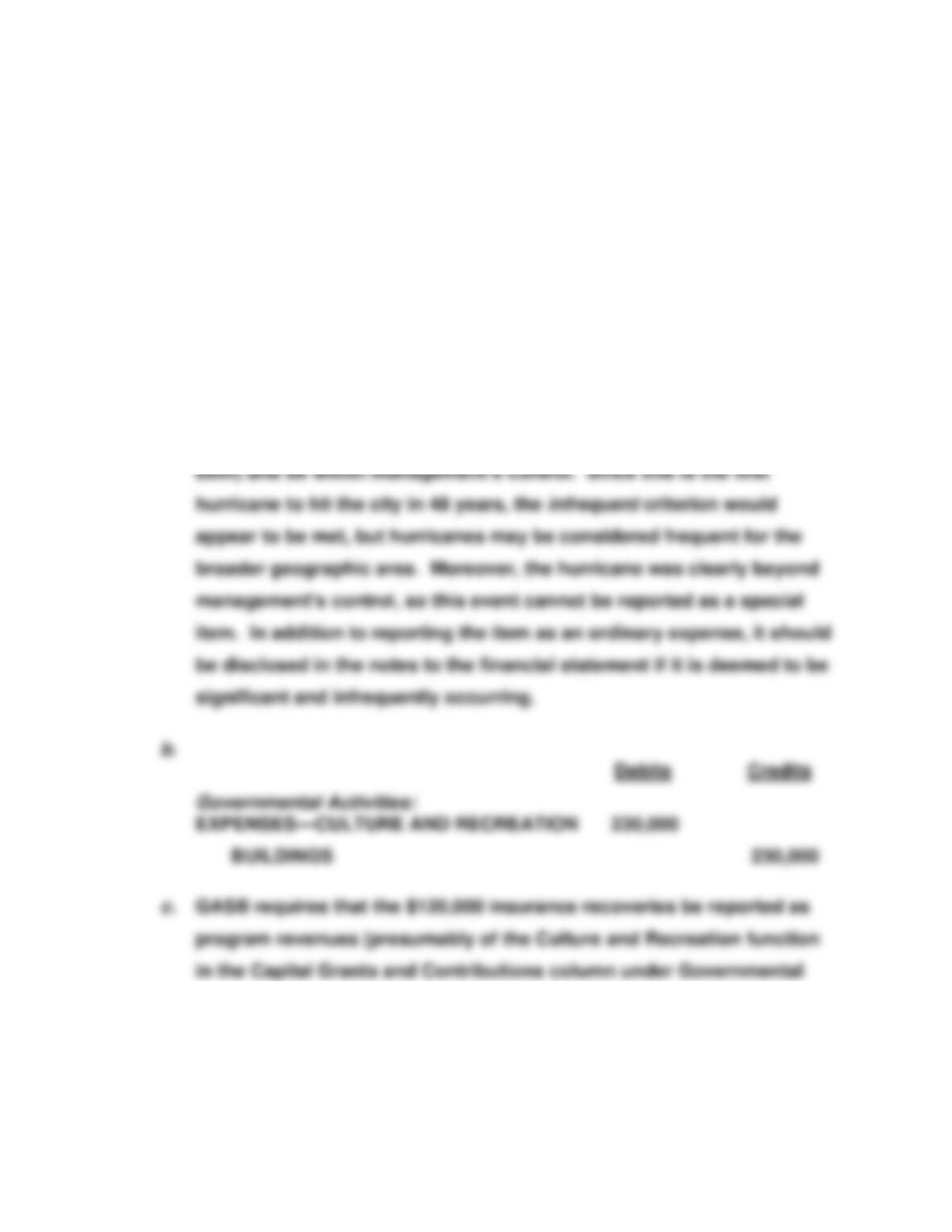
5-20. a. Because Sunshine City is located in an area that is susceptible to
hurricanes, the unusual criterion would not be met for the loss to be
reported as extraordinary. To be reported as a special item requires
that the event be either unusual or infrequent in occurrence (but not
Activities) on the government-wide statement of activities in the year
received. In addition, it should be reported as an other financing source
by the General Fund.