
Chapter 02 – Principles of Accounting and Financial Reporting for State and Local Governments
CHAPTER 2: PRINCIPLES OF ACCOUNTING AND FINANCIAL
Chapter 02 – Principles of Accounting and Financial Reporting for State and Local Governments
2-2
CHAPTER 2: PRINCIPLES OF ACCOUNTING AND FINANCIAL
REPORTING FOR STATE AND LOCAL
GOVERNMENTS
Answers to Questions
2-1. The three categories of broad service activities of a general purpose government are
governmental, business-type, and fiduciary. Governmental activities include
General Problem Information: Service activities categories
Learning Objective: 2-1
Topic: Activities of Government
Bloom’s Taxonomy: Remember
Accreditation Skills tag: AACSB: Communication, AICPA: BB Industry
Level of Difficulty: Easy
2-2. The primary objective of government-wide financial reporting is to report on the
government’s operational accountability so that users can evaluate whether the
government is covering the cost of its services over the long run. Additionally, recall
from Chapter 1 that operational accountability relates to how efficiently and effectively
2-3. The modified accrual basis of accounting records revenues when they are measurable and
available for use in paying current period obligations, while expenditures are recorded
Chapter 02 – Principles of Accounting and Financial Reporting for State and Local Governments
manner. This document may not be copied, scanned, duplicated, forwarded, distributed, or posted on a website, in whole or part.
Ch. 2, Answers, Question 2-3 (Cont’d)
General Problem Information: Modified accrual accounting
Learning Objective: 2-2
Topic: Financial Reporting Model
Bloom’s Taxonomy: Understand
Accreditation Skills tag: AACSB: Communication, AICPA: FN Reporting
Level of Difficulty: Medium
2-4. The three categories of funds are governmental, proprietary, and fiduciary. The fund
types included in each category are shown below:
Governmental
Proprietary
Fiduciary
General Fund
Special revenue funds
Debt service funds
Capital projects funds
Permanent funds
Enterprise funds
Internal service funds
Agency funds
Investment trust funds
Pension (and other
employee benefit) trust
funds
Private-purpose trust
funds
The basis of accounting used by governmental funds is modified accrual. Proprietary
funds use the accrual basis of accounting as do fiduciary funds.
General Problem Information: Fund categories
Learning Objective: 2-2
Topic: Financial Reporting Model
Bloom’s Taxonomy: Remember
Accreditation Skills tag: AACSB: Communication, AICPA: FN Reporting
Level of Difficulty: Easy
2-5. Governmental accounting systems must provide both reporting in accordance with GAAP
and reporting to determine and demonstrate compliance with finance-related legal and
contractual requirements. To ensure that both GAAP and compliance reporting
requirements are met, a separate accounting mechanism is used. The mechanism that is
2-4
© 2013 by McGraw-Hill Education. This is proprietary material solely for authorized instructor use. Not authorized for sale or distribution in any
manner. This document may not be copied, scanned, duplicated, forwarded, distributed, or posted on a website, in whole or part.
Ch. 2, Answers, Question 2-5 (Cont’d)
Accreditation Skills tag: AACSB: Communication, AICPA: FN Reporting
Level of Difficulty: Medium
2-6. Deferred outflows of resources are resources that have been consumed but are applicable
to a future reporting period (e.g., costs related to a debt refunding). Deferred outflows
increase net position. Deferred inflows of resources are resources that have been acquired
but are applicable to a future period (e.g. resources received but unavailable for use until
2-7 Expenditures report actual outlays of funds, whether for an operating cost or the purchase
of an asset. Expenses focus on costs necessary to generate revenues or fund operations,
and may be a result of the using up or expiration of an asset, even if no cash was paid out.
2-8. Both enterprise funds and internal service funds are classified as proprietary funds. These
two types of funds are operated in a manner similar to for-profit businesses. The reasons
they are operated similar to for-profit businesses is because of the types of customers they
2-5
© 2013 by McGraw-Hill Education. This is proprietary material solely for authorized instructor use. Not authorized for sale or distribution in any
manner. This document may not be copied, scanned, duplicated, forwarded, distributed, or posted on a website, in whole or part.
Ch. 2, Answers, Question 2-8 (Cont’d)
Accreditation Skills tag: AACSB: Communication, AICPA: FN Reporting
Level of Difficulty: Medium
2-9. The fund balance classifications and an example for each are provided below. There are
numerous examples of what could be included in each classification; therefore,
consideration should be given to whether the student’s answer appropriately fits the
definition for the fund balance classification.
Learning Objective: 2-2
Topic: Financial Reporting Model
Bloom’s Taxonomy: Remember
Accreditation Skills tag: AACSB: Communication, AICPA: FN Reporting
2-10. The GASB requires that any fund that meets the following relative size criteria be
designated as major:
a. Total assets, liabilities, revenues or expenditures/expenses of that governmental or enterprise fund are
Chapter 02 – Principles of Accounting and Financial Reporting for State and Local Governments
2-6
Ch. 2, Answers, Question 2-10 (Cont’d)
General Problem Information: Major fund criteria
Learning Objective: 2-3
Topic: Major Funds
Bloom’s Taxonomy: Remember
Accreditation Skills tag: AACSB: Communication, AICPA: FN Reporting
Level of Difficulty: Easy
2-11. A quick look at these financial statements reveals that Ms. Ramirez, while familiar with
not-for-profit reporting, has almost no knowledge of GASB reporting requirements.
Let’s analyze these financial statements from the viewpoint of (a) a local CPA who is
considering auditing the town’s financial statements and (b) a member of the town
1. The town does not present separate government-wide and fund financial
2. Since the government has both governmental and an enterprise fund, activities at
3. At the fund level the financial statements will need to provide separate columns
4. At the government-wide level there would be no net asset information; it would
2-7
© 2013 by McGraw-Hill Education. This is proprietary material solely for authorized instructor use. Not authorized for sale or distribution in any
manner. This document may not be copied, scanned, duplicated, forwarded, distributed, or posted on a website, in whole or part.
Ch. 2, Solutions, Case 2-11 (Cont’d)
5. Because no fund financial statements are prepared, key information such as
6. The statement of activities is not in the cost of services format recommended by
GASB, where the expenses are adjusted for program revenues (such as charges
7. Budget and actual comparison information is not presented as required, either as
8. Expense detail is lacking. More functional detail is needed under “Government
services,” such as general government, public safety, public works, and other
9. Why are accounts receivable relating to the Sewer Fund missing from the balance
sheet? Since the Sewer Fund is being operated as an enterprise fund, billings that
10. Since the Sewer Fund is an enterprise fund, a statement of cash flows is required
for that fund.
11. Where are the notes to the financial statements? The notes are an integral part of
any set of financial statements.
12. Where is the MD&A—also required by GAAP?
Given the serious reporting deficiencies observed, it is likely the CPA would be
Chapter 02 – Principles of Accounting and Financial Reporting for State and Local Governments
2-8
Ch. 2, Solutions, Case 2-11 (Cont’d)
2-12. a. Based on the description of this city’s financial statements in the MD&A, the
statements appear to conform very well to GASB standards. Specifically:
Government-wide Financial Statements
• Include the two required financial statements—statement of net position and
“These assets are restricted in purpose and do not represent discretionary assets of
the city. Therefore, these assets are not presented as a part of the government–
wide financial statements.”
Chapter 02 – Principles of Accounting and Financial Reporting for State and Local Governments
2-9
Ch. 2, Solutions, Case 2-12 (Cont’d)
2-13. There are a variety of reasons for the amounts that have been provided for each fund
balance classification appearing on the governmental fund balance sheet for Denver.
Following are some of the reasons provided in the 2013 CAFR.
Nonspendable sources: The majority of the nonspendable fund balance appears in the
Office, in addition to the City Council, to assign fund balances. Although the notes
identify assigned fund balances by government function (General Government, Public
Safety, Public Works, Parks and Recreation, and Cultural Activities), the purpose for
which the funds have been assigned is unclear. No specific sources for the amounts listed
Chapter 02 – Principles of Accounting and Financial Reporting for State and Local Governments
2-10
Ch. 2, Solutions, Case 2-13 (Cont’d)
General Problem Information: Major Fund Criteria
Learning Objective: 2-2
Topic: Financial Reporting Model
Bloom’s Taxonomy: Understand
Accreditation Skills tag: AACSB: Communication, AICPA: FN Reporting
Level of Difficulty: Medium
2-14. Each student should have a different governmental annual report, so will have different
2-15. 1. a. 6. d.
General Problem Information: Various
Learning Objective: 2-1
2-16. Agency fund FF
Permanent fund GF
Debt service fund GF
Chapter 02 – Principles of Accounting and Financial Reporting for State and Local Governments
2-11
© 2013 by McGraw-Hill Education. This is proprietary material solely for authorized instructor use. Not authorized for sale or distribution in any
manner. This document may not be copied, scanned, duplicated, forwarded, distributed, or posted on a website, in whole or part.
Ch. 2, Solutions, Exercise 2-16 (Cont’d)
Investment trust fund FF
Capital projects fund GF
Private-purpose trust fund FF
General Problem Information: Matching fund types with fund categories
Learning Objective: 2-2
Topic: Financial Reporting Model
Bloom’s Taxonomy: Remember
Accreditation Skills tag: AACSB: Communication, AICPA: FN Reporting
Level of Difficulty: Easy
2-17.
1. Governmental funds b, e, f, i
2. Proprietary funds a, d, g, h, j
business-type activities if the
2-18.
1.
h.
7.
e.
2.
a.
8.
i.
3.
j.
9.
f.
4.
g.
10.
c.
5.
d.
11.
k.
6.
b.
2-12
© 2013 by McGraw-Hill Education. This is proprietary material solely for authorized instructor use. Not authorized for sale or distribution in any
manner. This document may not be copied, scanned, duplicated, forwarded, distributed, or posted on a website, in whole or part.
Ch. 2, Solutions, Exercise 2-18 (Cont’d)
General Problem Information: Matching transactions with funds
Learning Objective: 2-2
Topic: Financial Reporting Model
Bloom’s Taxonomy: Understand
Accreditation Skills tag: AACSB: Communication, AICPA: FN Reporting
Level of Difficulty: Medium
2-19.
1. d.
General Problem Information: Fund balance classifications
2-20. DATE: xxx
MEMO TO: City Manager, Forest City
FROM: Independent Auditor
RE: Major Special Revenue Funds
Chapter 02 – Principles of Accounting and Financial Reporting for State and Local Governments
2-13
Ch. 2, Solutions, Exercise 2-20 (Cont’d)
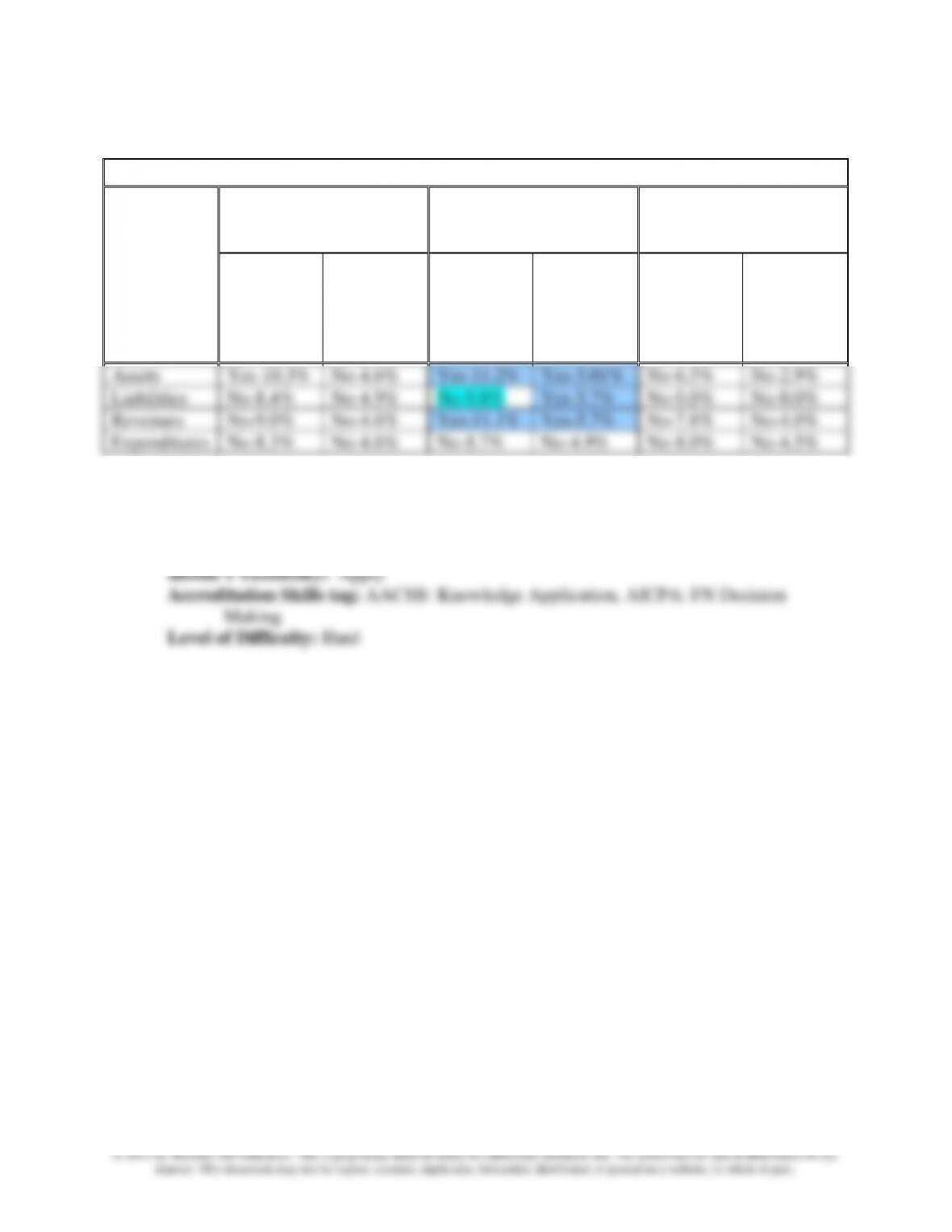
Calculation of Major Fund Thresholds
Financial
Statement
Elements
Gas Tax Revenue Fund
Housing and Urban
Development Fund
Forest City
Library Fund
>10% of
Govern-
mental
Funds
>5% of
Govern-
mental and
Enterprise
Funds
>10% of
Govern-
mental
Funds
>5% of
Govern-
mental and
Enterprise
Funds
>10% of
Govern-
mental
Funds
>5% of
Govern-
mental and
Enterprise
Funds
Assets
Yes-10.3%
No-4.6%
Yes-11.2%
Yes-5.01%
No-6.5%
No-2.9%
Liabilities
No-8.4%
No-4.9%
No-9.8%
Yes-5.7%
No-0.0%
No-0.0%
Revenues
No-9.0%
No-4.6%
Yes-11.1%
Yes-5.7%
No-7.8%
No-4.0%
Expenditures
No-8.3%
No-4.6%
No-8.7%
No-4.9%
No-8.0%
No-4.5%
General Problem Information: Determination of major funds
Learning Objective: 2-3
Topic: Major Funds