
Chapter 17 – Accounting and Reporting for the Federal Government
17-1
CHAPTER 17: ACCOUNTING AND REPORTING FOR THE FEDERAL
GOVERNMENT
OUTLINE
Number
Topic
Type/Task
Status
(re: 16/e)
Questions:
17-1
Roles of GOA, Treasury, and OMB in federal
financial reporting
Explain
New
17-2
Federal GAAP hierarchy
Compare
Same
17-3
Objectives of federal financial reporting
List, explain
New
17-4
Accounts used in federal accounting
Compare
Same
17-5
Net position and net assets
Compare
Same
17-6
Reporting entity
Compare
New
17-7
Federal funds
Identify, compare
Same
17-8
Stewardship assets
Define, compare
Same
17-9
Dual-track accounting
Explain, relate
New
17-10
Performance accountability report
Explain, identify
Revised
Cases:
17-11
Agency PAR and audit report
Calculate, explain
17-1 revised
17-12
Research case—FASAB
Explain, discuss
17-2
17-13
U.S. Government-wide financial statement audit
Explain, discuss
17-3 revised
17-14
Analysis of U.S federal budget deficit and net
cost of operations
Analyze, evaluate
New
Exercises/Problems:
17-15
Various
Multiple Choice
17-1 revised
17-16
Identifying account types and normal balances
Identify
New
17-17
Fund balance with U.S. Treasury
Compute
17-2 revised
17-18
Agency financial statements, continuation of 17-16
JE, apply
17-3 revised
17-19
Prepare statement of net cost
Apply
17-4 same
17-20
Prepare statement of budgetary resources
Apply
17-5 same
17-21
Transactions and statement of financing
Apply
17-6 same
17-22
Financial statement analysis
Analysis
17-7 revised
Chapter 17 – Accounting and Reporting for the Federal Government
17-2
CHAPTER 17: ACCOUNTING AND REPORTING FOR THE FEDERAL
GOVERNMENT
Answers to Questions
17-1. Each of these three agencies plays a significant role in the financial accounting and
reporting of federal agencies. The GAO serves as the independent audit agency for the
federal government. It is responsible for the audit of the federal government as a whole.
Its reports help ensure that the federal agencies are complying with legal requirements
General Problem Information: Roles of GAO, Treasury, and OMB in federal reporting
Learning Objective: 17-1
Topic: Federal Government Financial Management Structure
Bloom’s Taxonomy: Understand
Accreditation Skills tag: AACSB: Knowledge Application, AICPA: BB: Industry
Level of Difficulty: Medium
17-2. The GAAP hierarchies for the federal government and state and local governments are
quite similar. One major difference is that federal authoritative guidance comes from
FASAB while state and local government authoritative guidance is issued by GASB.
Chapter 17 – Accounting and Reporting for the Federal Government
17-3
© 2013 by McGraw-Hill Education. This is proprietary material solely for authorized instructor use. Not authorized for sale or distribution in any
manner. This document may not be copied, scanned, duplicated, forwarded, distributed, or posted on a website, in whole or part.
Ch. 17, Answers, 17- 2 (Cont’d)
include the Technical Bulletins issued by the respective standard-setting bodies. AICPA
Industry and Accounting Guides are also considered category b principles if made
applicable to federal entities by the FASAB or state and local governments by the GASB.
The GASB can also make AICPA Statements of Position applicable. Category c
principles are different for the two hierarchies. Technical Releases of the Accounting
and Auditing Policy Committee of the FASAB are considered category
c
for federal
entities; whereas, AICPA Practice Bulletins made applicable by GASB are
considered category
c
for state and local governments. Category
d
guidance is the
same, consisting of implementation guides issued by the respective standard-setting
bodies, as well as widely accepted practices.
General Problem Information: Federal GAAP hierarchy
Learning Objective: 17-1
Topic: Generally Accepted Accounting Principles for the Federal Government
Bloom’s Taxonomy: Understand
Accreditation Skills tag: AACSB: Knowledge Application, AICPA: BB: Industry
Level of Difficulty: Medium
17-3. The four objectives for federal financial reporting as outlined in SFFAC No. 1 are: (1)
budgetary integrity, (2) operating performance, (3) stewardship, and (4) adequacy of
systems and controls. Budgetary integrity is ensuring that taxes and other monies raised
by the federal government are raised in accordance with law and regulation, and that
expenditures are made in accordance with law and regulation. Operating performance
refers to how efficient, effective, and economical the federal agencies have been in using
Chapter 17 – Accounting and Reporting for the Federal Government
17-4
Ch. 17, Answers, 17- 3 (Cont’d)
General Problem Information: Objectives of federal financial reporting
Learning Objective: 17-2
Topic: Conceptual Framework
Bloom’s Taxonomy: Understand
Accreditation Skills tag: AACSB: Knowledge Application, AICPA: BB: Industry
Level of Difficulty: Medium
17-4. The account name Estimated Revenues used by state and local governments is a
budgetary account representing the government’s estimate of the amount of revenue
expected to be realized during the year. Federal agencies use the account Other
Appropriations Realized in their budgetary track to capture the amount Congress has
Accreditation Skills tag: AACSB: Knowledge Application, AICPA: FN: Measurement
Level of Difficulty: Medium
17-5. Agree, in part. The net position account on the balance sheet of a federal agency
represents the difference between assets and liabilities, as net position does for a state or
local government. However, net position is classified into two categories: unexpended
Chapter 17 – Accounting and Reporting for the Federal Government
17-5
Ch. 17, Answers, 17- 5 (Cont’d)
General Problem Information: Net position and net assets
Learning Objective: 17-5
Topic: Required Financial Reporting—Government Agencies
Bloom’s Taxonomy: Understand
Accreditation Skills tag: AACSB: Knowledge Application, AICPA: FN: Measurement
Level of Difficulty: Medium
17-6. The three perspectives from which the federal government can be viewed are the
organizational perspective, budget perspective, and program perspective. Organizational
perspective is most similar to what you would expect to see in an organizational chart; it
contains the department/agencies/commissions of the government. Budget perspective
17-7. The two groups of funds used by federal government entities are federal funds and trust
funds. There are three federal fund types—General Fund, special funds, and revolving
funds. The General Fund is similar in intent to the General Fund of state and local
governments. It receives all revenue and other receipts not designated (or identified) for
Chapter 17 – Accounting and Reporting for the Federal Government
17-6
© 2013 by McGraw-Hill Education. This is proprietary material solely for authorized instructor use. Not authorized for sale or distribution in any
manner. This document may not be copied, scanned, duplicated, forwarded, distributed, or posted on a website, in whole or part.
Ch. 17, Answers, 17-7 (Cont’d)
state and local government level. The second type of trust fund is a deposit fund.
Deposit funds hold receipts on behalf of others, making them similar to agency funds at
the state and local government level.
General Problem Information: Federal funds
Learning Objective: 17-3
Topic: Funds Used in Federal Accounting
Bloom’s Taxonomy: Understand
Accreditation Skills tag: AACSB: Knowledge Application, AICPA: BB: Industry
Level of Difficulty: Medium
17-8. Stewardship assets are of two types—heritage assets and stewardship land. Heritage
assets have historical or natural significance; cultural, artistic, or educational significance;
or are architecturally significant. Stewardship land is land that is not used by the federal
government for operating purposes.
17-9. The two tracks in the dual-track system are the budgetary accounts track and the
proprietary track. The purpose of the budgetary accounts track is to (1) ensure that
available budgetary resources and authority are not over expended or over obligated, and
Chapter 17 – Accounting and Reporting for the Federal Government
17-7
© 2013 by McGraw-Hill Education. This is proprietary material solely for authorized instructor use. Not authorized for sale or distribution in any
manner. This document may not be copied, scanned, duplicated, forwarded, distributed, or posted on a website, in whole or part.
Ch. 17, Answers, 17-9 (Cont’d)
exceeded. However, the federal budgetary accounts track records only budgetary
accounts, while the state and local governmental fund accounting track records the
budgetary accounts, as well as the sources and uses of funds during the period (modified
accrual accounting). The proprietary track at the federal level uses the accrual basis of
accounting, as does the governmental activities track for state and local governments.
(Note that state and local governments also have proprietary funds that utilize only one
track since all of their accounting is on an accrual basis; there is no recording of the
budget.)
General Problem Information: Dual-track accounting
Learning Objective: 17-3
Topic: Dual-track Accounting System
Bloom’s Taxonomy: Understand
Accreditation Skills tag: AACSB: Knowledge Application, AICPA: FN: Measurement
Level of Difficulty: Medium
17-10. The PAR contains several components including:
• An agency head message—analogous to a transmittal letter.
• A management’s discussion and analysis.
• Performance report—provides information on the agency’s success in achieving the
Level of Difficulty: Medium
Chapter 17 – Accounting and Reporting for the Federal Government
17-8
Ch. 17, Solutions (Cont’d)
Solutions to Cases
17-11. The information provided in the solution is based on HUD’s 2013 financial statements.
Numbers presented are in millions of dollars.
a. (1) HUD has 84.73 percent of its total assets in cash (fund balance with treasury).
(2) HUD had an increase in its net position of $22,850 million from 2012 to 2013
(see balance sheet).
b. The HUD audit was conducted by the Office of Inspector General of HUD, in
accordance with Governmental Auditing Standards (GAS). Reference to the GAS
c. The reason for the qualified opinion was improper budgetary accounting and a lack of
accounting for cash management; additionally, there were several material
General Problem Information: Agency PAR and audit
Learning Objective: 17-3
Topic: Required Financial Reporting—Government Agencies
Bloom’s Taxonomy: Understand
Accreditation Skills tag: AACSB: Communication, AICPA: FN: Research
Level of Difficulty: Medium
17-12. The information provided in the solution is current as of July 12, 2014.
a. According to the FASAB Web site the mission of the FASAB is to “serve the public
Chapter 17 – Accounting and Reporting for the Federal Government
17-9
Ch. 17, Solutions, 17-12 (Cont’d)
community, or academia. Nonfederal members are appointed by the sponsors. The
chair of the FASAB is a nonfederal member appointed by the sponsors.
c. The FASAB is funded by legislative appropriation through the budgets of the three
sponsors.
d. Given the funding source and the method of selecting members, it could be argued
that the FASAB is not structurally independent. The sponsors are affected by the
• Concepts – The Financial Report. The purpose of the project is to revisit the
reporting model described in SFFAC No. 2, “Entity and Display.” The project is
looking at what financial statements should be used to present the elements
critical to meeting financial reporting objectives, and what guidance should be
provided to determine when a certain means of communication should be used.
• Concepts – Federal Entity. The purpose of the project is to define the boundaries
of the U.S. Government reporting entity and the component reporting entities.
Currently a federal entity is defined in the SFFAS, one consideration is whether
components of the definition should be in a concept statement.
Chapter 17 – Accounting and Reporting for the Federal Government
17–10
Ch. 17, Solutions, 17-12 (Cont’d)
Several other projects on the agenda include the following.
• Investments and Other Equity Interests in Non-Federal Entities. The project
would provide accounting standards for federal investments and other equity
interests in nonfederal entities. The standard would provide requirements for
f. The FASAB standards are not proprietary. Anyone can access the standards at the
FASAB Web site www.fasab.gov. This is unlike the FASB Codification, which is
accessed through subscription, or the GASB Codification which can be purchased in
hardcopy or electronic form.
Chapter 17 – Accounting and Reporting for the Federal Government
17–11
Ch. 17, Solutions, 17-12 (Cont’d)
General Problem Information: Research case—FASAB
Learning Objective: 17-1
Topic: Generally Accepted Accounting Principles for the Federal Government
Bloom’s Taxonomy: Understand
Accreditation Skills tag: AACSB: Communication, AICPA: FN: Research
Level of Difficulty: Medium
17-13. The FY 2013 report for the U. S. government is available at
www.fms.treas.gov/fr/index.html. The 2014 report should be available in December of
2014. The answers to these questions are based on the FY 2013 (i.e., October 1, 2012 –
September 30, 2013) report.
a. The Comptroller General of the GAO was not able to render an opinion; therefore, he
reported a disclaimer of opinion because he was unable to determine the reliability of
b. Several material weaknesses in internal control were cited as contributing factors to
GAO’s inability to provide an opinion. It should be noted that most of these
weaknesses are ongoing and have been cited repeatedly over the years. The
Chapter 17 – Accounting and Reporting for the Federal Government
17–12
Ch. 17, Solutions, 17-13 (Cont’d)
c. Twenty federal agencies out of 24 required to report under the CFO Act received
d. Social insurance statements received a disclaimer of opinion. Significant
uncertainties, primarily related to the achievement of projected reductions in
General Problem Information: Audit of U.S. government-wide annual report
Learning Objective: 17-3
Topic: Required Financial Reporting—U.S. Government-wide
Bloom’s Taxonomy: Understand
Accreditation Skills tag: AACSB: Communication, AICPA: FN: Research
Level of Difficulty: Medium
17-14 The answers provided below are based on information from the Fiscal Year 2013
Financial Report of the U.S. Government. If subsequent reports are used the numbers
Chapter 17 – Accounting and Reporting for the Federal Government
17–13
Ch. 17, Solutions, 17-14 (Cont’d)
cost is from the financial report of the government and it represents the amount by
which government costs (incurred but not necessarily paid) exceeded revenues
General Problem Information: Analysis of U.S. government budget deficit and net cost
of operations
Learning Objective: 17-3
Topic: Required Financial Reporting—U.S. Government-wide
Bloom’s Taxonomy: Analyze
Accreditation Skills tag: AACSB: Analytical thinking, AICPA: Research
Level of Difficulty: Hard
Solutions to Exercises and Problems
17-15. 1. a. 6. b.
General Problem Information: Various topics
Learning Objective: 17-1
Learning Objective: 17-2
Learning Objective: 17-3
Learning Objective: 17-5
Topic: Various chapter topics
Bloom’s Taxonomy: Understand
Accreditation Skills tag: AACSB: Knowledge Application, AICPA: FN Reporting
Level of Difficulty: Medium
Chapter 17 – Accounting and Reporting for the Federal Government
17–14
Ch. 17, Solutions (Cont’d)
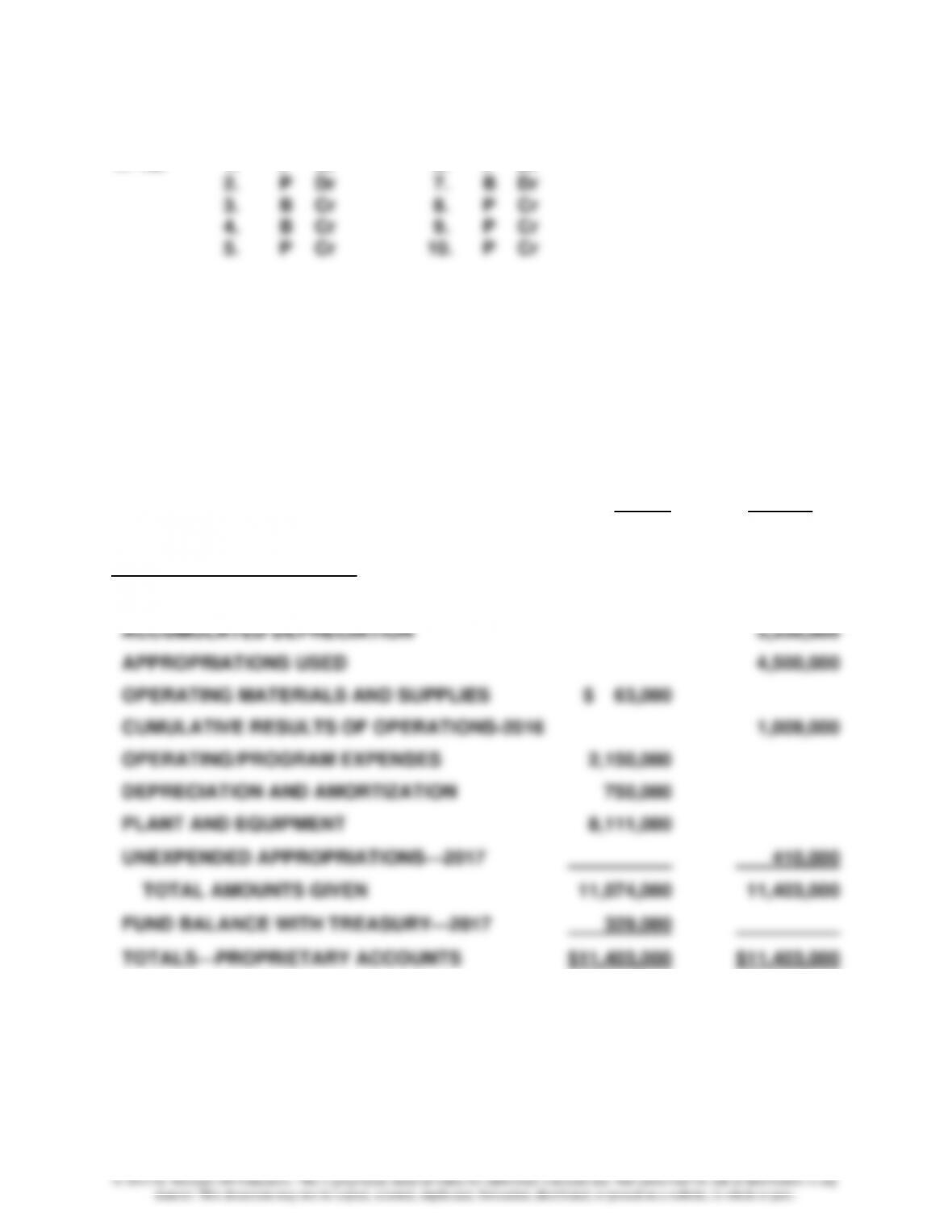
17-16. 1. P Cr 6. P Dr
General Problem Information: Identifying account types and normal balances
Learning Objective: 17-3
Topic: Dual-track Accounting System
Bloom’s Taxonomy: Remember
Accreditation Skills tag: AACSB: Knowledge Application, AICPA: FN: Measurement
Level of Difficulty: Easy
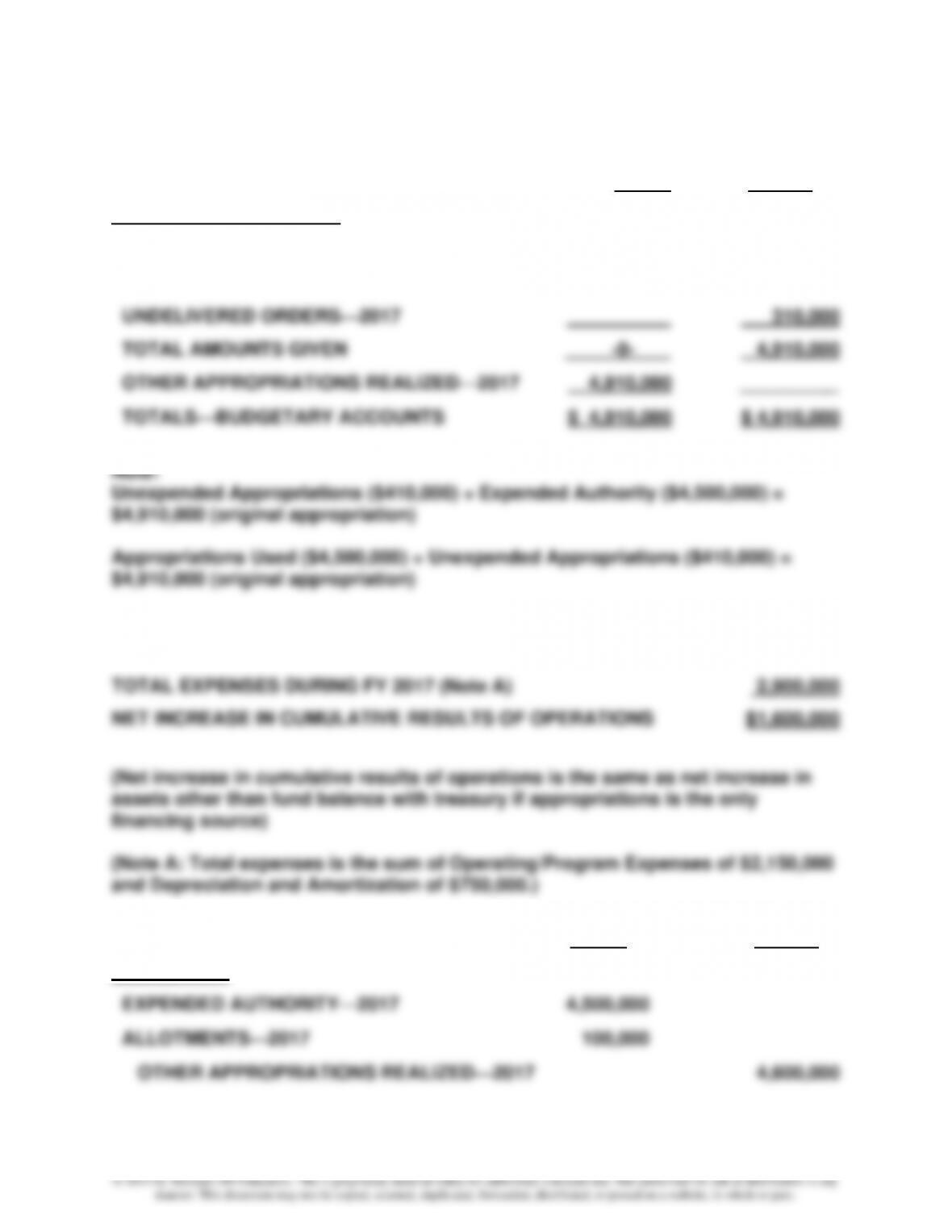
17-17. SAVE OUR RESOURCES COMMISSION
a. COMPUTATION OF MISSING AMOUNTS: Debits Credits
PROPRIETARY ACCOUNTS
ACCOUNTS PAYABLE $ 134,000
Chapter 17 – Accounting and Reporting for the Federal Government
17–15
Ch. 17, Solutions, 17-17 (Cont’d)
SAVE OUR RESOURCES COMMISSION
Debits Credits
BUDGETARY ACCOUNTS
EXPENDED AUTHORITY⎯2017 $ 4,500,000
ALLOTMENTS⎯2017 100,000
b.
APPROPRIATIONS USED DURING FY 2017 $4,500,000
c. Closing entries Debits Credits
BUDGETARY