
Chapter 16 – Accounting for Health Care Organizations
CHAPTER 16: ACCOUNTING FOR HEALTH CARE
Chapter 16 – Accounting for Health Care Organizations
16-2
CHAPTER 16: ACCOUNTING FOR HEALTH CARE ORGANIZATIONS
Answers to Questions
16-1. Disagree. It is true that the FASB is the authoritative source for establishing accounting
and financial reporting standards for investor-owned and not-for-profit health care
organizations; however, there are some differences that do exist in the reporting
General Problem Information: Standards-setting authority
Learning Objective: 16-1
Topic: GAAP for Health Care Providers
Bloom’s Taxonomy: Understand
Accreditation Skills tag: AACSB: Knowledge Application, AICPA: FN: Measurement
Level of Difficulty: Medium
16-2. The FASB requires health care providers to issue a statement of financial position,
statement of operations, and a statement of cash flows, as well as notes to the financial
financial statements.
General Problem Information: Financial statements
Learning Objective: 16-2
Topic: Reporting and Accounting Issues
Bloom’s Taxonomy: Remember
Accreditation Skills tag: AACSB: Knowledge Application, AICPA: FN: Reporting
Level of Difficulty: Easy
16-3. FASB ASC 954-605-45 indicates that patient discounts, contractual adjustments, and bad
Chapter 16 – Accounting for Health Care Organizations
16-3
Ch. 16, Answers, 16-3 (Cont’d)
General Problem Information: Deductions from revenue
Learning Objective: 16-3
Topic: Reporting and Accounting Issues
Bloom’s Taxonomy: Understand
Accreditation Skills tag: AACSB: Knowledge Application, AICPA: FN: Measurement
Level of Difficulty: Medium
16-4. Performance indicators relate to the results of operations. An example of a performance
indicator is the excess of revenues and gains over expenses and losses. Items that would
General Problem Information: Performance indicators
Learning Objective: 16-3
Topic: Reporting and Accounting Issues
Bloom’s Taxonomy: Remember
Accreditation Skills tag: AACSB: Knowledge Application, AICPA: FN: Measurement
Level of Difficulty: Easy
Chapter 16 – Accounting for Health Care Organizations
16-4
Ch. 16, Answers, 16-5 (Cont’d)
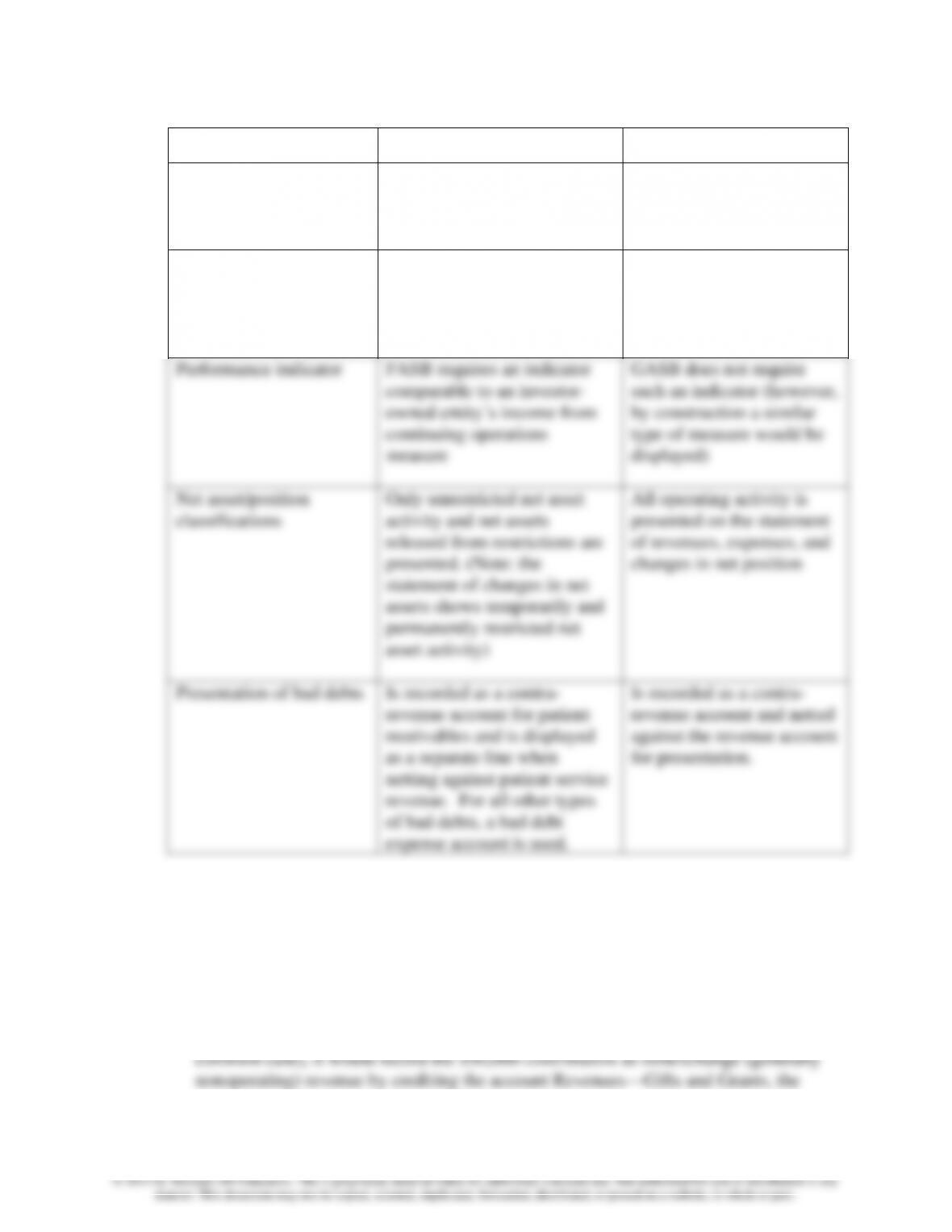
Item
Not-for-profit Presentation
Government Presentation
Title
Statement of operations
Statement of revenues,
expenses, and changes in
net position
Presentation of operating
and nonoperating
activities
FASB does not require that
revenues and/or expenses be
displayed as
operating/nonoperating
GASB requires operating
and nonoperating activity
sections be displayed
Performance indicator
FASB requires an indicator
comparable to an investor-
owned entity’s income from
continuing operations
measure
GASB does not require
such an indicator (however,
by construction a similar
type of measure would be
displayed)
Net asset/position
classifications
Only unrestricted net asset
activity and net assets
released from restrictions are
presented. (Note: the
statement of changes in net
assets shows temporarily and
permanently restricted net
asset activity)
All operating activity is
presented on the statement
of revenues, expenses, and
changes in net position
Presentation of bad debts
Is recorded as a contra-
revenue account for patient
receivables and is displayed
as a separate line when
netting against patient service
revenue. For all other types
of bad debts, a bad debt
expense account is used.
Is recorded as a contra-
revenue account and netted
against the revenue account
for presentation.
General Problem Information: Operating statements
Learning Objective: 16-3
Topic: Reporting and Accounting Issues
Bloom’s Taxonomy: Understand
Accreditation Skills tag: AACSB: Knowledge Application, AICPA: FN: Reporting
Level of Difficulty: Medium
16-6. a. If Tupper is a governmental hospital using business-type accounting (the most
Chapter 16 – Accounting for Health Care Organizations
16-5
© 2013 by McGraw-Hill Education. This is proprietary material solely for authorized instructor use. Not authorized for sale or distribution in any
manner. This document may not be copied, scanned, duplicated, forwarded, distributed, or posted on a website, in whole or part.
Ch. 16, Answers, 16-6 (Cont’d)
debit would be to Cash. Since the pledge amount is not available, the time
requirement for recognition under GASB standards is not met. Therefore, the pledge
amount would not be recorded. At the end of the period Tupper would need to record
a debit to Net Position—Unrestricted and a credit to Net Position—Restricted for any
amounts that have not been expended for the purpose of the grant.
b. If Tupper is a not-for-profit hospital, it would record the $100,000 as a debit to Cash
for $50,000, a debit to Pledges Receivable for $50,000 credit, and a credit to
Contributions—Temporarily Restricted for $100,000. If Tupper expends amounts
related to the purpose restriction during the year it would debt Net Assets Released
from Restrictions—Temporarily Restricted and credit Net Assets Released from
Restrictions—Unrestricted.
General Problem Information: Restricted contributions
Learning Objective: 16-3
Topic: Reporting and Accounting Issues
Bloom’s Taxonomy: Understand
Accreditation Skills tag: AACSB: Knowledge Application, AICPA: FN: Measurement
Level of Difficulty: Medium
16-7. The FASB recognizes assets limited as to use as unrestricted assets whose use is limited
by contract or agreements with outside parties, or by the governing body. Restrictions
General Problem Information: Assets limited as to use
Learning Objective: 16-3
Topic: Reporting and Accounting Issues
Bloom’s Taxonomy: Understand
Accreditation Skills tag: AACSB: Knowledge Application, AICPA: FN: Reporting
Level of Difficulty: Medium
16-8. Premium revenue is the revenue that a health care entity receives for prepaid health plans
such as HMOs and PPOs. A health care entity immediately recognizes premium revenue
General Problem Information: Premium revenue
Learning Objective: 16-5
Chapter 16 – Accounting for Health Care Organizations
16-6
Ch. 16, Answers, 16-8 (Cont’d)
Topic: Other Health Care Issues
Bloom’s Taxonomy: Understand
Accreditation Skills tag: AACSB: Knowledge Application, AICPA: FN: Measurement
Level of Difficulty: Medium
16-9. The Patient Protection and Affordability Act, also referred to as the Affordable Care Act,
is a public law intended to provide health insurance reform and improved health care for
General Problem Information: Patient Protection and Affordability Act
Learning Objective: 16-5
Topic: Other Health Care Issues
Bloom’s Taxonomy: Understand
Accreditation Skills tag: AACSB: Knowledge Application, AICPA: BB: Industry
Level of Difficulty: Medium
16-10. There are many organizations mentioned in the text that compile benchmarking
databases. It is highly likely that the hospital is a member of at least some of the
General Problem Information: Financial and operational performance
Learning Objective: 16-6
Topic: Other Health Care Issues
Bloom’s Taxonomy: Understand
Accreditation Skills tag: AACSB: Knowledge Application, AICPA: BB: Industry
Level of Difficulty: Medium
Solutions to Cases
16-11. a. There are no precise guidelines discussed in the text or in Internal Revenue Service
announcements regarding the amount of charity care that must be provided in order to
Chapter 16 – Accounting for Health Care Organizations
16-7
Ch. 16, Solutions, Case 16-11 (Cont’d)
b. The chart shows that if charity care alone is considered all three hospitals fall short of
the estimated taxes the hospitals would pay if they were not tax-exempt. When
contractual adjustments are added to the charity care all three hospitals exceed the
c. The audited annual financial statements of these three hospitals would be useful. The
amount of charity care and the hospitals’ policies should be disclosed in the notes to
General Problem Information: Charity care
Learning Objective: 16-5
Topic: Other Health Care Issues
Bloom’s Taxonomy: Evaluate
Accreditation Skills tag: AACSB: Analytical Thinking, AICPA: BB: Legal
Level of Difficulty: Medium
16-12. a. Out of 500 hospitals that were sent surveys, 489 responded with sufficient community benefit
information. The types of information gathered included patient mix, emergency room, board
of directors, medical staff privileges, and a variety of programs (specifically, its medical
research, professional education and training, uncompensated care, and community
Chapter 16 – Accounting for Health Care Organizations
16-8
Ch. 16, Solutions, Case 16-12 (Cont’d)
c. Students’ answers to part c will vary. The authors suggest that grading be done based on the
level of thought and analysis demonstrated in the response, and the relevance of examples
suggested.
General Problem Information: Research Case—Determining Community Benefit
Learning Objective: 16-6
Topic: Other Health Care Issues
Bloom’s Taxonomy: Evaluate
Accreditation Skills tag: AACSB: Analytical Thinking, AICPA: BB: Decision Making
Level of Difficulty: Hard
16-13. a. The primary purpose of the act is health insurance reform. Reforms required under
the act are intended to enhance the quality of health care by holding insurance
companies more accountable, lowering health care costs, and guaranteeing more
health care choices.
Chapter 16 – Accounting for Health Care Organizations
16-9
Ch. 16, Solutions, Case 16-13 (Cont’d)
Why students see the purchase of insurance as controversial should generate a good
discussion, given that students tend to be younger and healthier than those who would
most immediately benefit from the enactment of the provision (older and less healthy
individuals who would see lower premiums). The controversy has generally focused
General Problem Information: Patient Protection and Affordability Act
Learning Objective: 16-5
Topic: Other Health Care Issues
Bloom’s Taxonomy: Understand
Accreditation Skills tag: AACSB: Knowledge Application, AICPA: BB: Industry
Level of Difficulty: Medium
16-14. a. The purpose of Hospital Compare is to provide consumers with information about the
quality of care for hospitals and other types of health care providers. Information on
the site can help the consumer make more informed decisions about where he/she

Chapter 16 – Accounting for Health Care Organizations
16–10
Ch. 16, Solutions, Case 16-14 (Cont’d)
General Problem Information: Evaluating the quality of health care
Learning Objective: 16-6
Topic: Other Health Care Issues
Bloom’s Taxonomy: Evaluate
Accreditation Skills tag: AACSB: Analytical Thinking, AICPA: BB: Critical Thinking
Level of Difficulty: Medium
Solutions to Exercises and Problems
16-15. 1. a. 6. c.
2. b. 7. a.
General Problem Information: Various
Learning Objective: 16-1
Learning Objective: 16-2
Learning Objective: 16-3
Learning Objective: 16-5
Learning Objective: 16-6
Topic: Various chapter topics
Bloom’s Taxonomy: Understand
Accreditation Skills tag: AACSB: Knowledge Application, AICPA: FN Reporting
Level of Difficulty: Medium
16-16.
1. a. 6. c.
General Problem Information: Revenue classifications
Learning Objective: 16-3
Topic: Reporting and Accounting Issues
Bloom’s Taxonomy: Understand
Accreditation Skills tag: AACSB: Knowledge Application AICPA: BB: Measurement
Level of Difficulty: Medium
Chapter 16 – Accounting for Health Care Organizations
16–11
Ch. 16, Solutions (Cont’d)
16-17.
a. NOT-FOR-PROFIT FACILITY JOURNAL
Debits Credits
1. ASSETS LIMITED AS TO USE—CASH 500,000
CASH 500,000
4. GENERAL SERVICES EXPENSE 100,000
CONTRIBUTIONS—UNRESTRICTED 100,000
6. INVESTMENTS 32,000
UNREALIZED GAIN—CHANGE IN FAIR VALUE 32,000
NET ASSETS RELEASED FROM RESTRICTIONS—
Chapter 16 – Accounting for Health Care Organizations
16–12
Ch. 16, Solutions, 16-17 (Cont’d)
b. BUSINESS-TYPE GOVERNMENT FACILITY JOURNAL
Debits Credits
1. CASH—BOND REPAYMENT 500,000
CASH 500,000
2. The journal entry is the same for the government facility.
3. The journal entry is the same for the government facility. The Provision for
5. CASH 1,500,000
6. INVESTMENTS 32,000
Chapter 16 – Accounting for Health Care Organizations
16–13
© 2013 by McGraw-Hill Education. This is proprietary material solely for authorized instructor use. Not authorized for sale or distribution in any
manner. This document may not be copied, scanned, duplicated, forwarded, distributed, or posted on a website, in whole or part.
Ch. 16, Solutions, 16-17 (Cont’d)
(Note at the end of the reporting period the government facility would adjust
the account Net Position—Restricted to reflect the decrease in restricted
assets as a result of meeting the purpose of the restriction.)
General Problem Information: Various unrelated transactions—journalize
Learning Objective: 16-4
Topic: Reporting and Accounting Issues
Bloom’s Taxonomy: Apply
Accreditation Skills tag: AACSB: Knowledge Application AICPA: BB: Measurement
Level of Difficulty: Hard
16-18.
1. Y Unrealized gains/losses on only trading type securities are
included in the performance indicator
2. N Operating performance relates to unrestricted net assets
General Problem Information: Performance indicators
Learning Objective: 16-3
Topic: Reporting and Accounting Issues
Bloom’s Taxonomy: Classify
Accreditation Skills tag: AACSB: Knowledge Application AICPA: BB: Measurement
Level of Difficulty: Medium
Chapter 16 – Accounting for Health Care Organizations
16–14
Ch. 16, Solutions (Cont’d)
16-19. a. EVANSTON GENERAL HOSPITAL
GENERAL JOURNAL
Debits Credits
1. ACCOUNTS AND NOTES RECEIVABLE 8,222,000
CASH 928,000
PATIENT SERVICE REVENUE 9,150,000
2. GENERAL EXPENSES 265,000
CONTRIBUTIONS—UNRESTRICTED 265,000
Chapter 16 – Accounting for Health Care Organizations
16–15
Ch. 16, Solutions, 16-19 (Cont’d)
c. The $5,000,000 temporarily restricted contribution would be reported as part of
the statement of changes in net assets, assuming a separate statement is
General Problem Information: Revenue and related transactions—journalize
Learning Objective: 16-4
Topic: Reporting and Accounting Issues
Bloom’s Taxonomy: Apply
Accreditation Skills tag: AACSB: Knowledge Application AICPA: BB: Measurement
Level of Difficulty: Hard
16-20. a. MILOS COUNTY HOSPITAL
GENERAL JOURNAL
FOR THE YEAR 2017
Debits Credits
1. ACCOUNTS AND NOTES RECEIVABLE 1,664,900
PATIENT SERVICE REVENUES 1,664,900
3. CONTRACTUAL ADJUSTMENTS 632,000