
Chapter 15 – Accounting for Colleges and Universities
15-1
CHAPTER 15: ACCOUNTING FOR COLLEGES AND UNIVERSITIES
OUTLINE
Number
Topic
Type/Task
Status
(re: 16/e)
Questions:
15-1
Financial statements
Identify
Same
15-2
Recording grants
Compare
New
15-3
Net asset categories
Identify
Same
15-4
Bad debts
Compare
Same
15-5
Grant revenue
Explain
Same
15-6
Pledges
Explain
Revised
15-7
Support functions
Compare
Revised
15-8
Split-interest agreements
Explain
New
15-9
UPMIFA
Explain
Same
15-10
Single Audits
Identify
New
Cases:
15-11
Annual report
Apply
15-1 revised
15-12
Comparison of public to a private college
Analyze
New
15-13
Research Case—Rating college and university
performance
Explain, discuss
New
15-14
Research Case—UPMIFA
Research, analyze
15-3 revised
Exercises/Problems:
15-15
Various
Multiple Choice
15-1 revised
15-16
Identifying the appropriate GAAP
Classify
New
15-17
Private college transactions and FS
Apply
15-2 revised
15-18
Private college transactions and FS
Apply
15-3 same
15-19
Public university transactions
Apply
15-4 revised
15-20
Public and private university transactions
Apply
15-5 revised
15-21
Private university trial balance to FS
Apply
15-6 same
15-22
Public university trial balance to FS
Apply
15-7 revised
Chapter 15 – Accounting for Colleges and Universities
15-2
CHAPTER 15: ACCOUNTING FOR COLLEGES AND UNIVERSITIES
Answers to Questions
15-1. FASB standards indicate that private colleges and universities are to prepare a statement
of financial position or a balance sheet; a statement of activities; and a statement of cash
flows. Similar to for-profit entities, private colleges and universities are allowed a great
deal of flexibility in preparing statements. For example, private entities can use a multi-
15-2. Notification of a grant to be received in a subsequent period. FASB standards would
require that the private university accrue the grant by recording a debit to a receivable
account, such as Grant Receivable, and a credit to Contributions—Temporarily
Restricted. In the next fiscal year, the resources would be released from restriction. Under
Chapter 15 – Accounting for Colleges and Universities
15-3
© 2013 by McGraw-Hill Education. This is proprietary material solely for authorized instructor use. Not authorized for sale or distribution in any
manner. This document may not be copied, scanned, duplicated, forwarded, distributed, or posted on a website, in whole or part.
Ch. 15, Answers, 15-2 (Cont’d)
As costs allowable under the grant are incurred the private university would release
resources from restriction. As the cash to reimburse the costs is received the cash would
be debited and the receivable would be credited. Recall that under the GASB standards
cost reimbursement is considered an eligibility requirement. Therefore, the public
university cannot recognize the grant until such time as allowable costs are incurred
under the grant. At the time costs are incurred, the public university would debit a
receivable, such as Grant Receivable, for the amount of the allowable costs incurred and
it would credit an account such as Revenue—Gifts and Grants. When the cash is received
the public university would debit cash and credit the receivable.
General Problem Information: Recording grants
Learning Objective: 15-1
Learning Objective: 15-3
Topic: Reporting and Accounting Issues
Bloom’s Taxonomy: Understand
Accreditation Skills tag: AACSB: Knowledge Application, AICPA: FN: Measurement
Level of Difficulty: Medium
15-3. The FASB requires that private colleges and universities identify donor/contributor
restrictions on net assets as temporarily restricted or permanently restricted. The GASB
does not utilize the same categories; however, it does provide that within the restricted
category of net position, public colleges and universities should identify net position as
Chapter 15 – Accounting for Colleges and Universities
15-4
Ch. 15, Answers (Cont’d)
15-4. Private colleges and universities follow FASB/NACUBO guidance and record bad debts
as a direct deduction to the revenue account. Thus a private entity would debit Tuition
and Fees for the estimated bad debts and credit an account such as Allowance for
Doubtful Accounts. In contrast public colleges and universities use a contra-revenue
Bloom’s Taxonomy: Understand
Accreditation Skills tag: AACSB: Knowledge Application, AICPA: FN: Measurement
Level of Difficulty: Medium
15-5. Not all grants are recorded as nonexchange transactions or contributions. If the grant
requires performance on the part of the college or university the receipt of the grant
would be recorded as an exchange or revenue transaction. An example would be a
15-6. For the pledges due within one year, the college can report the pledge at its net realizable
Chapter 15 – Accounting for Colleges and Universities
15-5
© 2013 by McGraw-Hill Education. This is proprietary material solely for authorized instructor use. Not authorized for sale or distribution in any
manner. This document may not be copied, scanned, duplicated, forwarded, distributed, or posted on a website, in whole or part.
Ch. 15, Answers, 15-6 (Cont’d)
one demonstrated in the textbook and used by many not-for-profit entities, involves using
a present value technique and a contra-asset account (see chapter 13 for additional
information). Multi-year pledges would be considered temporarily restricted net assets.
General Problem Information: Pledges
Learning Objective: 15-3
Topic: Reporting and Accounting Issues
Bloom’s Taxonomy: Understand
Accreditation Skills tag: AACSB: Knowledge Application, AICPA: FN: Measurement
Level of Difficulty: Medium
15-7. Although the NACUBO accounts do not clearly identify program and support functions,
under FASB standards private colleges and universities are still required to provide
program and support information. The FASB allows that if the information about
program and support is not provided on the face of the financial statements it should be
15-8. An split-interest agreement is when a donor and a college or university enter into an
arrangement whereby the donor (or a designated beneficiary) and the college or
university share the benefits from the donor’s gift. Generally, they share in the earnings
that result from the donated assets. Such agreements are a planned form of giving that
15-6
© 2013 by McGraw-Hill Education. This is proprietary material solely for authorized instructor use. Not authorized for sale or distribution in any
manner. This document may not be copied, scanned, duplicated, forwarded, distributed, or posted on a website, in whole or part.
Ch. 15, Answers, 15-8 (Cont’d)
Topic: Planned Giving
Bloom’s Taxonomy: Understand
Accreditation Skills tag: AACSB: Knowledge Application, AICPA: BB: Industry
Level of Difficulty: Medium
15-9. UPMIFA stands for the Uniform Prudent Management of Investment Funds Act. The Act provides
legal guidance to not-for-profit organizations on the management, investment and
expenditure of funds held by the organizations for what the UPMIFA terms charitable
purposes (this includes endowment funds). UPMIFA is important to colleges and
Topic: Planned Giving
Bloom’s Taxonomy: Understand
Accreditation Skills tag: AACSB: Knowledge Application, AICPA: BB: Legal
Level of Difficulty: Medium
15-10. Whether a college or university is subject to an audit under Governmental Auditing
Standards depends on the amount of federal dollars it has expended. Any college or
university (public or private) that expends $750,000 or more in federal funds is subject to
Chapter 15 – Accounting for Colleges and Universities
15-7
Solutions to Cases
15-11. a. If the school is a public college or university it should follow the GASB
standards. There are many ways a student could identify the GASB standards
from the financial reports, including: the presence of an MD&A; a statement of
net position with the net position classifications, net investment in capital assets,
restricted, and unrestricted; a statement of revenues, expenses, and changes in net
asset categories permanently restricted, temporarily restricted, and unrestricted; a
statement of activities identifying changes to net asset categories and identifying
net assets released from restrictions; and a statement of cash flow prepared using
three categories of cash flows.
b. Again, the answers will vary based on the financial reports reviewed. The answer
c. For an example of how to calculate the percentage of tuition and fees to total
d. This will vary by college and university. Information to calculate the percentage
e. This too will vary by college and university. The percentage would be calculated
by taking the total of all program expenses and dividing by the total expenses. It is
Chapter 15 – Accounting for Colleges and Universities
15-8
Ch. 15, Solutions, Case 15-11 (Cont’d)
General Problem Information: Annual report
Learning Objective: 15-1
Learning Objective: 15-3
Topic: Reporting and Accounting Issues
Bloom’s Taxonomy: Apply
Accreditation Skills tag: AACSB: Knowledge Application, AICPA: FN: Reporting
Level of Difficulty: Hard
15-12. a. The private college (Catherine College) has prepared it statements under the
FASB standards, while the public college (Midland State College) has prepared
its statements under the GASB standards. Catherine College reports its expenses
using functional classifications and reports changes in unrestricted, temporarily
State appropriation: = 0.00%
Chapter 15 – Accounting for Colleges and Universities
15-9
Ch. 15, Solutions, Case 15-12 (Cont’d)
Grants and contributions: $(2,241,863+$9,020,584)/$91,614,600 = 12.29%
Midland State College
Clearly the private college is more dependent on tuition as the primary source of
c. To some extent the answer will depend on how students interpret the definition of
operating income, which is defined as the revenues and expenses related to the
primary activities of the colleges. Here are calculations that can be used for the
discussion:
Chapter 15 – Accounting for Colleges and Universities
15–10
Ch. 15, Solutions, Case 15-12 (Cont’d)
The private college has a small positive “income” per student using the
calculation provided, while the public college has a small negative “income” per
d. Students should believe that the Catherine College statement provides more
General Problem Information: Comparison of public to a private college
Learning Objective: 15-1
Leaning Objective: 15-2
Learning Objective: 15-3
Topic: Reporting and Accounting Issues
Bloom’s Taxonomy: Analyze
Accreditation Skills tag: AACSB: Analytical Thinking, AICPA: BB: Critical Thinking
Level of Difficulty: Hard
15-13. a. This initiative will affect primarily public colleges and universities receiving
federal student financial aid. The purpose of the initiative is to encourage states
to fund public colleges based on performance and to hold students and institutions
Chapter 15 – Accounting for Colleges and Universities
15–11
© 2013 by McGraw-Hill Education. This is proprietary material solely for authorized instructor use. Not authorized for sale or distribution in any
manner. This document may not be copied, scanned, duplicated, forwarded, distributed, or posted on a website, in whole or part.
Ch. 15, Solutions, Case 15-13 (Cont’d)
Access – a possible measure would be the percentage of students receiving Pell
grants.
Affordability – possible metrics would be the net price of attending and student
loan debt.
Outcomes – possible metrics would include graduation/transfer rates, earnings of
graduates, and completion of advanced degrees.
d. The expectation is that the rating system will be in place so students can use it for
the selection decisions they would make prior to their admission in fall of 2015.
e. Students will have very different views on what they believe to be strengths and
weaknesses of such systems. Some possible points include:
Strengths – a national system that will allow for increased comparability,
increased transparency of information, increased accountability
Weaknesses – a national system cannot consider the different missions of each
university, the diversity of the student body, the different funding
levels/structures in each state
General Problem Information: Rating college and university performance
Learning Objective: 15-5
Topic: Other Accounting Issues
Bloom’s Taxonomy: Analyze
15-14. a. Yes, organizations in Minnesota are subject to UPMIFA.
b. The foundation would be subject to UPMIFA since it is located in Minnesota and
c. The spending rate is not set by UPMIFA. UPMIFA allows NFP organizations to
Chapter 15 – Accounting for Colleges and Universities
15–12
Ch. 15, Solutions, Case 15-14 (Cont’d)
Ms. Hernandez might look to criteria 1, 5 and 7 in addressing her concerns. The
expected total return is not much higher than the spending rate. If the expectation
d. The donor is no longer available to release the endowment from the restriction
that the income be used to study Lake Superior fossils. However, given that it is
General Problem Information: UPMIFA
Learning Objective: 15-5
Topic: Other Accounting Issues
Bloom’s Taxonomy: Analyze
Accreditation Skills tag: AACSB: Analytical Thinking, AICPA: BB: Decision Making
Level of Difficulty: Hard
Solutions to Exercises and Problems
15-15. 1. d. 6. a.
General Problem Information: Various
Learning Objective: 15-1
Learning Objective: 15-2
Learning Objective: 15-3
Learning Objective: 15-5
Topic: Various Chapter Topics
Bloom’s Taxonomy: Understand
Accreditation Skills tag: AACSB: Knowledge Application, AICPA: BB: Critical
Thinking
Level of Difficulty: Medium
Chapter 15 – Accounting for Colleges and Universities
15–13
Ch. 15, Solutions (Cont’d)
15-16. 1. b. 6. b.
General Problem Information: Identifying the appropriate GAAP
Learning Objective: 15-1
Learning Objective: 15-3
Topic: Reporting and Accounting Issues
Bloom’s Taxonomy: Identify
Accreditation Skills tag: AACSB: Knowledge Application, AICPA: FN: Reporting
Level of Difficulty: Easy
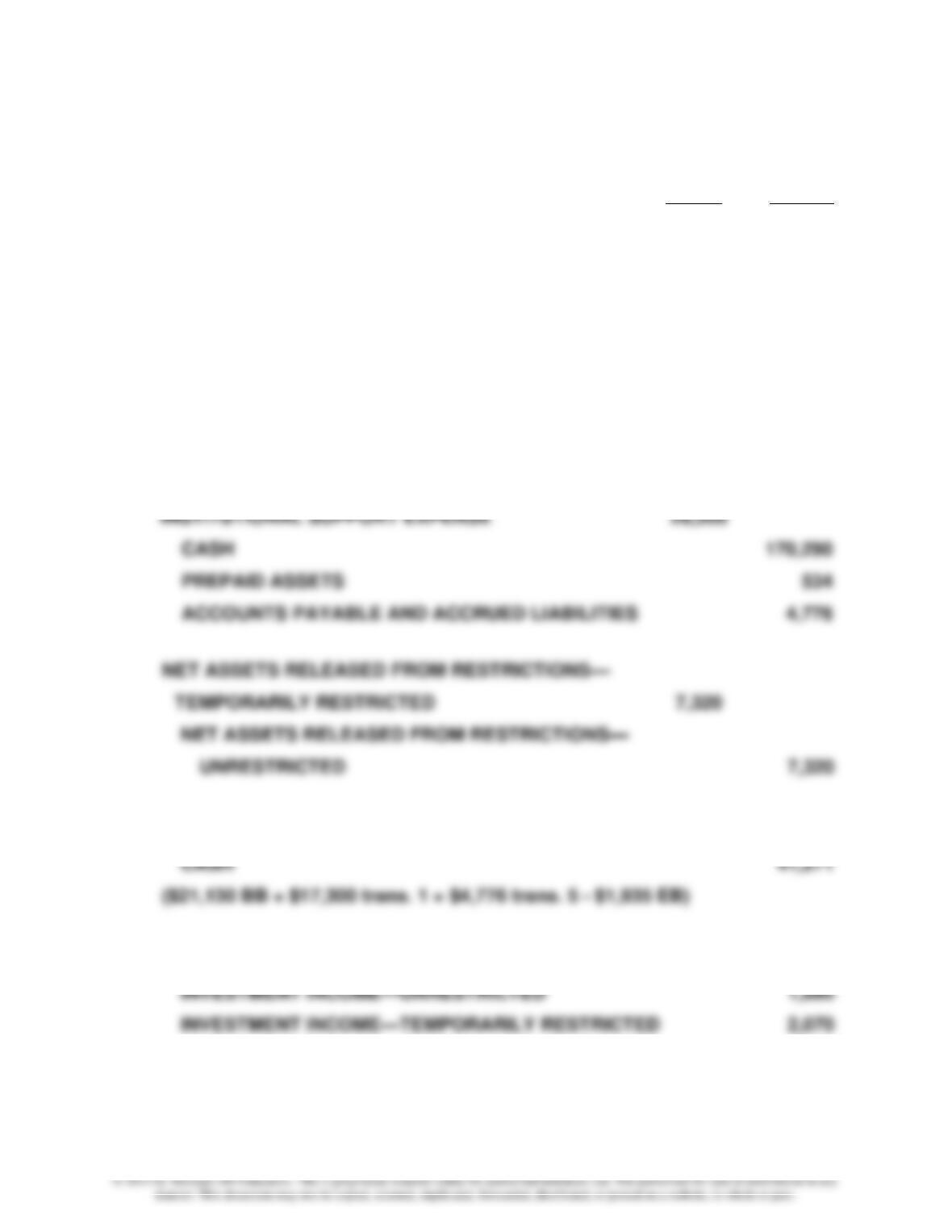
15–17.
a. STEINER COLLEGE
GENERAL JOURNAL
Debits Credits
1. TUITION AND FEES RECEIVABLE 223,100
TUITION & FEES DISCOUNT AND ALLOWANCES 21,400
2. CASH 3,235
PLEDGES RECEIVABLE 550
Chapter 15 – Accounting for Colleges and Universities
15–14
Ch. 15, Solutions, 15-17 (Cont’d)
STEINER COLLEGE
GENERAL JOURNAL
Debits Credits
3. CASH 222,600
TUITION AND FEES RECEIVABLE 222,600
4. DEPOSITS HELD IN CUSTODY FOR OTHERS 10
CASH 10
5. INSTRUCTION EXPENSE 86,100
ACADEMIC SUPPORT EXPENSE 23,300
STUDENT SERVICES EXPENSE 37,700
6. ACCOUNTS PAYABLE AND ACCRUED LIABILITIES 41,271
7. CASH 3,960
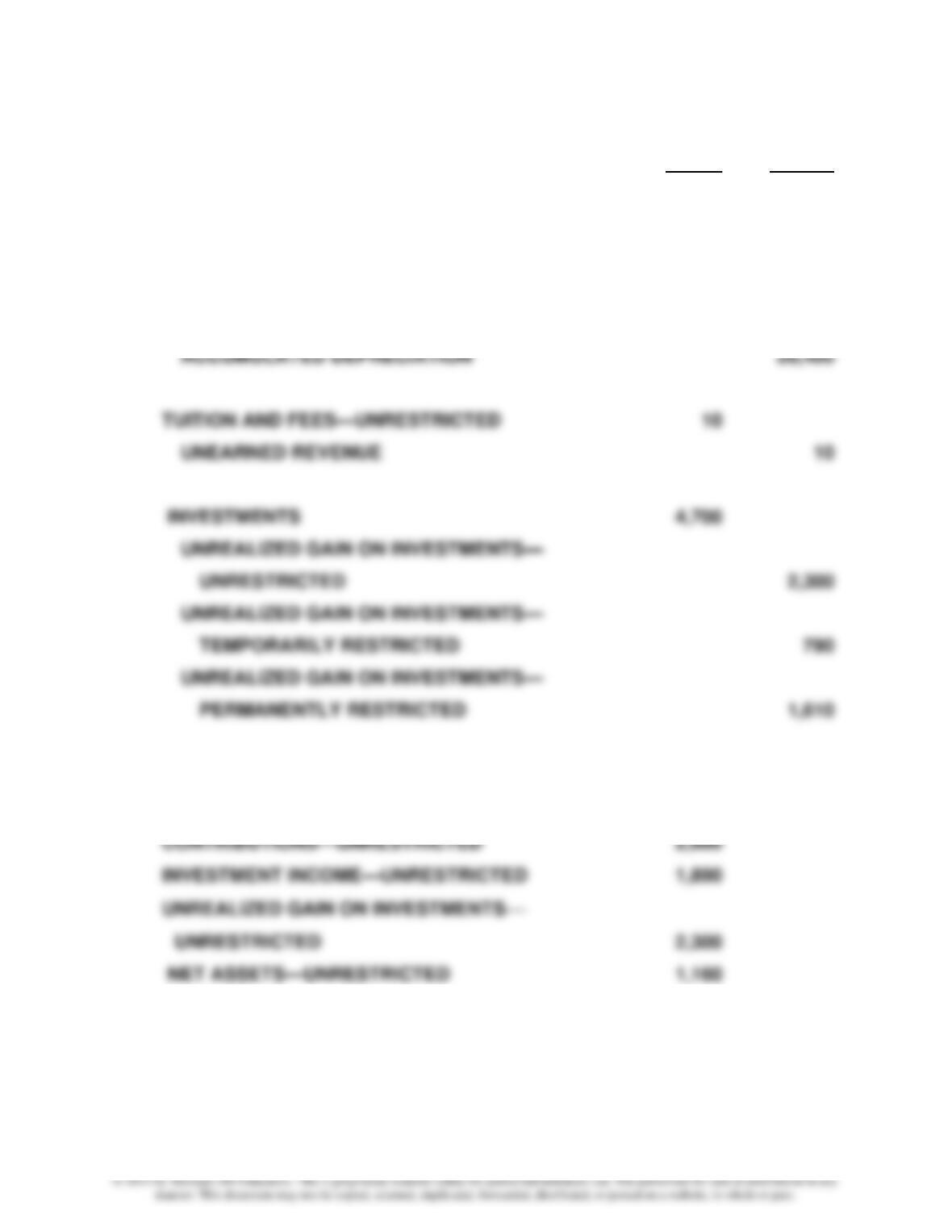
Chapter 15 – Accounting for Colleges and Universities
15–15
Ch. 15, Solutions, 15-17 (Cont’d)
STEINER COLLEGE
GENERAL JOURNAL
Debits Credits
8. TUITION AND FEES—UNRESTRICTED 20
ALLOWANCE FOR DOUBTFUL ACCOUNTS 20
INSTRUCTION EXPENSE 18,480
ACADEMIC SUPPORT EXPENSE 7,920
9. To close nominal accounts
TUITION AND FEES⎯UNRESTRICTED (trans. 1 & 8) 233,270