Chapter 14 – Not-for-Profit Organizations—Regulatory, Taxation, and Performance Issues
14–11
Ch. 14, Solutions, 14-14 (Cont’d)
The balance of the student’s answer to this question will vary from student to
student. The authors suggest grading on the thoughtfulness and analysis in each
student’s response as opposed to their selection of criteria.
b. (1) Charity Navigator uses data from Forms 990 for charitable organizations to
compute its ratings. It uses seven financial performance metrics. Four of the
(2) CharityWatch uses an organization’s Form 990 and, when available, its annual
report and audited financial statements. CharityWatch publishes a Charity Rating
(3) Guidestar is the source for Forms 990 filed by not-for-profit organizations. It
offers images of Forms 990, as well as digitized data from Forms 990. Free
(4) Better Business Bureau Wise Giving Alliance has 20 standards that it uses to
evaluate charities. Many of the standards are qualitative or relate to the amount
and quality of information provided by the charity. There are three financial
c. Students’ answers for this part will vary depending on the organizations and measures
they use.
Chapter 14 – Not-for-Profit Organizations—Regulatory, Taxation, and Performance Issues
14–12
Ch. 14, Solutions, 14-14 (Cont’d)
General Problem Information: Evaluating charity organizations
Leaning Objective: 14-5
Topic: Benchmarking and Performance Measures
Bloom’s Taxonomy: Evaluate
Accreditation Skills tag: AACSB: Analytical Thinking, AICPA: FN: Decision Making
Level of Difficulty: Hard
14-15. Note: Answers to case 14-15 are based on Internet access dated 6/22/2014 and may differ
slightly at the time the case is assigned.
a. The Conservation Fund received an A+ rating. The rating is assigned based on
the following criteria:
• Program effectiveness (program expenses/total expenses)—to receive such a
high rating the Conservation Fund would need to have an effectiveness ratio
b. Yes, the Conservation Fund does meet the BBB’s standards for charity
c. According to the BBB Web site, the Conservation Fund’s program effectiveness

Chapter 14 – Not-for-Profit Organizations—Regulatory, Taxation, and Performance Issues
14–13
Ch. 14, Solutions, 14-15 (Cont’d)
d. Yes, based on the limited analysis conducted it appears the Conservation Fund is
performing quite well. Program effectiveness percentages and the fund-raising
General Problem Information: Performance evaluation of a NFP
Leaning Objective: 14-5
Topic: Benchmarking and Performance Measures
Bloom’s Taxonomy: Evaluate
Accreditation Skills tag: AACSB: Analytical Thinking, AICPA: FN: Decision Making
Level of Difficulty: Hard
Solutions to Exercises and Problems
14-16. 1. c. 6. d.
General Problem Information: Various
Learning Objective: 14-1
Learning Objective: 14-2
Learning Objective: 14-3
Learning Objective: 14-5
Topic: Various Chapter Topics
Bloom’s Taxonomy: Analyze
Accreditation Skills tag: AACSB: Knowledge Application, AICPA: BB: Critical
Thinking
Level of Difficulty: Hard
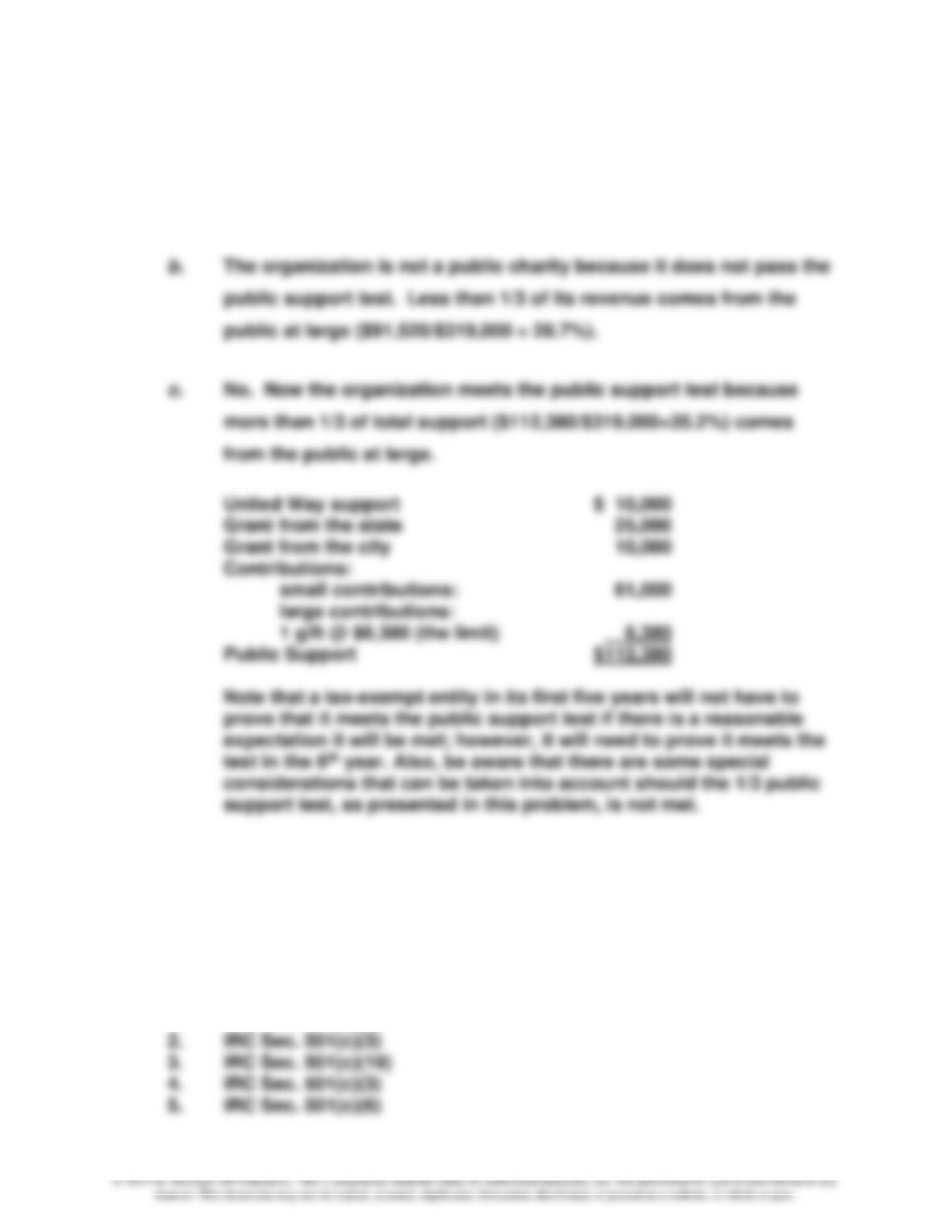
14-17. a. United Way support $ 10,000
Grant from the state 25,000
Chapter 14 – Not-for-Profit Organizations—Regulatory, Taxation, and Performance Issues
14–14
Ch. 14, Solutions, 14-17 (Cont’d)
* total support is $319,000. Since four contributors each provided
more than 2% of the total contribution the limit per individual is
$319,000*.02=$6,380. The answer is based on the revised 2013 IRS
publication 557, Chapter 3, Comprehensive Examples, p. 36.
General Problem Information: Public Charity
Leaning Objective: 14-3
Topic: Federal Regulation
Bloom’s Taxonomy: Apply
Accreditation Skills tag: AACSB: Analytical Thinking, AICPA: FN: Measurement
Level of Difficulty: Hard
14-18.
1. IRC Sec. 501(c)(6)
Chapter 14 – Not-for-Profit Organizations—Regulatory, Taxation, and Performance Issues
14–15
Ch. 14, Solutions, 14-18 (Cont’d)
General Problem Information: Tax-exempt categories
Leaning Objective: 14-3
Topic: Federal Regulation
Bloom’s Taxonomy: Remember
Accreditation Skills tag: AACSB: Knowledge Application, AICPA: BB: Legal
Level of Difficulty: Easy
14-19.
Yes – subject to
UBIT
No – not unrelated
business income
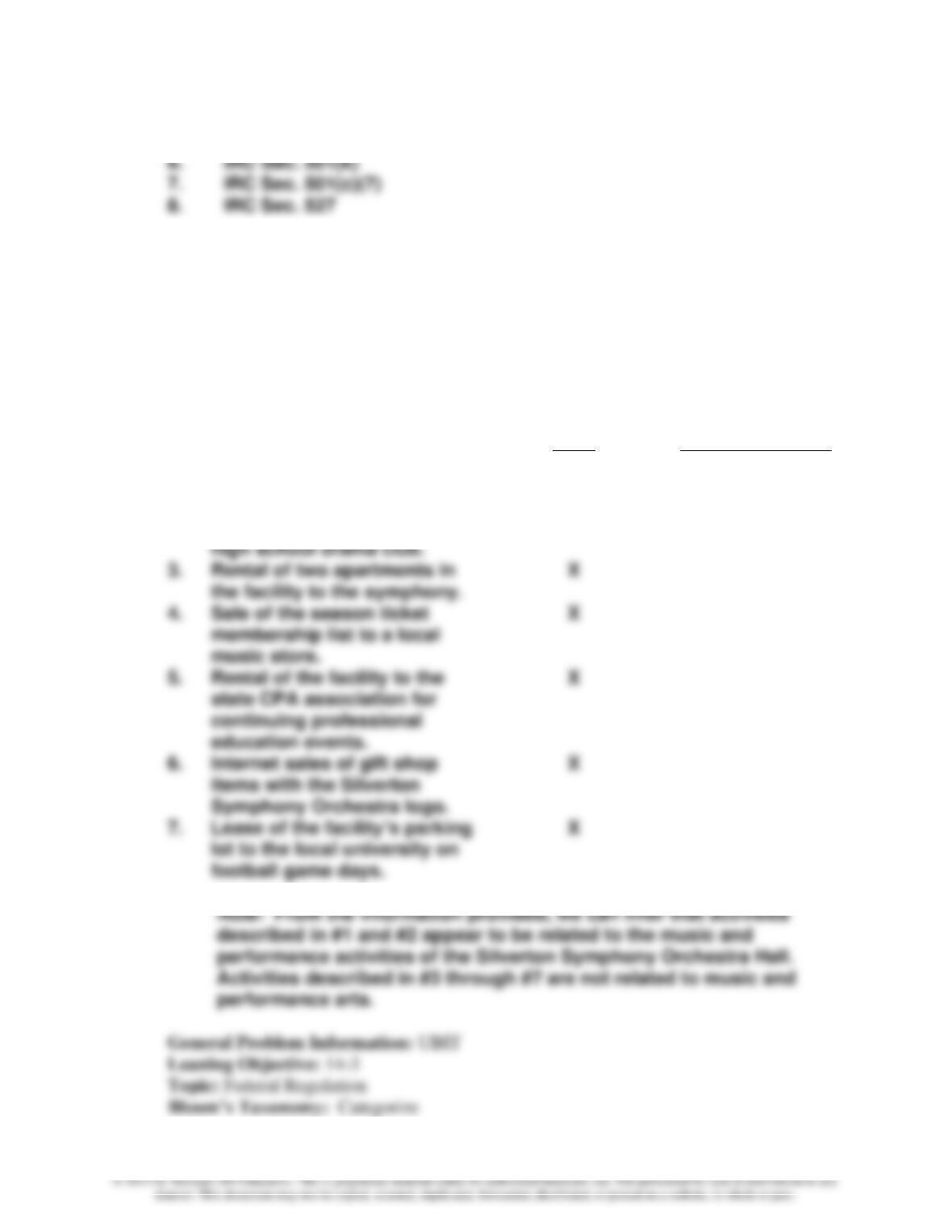
1.
Sale of Silverton Symphony
Orchestra Concert CDs in the
facility’s gift shop.
X
2.
Rental of the facility to the
high school drama club.
X
3.
Rental of two apartments in
the facility to the symphony.
X
4.
Sale of the season ticket
membership list to a local
music store.
X
5.
Rental of the facility to the
state CPA association for
continuing professional
education events.
X
6.
Internet sales of gift shop
items with the Silverton
Symphony Orchestra logo.
X
7.
Lease of the facility’s parking
lot to the local university on
football game days.
X
Chapter 14 – Not-for-Profit Organizations—Regulatory, Taxation, and Performance Issues
14–16
Ch. 14, Solutions (Cont’d)
Accreditation Skills tag: AACSB: Knowledge Application, AICPA: BB: Legal
Level of Difficulty: Medium
14-20. 1. Yes. This is a classic example of excess economic benefit
transactions. Jane is a disqualified person because she is an officer
2. Yes. However, the risk only occurs when the excess benefit is paid.
3. No. However, the law is silent on this particular example. She is
probably receiving the tickets as a member, if all members receive
4. Possibly. If the incoming president’s duties are similar to the
outgoing president and comparable organizations, then the
compensation may be unreasonable. If the duties are similar,
Chapter 14 – Not-for-Profit Organizations—Regulatory, Taxation, and Performance Issues
14–17
© 2013 by McGraw-Hill Education. This is proprietary material solely for authorized instructor use. Not authorized for sale or distribution in any
manner. This document may not be copied, scanned, duplicated, forwarded, distributed, or posted on a website, in whole or part.
Ch. 14, Solutions, 14-20 (Cont’d)
previous president, as well as any difficulty in finding a candidate as
qualified as Joe Curtis.
General Problem Information: Intermediate sanctions
Leaning Objective: 14-3
Topic: Federal Regulation
Bloom’s Taxonomy: Evaluate
Accreditation Skills tag: AACSB: Analytical Thinking, AICPA: FN: Decision Making
Level of Difficulty: Hard
14-21.
a.
Ratios Based on the 2012 Form 990
Measure
Calculation (amounts in 000s)
Ratio
Current ratio
$24,906+$21,689+$4,544+$974
2.81
(part X, col. B, lines 1-9, 17–19)
$12,915+$5,044+$619
Revenues/expenses
$1,893,359
1.00
(part VIII, line 12 & part IX, line 25)
$1,886,999
Program expenses/total expenses
$1,858,065
0.98
(part IX, line 25)
$1,886,999
Fund-raising expenses/public support
$22,112
0.01
(part IX, line 25, & part VIII, line 1h)
$1,855,399
The current ratio indicates that Feeding America is liquid, covering its
Chapter 14 – Not-for-Profit Organizations—Regulatory, Taxation, and Performance Issues
14–18
Ch. 14, Solutions, 14-21 (Cont’d)
b.
Ratios Based on the 2013 Audited Financial Statements
Measure
Calculation (amounts in 000s)
Ratio
Current ratio
$49,707
2.61
$19,045
Revenues/expenses
$1,944,436
1.00
(total support & revenue, and total exp.)
$1,939,393
Program expenses/total expenses
$1,910,102
0.98
(total program services and total exp.)
$1,939,393
Fund-raising expenses/public support
$22,143
0.01
(fund development & total public support)
$1,872,090
Although the numbers entering the calculations are different, using annual
report information to calculate ratios for Feeding America provides results
c. As a general rule, audited financial statements that conform to generally
accepted accounting principles should be preferred to Form 990 information
Chapter 14 – Not-for-Profit Organizations—Regulatory, Taxation, and Performance Issues
14–19
Ch. 14, Solutions, 14-21 (Cont’d)
statements and uses accrual accounting numbers in its Form 990 (see part
General Problem Information: Performance measures
Leaning Objective: 14-5
Topic: Benchmarking and Performance Measures
Bloom’s Taxonomy: Analyze
Accreditation Skills tag: AACSB: Analytical Thinking, AICPA: FN: Measurement
Level of Difficulty: Hard