
Chapter 14 – Not-for-Profit Organizations—Regulatory, Taxation, and Performance Issues
14-1
CHAPTER 14: NOT-FOR-PROFIT ORGANIZATIONS—
REGULATORY, TAXATION, AND PERFORMANCE
ISSUES
OUTLINE
Number
Topic
Type/Task
Status
(re: 16/e)
Questions:
14-1
Regulatory authority of states and
federal government
Identify
New
14-2
Differences in tax-exempt categories
Explain
Same
14-3
Filing Form 990
Explain
Revised
14-4
Public charities and private
foundations
Explain
Revised
14-5
Political activity
Explain
New
14-6
Unrelated business income tax
Discuss
Same
14-7
Political action committees
Define, identify
Same
14-8
Excessive benefits
Explain
New
14-9
Performance measures
Explain
New
14-10
Governing documents
Explain
New
Cases:
14-11
Research Case—Analyzing a NFP
Analyze
14-1 revised
14-12
UBIT and advertising
Evaluate
14-2 revised
14-13
Research Case—Financial
performance measures of largest
NFPs
Apply, evaluate
14-3 revised
14-14
Evaluating charity organizations
Evaluate
New
14-15
Research Case—
Performance evaluation of
a NFP
Analyze
14-5 revised
Exercises/Problems:
14-16
Various
Multiple Choice
14-1 revised
14-17
Public charity
Apply
14-2 revised
14-18
Tax-exempt categories
Identify
14-3 revised
14-19
UBIT
Categorize
14-4 same
14-20
Intermediate sanctions
Evaluate
14-6 same
14-21
Performance measures
Compute, analyze
14-7 revised
Chapter 14 – Not-for-Profit Organizations—Regulatory, Taxation, and Performance Issues
14-2
CHAPTER 14: NOT-FOR-PROFIT ORGANIZATIONS—
REGULATORY, TAXATION, AND PERFORMANCE
ISSUES
Answers to Questions
14-1. Not-for-profit organizations are primarily regulated by the state and federal governments.
State governments grant NFP organizations their “legal life” or their right to operate,
either in the form of a NFP corporation, a limited liability company, or as a charitable
trust. It is this source of authority that causes states to regulate NFP organizations in an
14-2. A 501(c)(3) tax-exempt organization is considered a public charity. As such,
contributions a donor makes to a 501(c)(3) NFP are tax deductible on federal income tax
General Problem Information: Differences in tax-exempt categories
Learning Objective: 14-3
Topic: Federal Regulation
Bloom’s Taxonomy: Understand
Accreditation Skills tag: AACSB: Knowledge Application, AICPA: BB: Legal
Level of Difficulty: Medium
14-3. The purpose of the Form 990 is to provide information to the government and the public
concerning the activities of the NFP organizations receiving tax-exempt status. The
Chapter 14 – Not-for-Profit Organizations—Regulatory, Taxation, and Performance Issues
14-3
Ch. 14, Answers, 14-3 (Cont’d)
receipts of $50,000 or less per year, (2) Form 990-EZ is filed by NFPs with annual gross
receipts of between $50,000 and $200,000, and with less than $500,000 in total assets,
General Problem Information: Filing Form 990
Learning Objective: 14-3
Topic: Federal Regulation
Bloom’s Taxonomy: Understand
Accreditation Skills tag: AACSB: Knowledge Application, AICPA: BB: Legal
Level of Difficulty: Medium
14-4. Public charities are broadly supported by the general public in the form of contributions,
dues, or charges for services, which is why the adjective “public” is appropriate. Private
foundations are funded by gifts from a small set of donors, usually a family or
General Problem Information: Public charities and private foundations
Learning Objective: 14-3
Topic: Federal Regulation
Bloom’s Taxonomy: Understand
Accreditation Skills tag: AACSB: Knowledge Application, AICPA: BB: Legal
Level of Difficulty: Medium
14-5. At the state level the type and amount of political activity an NFP can undertake will
Chapter 14 – Not-for-Profit Organizations—Regulatory, Taxation, and Performance Issues
14-4
Ch. 14, Answers, 14-5 (Cont’d)
General Problem Information: Political activity and tax-exempt status
Learning Objective: 14-3
Topic: Federal Regulation
Bloom’s Taxonomy: Understand
Accreditation Skills tag: AACSB: Knowledge Application, AICPA: BB: Legal
Level of Difficulty: Medium
14-6. A gift shop that is considered unrelated to the tax-exempt mission of the museum and
regularly carries on business activities will be subject to the unrelated business income
General Problem Information: Unrelated business income tax
Learning Objective: 14-3
Topic: Federal Regulation
Bloom’s Taxonomy: Understand
Accreditation Skills tag: AACSB: Knowledge Application, AICPA: BB: Legal
Level of Difficulty: Medium
14-7. IRC Sec. 527 includes such organizations as political action committees, political parties
and political campaigns. Sec. 527 organizations are considered tax-exempt under the
General Problem Information: Regulatory authority of states and federal government
Learning Objective: 14-3
Topic: Federal Regulation
Bloom’s Taxonomy: Remember
Chapter 14 – Not-for-Profit Organizations—Regulatory, Taxation, and Performance Issues
14-5
Ch. 14, Answers, 14-7 (Cont’d)
Accreditation Skills tag: AACSB: Knowledge Application, AICPA: BB: Legal
Level of Difficulty: Easy
14-8. Excessive benefits refer to amounts or “deals” received by a NFP organization’s officers
(i.e., a disqualified persons) that are deemed to be unreasonable when compared to
similar transactions received by those in comparable positions. Examples of excessive
14-9. There are several types of performance measures; however, of primary interest to the
financial manager would be the financial performance measures discussed in the
textbook. Performance measures have the benefit of providing context for the raw data
Chapter 14 – Not-for-Profit Organizations—Regulatory, Taxation, and Performance Issues
14-6
Ch. 14, Answers, 14-9 (Cont’d)
General Problem Information: Performance measures
Learning Objective: 14-5
Topic: Benchmarking and Performance Measures
Bloom’s Taxonomy: Understand
Accreditation Skills tag: AACSB: Knowledge Application, AICPA: BB: Legal
Level of Difficulty: Medium
14-10. The articles of incorporation for an NFP state the charitable purpose of the organization.
The purpose and mission identified in the articles of incorporation are important for
General Problem Information: Governing documents
Learning Objective: 14-4
Topic: Governance
Bloom’s Taxonomy: Understand
Accreditation Skills tag: AACSB: Knowledge Application, AICPA: BB: Legal
Level of Difficulty: Medium
Solutions to Cases
14-11. Note: The answers provided to this case are based on the 2013 annual report of the
American Institute of Certified Public Accountants.
a. In the significant accounting policies note you will find that the American
Institute of Certified Public Accountants (AICPA) receives its exempt status
Chapter 14 – Not-for-Profit Organizations—Regulatory, Taxation, and Performance Issues
14-7
Ch. 14, Solutions, 14-11 (Cont’d)
c. Yes. A review of the AICPA’s statement of cash flow reveals that this tax–
exempt organization has paid income taxes, indicating unrelated business income
d. The effectiveness ratio is calculated as Program Expenses/Total Expenses. Using
the 2013 combined statements of activities found in the annual report for the
AICPA the following ratio was calculated:
e. Accounting students would be surprised and disappointed if there wasn’t some
evidence the AICPA was practicing good governance. There are several
indicators of good governance provided by the annual report and the Web site.
Some of the items mentioned include:
Chapter 14 – Not-for-Profit Organizations—Regulatory, Taxation, and Performance Issues
14-8
Ch. 14, Solutions, 14-11 (Cont’d)
General Problem Information: Analyzing an NFP
Leaning Objective: 14-3
Learning Objective: 14-4
Leaning Objective: 14-5
Topic: Federal Regulation, Governance, Benchmarking and Performance Measures
Bloom’s Taxonomy: Analyze
Accreditation Skills tag: AACSB: Analytical Thinking, AICPA: BB: Critical Thinking
Level of Difficulty: Hard
14-12. a. The following are questions the executive director of the association should be
prepared to answer:
• Would the net income derived from the sale of exhibit space be large
enough to subject the NFP to UBIT?
• Does the activity meet any of the exclusions under UBIT, such as
Chapter 14 – Not-for-Profit Organizations—Regulatory, Taxation, and Performance Issues
14-9
Ch. 14, Solutions, 14-12 (Cont’d)
General Problem Information: UBIT and advertising
Leaning Objective: 14-3
Topic: Federal Regulation
Bloom’s Taxonomy: Evaluate
Accreditation Skills tag: AACSB: Analytical Thinking, AICPA: FN: Research
Level of Difficulty: Hard
14-13. a. Students will choose different sets of charities. Web sites for the organizations
listed on Illustration 14-7 can be readily obtained through a search engine such as
and 90%. The availability of data for calculating ratios will vary by the NFP.
14-6 from the audited annual financial statements and IRS Form 990. For
example, donors can calculate the organization’s fund-raising ratio by looking at
the statement of activities to see if the dollars from contributions and support
Chapter 14 – Not-for-Profit Organizations—Regulatory, Taxation, and Performance Issues
14–10
Ch. 14, Solutions, 14-13 (Cont’d)
c. If the organizations provide financial reports or the form 990 on their Web sites
they are generally also providing the reports or forms for several years. The
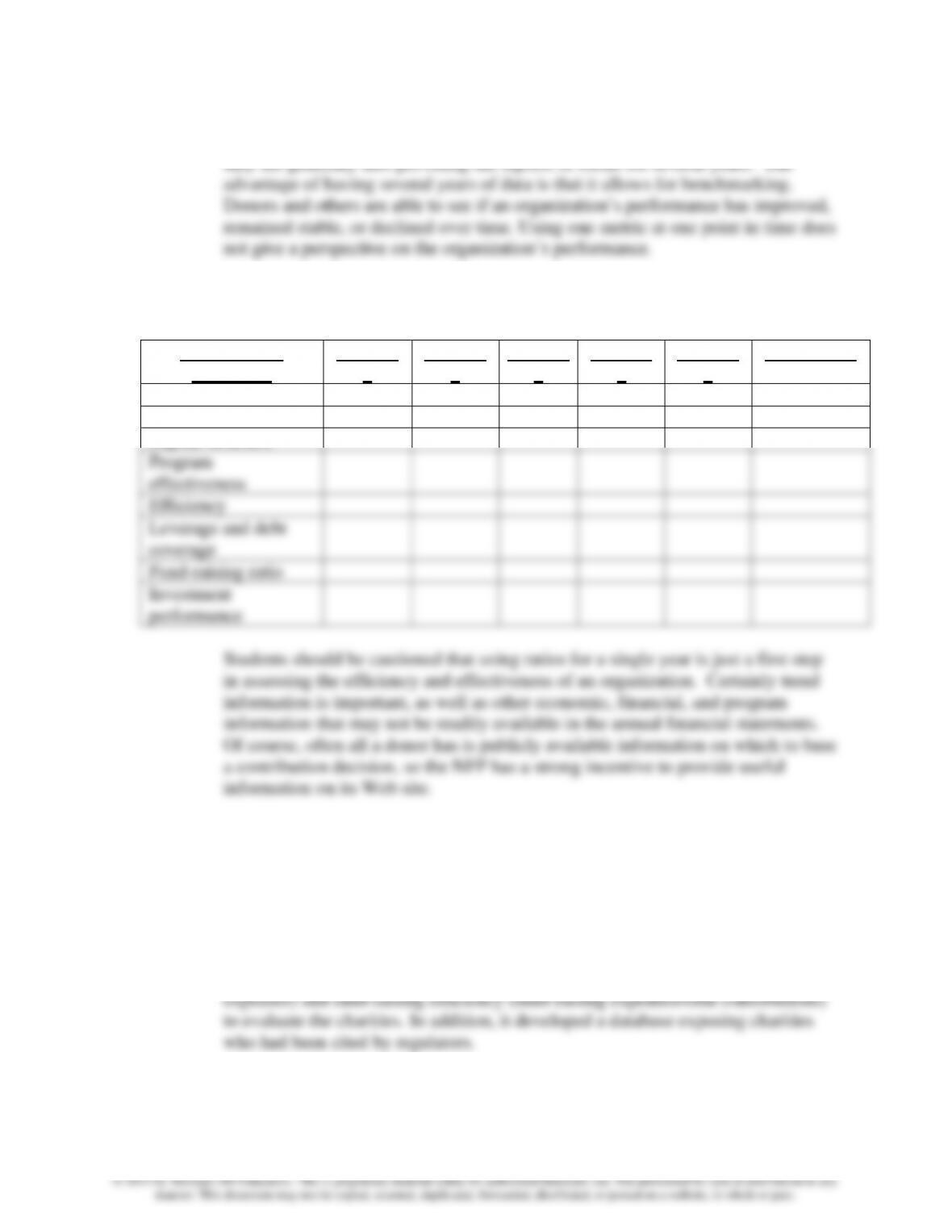
d. Students could present information in this manner:
General Problem Information: Financial performance measures of largest NFPs
Leaning Objective: 14-5
Topic: Benchmarking and Performance Measures
Bloom’s Taxonomy: Apply
Accreditation Skills tag: AACSB: Analytical Thinking, AICPA: FN: Decision Making
Level of Difficulty: Hard
14-14. a. The Tampa Bay Times used program effectiveness (program expenses/total
Performance
measures:
Charity
1
Charity
2
Charity
3
Charity
4
Charity
5
Comments:
Liquidity
Going concern
Capital structure
Program
effectiveness
Efficiency
Leverage and debt
coverage
Fund-raising ratio
Investment
performance