
Brief Learning
Exercises Objectives
B. Ex. 8.1 FIFO inventory 8-1, 8-4
B. Ex. 8.2 LIFO inventory 8-1, 8-4
B. Ex. 8.3 Average-cost inventory 8-1
B. Ex. 8.4 FIFO and LIFO inventory 8-1 Analysis
B. Ex. 8.5 FIFO and Average-cost inventory 8-4
B. Ex. 8.6 Inventory shrinkage 8-3 Analysis
B. Ex. 8.7 Inventory error 8-5 Analysis
B. Ex. 8.8 Inventory error 8-5
B. Ex. 8.9 Inventory turnove
r
8-7
B. Ex. 8.10 Inventory turnove
r
8-7
8.1 Accountin
g
terminolo
gy
8-1–8-7
8.2 Cost flow assum
p
tions 8-1
8.3 Ph
y
sical flows vs. cost flows assum
p
tion
s
8-4
8.4 Effects of different cost-flow flows 8-4
8.5 Transfer of title 8-2
8.6 Inventory write-downs 8-3
8.7 Costing inventory in a periodic system 8-4
8.8 Effects of errors in inventory valuation 8-5
8.9 Estimating inventory by the gross profit
method 8-6
8.10 Estimating inventory by the retail method 8-6
8.11 8-1, 8-7
8.12 8-1, 8-7
8.13 8-7
8.14 8-7
8.15 8-7
Real World: Wal-Mart
Inventory analysis
Learning
Objectives
Analysis
Analysis, judgment
Anal
y
sis
Real World: Ford Motor Company
FIFO vs. LIFO
Real World: Kraft Foods Group, Inc.
Inventory turnover
Real World: The Home Depot, Inc.
Using the financial statements of The
Home Depot, Inc.
Anal
y
sis
Analysis, communication,
j
ud
g
men
t
Analysis, communication
Analysis
Analysis
Real World: Chrysler: Evaluating cost
flow assumptions
Analysis, communication,
judgment
Skills
Analysis
Analysis
Anal
y
sis
Analysis
Analysis
Analysis
Anal
y
sis
CHAPTER 8
INVENTORIES AND THE
Topic
Analysis
Analysis
Analysis
COST OF GOODS SOLD
OVERVIEW OF BRIEF EXERCISES, EXERCISES, PROBLEMS, AND CRITICAL THINKING
CASES
Topic
Exercises
Analysis
Analysis
Analysis
Skills

8.1 A,B Four methods of inventory valuation 8-1
8.2 A,B Alternative cost flow assumptions in a
perpetual system 8-1
8.3 A,B Alternative cost flow assumptions in a
periodic system 8-4
8.4 A,B Year-end adjustments; shrinkage losses and
LCM 8-1–8-3
8.5 A,B Periodic inventory costing procedures 8-4
8.6 A,B Effects of inventory errors on earnings 8-5
8.7 A,B Retail method 8-2, 8-3, 8-6
8.8 A,B 8-1, 8-7
8.1 Inventory errors 8-5
8.2 LIFO Liquidation 8-4
Dealing with the bank
8.4 8-7
Critical Thinking Cases Analysis, communication,
(Ethics, fraud & corporate governance)
Analysis, communication,
technology
Analysis, communication,
8-3 8.3 Analysis, communication,
Real World: Safeway, Inc., and Staples, Inc.
Inventory turnover rates (Internet)
Analysis, communication
Analysis
Real World: Wal-Mart/J.C. Penney
FIFO vs. LIFO comparisons Analysis, communication,
judgment
Problems
Sets A, B
Analysis, judgment
Topic
Learning
Objectives Skills
Analysis, judgment
Analysis, judgment
Analysis, communication,
j
ud
g
men
t
Analysis, judgment

DESCRIPTIONS OF PROBLEMS AND CRITICAL THINKING CASE
S
Problems (Sets A and B)
20 Strong
25 Medium
Compute the cost of goods sold and ending inventory by three different flow
assumptions. Answer the questions regarding the characteristics of these
assumptions.
Speed World Cycles/Sea Travel (Periodic)
25 Easy
Adjustments under various flow assumptions to reflect the taking of a physical
inventory. Also requires a write-down of the remaining inventory to a market value
below cost.
Computations similar to those in Problem 8-2 except that periodic costing procedures
are used in place of a perpetual inventory system.
35 Medium
30 Strong
20 Medium
20 Medium
20 Medium
8.7 A,B
8.8 A,B
Between the Ears/Song Meister
Illustration of the retail method and its use in estimating inventory shrinkage.
Wal-Mart/J.C. Penney
Using data compiled from the company’s financial statements under LIFO, students
must make necessary adjustments such that resulting financial ratios will be
comparable to those computed under FIFO. Requires a review of ratios introduced in
previous chapters.
Below are brief descriptions of each problem and case. These descriptions are accompanied by the estimated time
(in minutes) required for completion and by a difficulty rating. The time estimates assume use of the partially filled
–
in working papers.
8.2 A,B
Sports World/Dobbins Supply (Perpetual)
A comprehensive problem calling for measurement of the cost of goods sold and
valuation of inventory by specific identification and three different flow assumptions.
Requires both journal entries and maintenance of inventory subsidiary ledger records.
Speed World Cycles/Sea Travel (Perpetual)
8.1 A,B
8.3 A,B
8.4 A,B Mary’s Nursery/Sam’s Lawn Maintenance
8.5 A,B
8.6 A,B
Clear Sound Audio/Ryan Sound
FIFO, LIFO, and average cost in a periodic inventory system. Students also are asked
to answer questions about the characteristics of these flow assumptions.
Health Foods/City Software
A series of income statements for a business being offered for sale indicates a rising
trend in gross profit. The student is given information on errors in inventory and
asked to prepare revised income statements and to evaluate the trend of gross profit.

Critical Thinking Cases
Inventory Errors
LIFO Liquidation
Dealing with the Bank
Ethics, Fraud & Corporate Governance
Safeway and Staples No time limit
Internet Strong
8.4
Requires an analytical interpretation of inventory performance measures reported by
a grocery chain and an office supply chain.
15 Medium8.3
8.1
20 Medium
Dramatic illustration of the potential effect of a LIFO liquidation. Excellent case for
illustrating why finance and marketing majors should understand accounting.
Students are required to evaluate ethical implications of manipulating financial
statement information in order to be in compliance with bank covenants. Also
requires analytical understanding of working capital relationships.
30 Strong
While interviewing for a position as controller, the job applicant learns that the
employer has an inventory “problem.” Inventories have been understated
consistently in past income tax returns.
8.2
SUGGESTED ANSWERS TO DISCUSSION QUESTION
S
2.
3.
4.
5.
6.
1. The use of a cost flow assumption eliminates the need for separately identifying each unit sold and looking
Generally accepted accounting principles permit the use of inventory cost flow assumptions whenever the
items comprising the inventory are similar in terms of cost, function, and sales price.
The specific identification method should be used by the art gallery. Each item is unique and prices vary
widely. Therefore, the gross profit on a sale can be determined logically only by a method that offsets the
cost of a specific painting against its sales price. The ending inventory will be stated at the cost incurred
for the individual paintings on hand at the end of the year.
In measuring the results of operations, accountants generally consider the flow of costs to be more
important than the physical flow of specific units of merchandise. Therefore, a cost flow assumption need
not correspond to the physical movement of the company’s merchandise.
During a period of rising purchase costs, FIFO results in the highest reported profits, as the cost
of goods sold is measured using the oldest (and lowest) costs. LIFO results in the lowest
The phrase “just-in-time inventory system” relates primarily to the management of inventories within
manufacturing companies. With respect to the purchase of raw materials, just-in-time means that materials
arrive at the time they are needed in the production process. With respect to finished goods, the just-in-
The primary reason for taking a physical inventory is to adjust the perpetual inventory records for
9.
Errors in the valuation of ending inventory are said to be “counterbalancing” or “self-correcting” because
these errors have opposite effects on the gross profit (and net income) reported in each of two successive
14. a.
This is because the flow assumption in use has no effect upon the cash receipts from customers or
cash payments to suppliers, but it does affect income taxes. By using FIFO in this period of declining
prices, the older and higher costs will be assigned to the cost of goods sold, thereby minimizing
taxable income. This, in turn, minimizes income tax payments—a cash outflow that enters into the
determination of net cash flow from operating activities.
In a period of declining prices, use of the FIFO method will minimize the reported rate of gross
profit. This is because the oldest (and therefore highest) purchase costs will be assigned to the cost of
goods sold.
B.Ex. 8.1
SOLUTIONS TO BRIEF EXERCISES
50 units @ $2.10 = $105 (the oldest costs)
B.Ex. 8.10
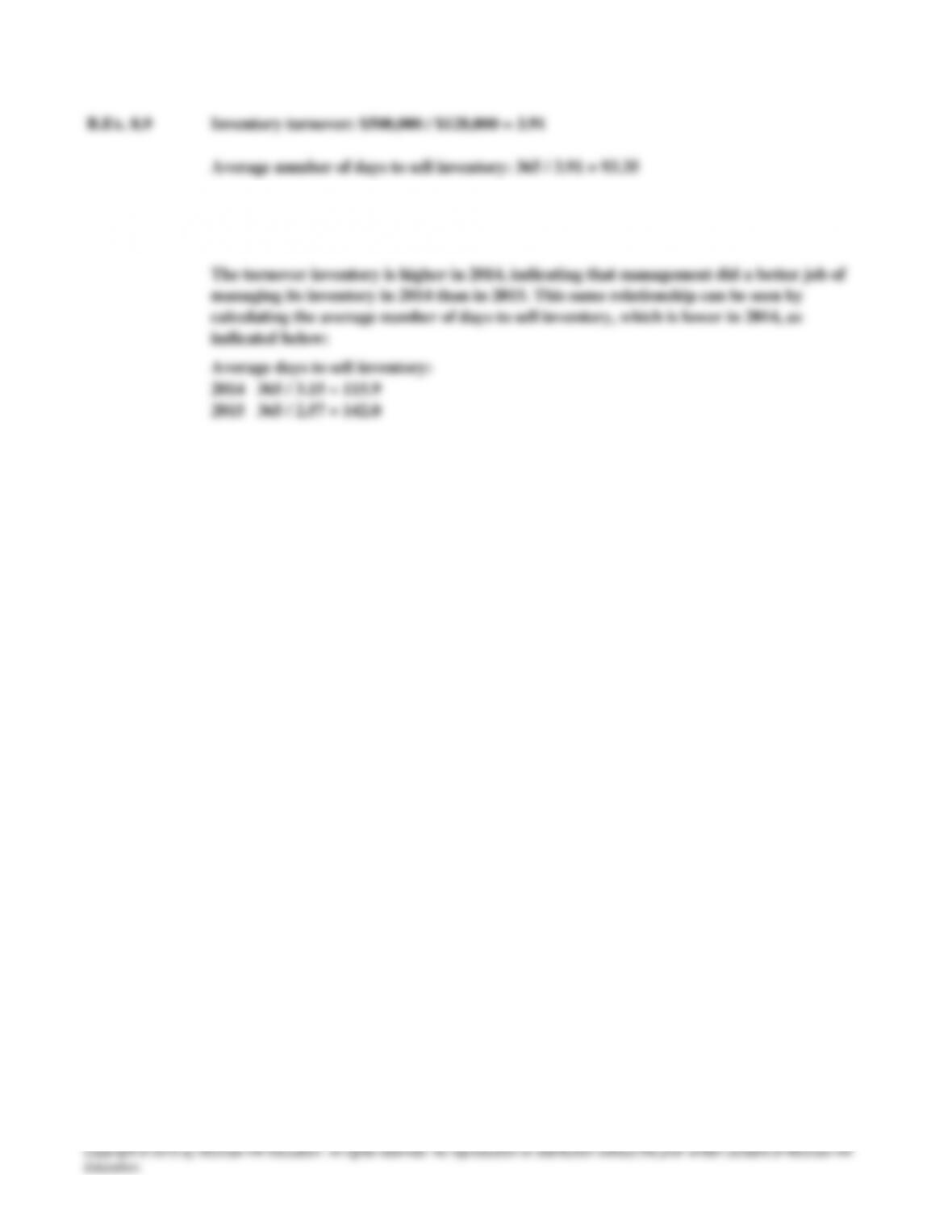
Inventory turnover for 2015: $90 / $35 = 2.57
2014 365 / 3.15 = 115.9
Average number of days to sell inventory: 365 / 3.91 = 93.35
2015 365 / 2.57 = 142.0
Inventory turnover for 2014: $85 / $27 = 3.15
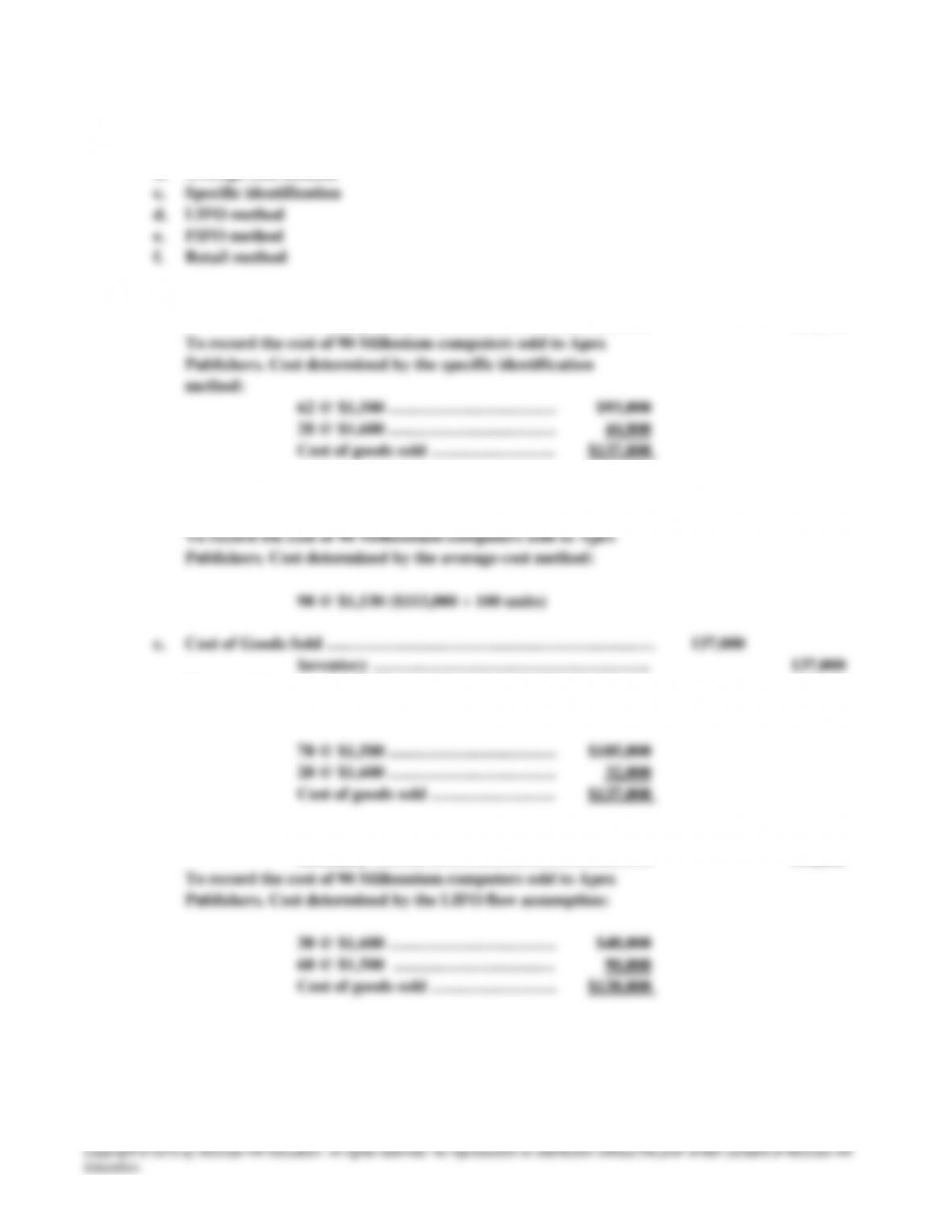
Ex. 8.1 a.
b.
Cost flow assumption
SOLUTIONS TO EXERCISES
Average-cost method