30 Minutes, Medium PROBLEM 19.3B
ORO MINING
a.
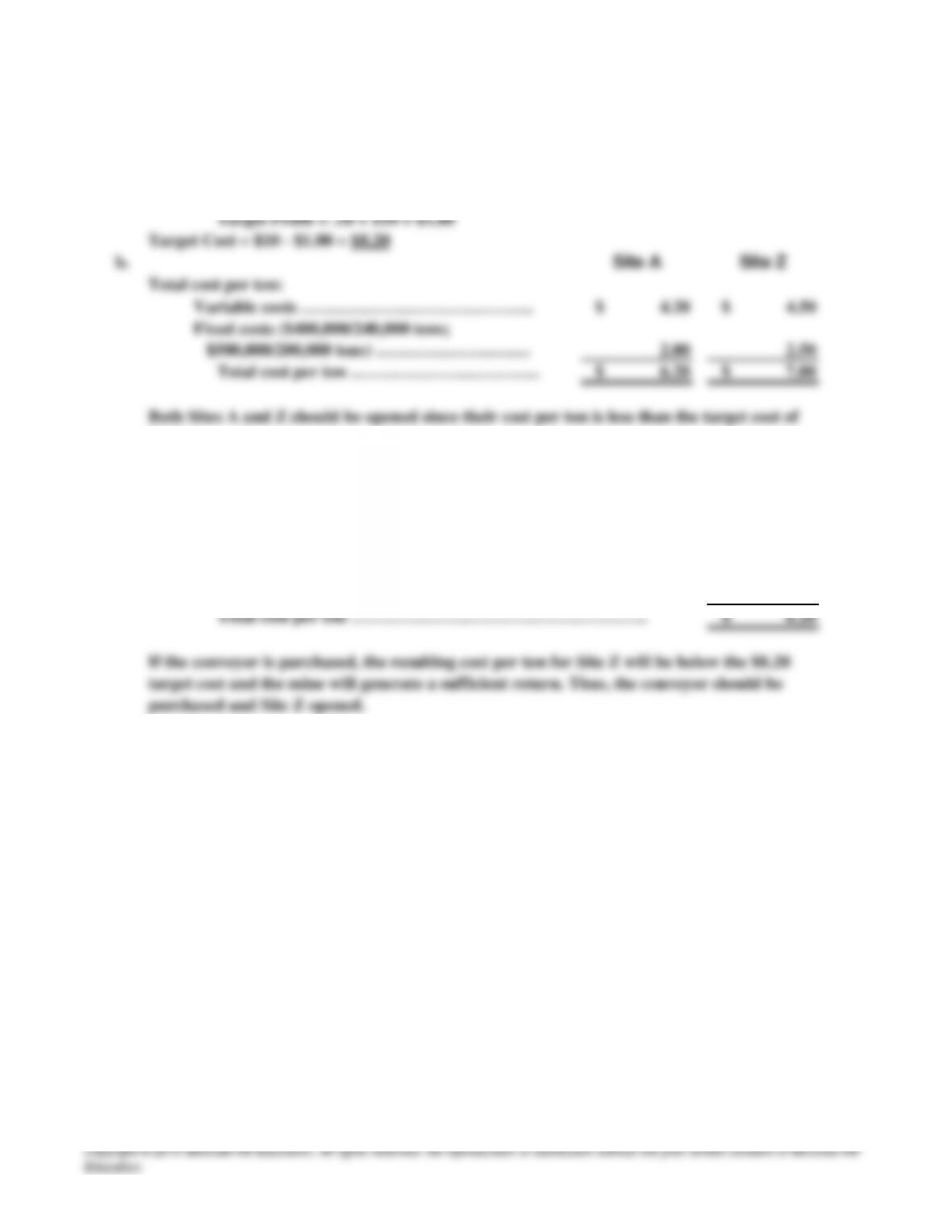
Target Cost = Target Price – Target Profit
Target Price = $10
PROBLEM 19.4B
NAZU, INC.
a.
Y
ear 1
Y
ear 2
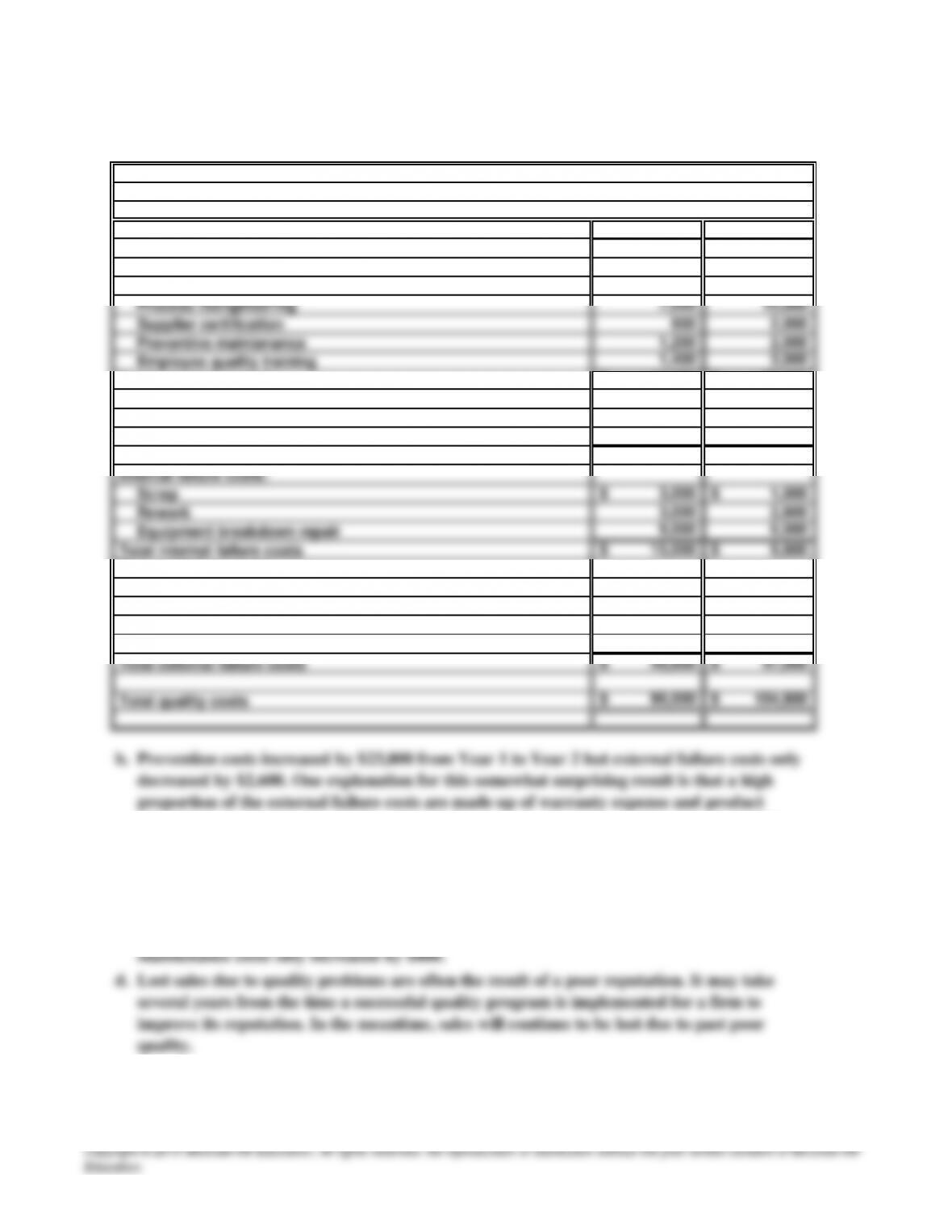
Prevention costs:
Product design 4,000$ 16,000$
Total prevention costs 14,200$ 38,000$
Appraisal costs:
Raw materials inspections 5,200$ 2,000$
Final inspections 12,000 8,000
Total appraisal costs 17,200$ 10,000$
External failure costs:
Warranty expense 25,000$ 23,000$
Product liability claims 6,200 7,000
Defect returns 6,400 5,000
Lost sales 12,000 12,000
c.
40 Minutes, Medium
Quality Cost Report
liability claims. These costs likely still include products that were made before the TQM
program was started. It is encouraging that product returns, which are comprised of the
most recently sold/produced products, has dropped significantly. Overall, it may take
several years before the program’s impact on external failure costs are known.
Yes, the increase in maintenance costs was justified. Repair costs decreased by $3,000, while
SOLUTIONS TO CRITICAL THINKING CASE
S
CASE 19.1
MAYS ELECTRONICS
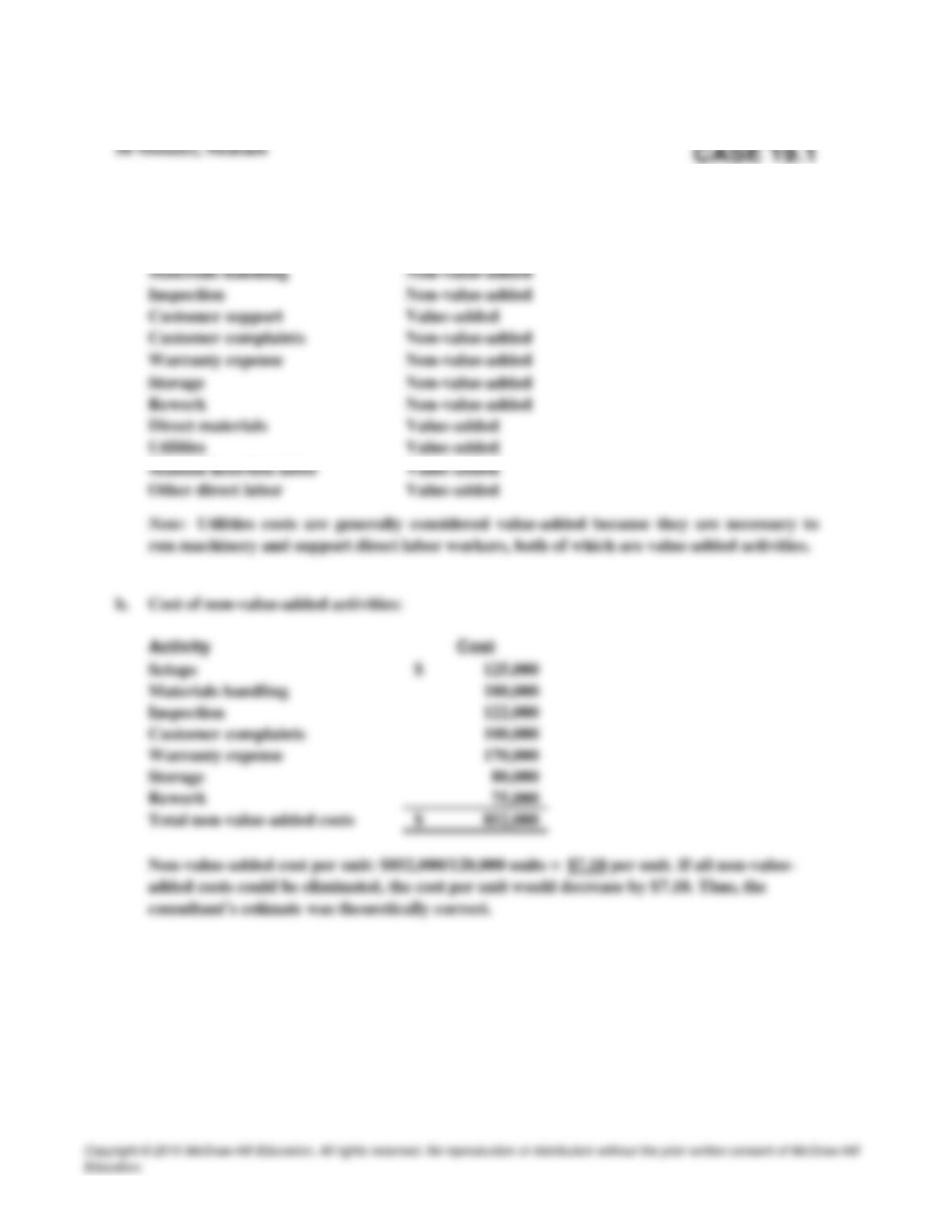
a. Activity Classification
Setu
p
s Non-value-added
50 Minutes, Medium
p
CASE 19.1
MAYS ELECTRONICS (concluded)
d.
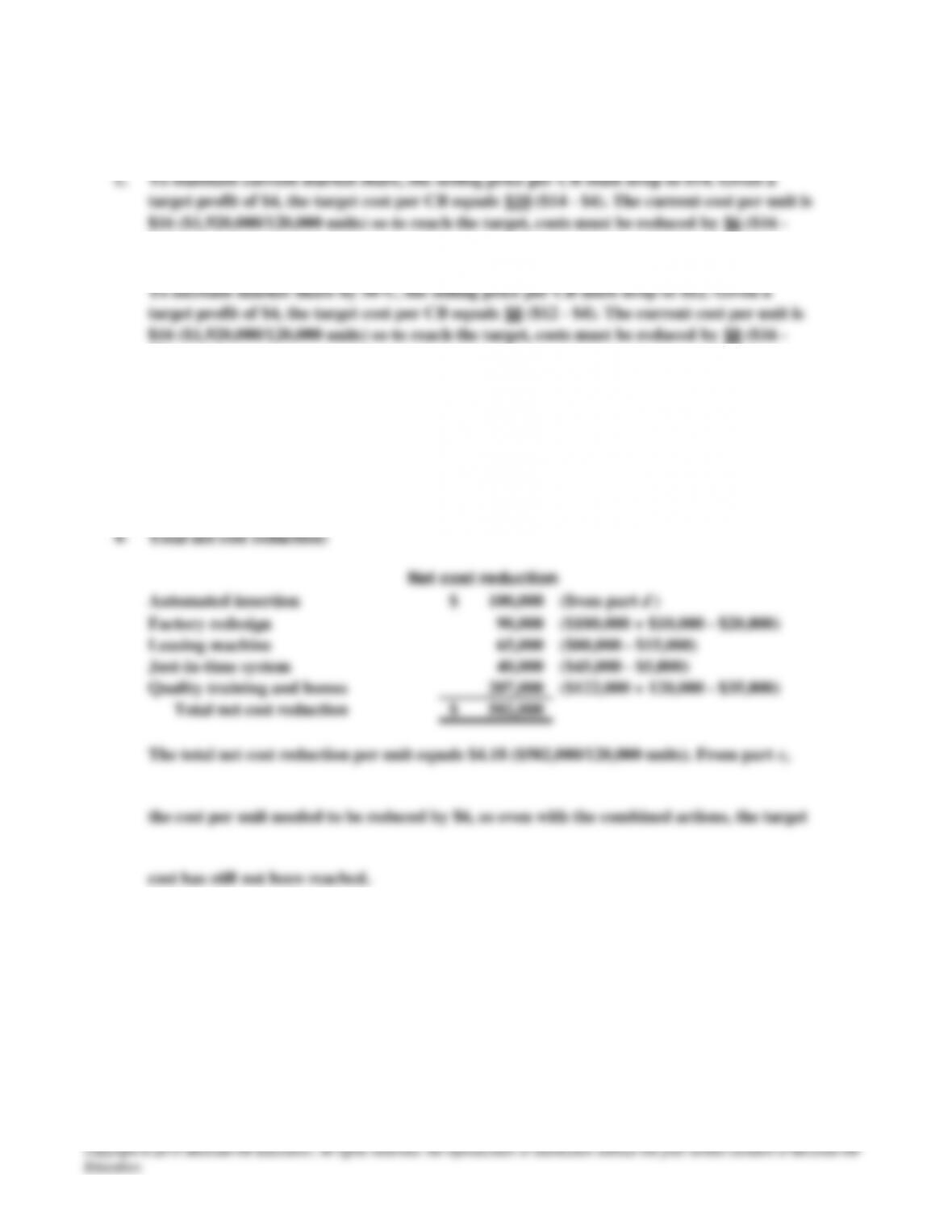
e. Total net cost reduction:
Automated insertion 100,000$ (from part d)
Factor
y
redesi
g
n 90,000 ($100,000 + $10,000 – $20,000)
Leasin
g
machine 65,000 ($80,000 – $15,000)
Just-in-time s
y
stem 40,000 ($45,000 – $5,000)
Qualit
y
trainin
g
and bonus 207,000 ($122,000 + 120,000 – $35,000)
Total net cost reduction 502,000$
The total net cost reduction per unit equals $4.18 ($502,000/120,000 units). From part c,
the cost per unit needed to be reduced by $6, so even with the combined actions, the target
cost has still not been reached.
Net cost reduction
target profit of $4, the target cost per CB equals $10 ($14 – $4). The current cost per unit is
$16 ($1,920,000/120,000 units) so to reach the target, costs must be reduced by $6 ($16 –
$10).
$8).
The net cost reduction of switching to automated insertion is $100,000 ($90,000 + $20,000 +
$40,000 – $50,000). The per unit cost reduction would be $0.83 ($100,000/120,000 units). To
maintain current market share, the cost per unit must be reduced by $6 from part c.
Switching to automated insertion does not result in enough cost savings to reach the target
cost.
CASE 19.2
HEALTHY TIMES FROZEN DINNERS
a.
—
—
—
c.
40 Minutes, Strong
Transporting materials, work in process, and finished goods back and forth between the
warehouse and the factory is a non-value-added activity. If materials were delivered
Excess production is a non-value-added activity. The company currently produces 2,000
units per day in excess of its sales. Limiting production to demand would reduce all
manufacturing costs and also finished goods storage costs.
Description of a JIT system for Healthy Times:
The company operates from a single location—what is now the factory. Production and
A JIT manufacturing system is a “demand pull” system, in which materials are acquired
and units are produced only at the time and in the quantity necessary to meet customer
demand. The basic goals of the system are to increase efficiency by minimizing non-value-
added activities and also to increase product quality.
The fresh-freezing equipment is idle four days each week. If smaller shipments were
received and frozen daily, possibly the company could reduce the amount of equipment
needed for this production process.
CASE 19.2
HEALTHY TIMES FROZEN DINNERS (concluded)
d.
A small storage freezer at the factory contains a two-day supply of direct materials and also
has the capacity to store one day’s production of finished goods. This freezer serves as
“insurance” against a temporary interruption in supplies or delays in making shipments.
A JIT system should work at Healthy Times. Customer orders are received at least a week
as easily as from the warehouse. Some ethical concerns might include the impact on
suppliers and distributors. For example, will suppliers be able to provide the required
materials in a just in time fashion and not disturb their other customers’ requirements? Can
MANUFACTURING ENGINEERING, INC.
INTERNET
a.
5S and Standardized Work: 5S is a methodology for organizing, cleaning, developing,
and sustaining a productive work environment and is a foundation of a performance
improvement program.
The web site has a long list of different innovations. However, the majority of these
innovations result in changes in existing production processes or in characteristics of
existing products as illustrated by the categories below. Thus, the innovations are usually
targeted at the manufacturing phase of the value chain.
30 Minutes, Medium CASE 19.3
CASE 19.4
SARBANES-OXLEY AND NON-VALUE-ADDED ACTIVITIES
ETHICS, FRAUD & CORPORATE GOVERNANCE
a.
The costs of the Sarbanes-Oxley Act have been estimated to be enormous. Those costs
include the costs of documenting and auditing firm-wide internal control systems processes
25 Minutes, Medium