
Chapter 13 – Statement of Cash Flows
Financial and Managerial Accounting, 17e 13-7
CHAPTER 13 NAME #
10-MINUTE QUIZ B SECTION
Use the following information for questions 1 through 4.
Lester Corporation’s statement of cash flows for 2009 shows the following investing activities:
Proceeds from sale of marketable securities ……………………………………………… $ 160,000
Purchase of land …………………………………………………………………………………….. (250,000)
Proceeds from sale of land ……………………………………………………………………… 125,000
Net cash provided by investing activities ………………………………………………. $ 35,000
Lester’s income statement for 2009 includes the following:
Loss on sale of marketable securities ……………………………………………………….. $47,000
Gain on disposal of land …………………………………………………………………………. 65,000
1 Refer to the above data. The cost of the land sold during 2009 was:
a $65,000. b $125,000. c $190,000. d $60,000.
2 Refer to the above data. The cost (book value) of the marketable securities sold during
2009 was:
a $207,000. b $113,000. c $160,000. d Some other amount.
3 Refer to the above data. Lester’s balance sheet at the end of 2008 showed Land of
$100,000. On the basis of the data presented above, compute the amount to be reported for
Land in Lester Corporation’s balance sheet at December 31, 2009.
a $250,000. b $350,000. c $290,000. d Some other amount.
4 Refer to the above data. Lester’s balance sheet at the end of 2008 showed Investment in
Marketable Securities at $250,000. On the basis of the data presented above, compute the
amount to be reported for Investment in Marketable Securities in Lester Corporation’s
balance sheet at December 31, 2009.
a $43,000. b $110,000. c $137,000. d $253,000.
5 Which of the following correctly describes a difference between the direct method and the
indirect method of computing operating cash flow?
a The direct method is used when accounting records are kept on a cash basis; the
indirect method is used when accounting records are maintained on an accrual basis.
b The direct method may be used only when a company maintains special journals for
cash receipts and cash disbursements; the indirect method is used in all other
situations.
c Both the direct and the indirect methods result in the same net cash flow from
operating activities, but the format of this section of the statement of cash flows is
different under the alternative methods.
d The direct method is used when all accounting records and bank statements are
available; the indirect method is used when some accounting records or documents
are missing or have been destroyed.

Chapter 13 – Statement of Cash Flows
CHAPTER 13 NAME #
10-MINUTE QUIZ C SECTION
Using the following information, complete the statement of cash flows for Nutritional Foods for the year
ended December 31, 2010. Place parentheses around those figures in the statement representing cash outlays.
Payments for purchase of land …………………………………………………………………………………… $ 416,000
Proceeds from sale of land ………………………………………………………………………………………… $58,000
Proceeds from issuance of capital stock ……………………………………………………………………… $347,000
Proceeds from issuance of bonds payable …………………………………………………………………… $99,000
Payments to settle short-term debt ……………………………………………………………………………… $74,000
Interest and dividends received …………………………………………………………………………………. $49,500
Cash received from customers …………………………………………………………………………………… $1,502,000
Dividends paid ………………………………………………………………………………………………………… $182,000
Cash paid to suppliers and employees ………………………………………………………………………… $1,172,000
Interest paid ………………………………………………………………………………………………………….. $66,000
Income taxes paid …………………………………………………………………………………………………….. $115,500
Cash and cash equivalents, January 1, 2010 ……………………………………………………………….. $86,000
Cash and cash equivalents, December 31, 2010 ………………………………………………………….. ?
NUTRITIONAL FOODS
Statement of Cash Flows
For the Year Ended December 31, 2010
Cash flows from operating activities (direct method):
Cash received from customers ………………………………………………… $
_________
Cash provided by operating activities …………………………………. $
$
_________
Cash disbursed for operating activities ……………………………….. (_______)
Net cash flows from operating activities ………………………….. $
Cash flows from investing activities:
$
_________
Net cash used by investing activities ………………………………… ( )
Cash flows from financing activities:
$
_________
Net cash provided by financing activities ………………………… _______
Net increase (decrease) in cash ……………………………………………………. $
Cash and cash equivalents, beginning of year ……………………………….. _______
Cash and cash equivalents, end of year ………………………………………… $______

Chapter 13 – Statement of Cash Flows
Financial and Managerial Accounting, 17e 13-9
CHAPTER 13 NAME #
10–MINUTE QUIZ D SECTION____________________________________
The following balance sheets are provided for Socrates Foods:
End of Beginning
Year of Year
Cash and cash equivalents …………………………………………………………….. $170,000 $120,000
Accounts receivable ……………………………………………………………………… 80,000 65,000
Inventory …………………………………………………………………………………….. 140,000 130,000
Plant and equipment (net) ……………………………………………………………… 130,000 80,000
Total assets ……………………………………………………………………………….. $520,000 $395,000
Accounts payable (for merchandise) ………………………………………………. $ 65,000 $ 35,000
Wages payable …………………………………………………………………………….. 120,000 110,000
Long-term liabilities ……………………………………………………………………… 95,000 70,000
Common stock …………………………………………………………………………….. 100,000 100,000
Retained earnings …………………………………………………………………………. 140,000 80,000
Total liabilities and owners’ equity ……………………………………………… $520,000 $395,000
Selected information from Socrates Foods’ current year income statement:
Sales ……………………………………………………………………………………………………………….. $1,650,000
Cost of goods sold ……………………………………………………….…………………………………….. 840,000
Wages expense ………………………………………………………………………………………………….. 260,000
a Compute the following:
(1) Cash received from customers during the year ……………………………………. $__________
(2) Cash payments for merchandise during the year ………………………………….. $__________
(3) Wages paid to employees during the year …………………………………………… $__________
(4) In Socrates Foods’ statement of cash flows, what amount would be reported as the net change in
cash and cash equivalents?
$__________ (increase/decrease)
b Socrates Foods recorded the sale of equipment as follows:
Cash …………………………………………………………………………………… 25,000
Accumulated Depreciation: Equipment …………………………………. 20,000
Loss on Disposal of Equipment …………………………………………….. 15,000
Equipment ………………………………………………………………………. 60,000
How would this transaction be reported in Socrates Foods’ statement of cash flows? (Assume the direct
method is being used.)
Chapter 13 – Statement of Cash Flows
SOLUTIONS TO CHAPTER 13 10-MINUTE QUIZZES
QUIZ A QUIZ B
QUIZ C
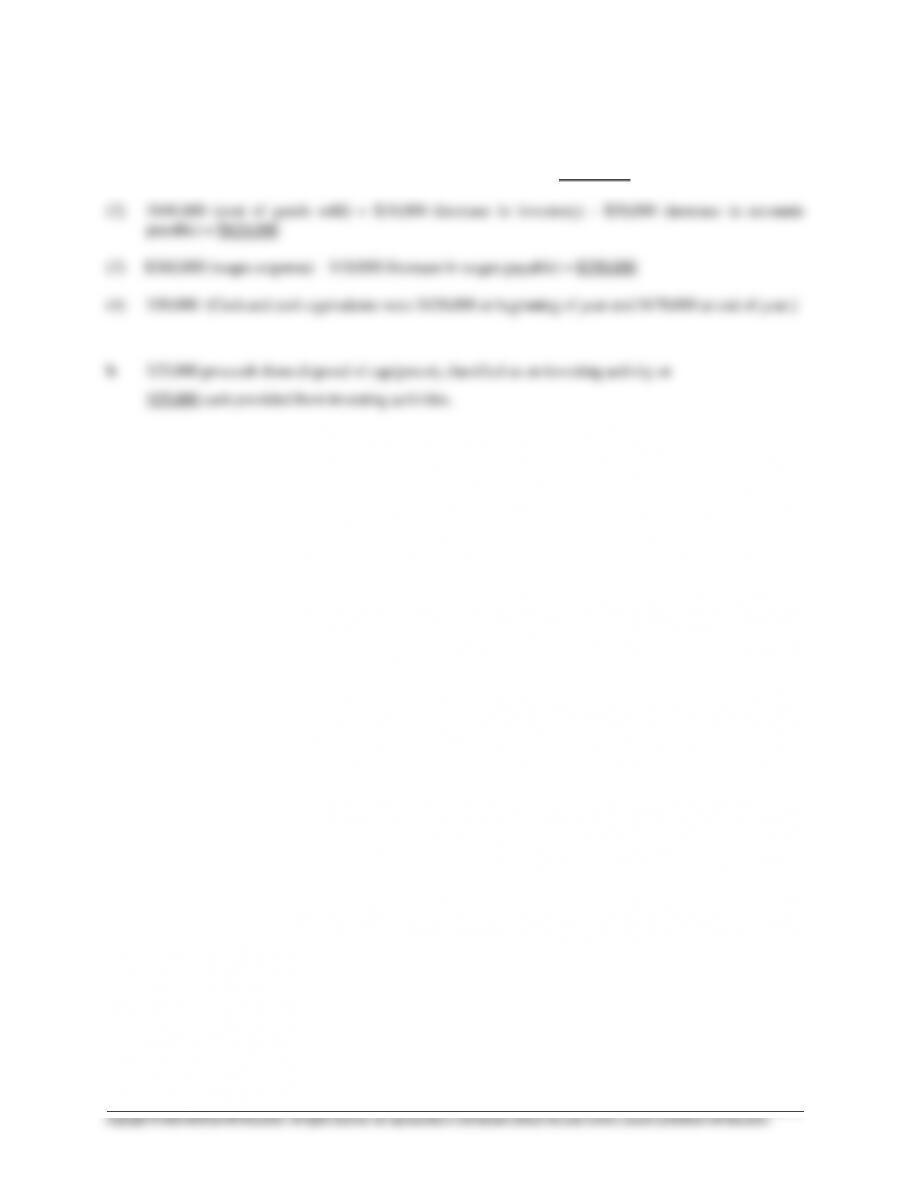
NUTRITIONAL FOODS
Statement of Cash Flows
For the Year Ended December 31, 2010
Cash flows from operating activities:
Cash received from customers ………………………………………………….. $ 1,502,000
Interest and dividends received ………………………………………………… 49,500
Cash provided by operating activities …………………………………….. $1,551,500
Cash paid to suppliers and employees ……………………………………….. $(1,172,000)
Interest paid …………………………..……………………………………………….. (66,000)
Income taxes paid ……………………………………………………………………. (115,500)
Chapter 13 – Statement of Cash Flows
Financial and Managerial Accounting, 17e 13–11
QUIZ D
a
(1) $1,650,000 (sales) – $15,000 (increase in accounts receivable) = $1,635,000
Chapter 13 – Statement of Cash Flows
Assignment Guide to Chapter 13
Brief
Exercises
Exercises
Problems
Cases
Net
1 – 10
1 – 15
1
2
3
4
5
6
7
8
1
2
3
4
5
6
Time estimate (in minutes)
< 15
< 15
40
40
25
30
60
25
25
50
25
15
45
15
20
30
Difficulty rating
E
E
M
M
S
M
S
E
M
S
S
E
M
E
M
M
Learning Objectives:
1, 2, 15
√
1. Explain the purposes and uses
of a statement of cash flows.
2. Describe how cash transactions
are classified in a statement of
cash flows.
8, 10
1, 2, 7, 11,
12, 15
3. Compute the major cash flows
relating to operating activities.
1, 3, 7
4, 5, 6
4. Compute the cash flows relating
to investing and financing
activities.
5, 6
3, 13, 14, 15
5. Distinguish between the direct
and indirect methods of
reporting operating cash flows.
6. Explain why net income differs
from net cash flows from
operating activities.
9
2, 4, 6, 9
7. Compute net cash flows from
operating activities using the
indirect method.
2, 4
9, 10
8.
Discuss the likely effects of
various business strategies on
cash flows.
8
9.
Explain how a worksheet may
be helpful in preparing a
statement of cash flows.