Problem 19-3B (30 minutes)
Part 1
Yes, it is possible for the company to report a net income by increasing its
production to 300,000 lbs. and storing the excess inventory. The following
absorption costing income statement shows this.
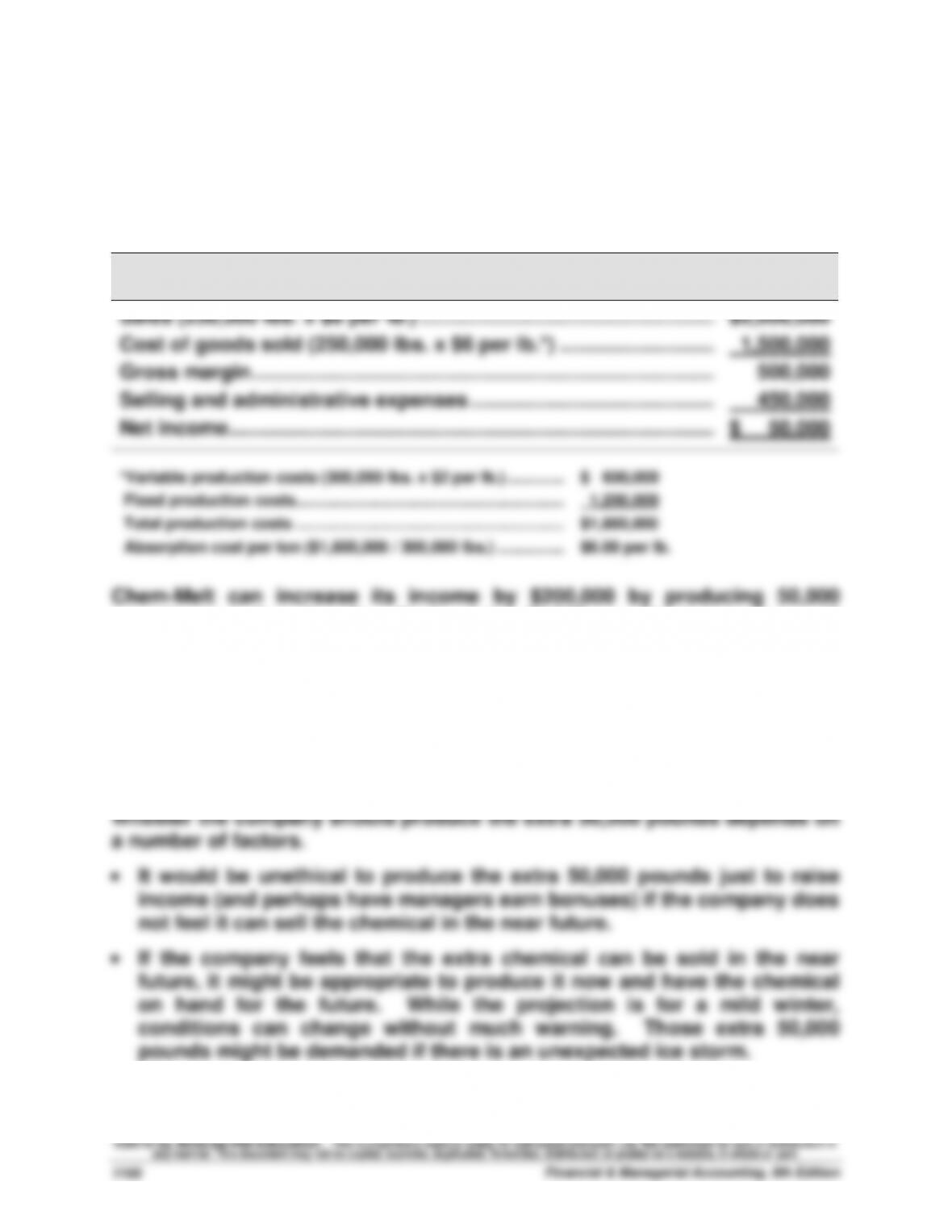
CHEM-MELT
Income Statement (Absorption Costing)
Sales (250,000 lbs. x $8 per lb.) ……………………………………………..………..
$2,000,000
Cost of goods sold (250,000 lbs. x $6 per lb.*) ……………………….….
1,500,000
Gross margin ………………………………………………………………………..………….
500,000
Selling and administrative expenses ……………………………………..………….
450,000
Net income …………………………..……………………………………………….………
$ 50,000
*Variable production costs (300,000 lbs. x $2 per lb.) ………….
$ 600,000
Fixed production costs……………………………………………………
1,200,000
Total production costs ……………………………………………………
$1,800,000
Absorption cost per ton ($1,800,000 / 300,000 lbs.) ……………
$6.00 per lb.
Chem-Melt can increase its income by $200,000 by producing 50,000
pounds more than it sells. Each of the 50,000 pounds in inventory will
carry $4.00 in fixed overhead ($1,200,000/300,000 lbs.). 50,000 pounds
times $4.00 per pound equals the $200,000 in fixed overhead that is not
expensed in the current period. It will be expensed when the chemical is
sold in a future period.
Part 2
Serial Problem — SP 19
Part 1 (a and b)
BUSINESS SOLUTIONS
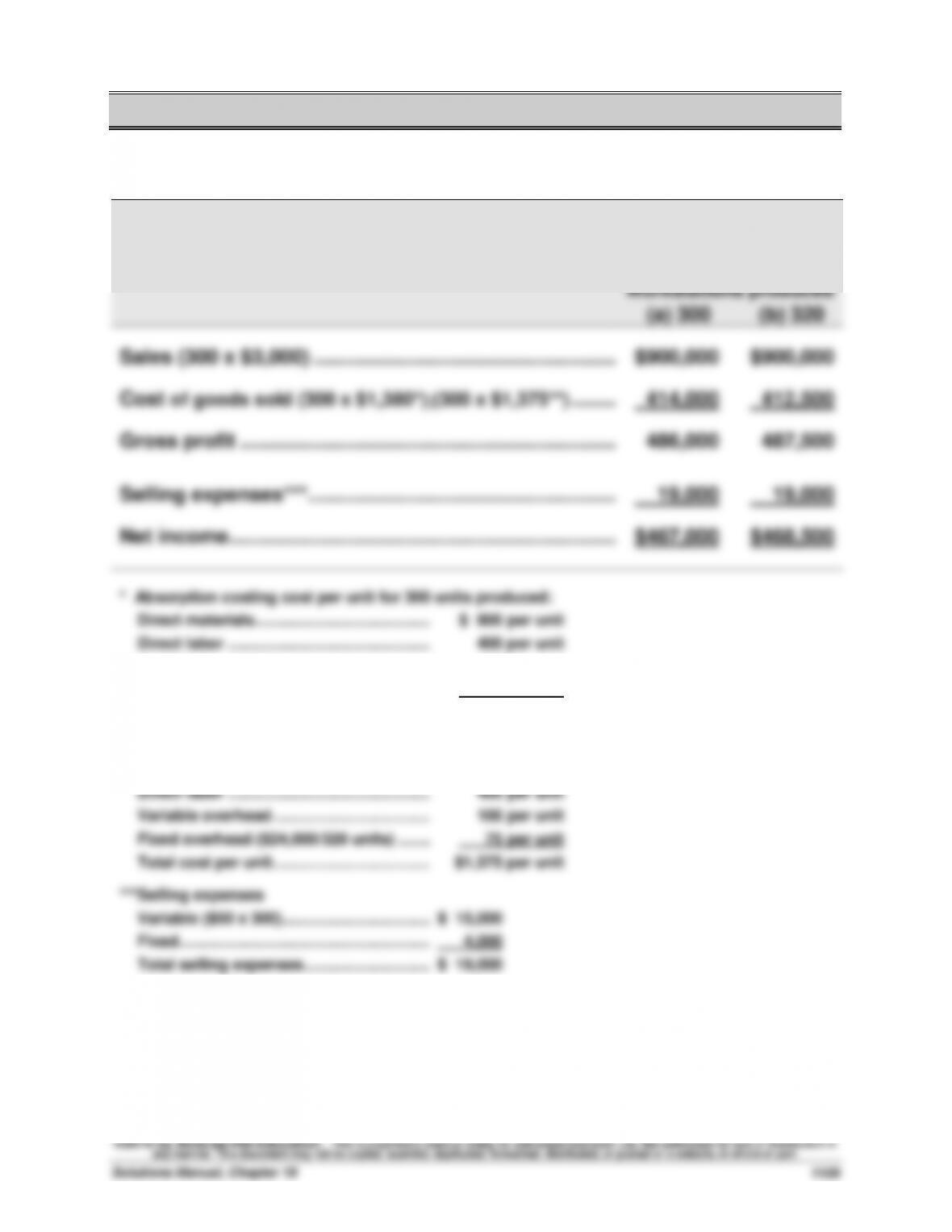
Absorption Costing Income Statements
Forecasted for Year Ended 2016
Workstations produced
(a) 300
(b) 320
Sales (300 x $3,000) ………………………………………………
$900,000
$900,000
Cost of goods sold (300 x $1,380*);(300 x $1,375**) ……..
414,000
412,500
Gross profit ………………………………………………………….
486,000
487,500
Selling expenses***……………………………………………….
19,000
19,000
Net income …………………………..……………………………….
$467,000
$468,500
* Absorption costing cost per unit for 300 units produced:
Direct materials ………………………………….…..
$ 800 per unit
Direct labor ……………………………………….…..
400 per unit
Variable overhead …………………………………..
100 per unit
Fixed overhead ($24,000/300 units) ……..…..
80 per unit
Total cost per unit …………………………………..
$1,380 per unit
** Absorption costing cost per unit for 320 units produced:
Direct materials ………………………………….…..
$ 800 per unit
Direct labor ……………………………………….…..
400 per unit
Variable overhead …………………………………..
100 per unit
Fixed overhead ($24,000/320 units) ……..…..
75 per unit
Total cost per unit …………………………………..
$1,375 per unit
***Selling expenses
Variable ($50 x 300)…………………………….…..
$ 15,000
Fixed ……………………………………………………..
4,000
Total selling expenses ………………………..…
$ 19,000
©2016 by McGraw–Hill Education. This is proprietary material solely for authorized instructor use. Not authorized for sale or distribution in
any manner. This document may not be copied, scanned, duplicated, forwarded, distributed, or posted on a website, in whole or part.
Financial & Managerial Accounting, 6th Edition
1110
Serial Problem SP–19 (Concluded)
Part 2 (a and b)
BUSINESS SOLUTIONS
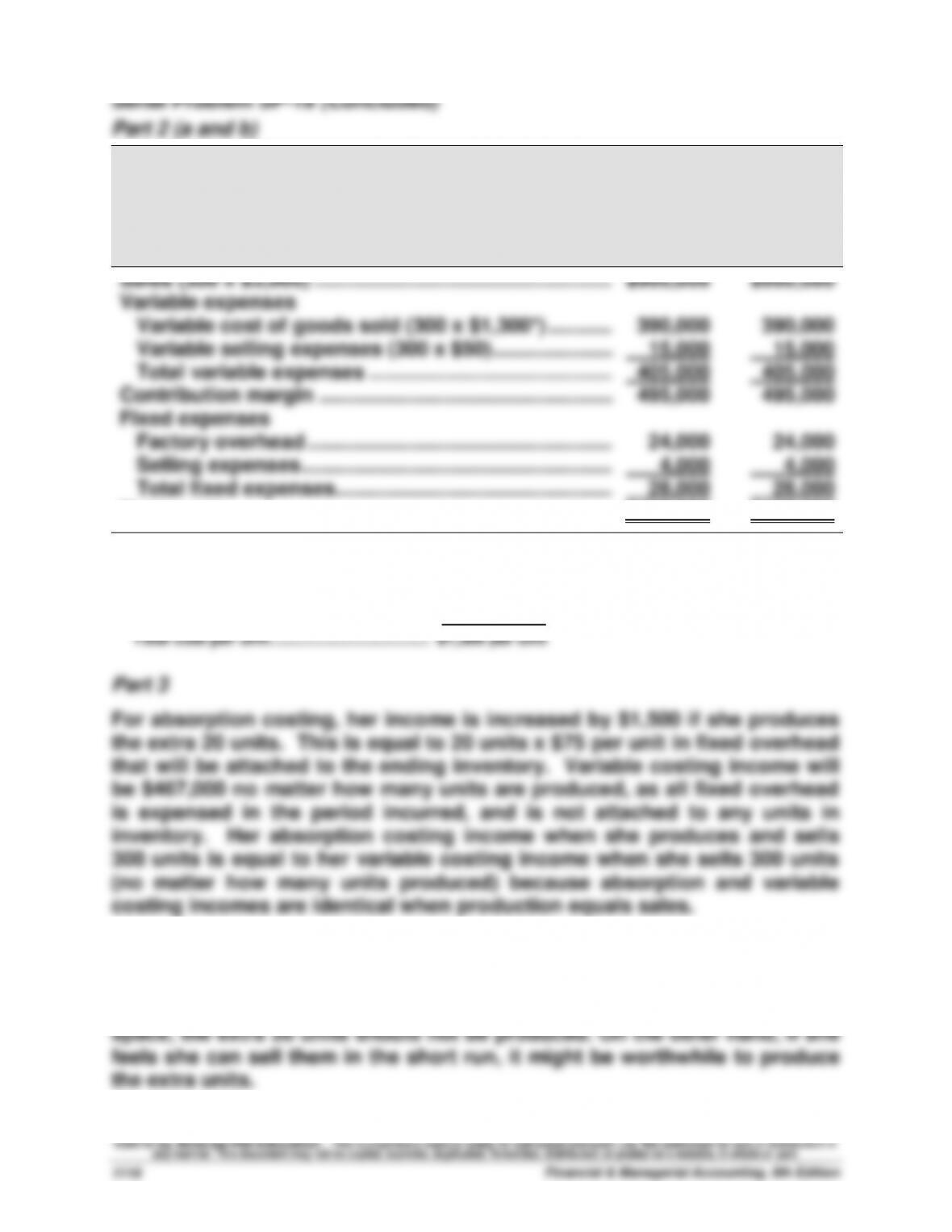
Variable Costing Income Statements
Forecasted for Year Ended 2016
Workstations produced
(a) 300
(b) 320
Sales (300 x $3,000) ……………………………………………….
$900,000
$900,000
Variable expenses
Variable cost of goods sold (300 x $1,300*) ………….
390,000
390,000
Variable selling expenses (300 x $50) …………………..
15,000
15,000
Total variable expenses ……………………………………...
405,000
405,000
Contribution margin ……………………………………………...
495,000
495,000
Fixed expenses
Factory overhead ………………………………………………..
24,000
24,000
Selling expenses ………………………………………………...
4,000
4,000
Total fixed expenses…………………………..……………….
28,000
28,000
Net income …………………………..………………………………..
$467,000
$467,000
*Variable costing cost per unit:
Direct materials …………………………………..…..
$ 800 per unit
Direct labor……………………………………………..
400 per unit
Variable overhead ……………………………….…..
100 per unit
Total cost per unit ……………………………….…..
$1,300 per unit
The information above will only tell her how her absorption costing income
will change if she increases production. Her production decisions should
be made based on how many units she expects to sell, and how many she
wishes to have in ending inventory. If she does not have sufficient storage
1. Apple’s ending inventory increased in each of the years 2013 and 2012.
All else equal, this means more fixed overhead costs remain in ending
2. One goal of just–in-time (JIT) inventory systems is to reduce the level of
inventory. Since the difference in income between variable costing and
1. The costs that Google must consider include variable overhead, such as
miscellaneous supplies, and any new fixed costs that must be incurred
2. In this case, absorption costing is probably more useful because of the
1. FDP Company must use absorption costing to determine its income for
external reporting purposes. Absorption costing “absorbs” both
variable and fixed manufacturing costs into each unit of inventory. FDP
2. Yes, there is an ethical concern. If the company produces excess
inventory it cannot sell, it will spend resources unnecessarily. The
company’s financial position will appear better than it really is, and
stockholders will be deceived as to the company’s performance.
Prudent stockholders or potential stockholders should closely examine
TO: ____________________
FROM: ____________________
DATE: ____________________
SUBJECT: ____________________
Break-even volume is determined by dividing total fixed expenses by the
1. This requires that students print out the required page.
2. Variable costing is also called “direct costing” or “marginal costing.”
3. According to the website:
If beginning and ending inventory levels are equal: absorption
costing profit = variable costing profit;
If inventory levels are run down over the period: variable costing
profit will be higher than absorption costing profit;
1. Happy Family Brands’s income measured under absorption costing
probably would be about the same as its income measured under
variable costing. The difference in income between these two methods
1. Many answers are possible, but variable costs with respect to
2. Fixed costs would include: Salary of hotel manager; wages of front desk
3. It is likely that the fixed costs will far outweigh the variable costs. Most
4. During low occupancy seasons, the hotel would like to have paying
patrons to help cover its fixed costs. As long as the room rate exceeds
the variable costs, those customers are helping to cover the fixed costs.