Comparative Analysis — BTN 12-2
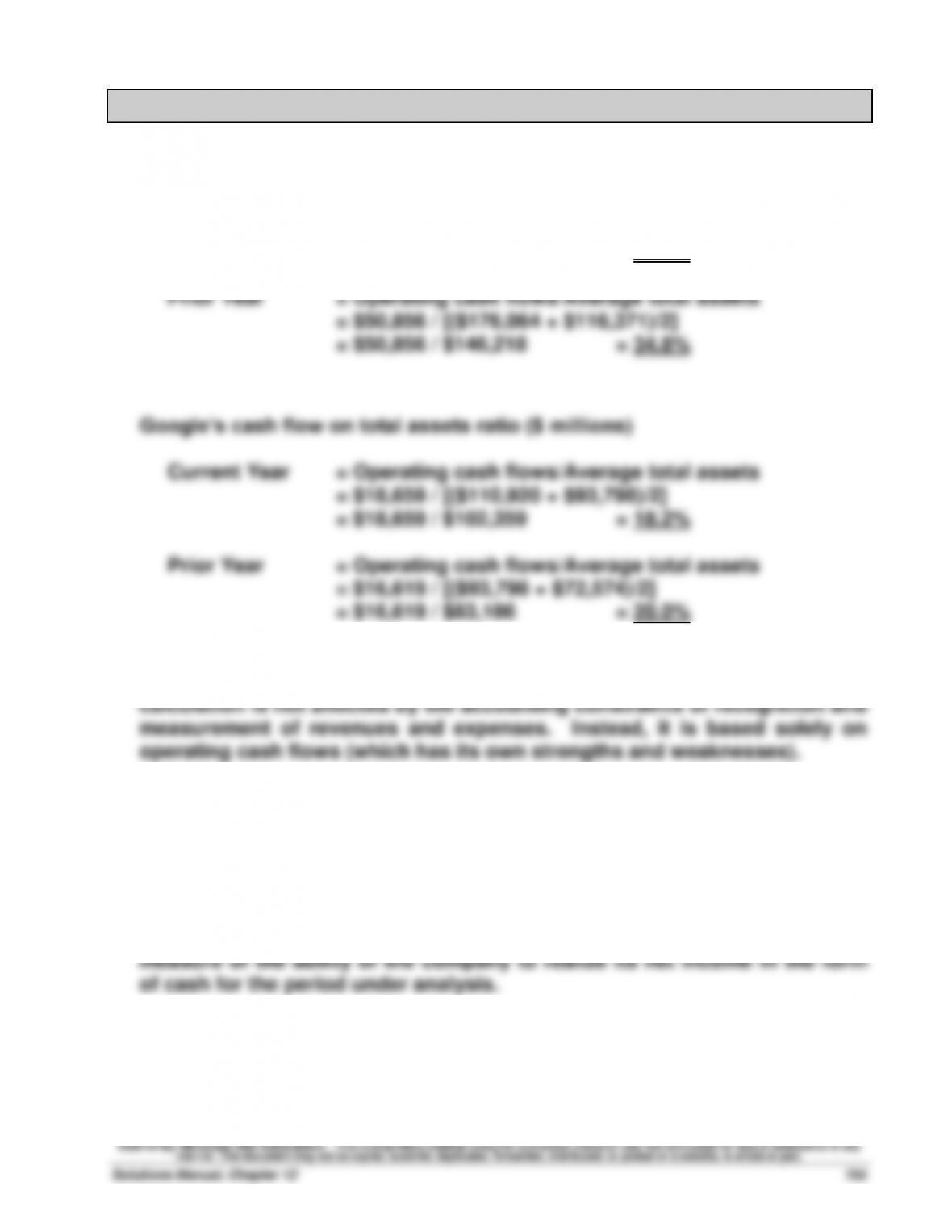
1. Apple’s cash flow on total assets ratio ($ millions)
Current Year = Operating cash flows/Average total assets
= $53,666 / [($207,000 + $176,064)/2]
= $53,666 / $191,532 = 28.0%
2. The cash flow on total assets ratio reflects the return on average assets by
using actual operating cash flows instead of net income. This return
3. For both years, Apple has a higher cash flow on total assets ratio than
Google.
4. Many business decision makers (such as analysts) feel that the cash flow
on total assets ratio is one indicator of earnings quality in that it is a
©2016 by McGraw–Hill Education. This is proprietary material solely for authorized instructor use. Not authorized for sale or distribution in any
manner. This document may not be copied, scanned, duplicated, forwarded, distributed, or posted on a website, in whole or par t.
Financial and Managerial Accounting, 6th Edition
726
Ethics Challenge — BTN 12-3
1. The business actions available include
a. Encourage early collection of receivables to reduce the accounts
receivable balance.
2. As a business owner, Katie Murphy certainly can exercise discretion over
business actions. However, the underlying economic realities should
support any proposed actions. It is not ethical to pursue actions that
purposely mislead users of financial statements.
In addition, Katie Murphy’s actions may be transparent to the banker when
©2016 by McGraw–Hill Education. This is proprietary material solely for authorized instructor use. Not authorized for sale or distribution in any
manner. This document may not be copied, scanned, duplicated, forwarded, distributed, or posted on a website, in whole or part.
Solutions Manual, Chapter 12
727
Communicating in Practice — BTN 12-4
Here is a sample of what the body of the memorandum might include:
TO: Diana Wood
FROM: (Your Name)
SUBJECT: Statement of Cash Flows
DATE: _________________
I am pleased to hear your business is more profitable this year than last.
However, I have been thinking about what you said regarding the statement of
cash flows and have some thoughts as to why you found it confusing.
The statement of cash flows (operating section) can be prepared using either
of two methods—the direct or the indirect method. From what you describe,
your statement is probably prepared using the indirect method. This method
inflows. You should find this format more understandable.
Note that good cash management is essential to business success and
growth. The statement of cash flows will provide you with a lot more
information regarding your cash than a balance sheet can offer. It will allow
you to see exactly where your cash came from, where it went, and how much
Taking It to the Net — BTN 12-5
1. Mendocino Brewing Company uses the indirect method to construct the
2. The largest reconciling item is for increase in accounts receivable totaling
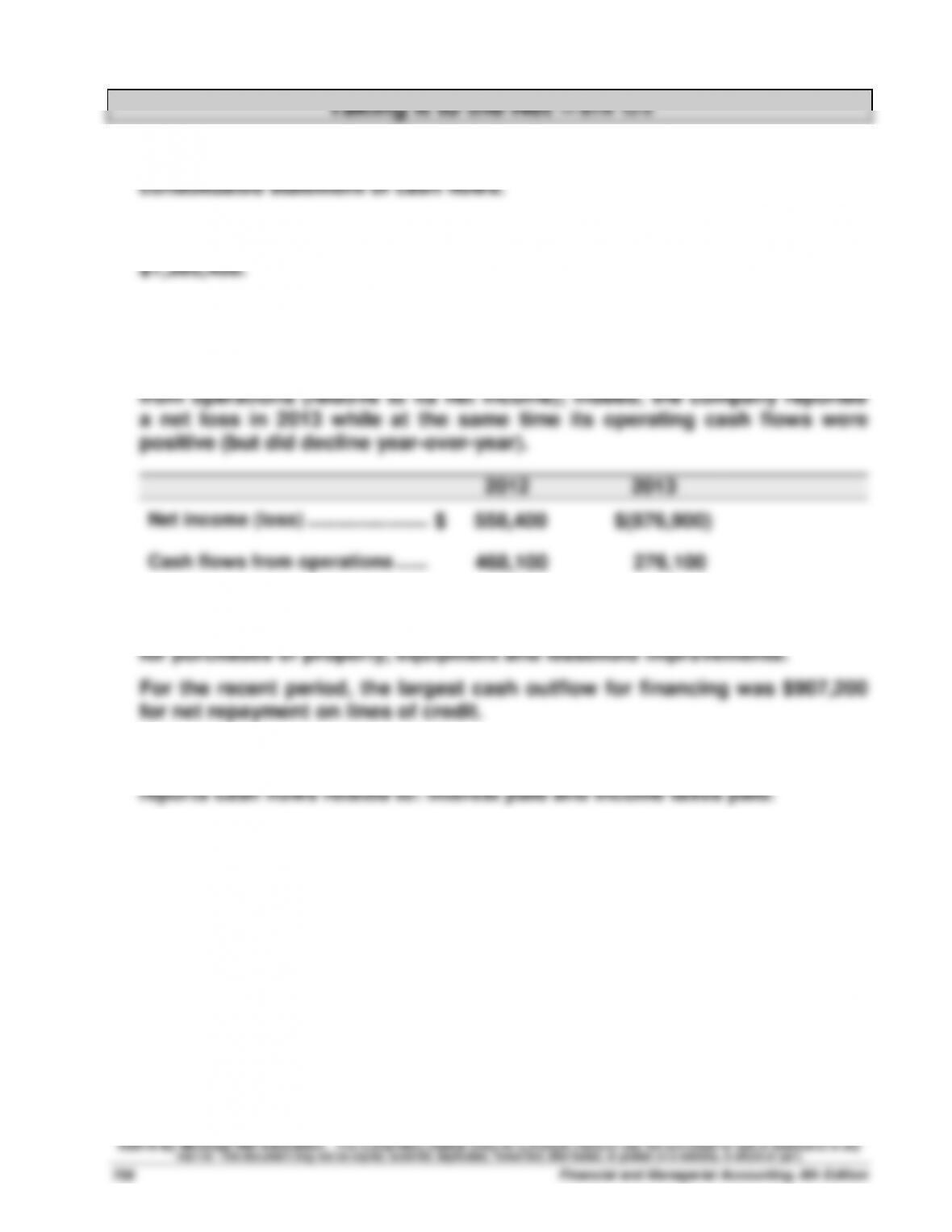
3. The following table shows the net income (or net loss) and the cash flows
from operations for Mendocino Brewing for 2012 and 2013. Over this two–
year period, Mendocino has generated consistently positive cash flows
Teamwork in Action — BTN 12-6
Part 1
a. The reporting objective of the statement of cash flows is to provide
information about important cash inflows and outflows for business
Both methods provide exactly the same information in the financing and
investing categories.
Both identify the change in cash, beginning cash, and ending cash.
Both are acceptable methods for financial reporting.
Differences
*
Teamwork in Action (Continued)
c. Steps to prepare the statement of cash flows:
(i) Compute the net increase or decrease in cash using comparative
balance sheet data. This is the target number or the number the
statement will explain and prove.
(ii) Compute net cash flow in operating activities using the direct or
Ability to generate future cash flows.
Ability to pay dividends.
Ability to meet obligations.
Ability to expand operations.
Ability to obtain financing.
©2016 by McGraw–Hill Education. This is proprietary material solely for authorized instructor use. Not authorized for sale or distribution in any
manner. This document may not be copied, scanned, duplicated, forwarded, distributed, or posted on a website, in whole or part.
Solutions Manual, Chapter 12
731
Teamwork in Action (Concluded)
Part 3
a. Cash receipts from customers = Sales – Increase in Accounts Receivable,
or, + Decrease in Accounts Receivable.
Explanation: Sales reflects what is earned during the period. If Accounts
Receivable increases, that increase represents earnings not yet collected,
so we subtract it. If Accounts Receivable decreases, the entity collected
that much more than the period’s sales, so we add it.
b. Cash paid for inventory requires a two-step computation.
c. Cash paid for wages and operating expenses = Wages and other operating
expenses [+ Increase in prepaid expenses, or, – Decrease in prepaid
expenses] and [+ Decrease in accrued liabilities, or, – Increase in accrued
liabilities].
Explanation: If prepaid expenses increase, the entity paid for more than
©2016 by McGraw–Hill Education. This is proprietary material solely for authorized instructor use. Not authorized for sale or distribution in any
manner. This document may not be copied, scanned, duplicated, forwarded, distributed, or posted on a website, in whole or par t.
Financial and Managerial Accounting, 6th Edition
732
Entrepreneurial Decision — BTN 12–7
1. It is common that small businesses must pay cash in advance for items such
as rent, advertising, supplies, and facilities expansion. Consequently, those
2. As a privately owned company, it can potentially raise cash financing for
expansion by selling shares in the company or by borrowing money. The
company is not a publicly traded company, so the potential to raise capital by
selling stock is somewhat restricted. Moreover, potential lenders will want to
evaluate the future profitability, cash flows, and solvency of the company
First, with respect to the net loss, please note that it includes an $85,000
extraordinary loss. Absent this extraordinary loss, Mountain High would report a
$75,000 net income. Using year-end total assets, Mountain High’s return on
assets would be roughly 9.4% (computed as $75,000 divided by $800,000). This
return is reasonable for a company in its second year of operations.
©2016 by McGraw–Hill Education. This is proprietary material solely for authorized instructor use. Not authorized for sale or distribution in any
manner. This document may not be copied, scanned, duplicated, forwarded, distributed, or posted on a website, in whole or part.
Solutions Manual, Chapter 12
733
Hitting the Road — BTN 12-9
1. The Motley Fool’s Website defines cash flow as earnings before interest,
taxes, depreciation, and amortization (EBITDA). The school’s justification
for this definition includes: “Interest income and expense, as well as taxes, are
all tossed aside because cash flow is designed to focus on the operating business
2. Some analysts tend to focus on this particular earnings definition
(earnings before interest and taxes or EBIT) as it purportedly allows a
3. Answer depends on the links visited and chosen for the report.
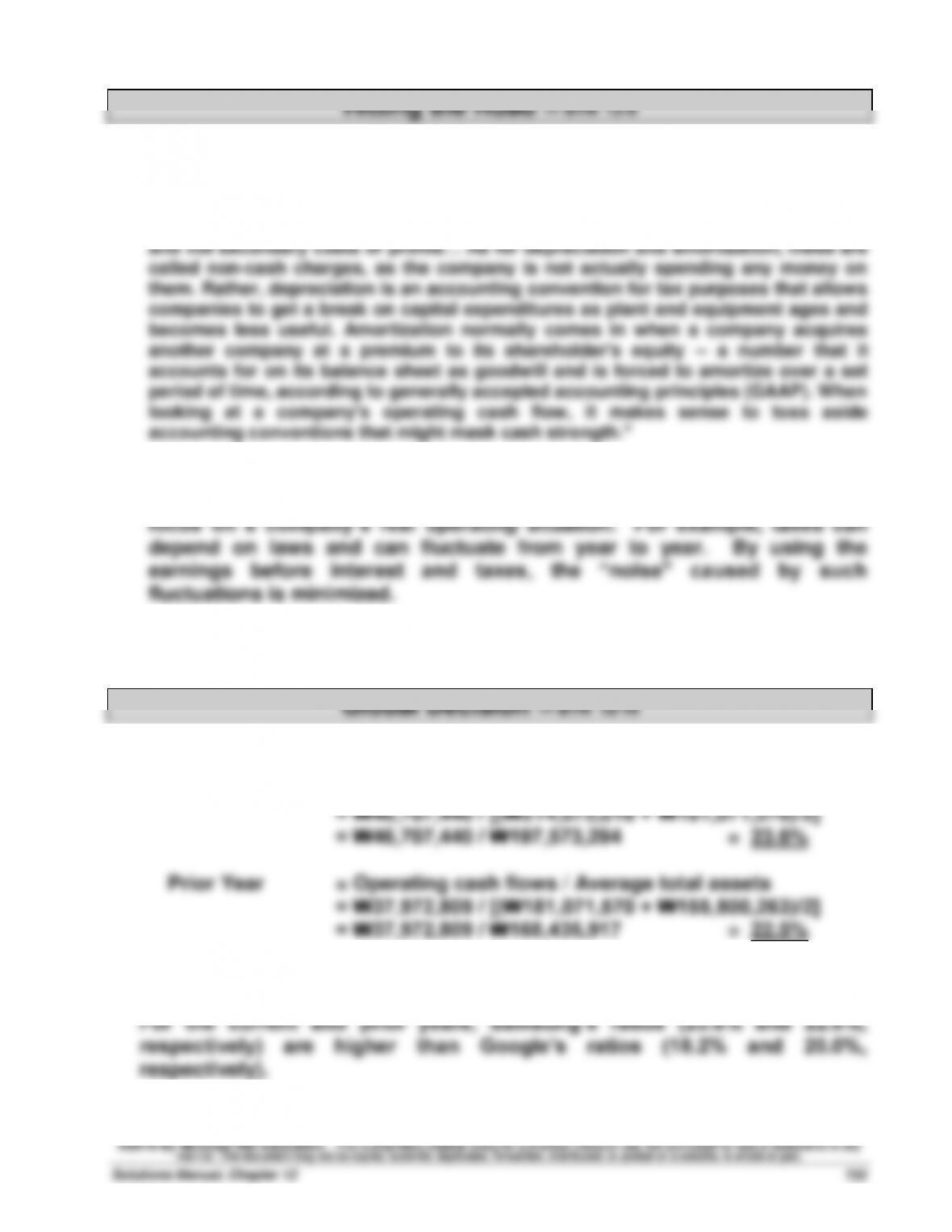
1. Samsung’s cash flow on total assets ratio follows (in KRW millions):
Current Year = Operating cash flows / Average total assets
2. For the current and prior years, Samsung’s ratios (23.6% and 22.5%,
respectively) are lower than Apple’s ratios (28.0% and 34.8%, respectively).