9-44
One possible reason for this apparent discrepancy is the equal
P9-14. Determining LIFO amounts—comprehensive (LO 6, 7, 8)
Requirement 1:
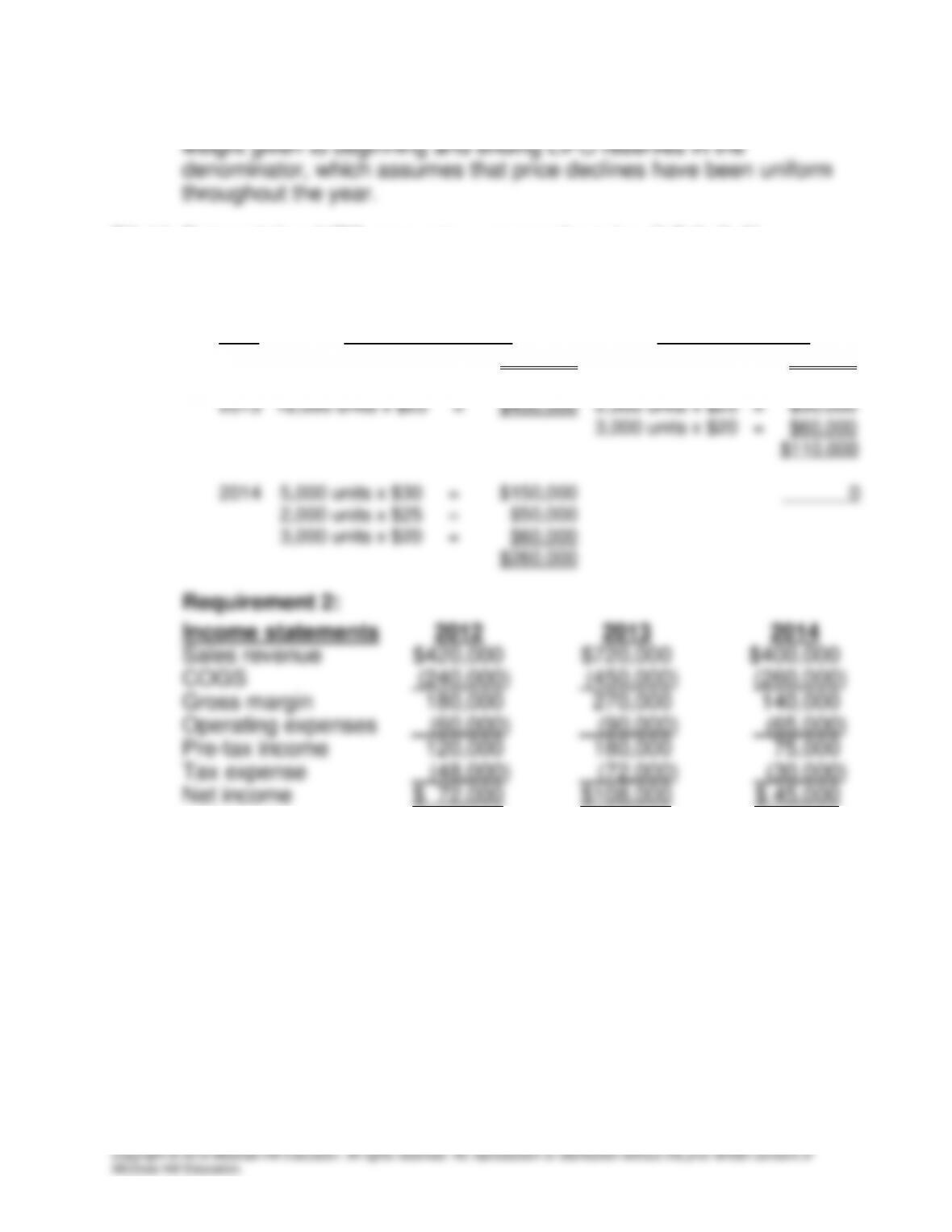
Year
Cost of goods sold
Ending inventory
2012
12,000 units x $20 =
$240,000
3,000 units x $20 =
$60,000
2013
18,000 units x $25 =
$450,000
2,000 units x $25 =
$50,000
3,000 units x $20 =
$60,000
$110,000
2014
5,000 units x $30 =
$150,000
0
2,000 units x $25 =
$50,000
3,000 units x $20 =
$60,000
$260,000
Requirement 2:
Income statements 2012 2013 2014
Sales revenue $420,000 $720,000 $400,000
COGS (240,000) (450,000) (260,000)
Gross margin 180,000 270,000 140,000
Operating expenses (60,000) (90,000) (65,000)
Pre-tax income 120,000 180,000 75,000
Tax expense (48,000) (72,000) (30,000)
Net income $ 72,000 $108,000 $ 45,000
Requirement 3:
2012 Since the price changes only at the beginning of the year, there
is no LIFO reserve at the end of 2012.
2013 2012 of 3,000 units @ ($25 – $20) = $15,000
2014 Since there is no ending inventory, there is no LIFO reserve.
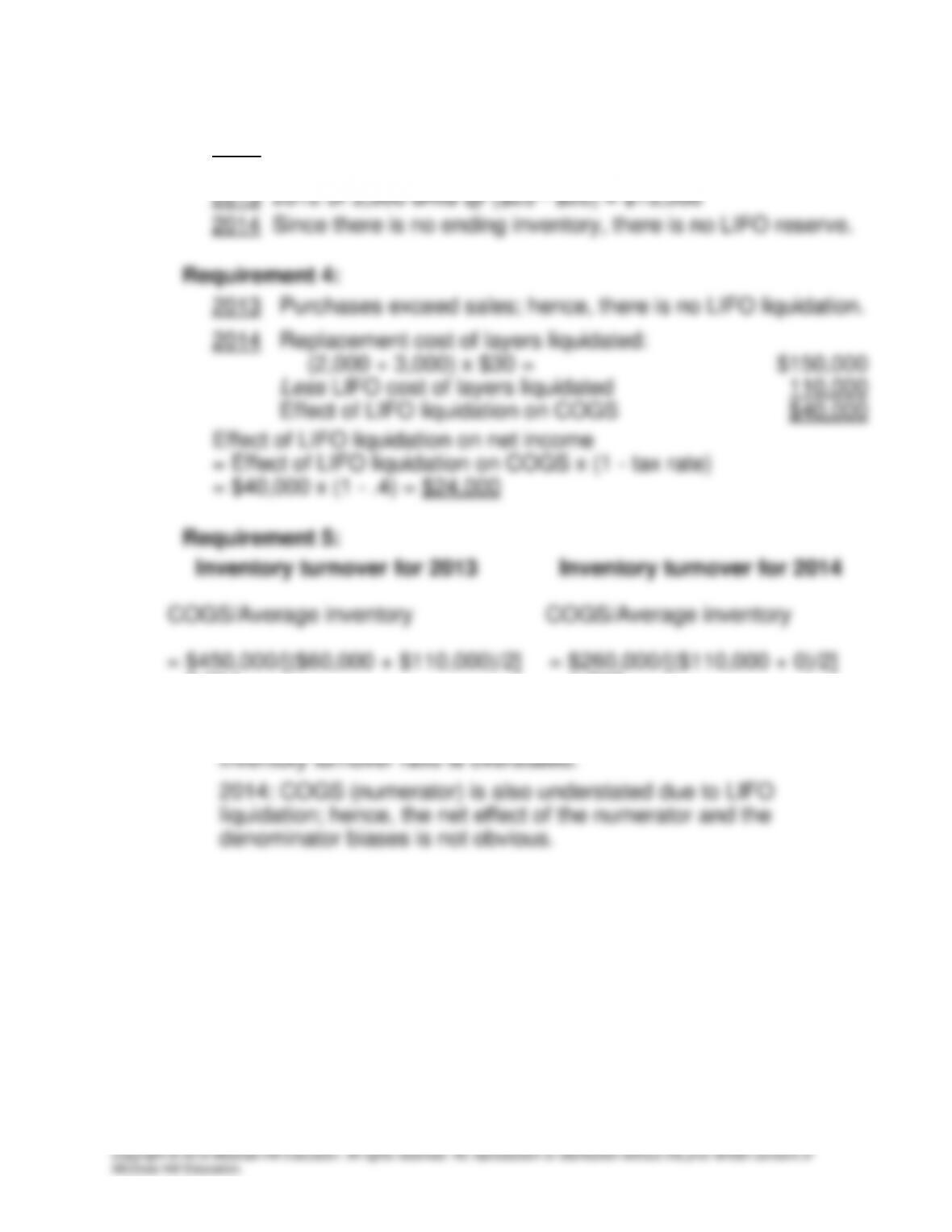
Requirement 4:
2013 Purchases exceed sales; hence, there is no LIFO liquidation.
2014 Replacement cost of layers liquidated:
(2,000 + 3,000) x $30 = $150,000
Less LIFO cost of layers liquidated 110,000
Effect of LIFO liquidation on COGS $40,000
Effect of LIFO liquidation on net income
= Effect of LIFO liquidation on COGS x (1 – tax rate)
= $40,000 x (1 – .4) = $24,000
Requirement 5:
Inventory turnover for 2013
COGS/Average inventory
= $450,000/[($60,000 + $110,000)/2]
= 5.294
Inventory turnover for 2014
COGS/Average inventory
= $260,000/[($110,000 + 0)/2]
= 4.727
2013: ending inventory (the denominator) is understated; hence, the
inventory turnover ratio is overstated.
2014: COGS (numerator) is also understated due to LIFO
liquidation; hence, the net effect of the numerator and the
denominator biases is not obvious.
Requirement 6:
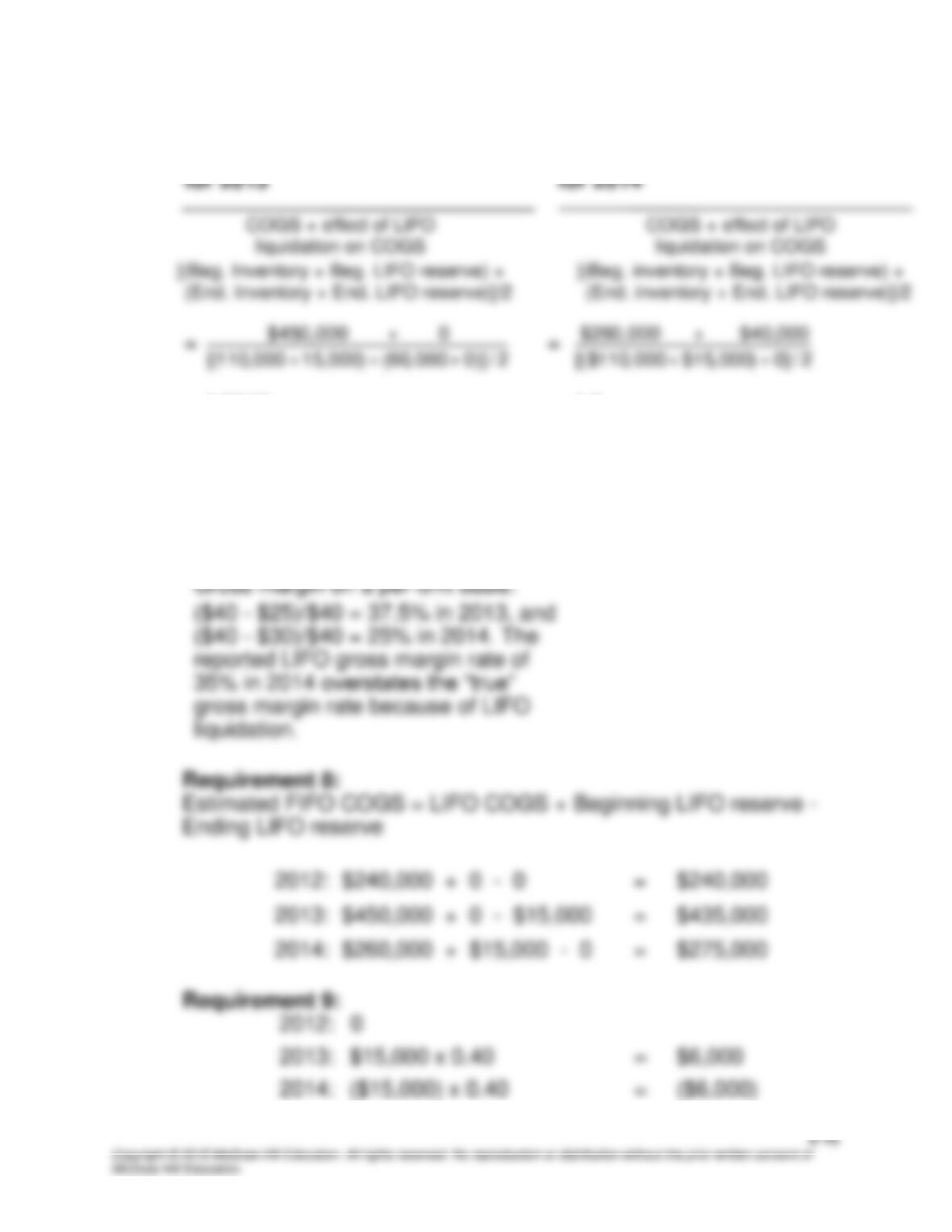
Adjusted inventory turnover
for 2013
COGS + effect of LIFO
liquidation on COGS
[(Beg. Inventory + Beg. LIFO reserve) +
(End. Inventory + End. LIFO reserve)]/2
=
$450,000 + 0
[(110,000 +15,000)+(60,000+0)] / 2
= 4.8649
Adjusted inventory turnover
for 2014
COGS + effect of LIFO
liquidation on COGS
[(Beg. inventory + Beg. LIFO reserve) +
(End. inventory + End. LIFO reserve)]/2
=
$260,000 + $40,000
[($110,000+$15,000)+0]/ 2
= 4.8
Requirement 7:
Gross margin rate for 2013
($270,000/$720,000) = 37.5%
Gross margin rate for 2014
($140,000/$400,000) = 35%
Gross margin on a per-unit basis:
($40 – $25)/$40 = 37.5% in 2013, and
($40 – $30)/$40 = 25% in 2014. The
reported LIFO gross margin rate of
35% in 2014 overstates the “true”
gross margin rate because of LIFO
liquidation.
Requirement 8:
Estimated FIFO COGS = LIFO COGS + Beginning LIFO reserve –
Ending LIFO reserve
2012: $240,000 + 0 – 0
= $240,000
2013: $450,000 + 0 – $15,000
= $435,000
2014: $260,000 + $15,000 – 0
= $275,000
9-47
Copyright © 2015 McGraw-Hill Education. All rights reserved. No reproduction or distribution without the prior written consent of
McGraw-Hill Education.
Requirement 10:
= (6,000 x 0.82645) + (-6,000 x 0.75131) = $450.84
P9-15. Identifying FIFO holding gains (LO 6, 12)
When inventory levels are constant (or nearly so), a good estimate
of realized holding gains included in FIFO Income is:
Beginning inventory x % change in input costs for the year.
9-48
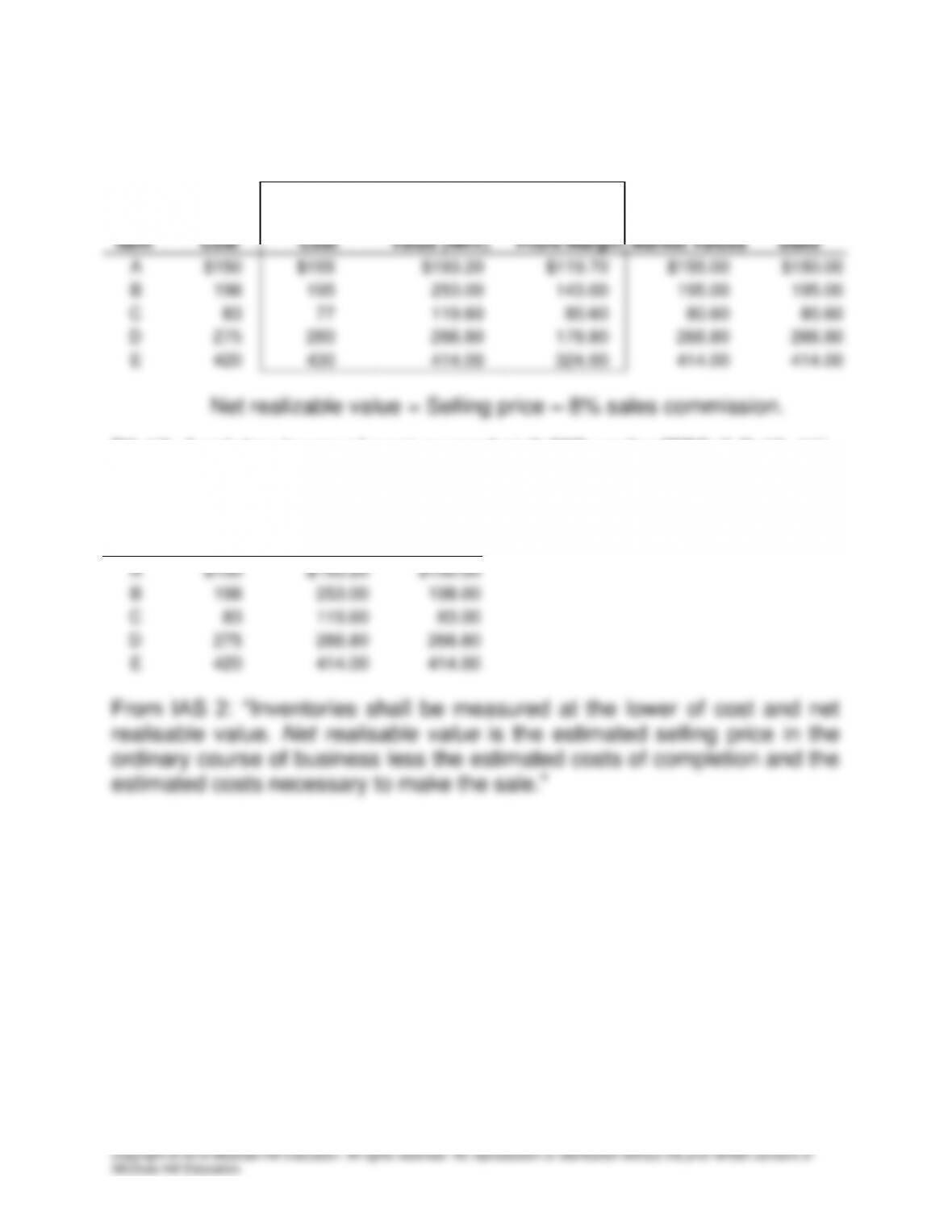
P9–16. Applying lower of cost or market (LCM) (LO 10)
Market
Item
Original
Cost
Replacement
Cost
Net Realizable
Value (NRV)
NRV Less
Normal
Profit Margin
Middle
of the Three
Market Values
Inventory
Value
Used
A
$150
$155
$193.20
$119.70
$155.00
$150.00
B
198
195
253.00
143.00
195.00
195.00
C
83
77
119.60
80.60
80.60
80.60
D
275
280
266.80
179.80
266.80
266.80
E
420
430
414.00
324.00
414.00
414.00
Net realizable value = Selling price – 8% sales commission.
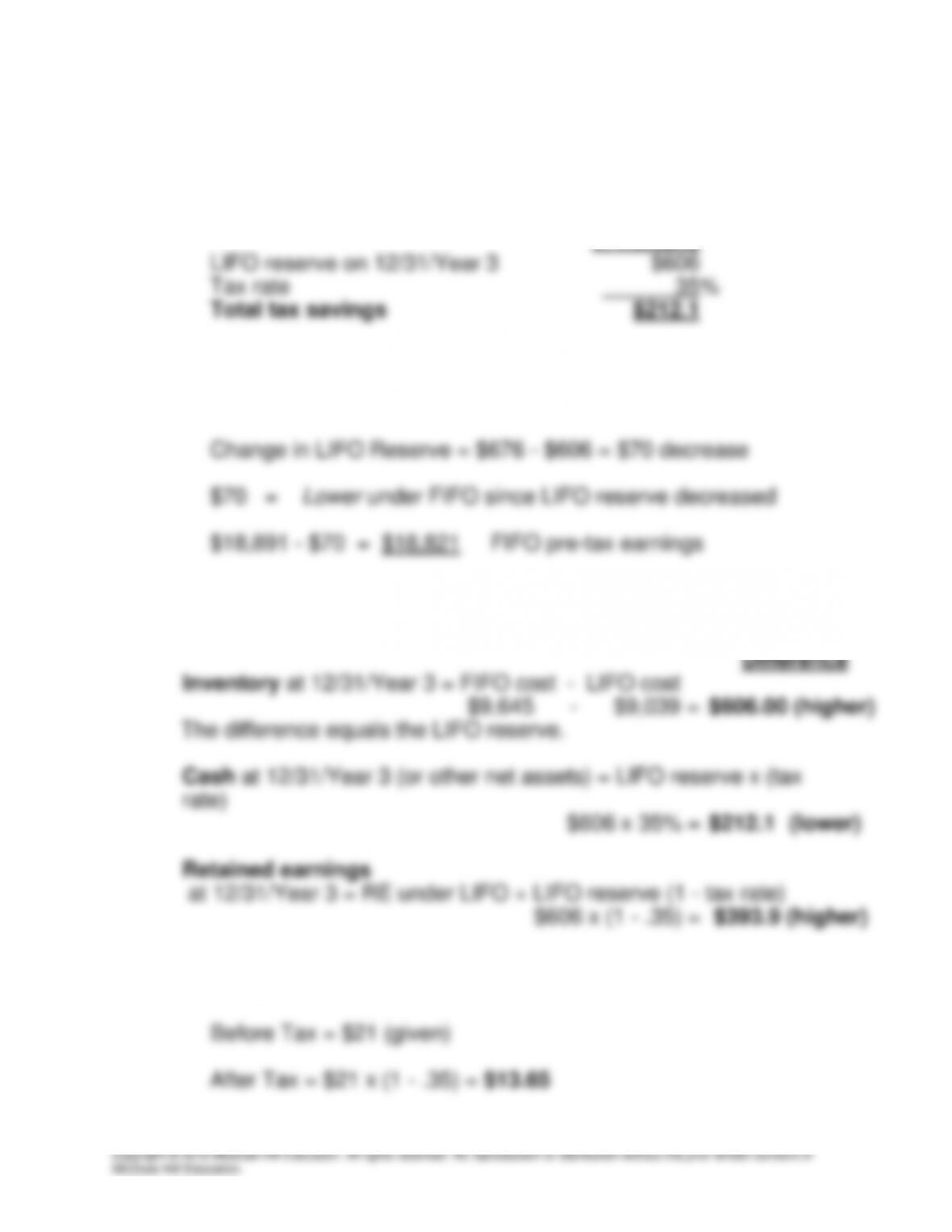
P9–17. Applying lower of cost or market (LCM) under IFRS (LO 10, 11)
Item
Original
Cost
Net Realizable
Value (NRV)
Inventory
Value
Used
A
$150
$193.20
$150.00
B
198
253.00
198.00
C
83
119.60
83.00
D
275
266.80
266.80
E
420
414.00
414.00
From IAS 2: “Inventories shall be measured at the lower of cost and net
realisable value. Net realisable value is the estimated selling price in the
ordinary course of business less the estimated costs of completion and the
estimated costs necessary to make the sale.”

9-49
Financial Reporting and Analysis (5th Ed.)
Chapter 9 Solutions
Inventories
Cases
Cases
C9–1. Daimler AG: Identifying differences and similarities between
IFRS and GAAP (LO 11)
Similarities
1. As a manufacturer, Daimler reports separate values for raw
materials, work-in-process, and finished goods.
Differences
1. Market is defined as net realizable value, instead of the middle
9-50
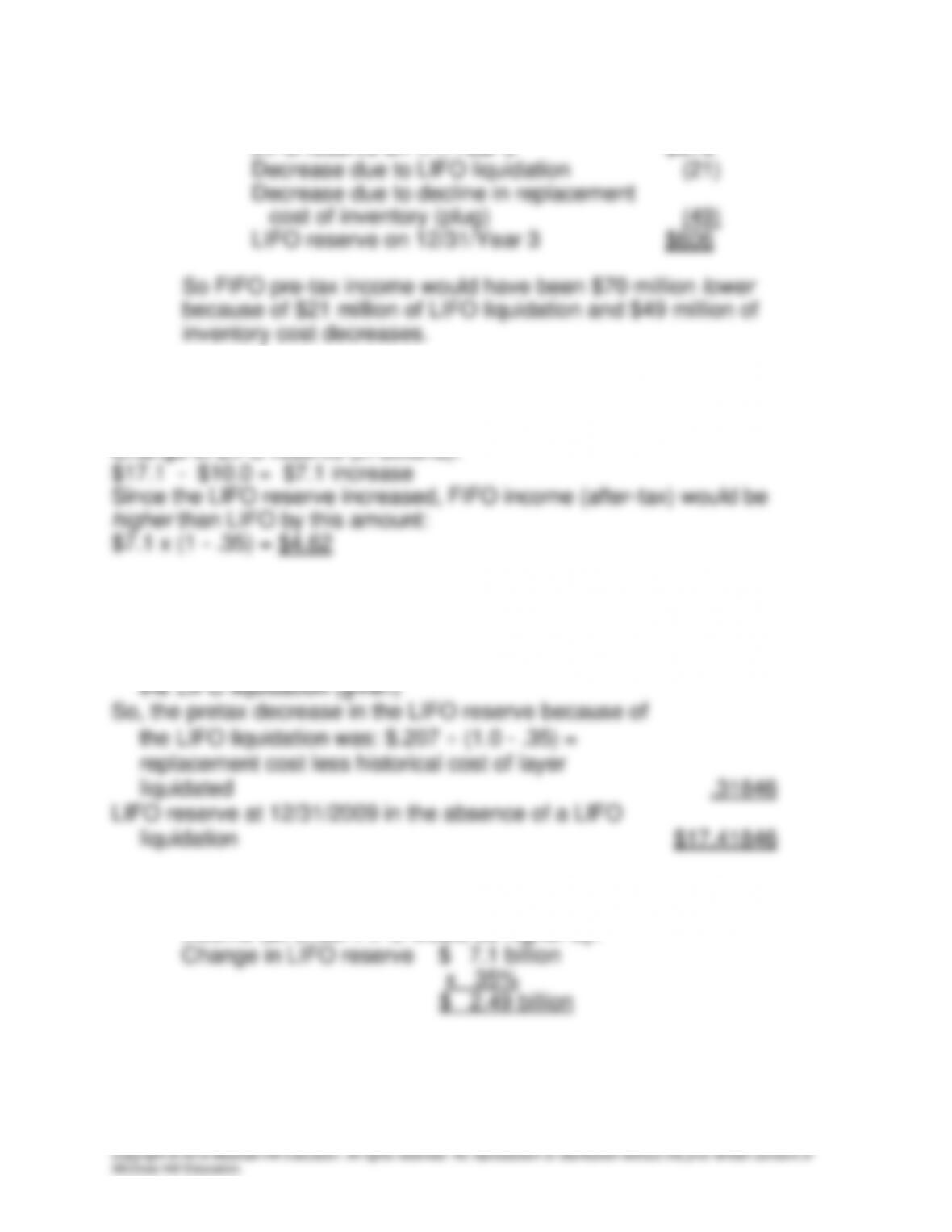
C9–2. General Electric: Interpreting a LIFO note (revise to match change)
Requirement 1:
What are the total tax savings as of 12/31/Year 3 that GE has
realized as a result of using the LIFO inventory method?
In millions
Requirement 2:
What would GE’s pre-tax earnings have been in Year 3 if they had
been using FIFO?
Requirement 3:
What 12/31/Year 3 balance sheet figures would be different and by
how much if GE had used FIFO?
Requirement 4:
LIFO liquidation profits in Year 3.
9-51
Requirement 5:
LIFO reserve on 1/1/Year 3 $676
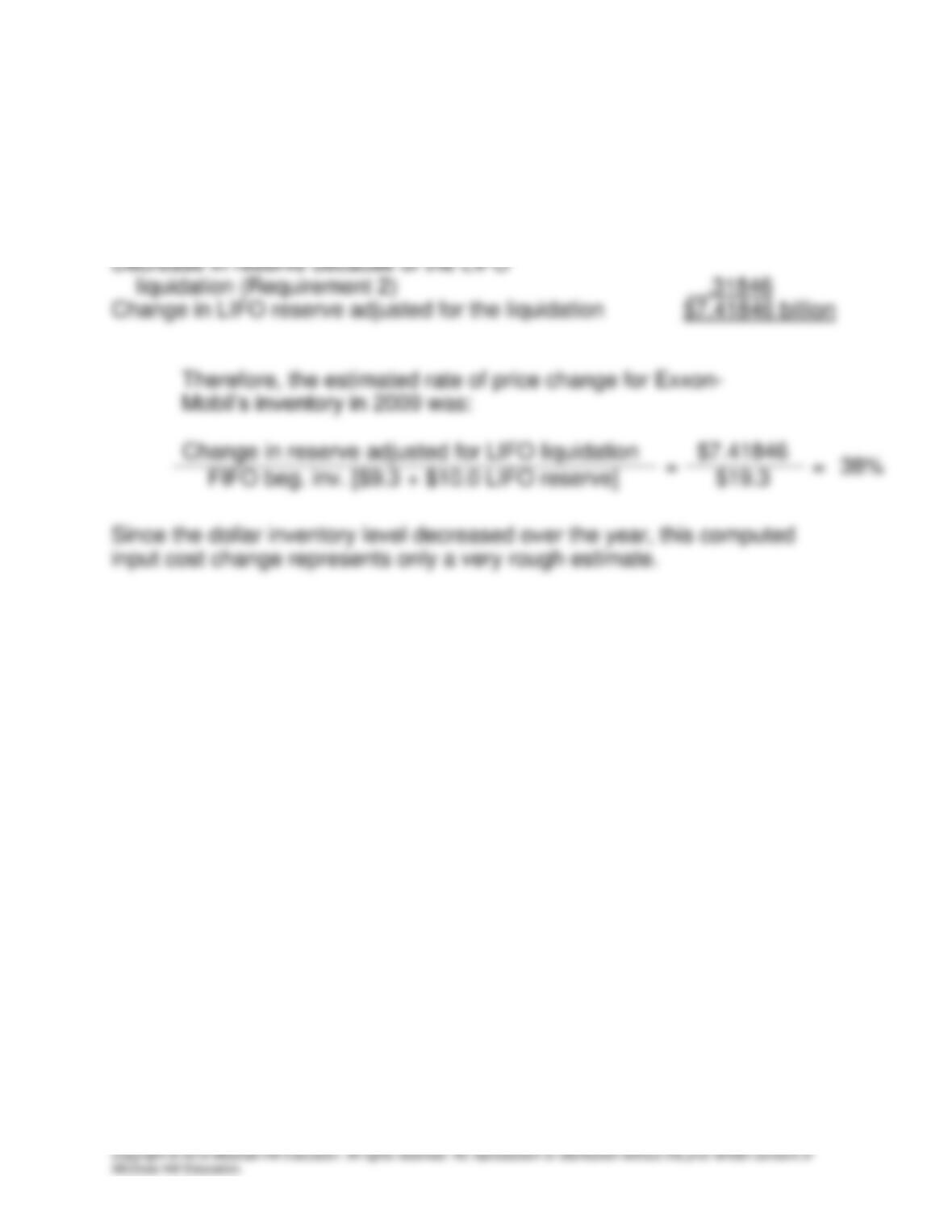
C9–3. ExxonMobil: Interpreting a LIFO footnote (LO 6, 8)
Requirement 1:
Change in LIFO reserve (in billions):
Requirement 2:
LIFO reserve (in billions) as reported at
12/31/2009
$17.1
2009 net income increased by $.207 billion because of
the LIFO liquidation (given)
So, the pretax decrease in the LIFO reserve because of
the LIFO liquidation was: $.207 (1.0 – .35) =
replacement cost less historical cost of layer
liquidated
.31846
LIFO reserve at 12/31/2009 in the absence of a LIFO
liquidation
$17.41846
Requirement 3:
Income tax under FIFO would be higher by:
9-52
Requirement 4:
To answer this part, we must determine the change in the LIFO reserve
after adding back the reserve decrease because of the LIFO liquidation:
Change in the LIFO reserve (Requirement 1) $7.1 billion
Plus:
9-53
C9–4. Baines Corporation: Using absorption vs. variable costing (LO
4)
Requirement 1:
The mood of the management team undoubtedly changed because
of the considerable decline in 2014 pre-tax profit and, thus, in 2014
Requirement 2:
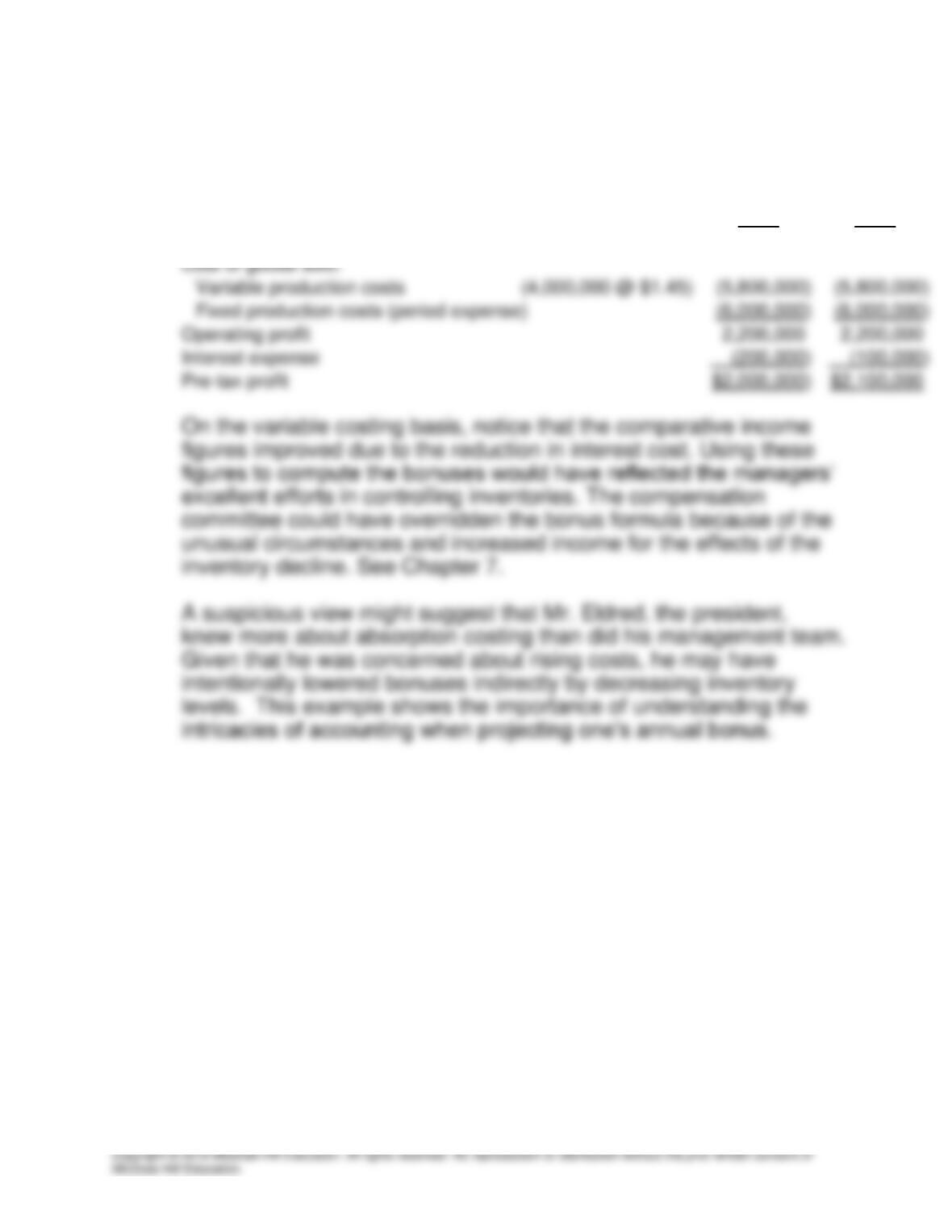
The problem could have been prevented had Mr. Eldred anticipated
the artificial decrease in profit that was sure to take place as
inventory levels were decreased. Then, this decrease could have
9-54
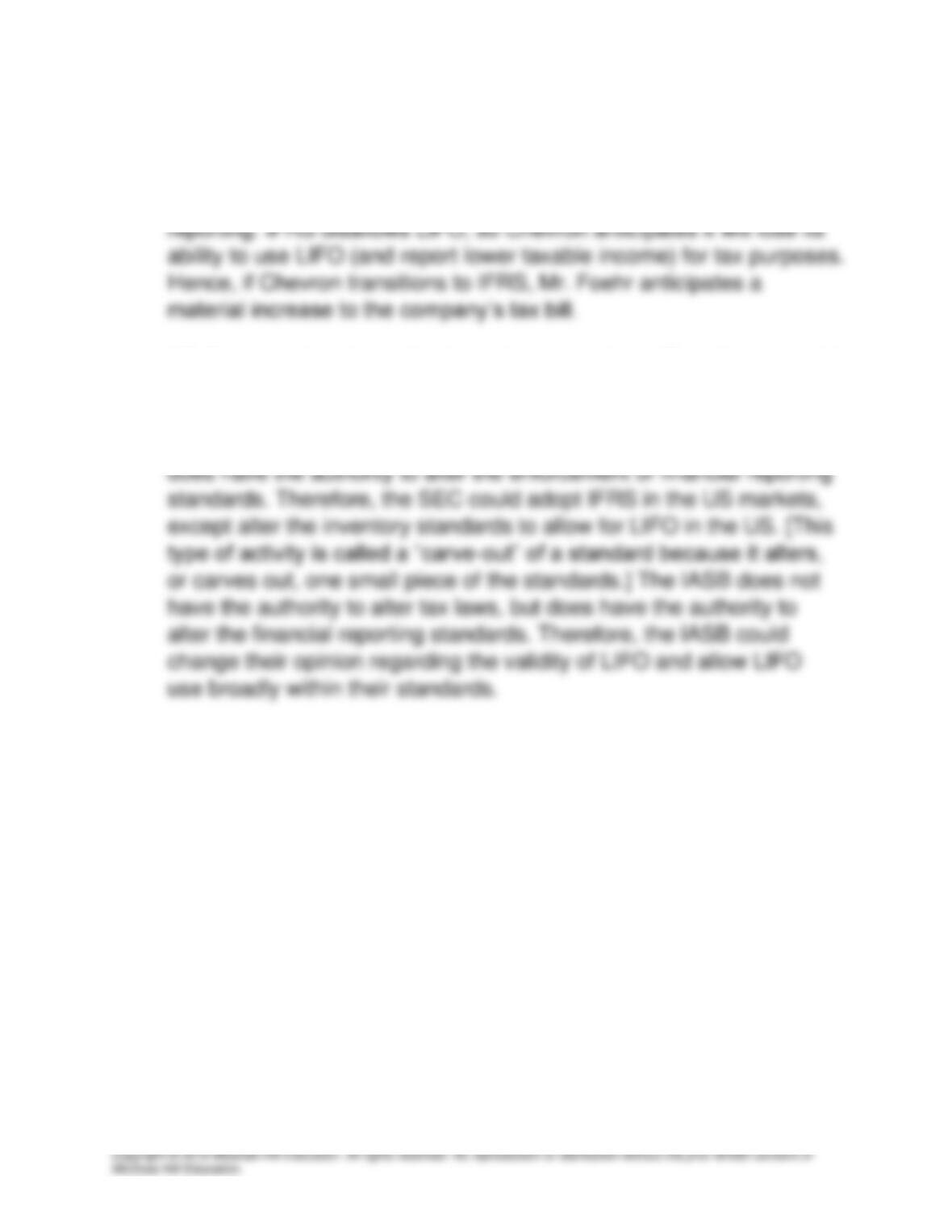
Had Baines Corporation been using variable costing as the
computation base, the comparative income figures for 2013 and
2014 would have been:
2013 2014
Sales revenues (4,000,000 @ $3.50) $14,000,000 $14,000,000
9-55
C9-5. Consequence of IFRS adoption (LO 5, 8, 11)
1. Currently, the LIFO Conformity rule does not allow firms to elect LIFO
for tax reporting unless they use LIFO for financial statement
2. US Congress has the authority to change tax laws. Therefore, it could
remove the LIFO Conformity rule and thereby allow firms to report
other-than-LIFO for financial statements and retain LIFO for tax
purposes. The SEC does not have the authority to alter tax laws, but