There are substantial differences in the economics of the transactions. Crown
Craft transfers the receivable without recourse as to credit losses, i.e., in
effect, the factor becomes the “true” owner of the receivables by bearing the
credit risk. Whereas, Ricoh is still responsible for all the credit risk since the
P8–16. Determining whether existing receivables represent real sales
Requirement 1:
The shipment of the 19 motors to Macco Corporation do not represent sales,
but a transfer of inventory from one point (Moto-Lite’s factory) to another point
(Macco’s production facility). Since title to the engines transfers to Macco
Requirement 2:
As stated above, the aircraft engines at Macco’s facility represent Moto-Lite
(consigned) inventory until they are placed into Macco’s production process.
The nine engines used by Macco would be included in Moto-Lites sales for
the quarter ending October 31. Accordingly, for the quarter ending October
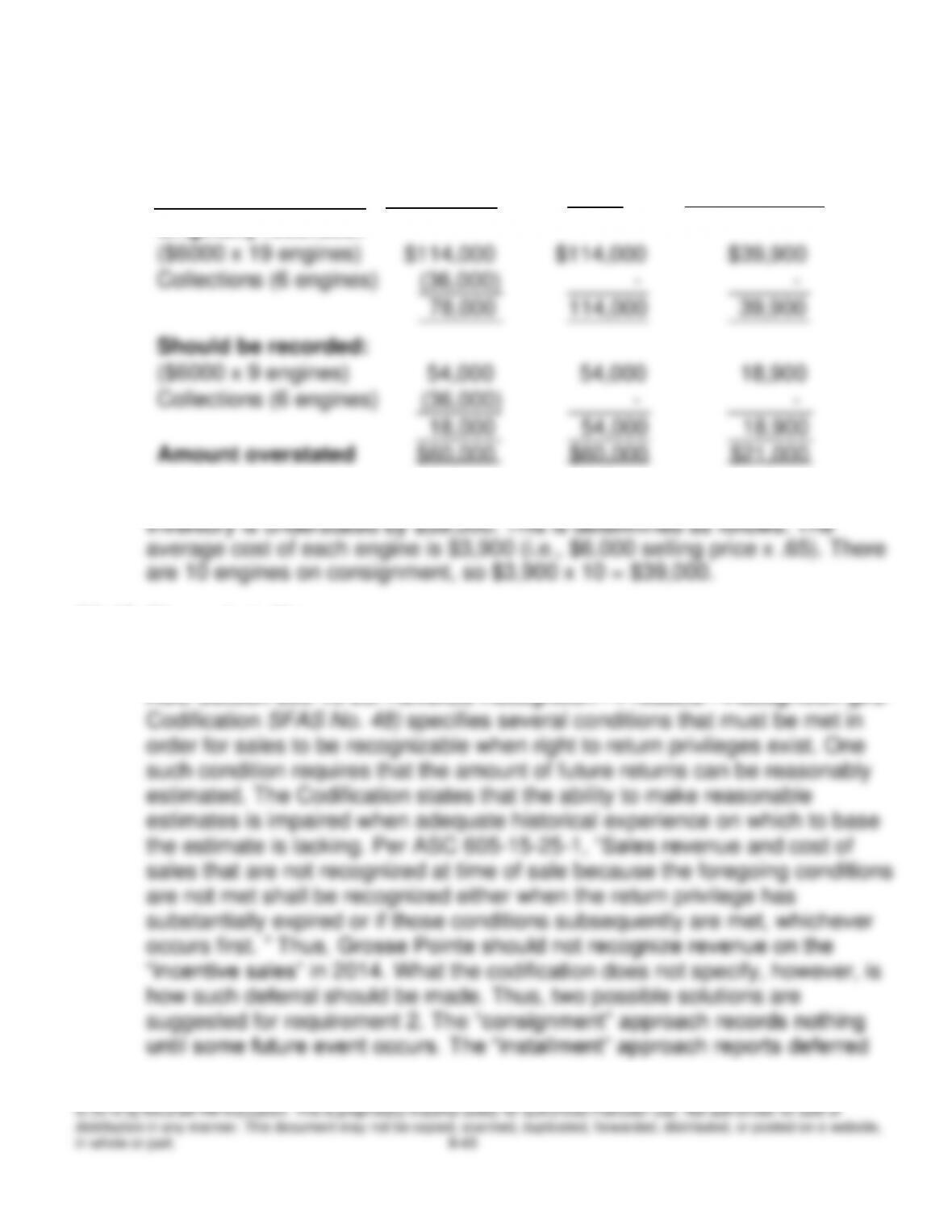
Moto-Lite Company
Summary of Overstatements
Accounts
Gross Profit
Description
Receivable
Sales
(35% of sales)
Originally recorded:
($6000 x 19 engines)
$114,000
$114,000
$39,900
Collections (6 engines)
(36,000)
–
–
78,000
114,000
39,900
Should be recorded:
($6000 x 9 engines)
54,000
54,000
18,900
Collections (6 engines)
(36,000)
–
–
18,000
54,000
18,900
Amount overstated
$60,000
$60,000
$21,000
P8–17. Channel stuffing
Note to the instructor: This problem illustrates that there may be accounting
alternatives in cases where GAAP is silent or vague on some matter. FASB
ASC Section 605-15-25: Revenue Recognition—Products—Recognition (pre-
gross profit as a liability that is offset by a net increase in current assets
(increase in accounts receivable minus decrease in inventory).
Requirement 1:
Although legal title has passed, the generous rights of return indicate that the
risks of ownership have not. While some of this revenue will probably be
realized, management has no real basis to estimate how much, especially
given the “sales pitch” being used and the year-end surge in sales. Thus,
them.
Requirement 2:
Deferred revenue recognition on the incentive sales made in late December
can be accomplished using alternative accounting approaches—although the
To recognize gross profit in 2015 upon cash receipt or expiration of return
period:
Financial Reporting and Analysis (6th Ed.)
Chapter 8 Solutions
Receivables
Cases
Cases
C8–1. Garrels Company: Analyzing allowances—Comprehensive
Requirement 1:
Allowance for Doubtful Accounts
(2012)
Allowance for doubtful
accounts (2013)
$1,324
Beginning
balance
“B” Beginning
balance
$1,349
Current year
bad debt
provision
502 Current
year
bad debt
provision
Write-offs “A”
Write-offs 622
$1,302 Ending
balance
“C” Ending balance
Allowance for Doubtful Accounts
(2014)
“D” Beginning
balance
“E” Current year
bad debt
provision
Write-Offs 1
$1,453 Ending
balance
2012:
End. balance = beg. Balance + current year bad debt provision – write-offs

A = $1,371
2013:
B = Beginning balance in 2013 = ending balance in 2012 = $1,302
End. Balance 2013 = Beg. balance + current year bad debt provision – write-offs
2014:
D = Beginning balance in 2014 = ending balance in 2013 = $1,182
End. balance 2014 = Beg. balance + current year bad debt provision – write-offs
Requirements 2 & 3:
Allowance method
Direct write-off
2012
DR Allowance for doubtful
accounts
$1,371
DR Bad debt prov.
$1,371
CR Accounts receivable
$1,371
CR Accounts receivable
$1,371
DR Bad debt prov.
$1,349
NO ENTRY
CR Allowance for doubtful
accounts
$1,349
2013
DR Allowance for doubtful
accounts
$ 622
DR Bad debt prov.
$ 622
CR Accounts receivable
$ 622
CR Accounts receivable
$ 622
DR Bad debt prov.
$ 502
NO ENTRY
CR Allowance for doubtful
accounts
$ 502
2014
DR Allowance for doubtful
accounts
$ 1
DR Bad debt prov.
$ 1
CR Accounts receivable
$ 1
CR Accounts receivable
$ 1
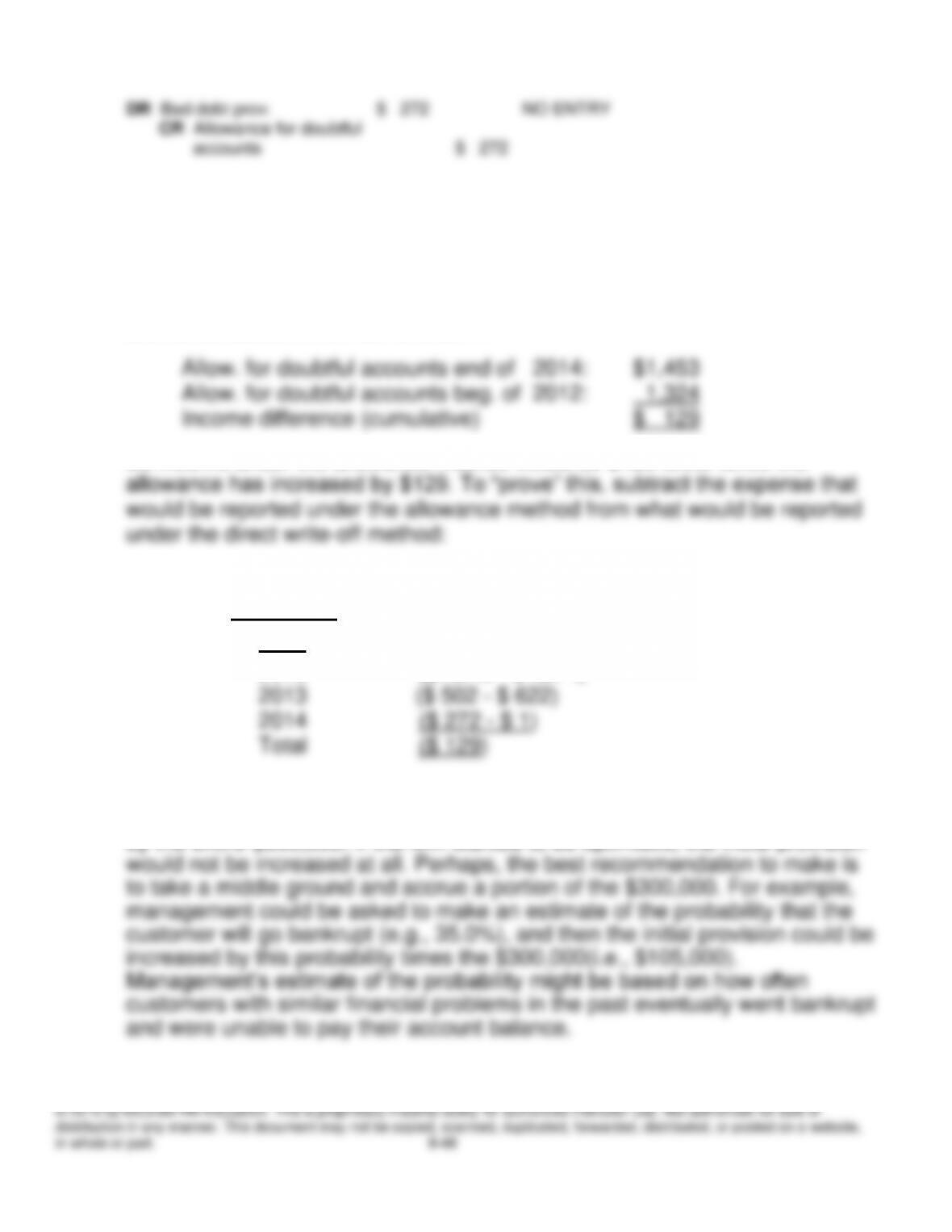
DR Bad debt prov.
$ 272
NO ENTRY
CR Allowance for doubtful
accounts
$ 272
Requirement 4:
The allowance method is consistent with the matching principle underlying
the accrual accounting model, whereas the direct write-off method is not.
Requirement 5:
The cumulative income difference is equal to the change in the balance of the
allowance account from 2012 to 2014.
So income under the allowance method would be $129 lower since the
Income
Difference
Year
2012 ($1,349 – $1,371)
Requirement 6:
If the firm wanted to be conservative, the initial provision could be increased
by the entire $300,000. If the firm wanted to be optimistic, the initial provision
Requirement 7:
a) Here, the CFO might want to take the entire $300,000 thousand as an
additional provision because earnings before income taxes of $11 million is
b) Here, the CFO might not want to take any additional bad debt provision
c) Here, the CFO might want to take the entire $300,000 as an additional
bad debt provision because earnings before income taxes of $38.25 million
d) Here, management might want to take an additional provision of $150,000
The moral of the story is that management’s financial reporting
decisions are not going to be made in isolation of other factors.
Requirement 8:
Managers might use the provision for bad debts to help avoid violation of debt
covenant restrictions that are written in terms of accounting numbers. Some
debt contracts contain minimum (or maximum) levels that various financial
Requirement 9:
“Managing” a financial statement item suggests the ability to influence net
income and the pattern of net income growth from year to year. Smoothing
income and taking “big–bath” charge–offs are examples.
Other items that can potentially be managed include:
C8–2. Citigroup, Inc.: Analyzing allowance for loan losses
Requirement 1 – Allowance for loans
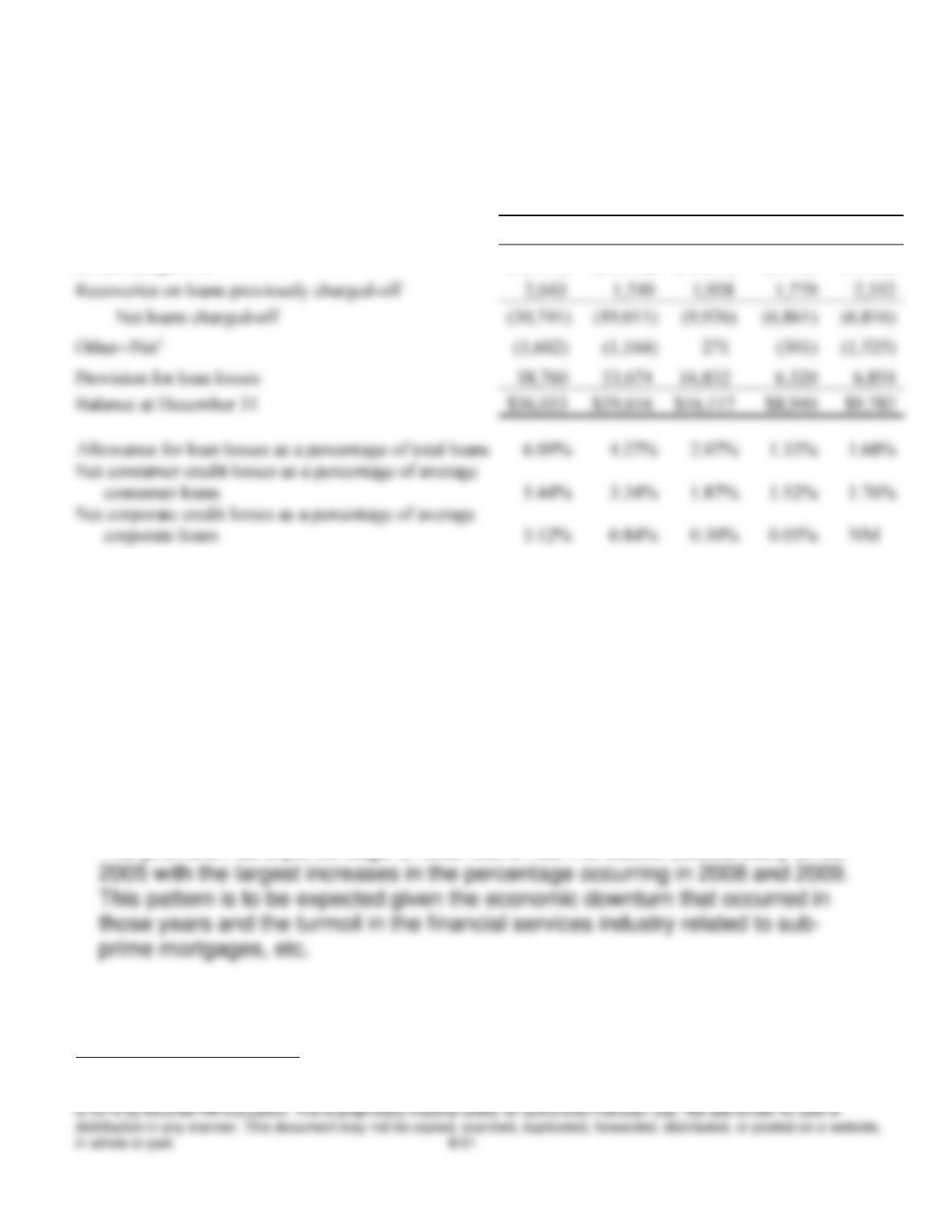
Details of Citigroup’s Credit Loss Experience are reproduced below (in millions).
2009
2008
2007
2006
2005
Allowance for loan losses at January 1
$29,616
$16,177
$8,940
$9,782
$11,269
Loans charged-off
(32,784)
(20,760)
(11,864)
(8,640)
(9,168)
Recoveries on loans previously charged-off
2,043
1,749
1,938
1,779
2,352
Net loans charged-off
(30,741)
(19,011)
(9,926)
(6,861)
(6,816)
Other—Net1
(1,602)
(1,164)
271
(301)
(1,525)
Provision for loan losses
38,760
33,674
16,832
6,320
6,854
Balance at December 31
$36,033
$29,616
$16,117
$8,940
$9,782
Allowance for loan losses as a percentage of total loans
6.09%
4.27%
2.07%
1.32%
1.68%
Net consumer credit losses as a percentage of average
consumer loans
5.44%
3.34%
1.87%
1.52%
1.76%
Net corporate credit losses as a percentage of average
corporate loans
3.12%
0.84%
0.30%
0.05%
NM
Requirement 1.a. – Comparison of charge-offs for 2008 and 2009
The amount of loans charged off in 2009 was $12,024 more ($32,784 –
$20,760) than in 2008.
Requirement 1.b. – Provision for loan losses
The provision for loan losses was $38,760 in 2009.
Requirement 1.c. – Trend in provision for loan losses to total loans
The provision as a percentage of total loans has increased substantially since
1 Other—net includes reductions to the loan loss reserve related to securitizations and the sale or transfers to held-for-sale of
various loans.
Requirement 2 – Evaluation of loan performance
Based on the increases to the allowance and provision account, we would
expect that the loans on the books in 2009 are lower quality and that defaults
2010 BUSINESS OUTLOOK
While showing signs of improvement, the macroeconomic environment going into 2010
remains challenging, with U.S. unemployment still elevated. The U.S. government has
Citigroup’s loan loss experience in 2010, and beyond, will certainly be affected by
events like those mentioned that are largely beyond their control.
Requirement 3 – Effect of FAS 166 and FAS 167 on Citigroup
Adopting FAS 166 and FAS 167 will impact Citigroup’s regulatory capital ratios by