P8–3. Determining allowance for uncollectibles
Requirement 1:
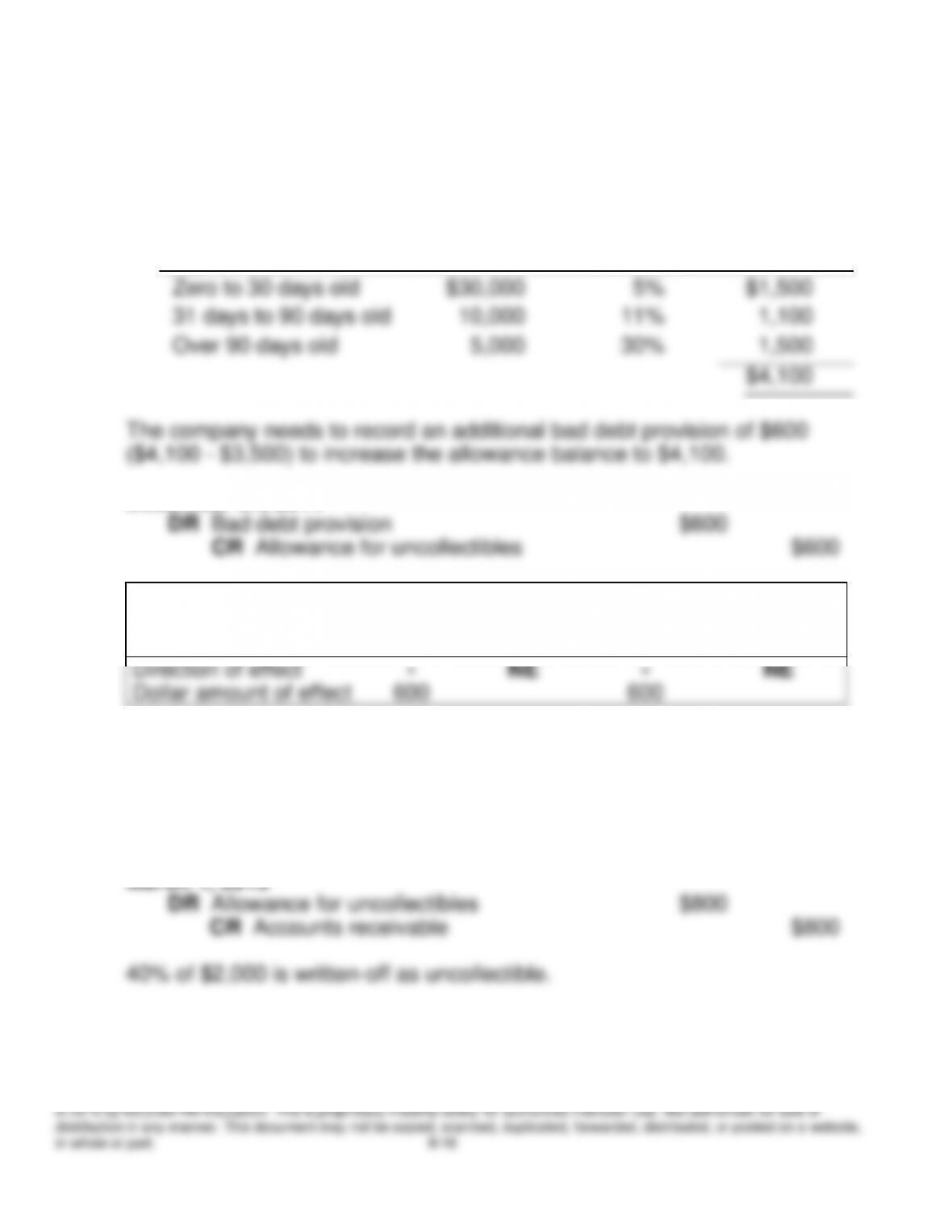
Based on the aging schedule, the ending balance in the allowance for
doubtful accounts is calculated as follows:
Expected
Dollar
Age of Receivables
Amount
Bad Debts
Amount
Zero to 30 days old
$30,000
5%
$1,500
31 days to 90 days old
10,000
11%
1,100
Over 90 days old
5,000
30%
1,500
$4,100
The company needs to record an additional bad debt provision of $600
($4,100 – $3,500) to increase the allowance balance to $4,100.
December 31, 2014
Cash Flow
Net
from
Assets
Liabilities
Income
Operations
Direction of effect
–
NE
–
NE
Dollar amount of effect
600
600
The journal entries for the other transactions are provided below:
January 1, 2015
No journal entry is recorded since the ultimate resolution of the account
receivable is still uncertain.
March 1, 2015
Cash Flow
Net
from
Assets
Liabilities
Income
Operations
Direction of effect
NE
NE
NE
NE
Dollar amount of effect
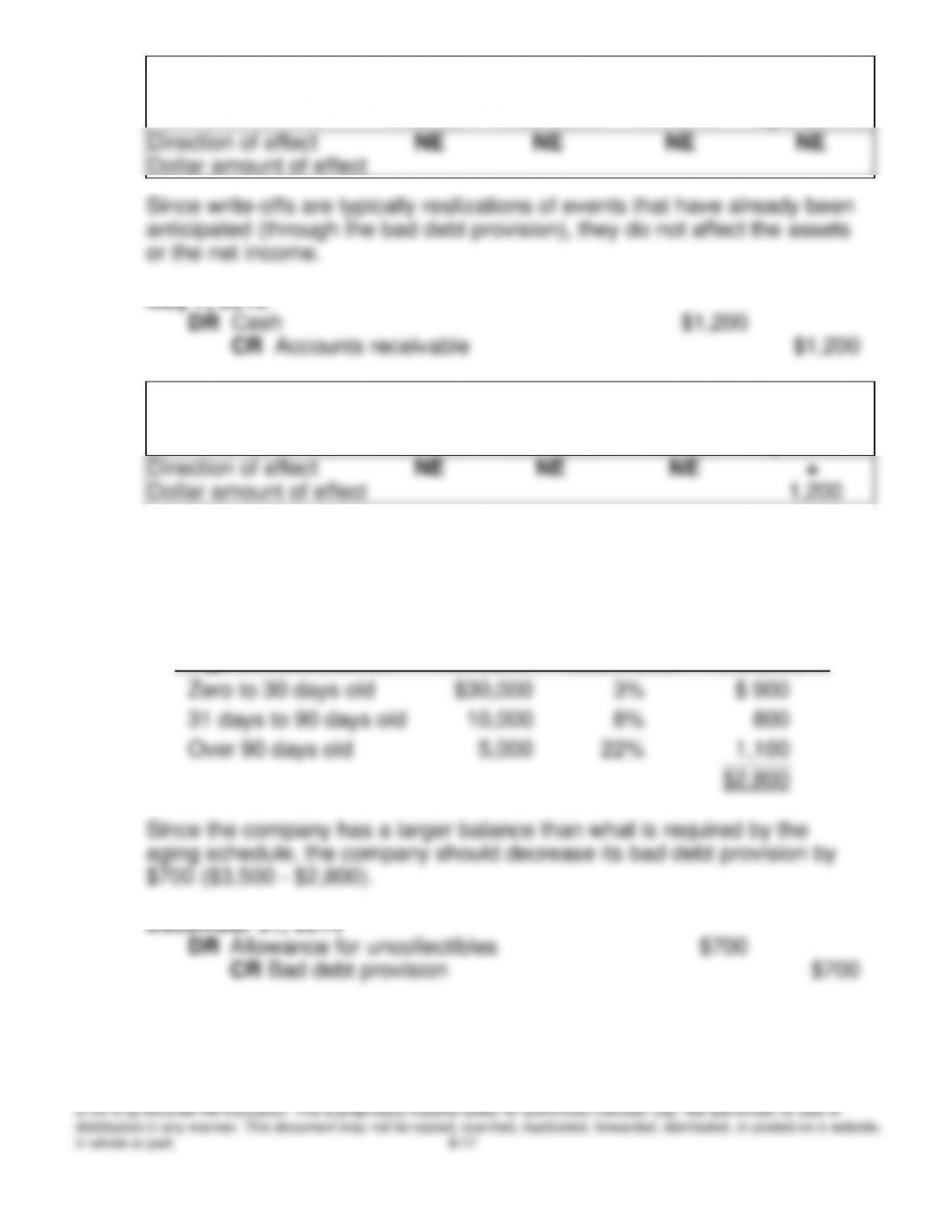
Since write-offs are typically realizations of events that have already been
anticipated (through the bad debt provision), they do not affect the assets
or the net income.
Cash Flow
Net
from
Assets
Liabilities
Income
Operations
Direction of effect
NE
NE
NE
+
Dollar amount of effect
1,200
Requirement 2:
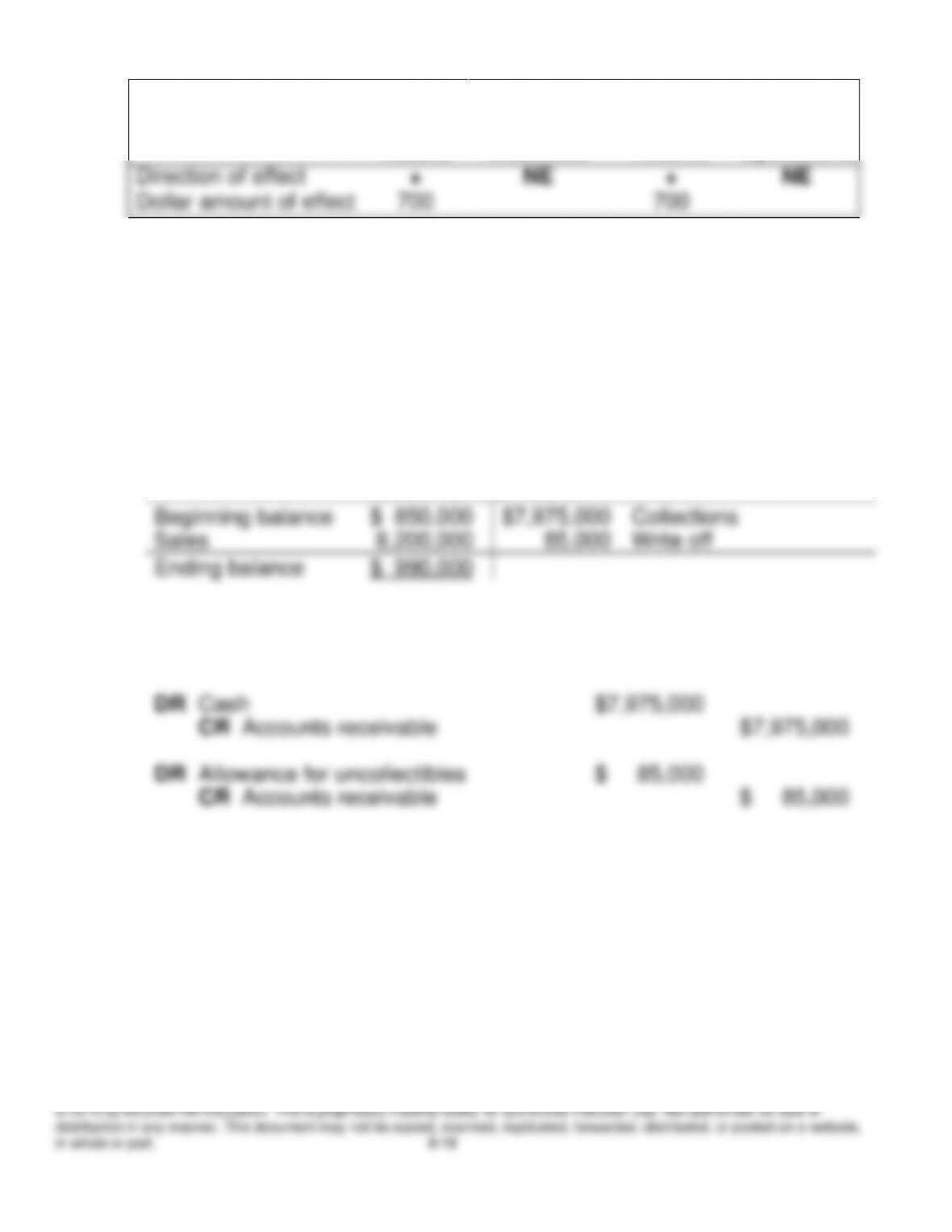
Based on the aging schedule, the ending balance in the allowance for
doubtful accounts is calculated as follows:
Expected
Dollar
Age of Receivables
Amount
Bad Debts
Amount
Zero to 30 days old
$30,000
3%
$ 900
31 days to 90 days old
10,000
8%
800
Over 90 days old
5,000
22%
1,100
$2,800
Cash Flow
Net
From
Assets
Liabilities
Income
Operations
Direction of effect
+
NE
+
NE
Dollar amount of effect
700
700
The other journal entries do not change from Requirement 1.
P8–4. Preparing journal entries, aging analysis and balance sheet
presentation
Requirement 1:
The accounts receivable balance at December 31, 2014 and related journal
entries are:
Accounts receivable
Beginning balance
$ 850,000
$7,975,000
Collections
Sales
8,200,000
85,000
Write off
Ending balance
$ 990,000
DR Accounts receivable
$8,200,000
CR Sales revenue
$8,200,000
DR
Cash
$7,975,000
CR Accounts receivable
$7,975,000
DR
Allowance for uncollectibles
$ 85,000
CR Accounts receivable
$ 85,000
Requirement 2:
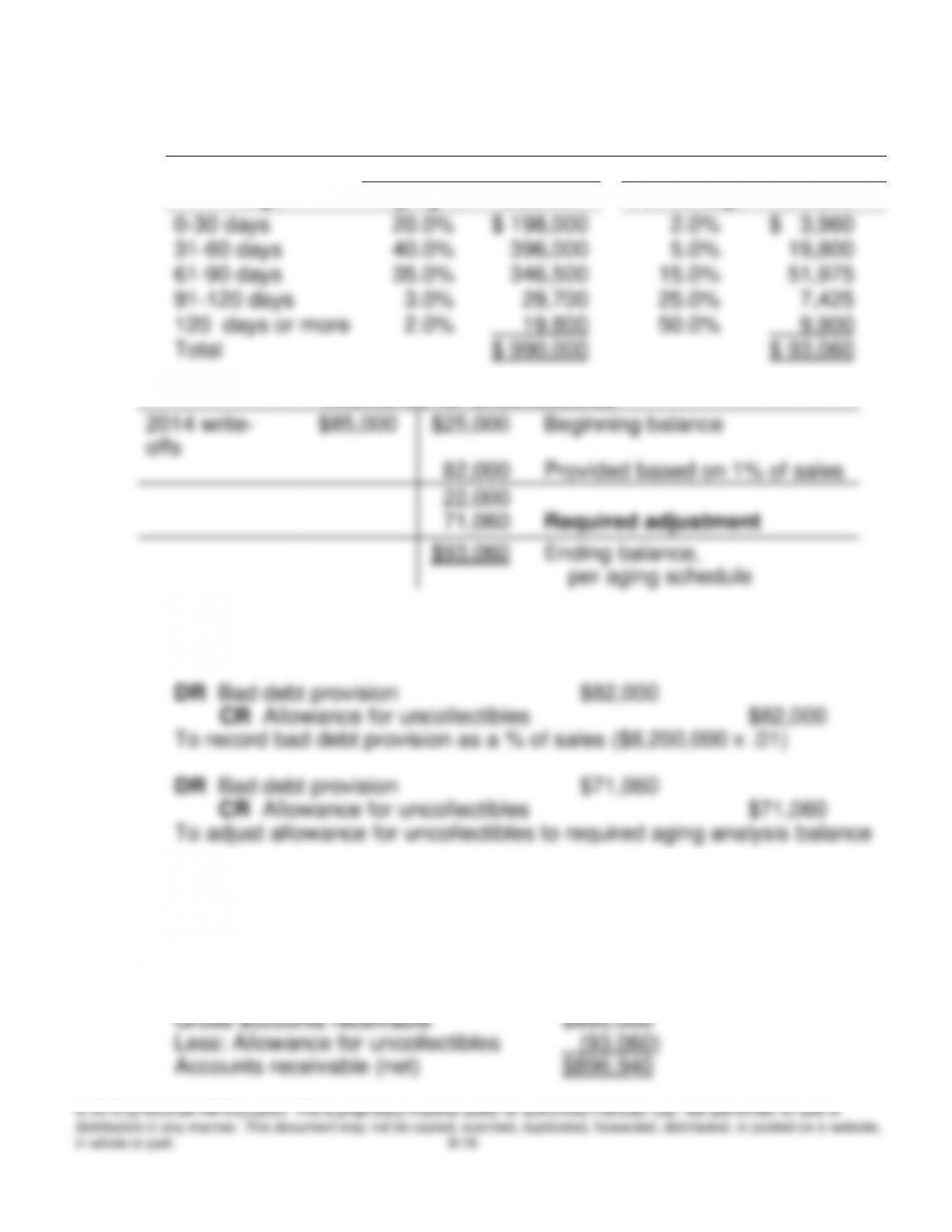
Oettinger Corporation
Accounts Receivable Aging Schedule
December 31, 2014
Accounts receivable
Uncollectibles
Age
Aging %
Balance
Percentage
Amount
0-30 days
20.0%
$ 198,000
2.0%
$ 3,960
31-60 days
40.0%
396,000
5.0%
19,800
61-90 days
35.0%
346,500
15.0%
51,975
91-120 days
3.0%
29,700
25.0%
7,425
120 days or more
2.0%
19,800
50.0%
9,900
Total
$ 990,000
$ 93,060
Allowance for uncollectibles
2014 write-
offs
$85,000
$25,000
Beginning balance
82,000
Provided based on 1% of sales
22,000
71,060
Required adjustment
$93,060
Ending balance,
per aging schedule
Requirement 3:
The journal entries affecting the allowance for uncollectible accounts are:
(Note: This excludes the entry for the $85,000 write-off made in
Requirement 1.)
Requirement 4:
Accounts receivable balance sheet presentation at December 31, 2014:
P8–5. Securitization
Requirement 1:
FASB ASC 860-10-40 on the subject of conditions for a sale of financial
assets states that a financial asset should be considered sold if it is
transferred and control is surrendered. Control is deemed to be surrendered
Requirement 2:
DR
Cash (or Due from SE)
$20,750,000
CR Accounts receivable
$20,000,000
CR Gain on sale of receivables
750,000
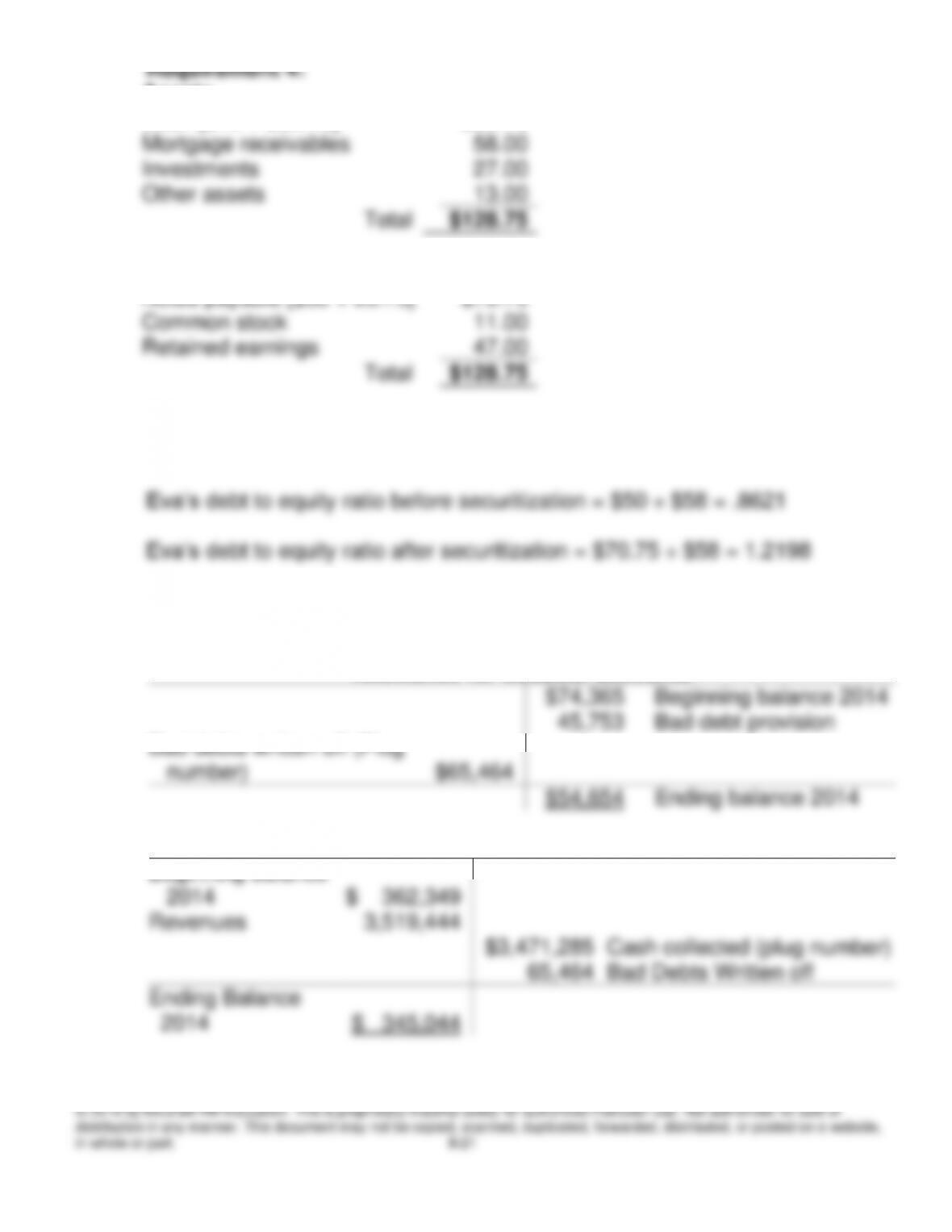
Requirement 3:
Assets
Cash [$10 + $20.75]
$30.75
Mortgage receivables [$58 – $20]
38.00
Investments
27.00
Other assets
13.00
Total
$108.75
Liabilities and shareholders’ equity
Notes payable
$50.00
Common stock
11.00
Retained earnings [$47 + $0.75]
47.75
Total
$108.75
© 2015 by McGraw-Hill Education. This is proprietary material solely for authorized instructor use. Not authorized for sale or
distribution in any manner. This document may not be copied, scanned, duplicated, forwarded, distributed, or posted on a website,
in whole or part. 8-21
Requirement 4:
Assets
Cash [$10 + $20.75]
$30.75
Mortgage receivables
58.00
Investments
27.00
Other assets
13.00
Total
$128.75
Liabilities and shareholders’ equity
Notes payable [$50 + 20.75]
$70.75
Common stock
11.00
Retained earnings
47.00
Total
$128.75
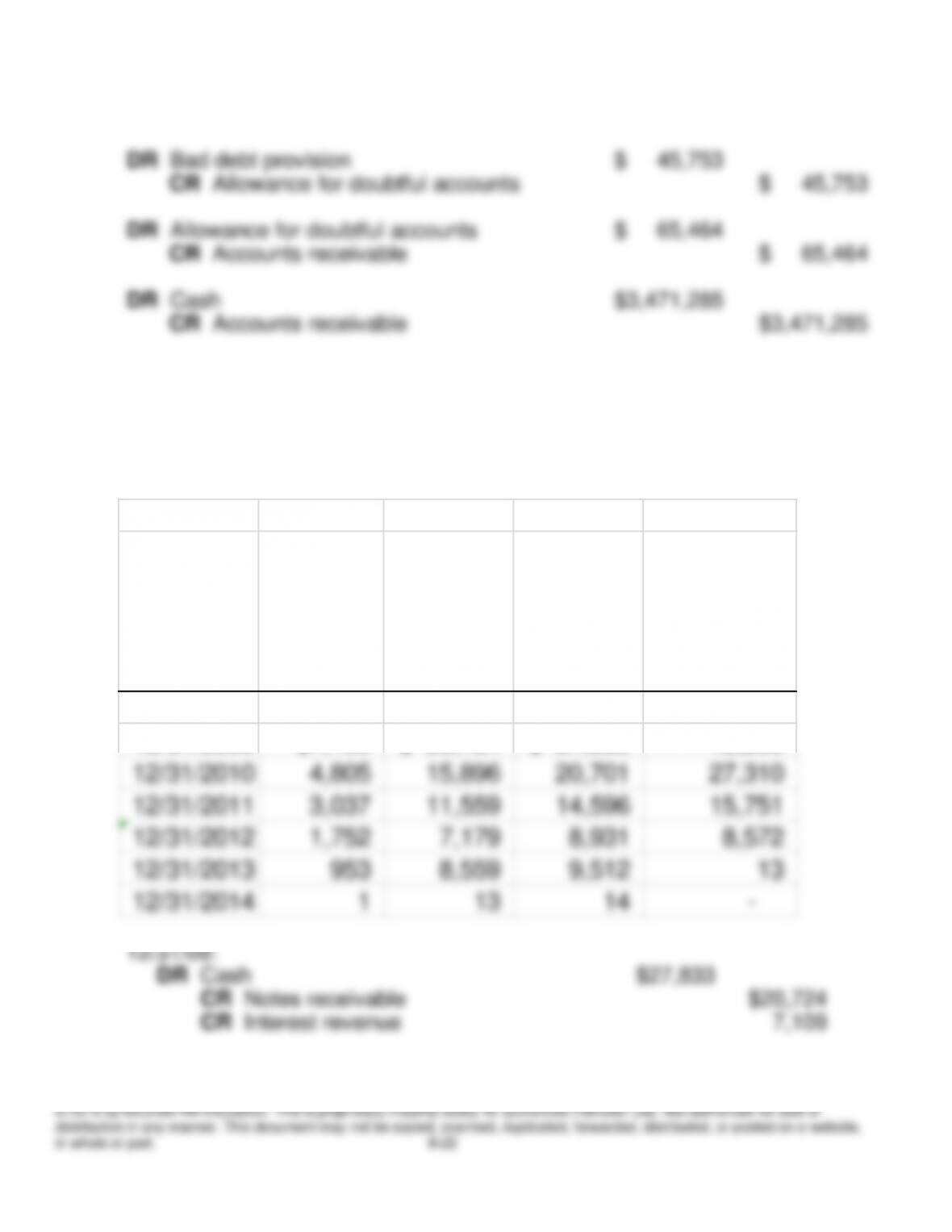
If the securitization did not qualify for “sale accounting,” it would be treated as
a collateralized borrowing, thus Eva’s reported debt would increase:
P8–6. Analyzing accounts receivable
Allowance for doubtful accounts
$74,365
Beginning balance 2014
45,753
Bad debt provision
Bad debts written off (Plug
number)
$65,464
$54,654
Ending balance 2014
Gross accounts receivable
Beginning balance
2014
$ 362,349
Revenues
3,519,444
$3,471,285
Cash collected (plug number)
65,464
Bad Debts Written off
Ending Balance
2014
$ 345,044
Journal entries for 2014
DR Accounts receivable
$3,519,444
CR Revenues
$3,519,444
DR Bad debt provision
$ 45,753
CR Allowance for doubtful accounts
$ 45,753
DR Allowance for doubtful accounts
$ 65,464
CR Accounts receivable
$ 65,464
DR Cash
$3,471,285
CR Accounts receivable
$3,471,285
P8–7. Scheduling interest received
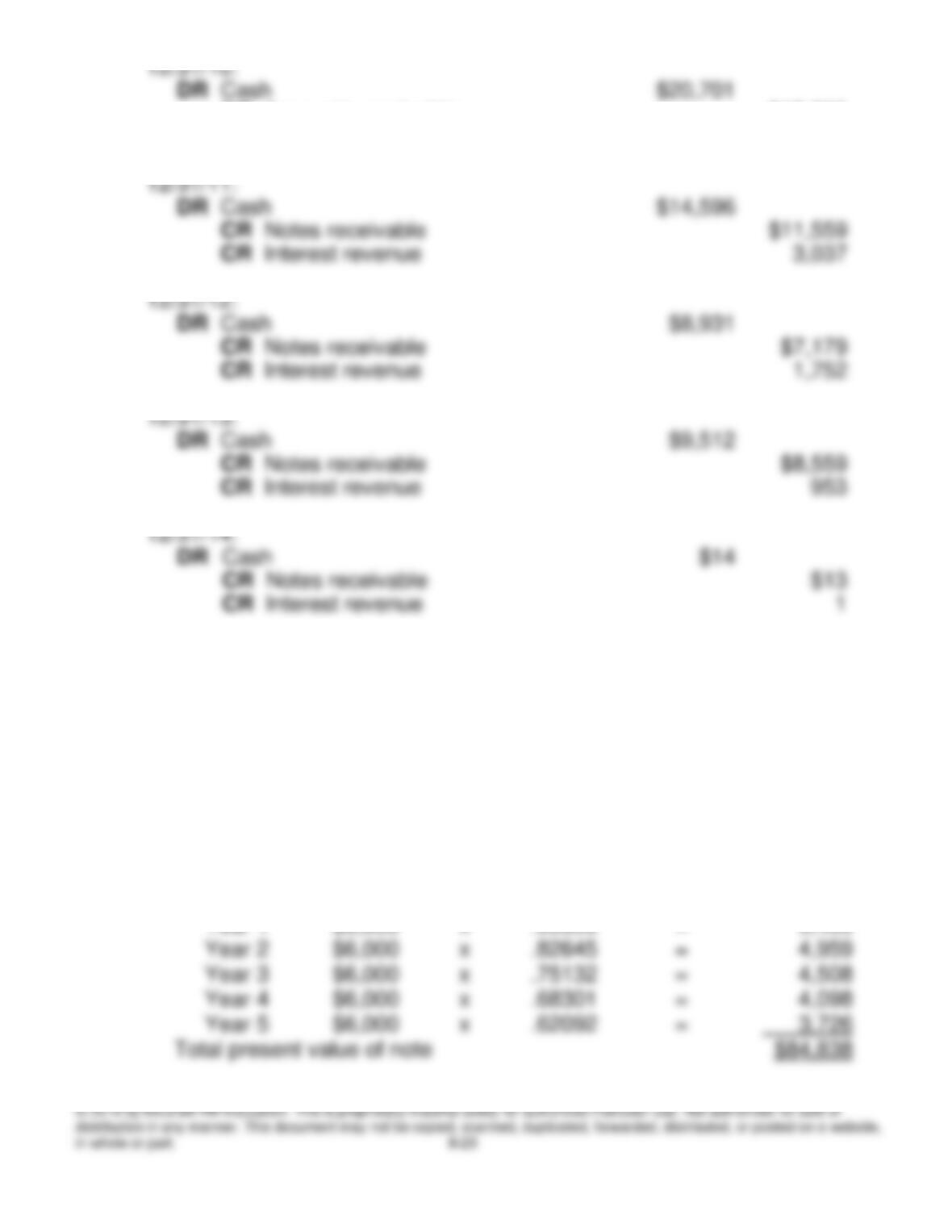
Effective interest table in 000’s
DR
Cash
CR Notes receivable
CR Interest revenue
( a ) ( b ) ( c ) ( d )
Date
Interest
income:
prior (d)
x 11.12%)
Note
payment
received
(given)
Total
cash
received
(a) + (b)
Note
receivable:
prior (d)
less (b)
12/31/2008 $63,930
12/31/2009 $7,109 20,724$ 27,833$ 43,206
12/31/2010 4,805 15,896 20,701 27,310
12/31/2011 3,037 11,559 14,596 15,751
12/31/2012 1,752 7,179 8,931 8,572
12/31/2013 953 8,559 9,512 13
12/31/2014 1 13 14 –
© 2015 by McGraw-Hill Education. This is proprietary material solely for authorized instructor use. Not authorized for sale or
distribution in any manner. This document may not be copied, scanned, duplicated, forwarded, distributed, or posted on a website,
in whole or part. 8-23
12/31/10:
DR
Cash
$20,701
CR Accounts receivable
$15,896
CR Interest revenue
4,805
DR
Cash
$14,596
CR Notes receivable
$11,559
CR Interest revenue
3,037
DR
Cash
$8,931
CR Notes receivable
$7,179
CR Interest revenue
1,752
DR
Cash
$9,512
CR Notes receivable
$8,559
CR Interest revenue
953
DR
Cash
$14
CR Notes receivable
$13
CR Interest revenue
1
P8–8. Imputing interest on a nominal interest-bearing note and fair value
option
Requirement 1:
Calculation of the present value of Criswell Acre’s note at a 10% effective rate
of interest:
Present value of $100,000 principal repayment in 5 years at 10%
$100,000
x
.62092
=
$62,092
Present value of five interest payments of $6,000
($100,000 x .06) each at 10%:
Year 1
$6,000
x
.90909
=
5,455
Year 2
$6,000
x
.82645
=
4,959
Year 3
$6,000
x
.75132
=
4,508
Year 4
$6,000
x
.68301
=
4,098
Year 5
$6,000
x
.62092
=
3,726
Total present value of note
$84,838
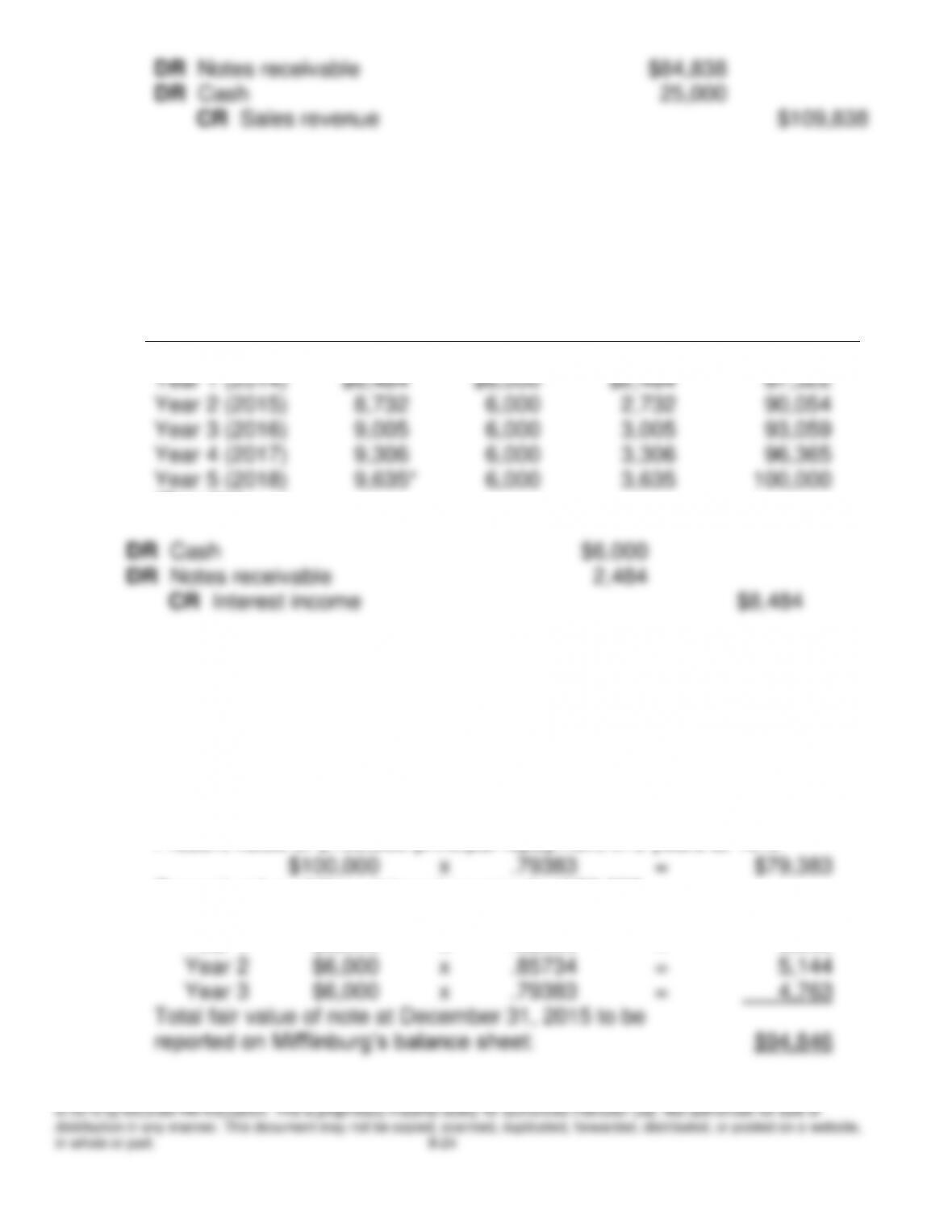
DR Notes receivable
$84,838
DR Cash
25,000
CR Sales revenue
$109,838
Requirement 2:
(a)
Interest
income—
10% of
column (d)
balance for
prior year
(b)
Cash
interest
received
(c)
Increase in
present
value of
note
(a)–(b)
(d)
End of year
present
value of
note
Inception
$84,838
Year 1 (2014)
$8,484
$6,000
$2,484
87,322
Year 2 (2015)
8,732
6,000
2,732
90,054
Year 3 (2016)
9,005
6,000
3,005
93,059
Year 4 (2017)
9,306
6,000
3,306
96,365
Year 5 (2018)
9,635*
6,000
3,635
100,000
*Rounded
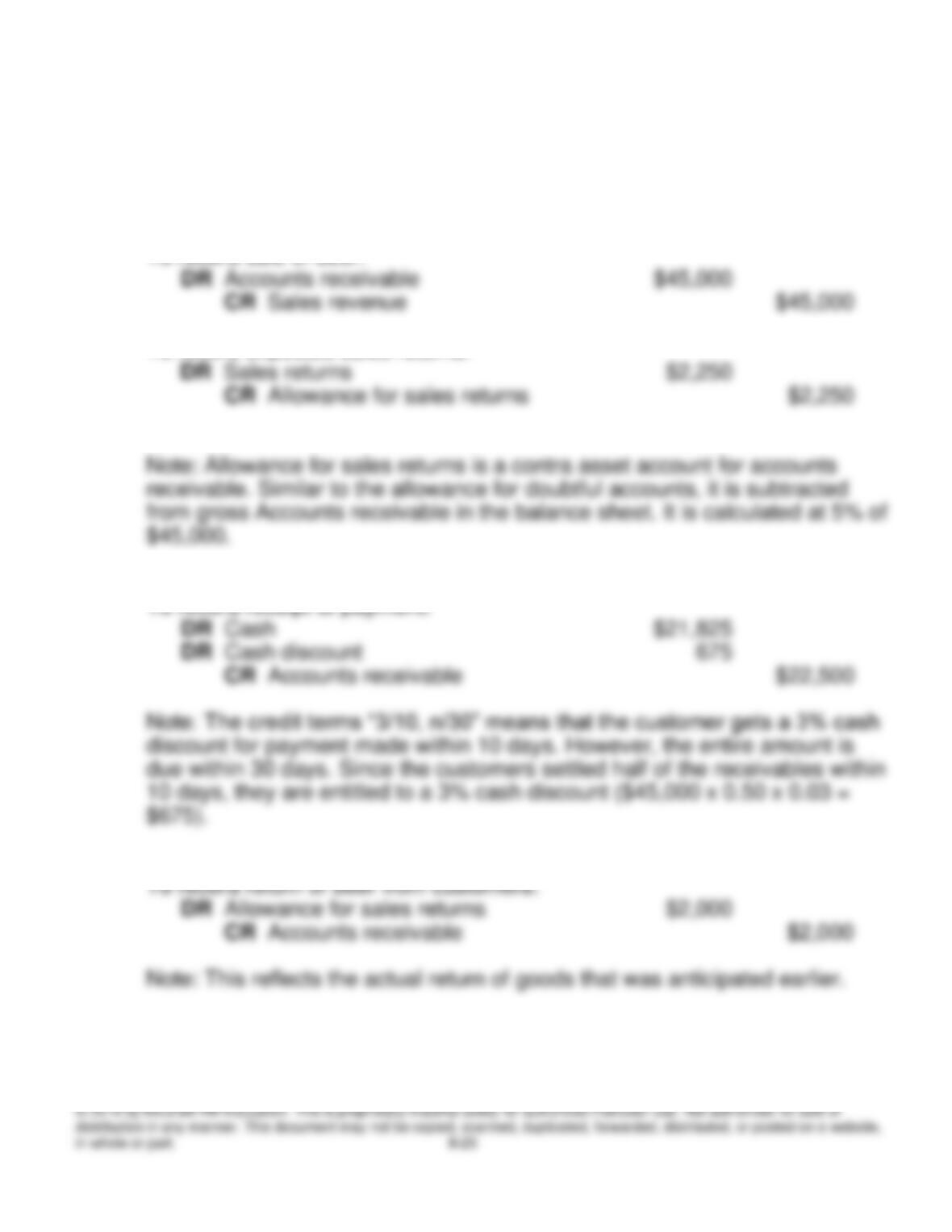
DR Cash
$6,000
DR Notes receivable
2,484
CR Interest income
$8,484
Present value of $100,000 principal repayment in 3 years at 10%
x
.79383
Year 1
x
.92593
=
Year 2
x
.85734
=
Year 3
x
.79383
=
P8–9. Recording cash discounts and sales returns
Note to instructor: This problem covers cash discount/credit terms not
discussed in the chapter and, thereby, provides an opportunity to introduce
these issues.
Requirement 1:
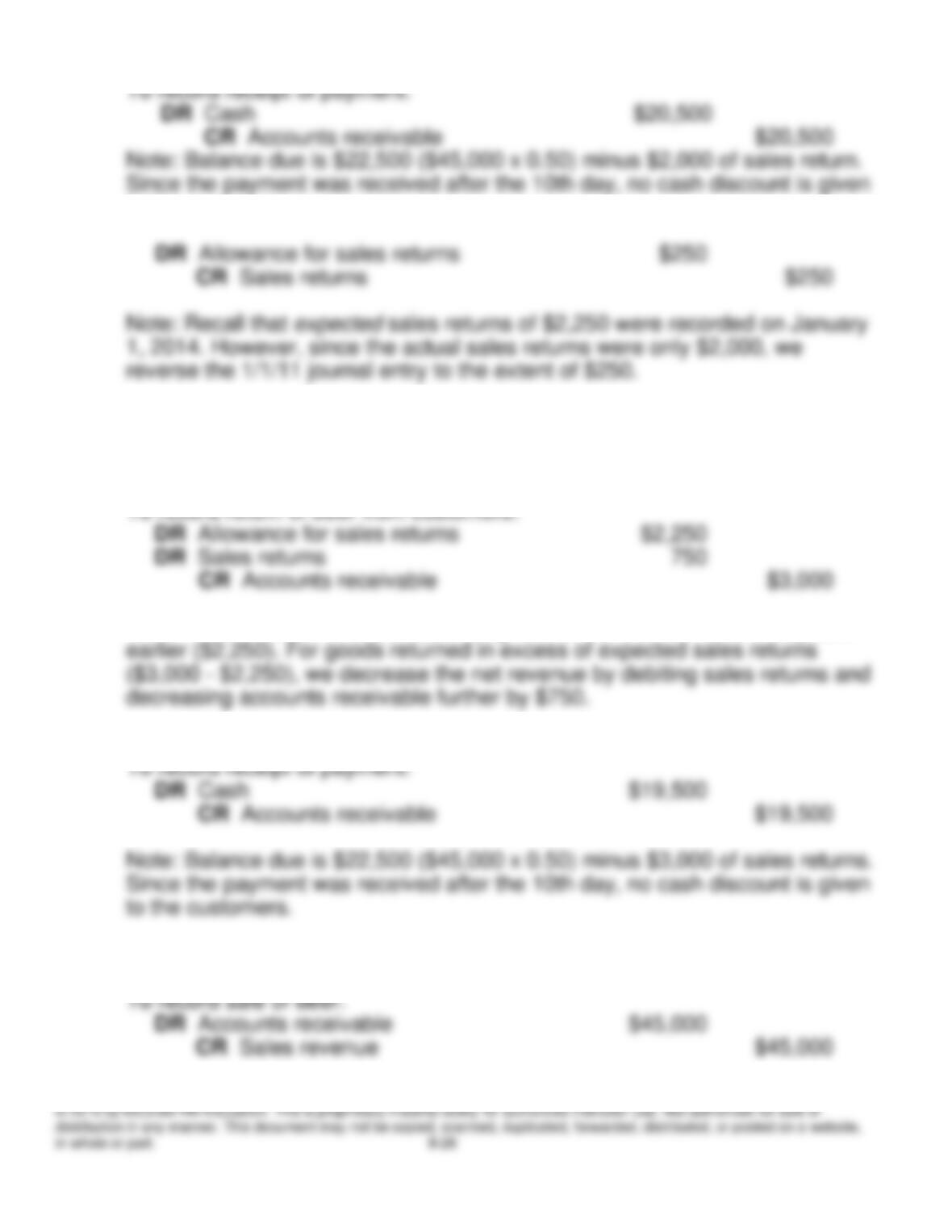
1/1/11:
To record sale of beer:
DR Accounts receivable
$45,000
CR Sales revenue
$45,000
To record expected sales returns:
DR Sales returns
$2,250
CR Allowance for sales returns
$2,250
1/9/14:
DR Cash
$21,825
DR Cash discount
CR Accounts receivable
DR Allowance for sales returns
$2,000
CR Accounts receivable
1/28/14:
to the customers.
Requirement 2:
Journal entries prior to January 15, 2014 are unaffected.
1/15/14:
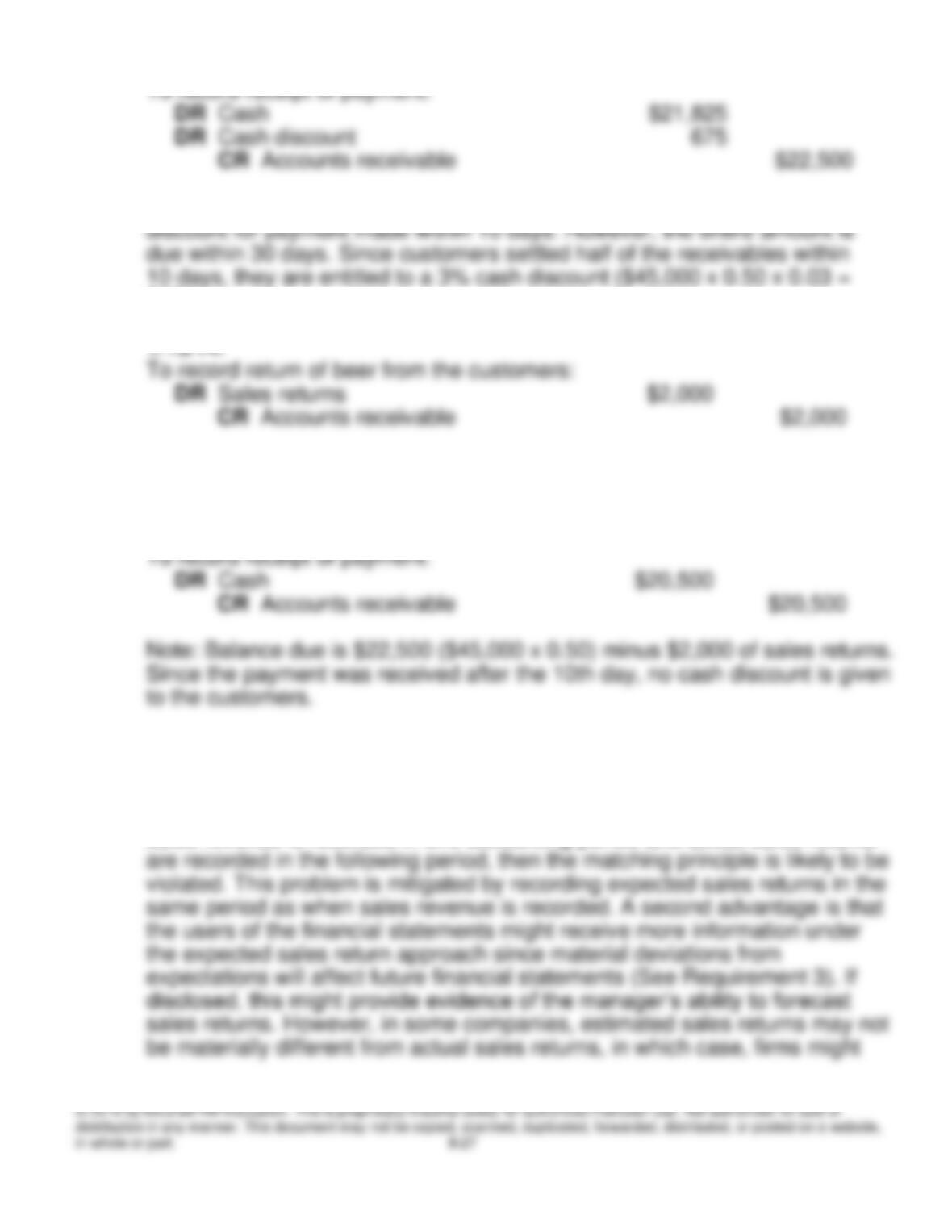
1/9/14:
minimize their bookkeeping costs by recording sales returns when goods are
actually returned.
Requirement 5:
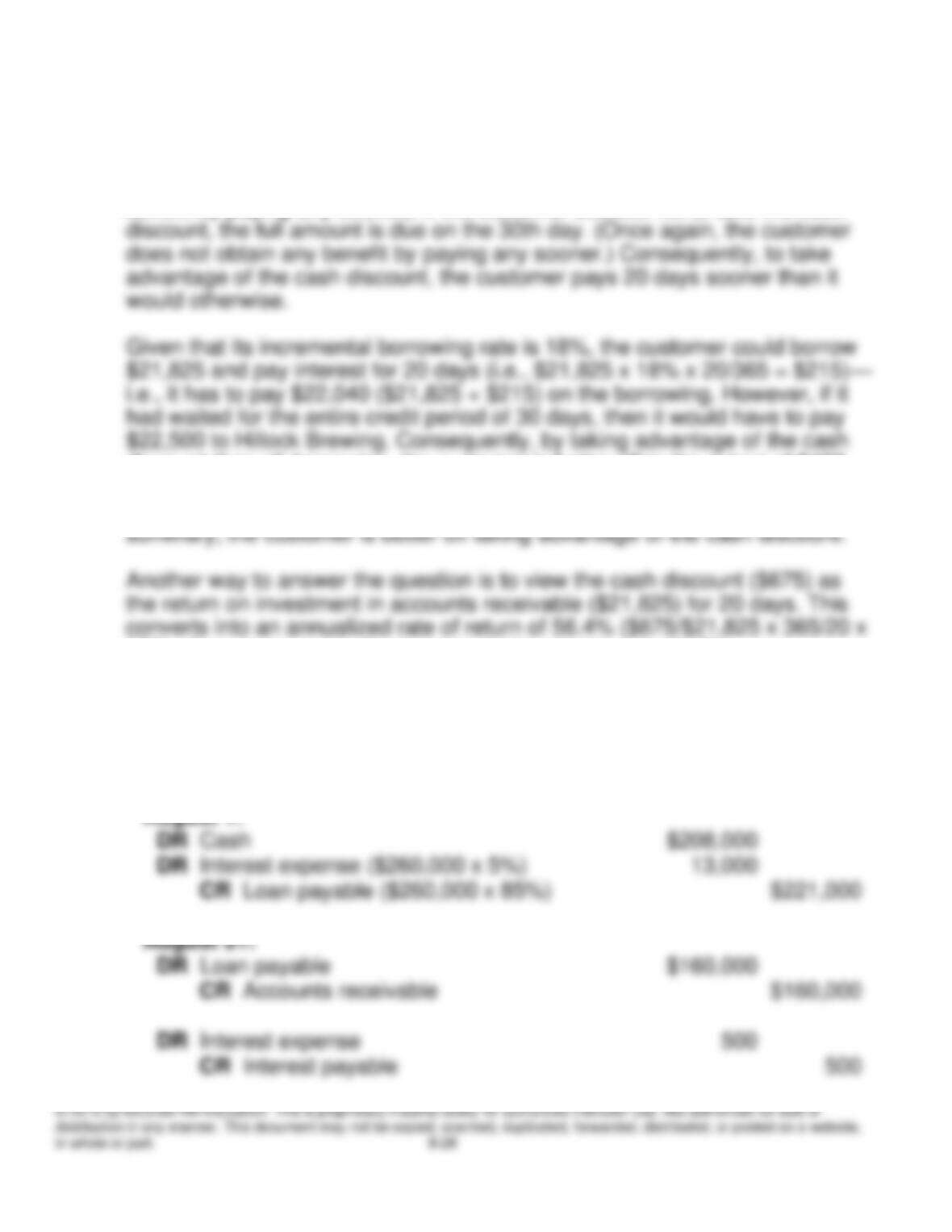
If the customer decides to take advantage of the cash discount, the optimal
time to do this is on the tenth day (i.e., the customer does not obtain any
benefit by paying any sooner). If the customer decides not to take the cash
discount through borrowing, the customer is better off to the extent of $460
($22,500 minus $22,040). The $460 also represents the difference between
the cash discount ($675) and the interest cost on the borrowing ($215). In
100) when compared to the incremental borrowing rate of 18%.
P8–10. Balance sheet effects of collateralized borrowing
Requirement 1:
Required journal entries
August 1:
DR Cash
$208,000
DR Interest expense ($260,000 x 5%)
13,000
CR Loan payable ($260,000 x 85%)
$221,000
August 31:
DR Loan payable
$160,000
CR Accounts receivable
$160,000
DR Interest expense
500
CR Interest payable
500
(($260,000 – 160,000) x .005)
September 30:
DR Loan payable ($221,000 – 160,000)
$61,000
DR Interest payable (per August 31)
500
DR Cash (a)
18,400
DR Interest expense
100
(($260,000 – 160,000 – 80,000) x .005)
CR Accounts receivable
$80,000
(a)
Cash collected by Needham:
Total cash collected by lender in September
$80,000
Less:
August 31 interest payable
(500)
September 30 interest expense
(100)
Remaining loan payable balance
(61,000)
Total deductions from collected cash
(61,600)
Cash collected by Needham
$18,400
Requirement 2:
August 31 balance sheet
Needham would disclose either in a note or on the face of the balance sheet:
Requirement 3:
August 1:
DR Cash
208,000
DR Due from factor
39,000
DR Loss on sale of receivables ($260,000 x 5%)
13,000
CR Accounts receivable
260,000
August 31:
DR Loss on sale of receivables
500
CR Due from factor
500
September 30:
DR Loss on sale of receivables
100
DR Cash
18,400
(($260,000 – 160,000 – 80,000) x .005)
CR Due from factor
18,500
Note to instructor: Subsequent cash remittances from the factor will reduce
the due from factor balance. Any remaining balance in the due from factor
account will be charged to the loss on sale of receivables account upon final
settlement with the factor.
P8–11. Factoring receivables
Requirement 1:
To record the sale of receivables to the factor:
Calculation of the proceeds from the factor
Gross accounts receivable factored
$200,000
(-) Interest (200,000 x 1%)
(2,000)
(-) Factoring fee (6% of $200,000)
(12,000)
(-) Holdback for returns (5% of $200,000)
(10,000)
Net proceeds
$176,000
DR
Allowance for uncollectibles
$ 4,000
DR
Cash
176,000
DR
Loss on sale of receivables
10,000
DR
Receivable from factor—holdback of 5%
10,000
CR Accounts receivable
$200,000
Since the factor is responsible for all the bad debts on the factored
receivables, the allowance for uncollectibles with respect to these receivables
Interest expense
$ 2,000
Factoring fee
12,000
(-) Elimination of allowance
(4,000)
Loss on sale of receivables
$10,000