Financial Reporting and Analysis (6th Ed.)
Chapter 8 Solutions
Receivables
Exercises
Exercises
E8–1. Analyzing accounts receivable
(AICPA adapted)
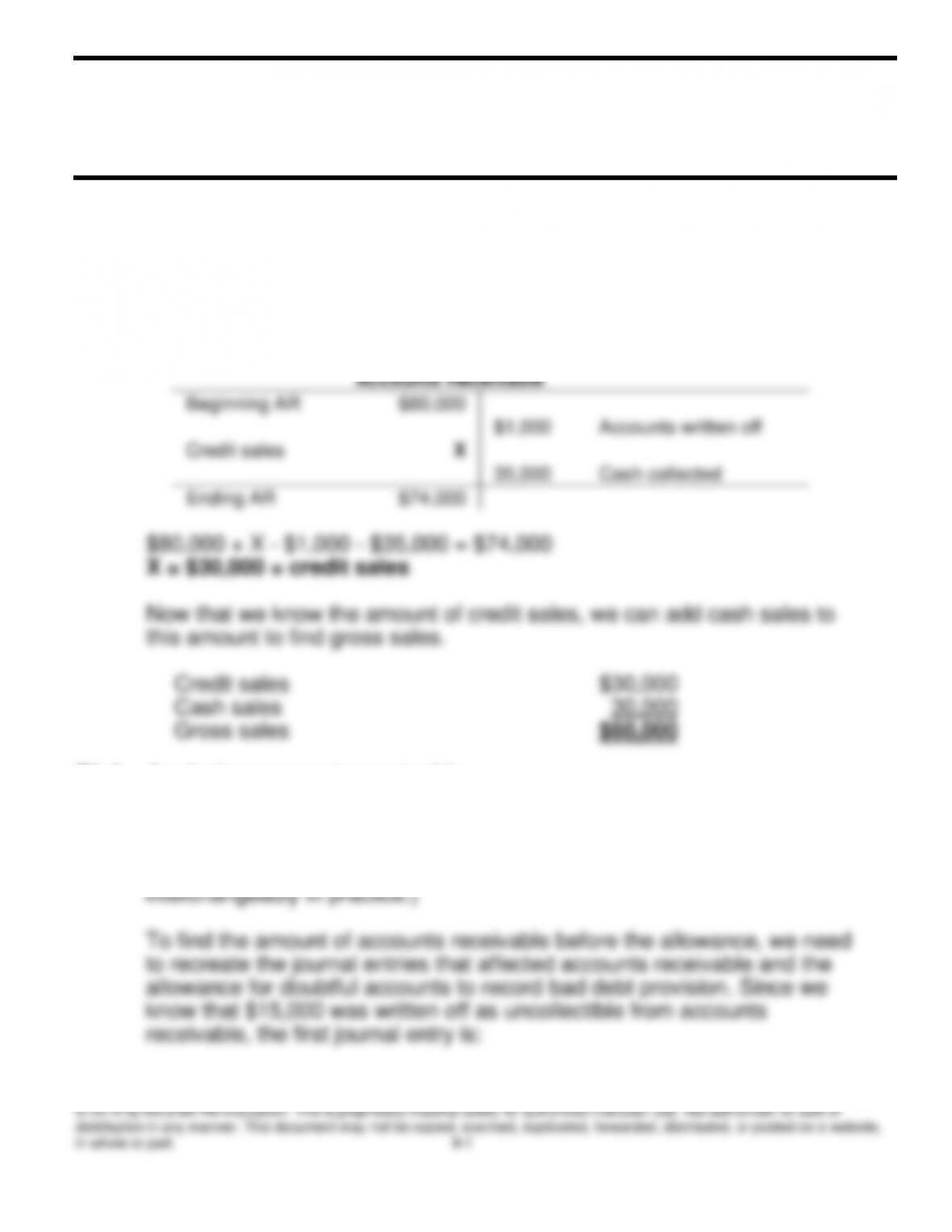
To find the amount of gross sales, start by determining credit sales. We
can do this with the accounts receivable T-account below.
E8–2. Analyzing accounts receivable
(AICPA adapted)
(Note to instructor: Students should be aware that the account titles
allowance for uncollectibles and allowance for doubtful accounts are used
© 2015 by McGraw-Hill Education. This is proprietary material solely for authorized instructor use. Not authorized for sale or
distribution in any manner. This document may not be copied, scanned, duplicated, forwarded, distributed, or posted on a website,
in whole or part. 8-2
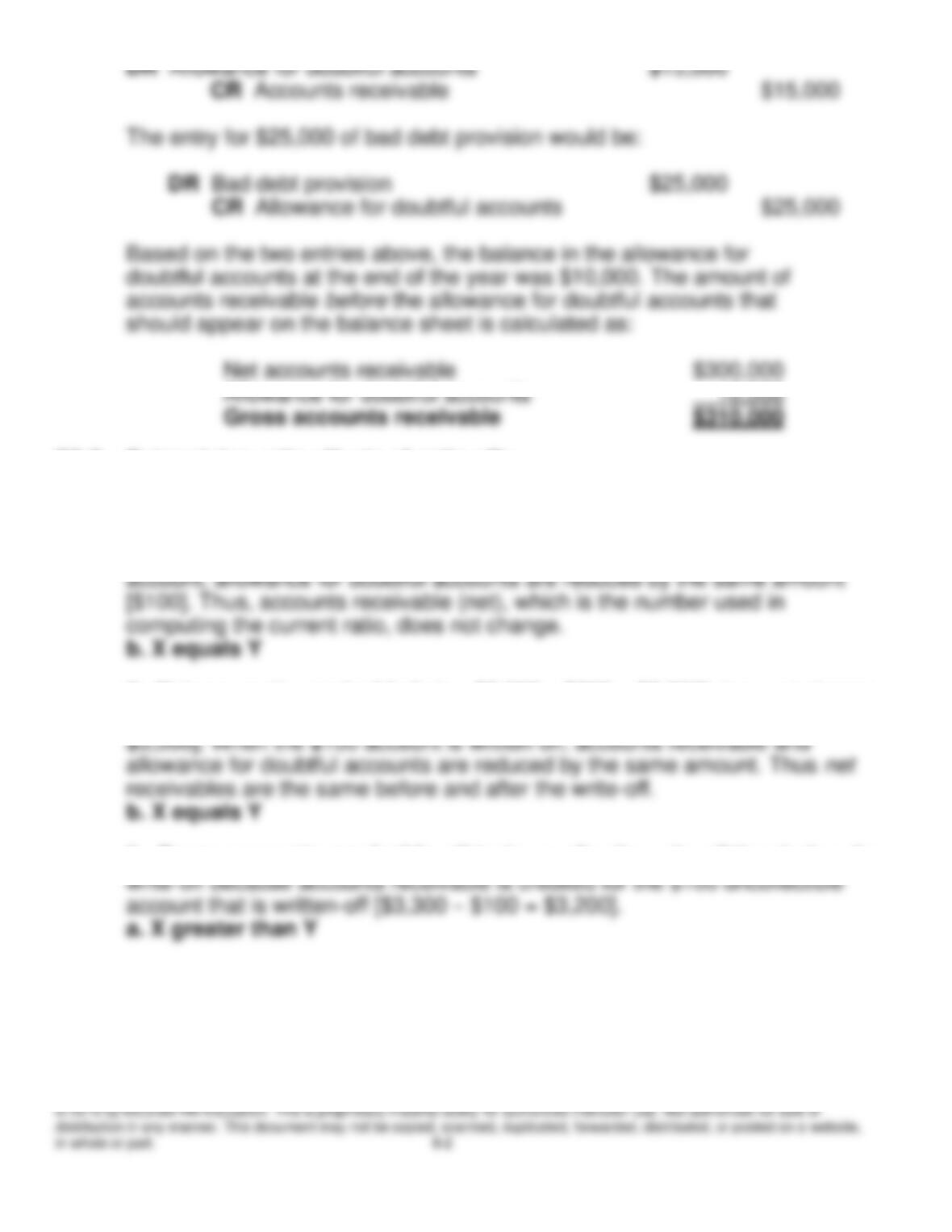
DR Allowance for doubtful accounts $15,000
CR Accounts receivable $15,000
The entry for $25,000 of bad debt provision would be:
DR Bad debt provision $25,000
CR Allowance for doubtful accounts $25,000
Based on the two entries above, the balance in the allowance for
doubtful accounts at the end of the year was $10,000. The amount of
accounts receivable before the allowance for doubtful accounts that
should appear on the balance sheet is calculated as:
Net accounts receivable $300,000
Allowance for doubtful accounts 10,000
Gross accounts receivable $310,000
E8–3. Determining ratio effects of write-offs
(AICPA adapted)
1. The current ratio [$30,000/$10,000 = 3:1] does not change as a result of
the write-off to the allowance account. Accounts receivable and its contra
2. Net accounts receivable [prior: $3,300 − $300 = $3,000] does not change
as a result of the write-off to the allowance account [after: $3,200 − $200 =
3. Gross accounts receivable will be lower after the write-off than before the
E8–4. Determining bad debt provision
(AICPA adapted)
Requirement 1:
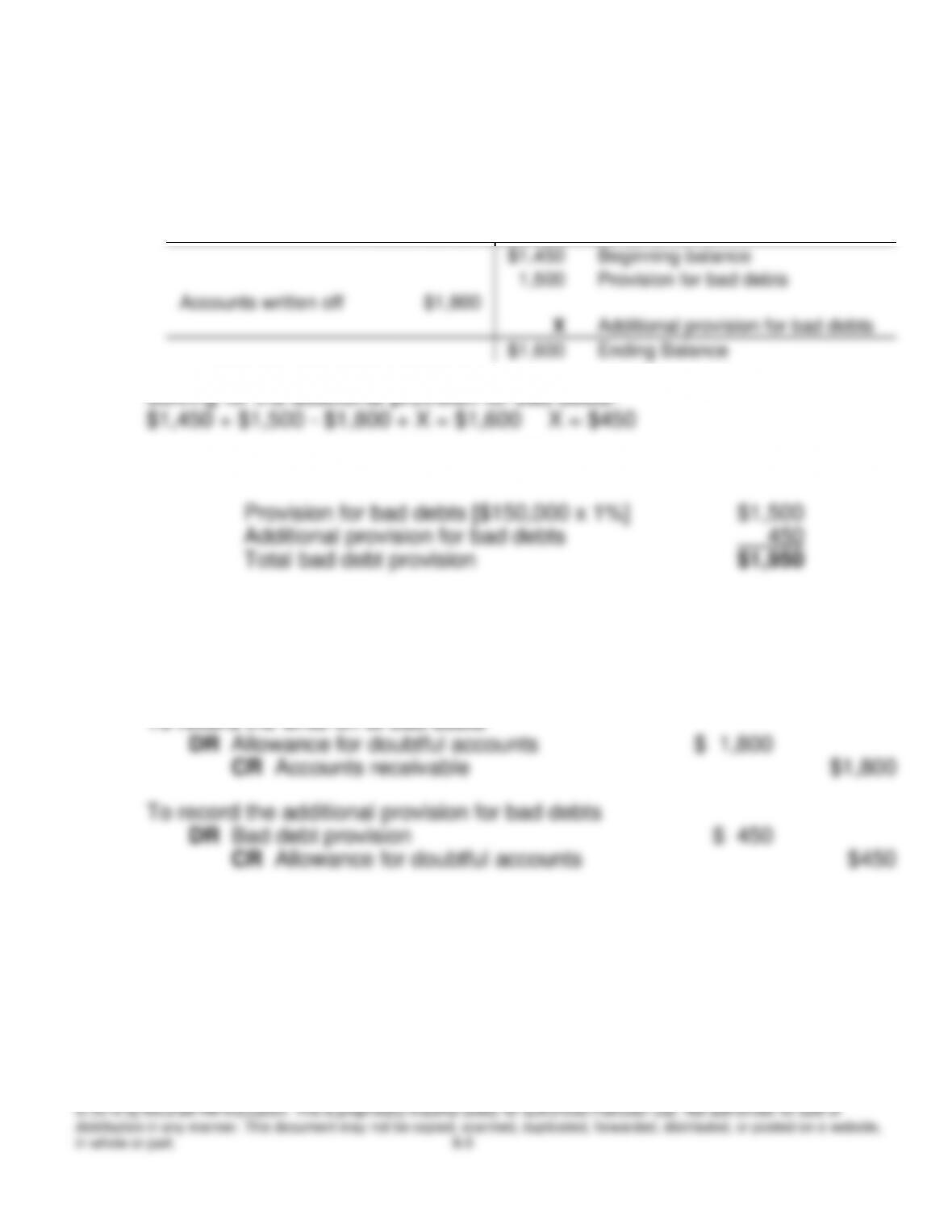
We can determine the amount of bad debt provision in 2014 by first examining
the allowance for doubtful accounts.
Allowance for doubtful accounts
$1,450
Beginning balance
1,500
Provision for bad debts
Accounts written off
$1,800
X
Additional provision for bad debts
$1,600
Ending Balance
Total bad debt provision for the year ended December 31, 2014 should be:
Requirement 2:
To record the original provision for bad debts
DR
Bad debt provision
$ 1,500
CR Allowance for doubtful accounts
$1,500
DR
Allowance for doubtful accounts
$ 1,800
CR Accounts receivable
$1,800
DR
Bad debt provision
$ 450
CR Allowance for doubtful accounts
$450
E8–5. Preparing an amortization schedule
(AICPA adapted)
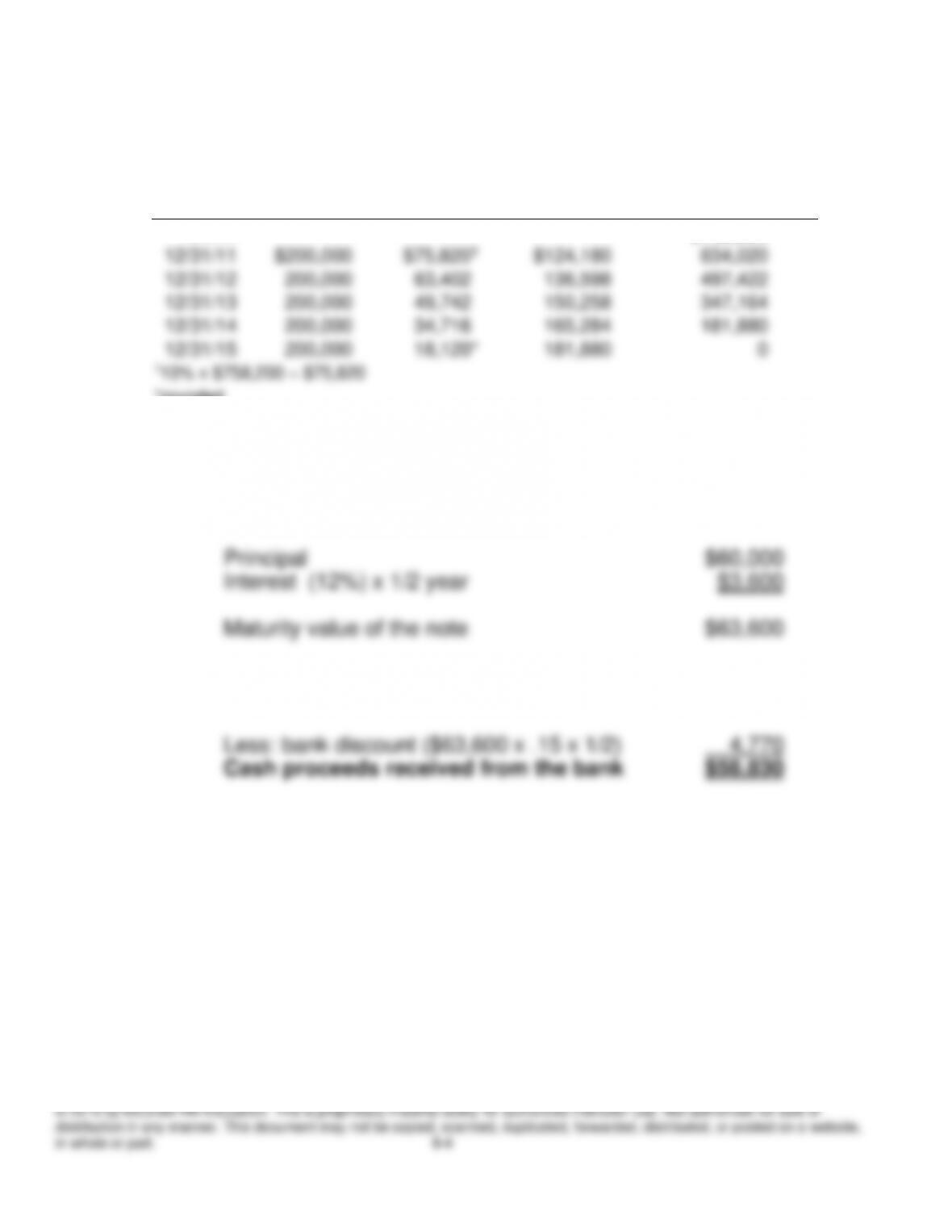
The amortization table for Lake Company appears below.
Date
Payments
Interest
Income
Reduction
of Principal
Net Installments
Due
1/1/11
$758,200
12/31/11
$200,000
$75,8201
$124,180
634,020
12/31/12
200,000
63,402
136,598
497,422
12/31/13
200,000
49,742
150,258
347,164
12/31/14
200,000
34,716
165,284
181,880
12/31/15
200,000
18,120*
181,880
0
110% x $758,200 = $75,820
*rounded
E8–6. Discounting a note
(AICPA adapted)
First, determine the value of the principal plus the interest.
Next, find the interest charged by the bank, discounted at 15% for one-half
year.
E8–7. Recording note receivable carrying amount and fair value option (AICPA
adapted)
Requirement 1:
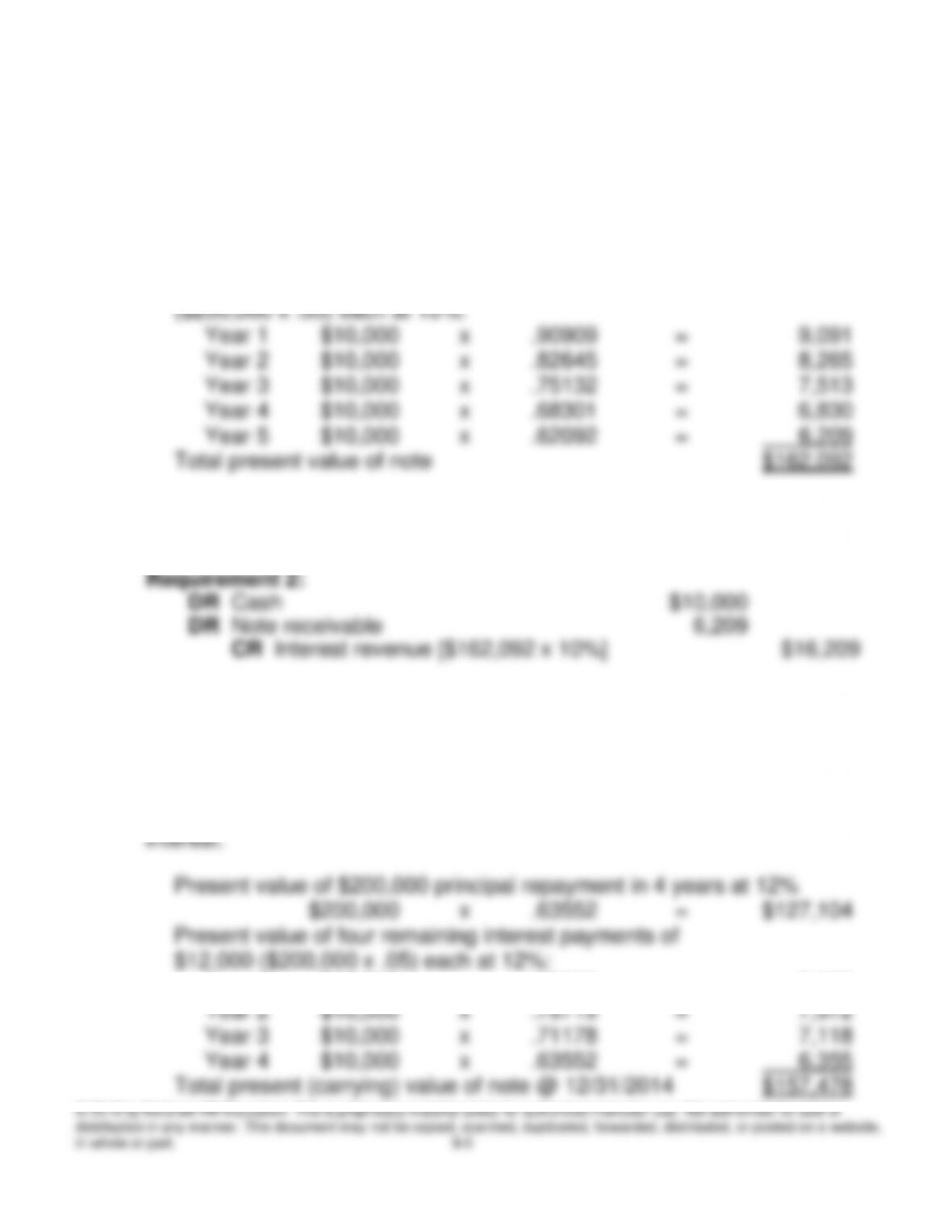
Calculation of the present value of Fletcher’s note at a 10% effective rate of
interest:
Present value of $200,000 principal repayment in 5 years at 10%
$200,000
x
.62092
=
$124,184
Present value of five interest payments of $12,000
($200,000 x .05) each at 10%:
Year 1
$10,000
x
.90909
=
9,091
Year 2
$10,000
x
.82645
=
8,265
Year 3
$10,000
x
.75132
=
7,513
Year 4
$10,000
x
.68301
=
6,830
Year 5
$10,000
x
.62092
=
6,209
Total present value of note
$162,092
DR Notes receivable
$162,092
CR Sales revenue
$162,092
Requirement 3:
The difference between interest revenue and cash received increases the
carrying amount of the note receivable which will total $200,000 at maturity.
Requirement 4:
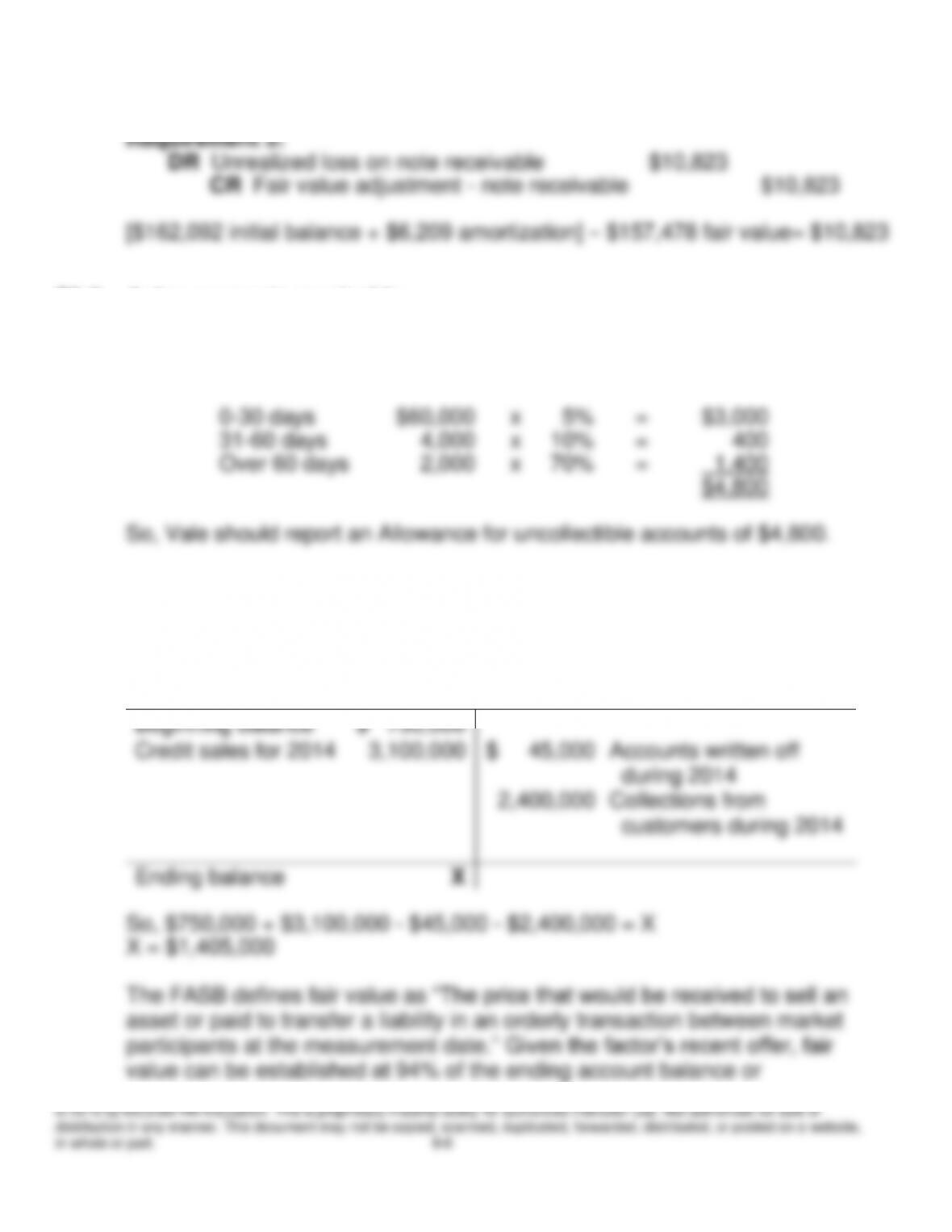
Calculation of the present value of Fletcher’s note at a 12% effective rate of
Present value of $200,000 principal repayment in 4 years at 12%
$200,000
x
.63552
=
$127,104
Present value of four remaining interest payments of
$12,000 ($200,000 x .05) each at 12%:
Year 1
$10,000
x
.89286
=
8,929
Year 2
$10,000
x
.79719
=
7,972
Year 3
$10,000
x
.71178
=
7,118
Year 4
$10,000
x
.63552
=
6,355
Total present (carrying) value of note @ 12/31/2014
$157,478
E8–8. Aging accounts receivable
(AICPA adapted)
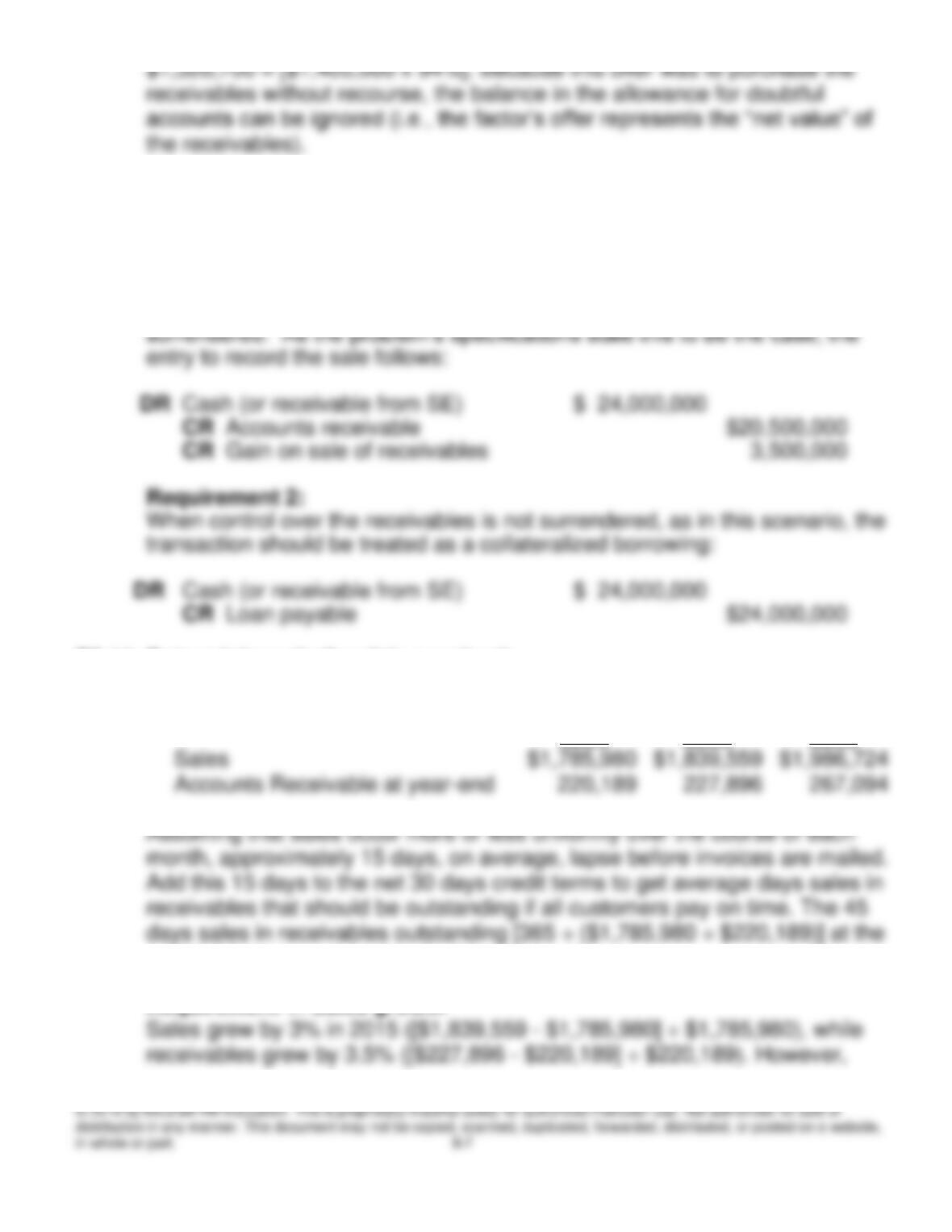
The estimated uncollectible accounts at December 31, 2014, total:
E8–9. Analyzing accounts receivable and fair value option
(AICPA adapted)
Zulu’s Accounts receivable ending balance is determined as follows:
Accounts receivable
Beginning balance
$ 750,000
Credit sales for 2014
3,100,000
$ 45,000
Accounts written off
during 2014
2,400,000
Collections from
customers during 2014
Ending balance
X
So, $750,000 + $3,100,000 – $45,000 – $2,400,000 = X
X = $1,405,000
The FASB defines fair value as “The price that would be received to sell an
asset or paid to transfer a liability in an orderly transaction between market
participants at the measurement date.” Given the factor’s recent offer, fair
value can be established at 94% of the ending account balance or
$1,320,700 = [$1,405,000 x 94%]. Because this offer was to purchase the
receivables without recourse, the balance in the allowance for doubtful
accounts can be ignored (i.e., the factor’s offer represents the “net value” of
the receivables).
E8–10. Accounting for a securitization
Requirement 1:
FASB ASC 860-10–40-3 states that a financial asset should be considered
sold and therefore should be derecognized if it is transferred and control is
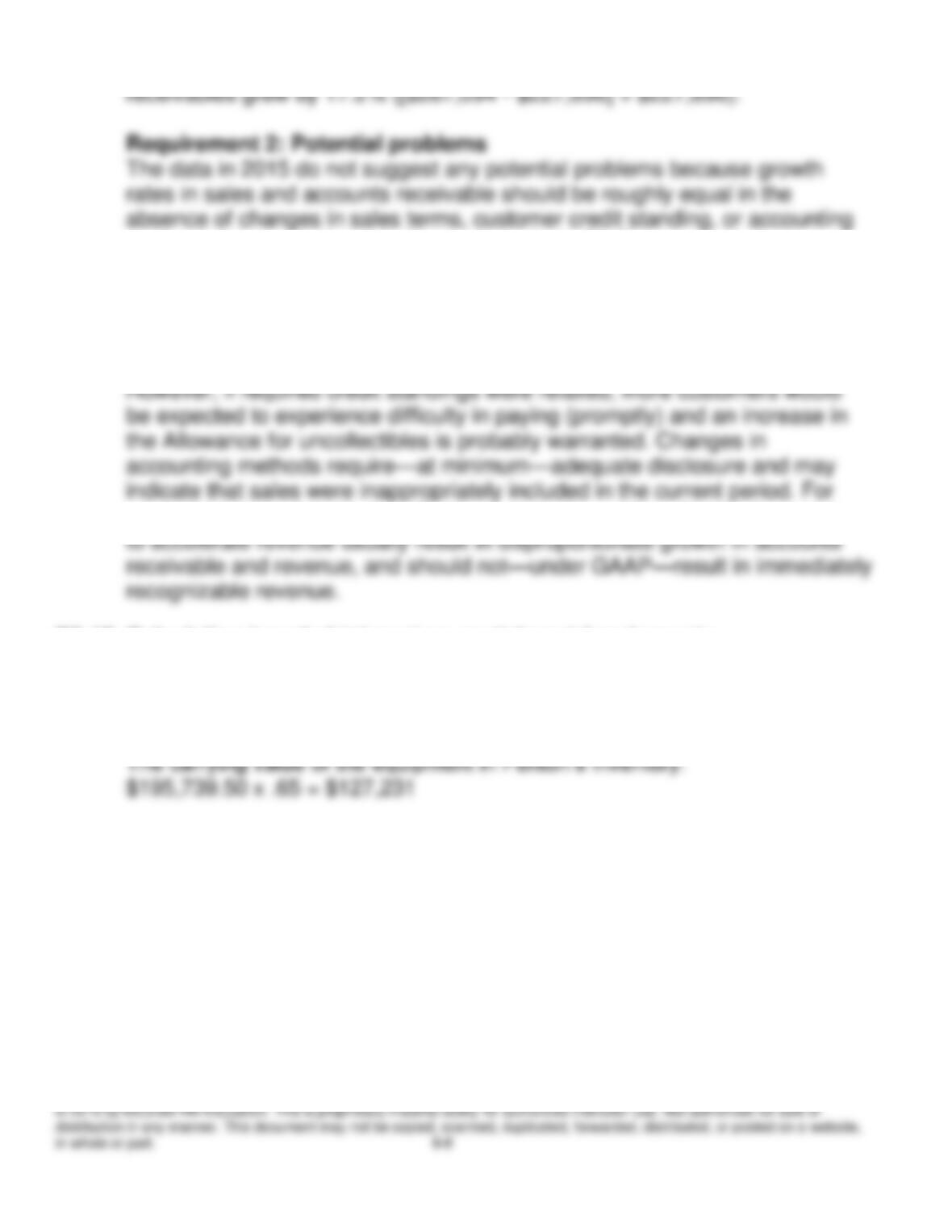
sales grew by 8% in 2016 ([$1,986,724 – $1,839,559] ÷ $1,839,559), while
methods. However, the growth rate disparity in 2016 suggests that one or
more of these factors has come into play.
Requirement 3: Possible explanations
A change in sales terms would not necessarily require any corrective
action to bring the financial statements into conformity with GAAP.
example, various “channel stuffing” schemes (e.g., bill and hold) designed
E8–12. Calculating imputed interest on noninterest-bearing note
Present value of $1 for n = 3, r = 12%: 0.71178
The cash selling price of the equipment is found by taking the present value
of the noninterest-bearing note ($275,000 x 0.71178 = $195,739.50)
© 2015 by McGraw-Hill Education. This is proprietary material solely for authorized instructor use. Not authorized for sale or
distribution in any manner. This document may not be copied, scanned, duplicated, forwarded, distributed, or posted on a website,
in whole or part. 8-9
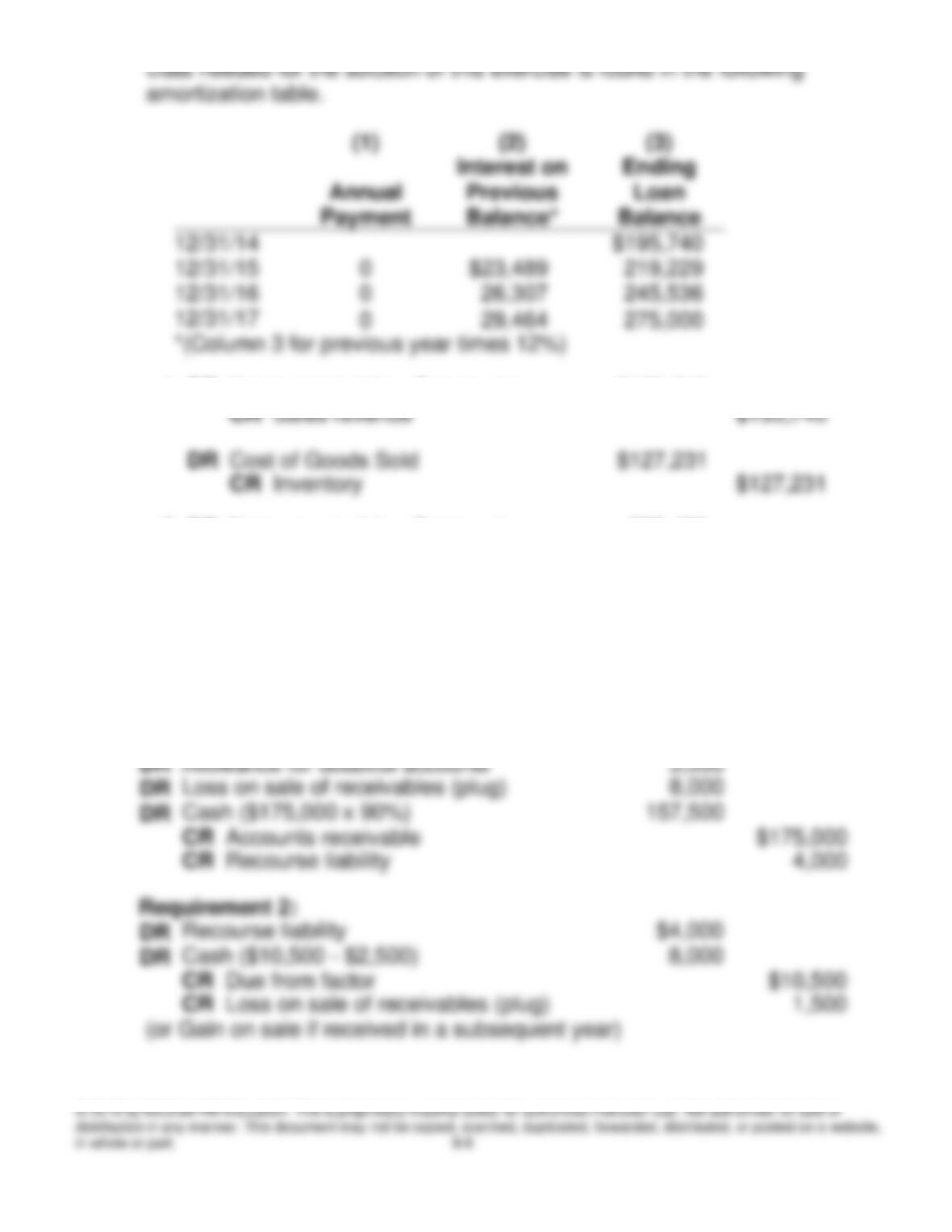
Data needed for the solution of this exercise is found in the following
amortization table.
(1)
(2)
(3)
Interest on
Ending
Annual
Previous
Loan
Payment
Balance*
Balance
12/31/14
$195,740
12/31/15
0
$23,489
219,229
12/31/16
0
26,307
245,536
12/31/17
0
29,464
275,000
1.
DR
Notes receivable—Denver, Inc.
$195,740
CR Sales revenue
$195,740
DR
Cost of Goods Sold
$127,231
CR Inventory
$127,231
2.
DR
Notes receivable—Denver, Inc.
$23,489
CR Interest revenue
$23,489
3.
Notes receivable—Denver, Inc.
$219,229
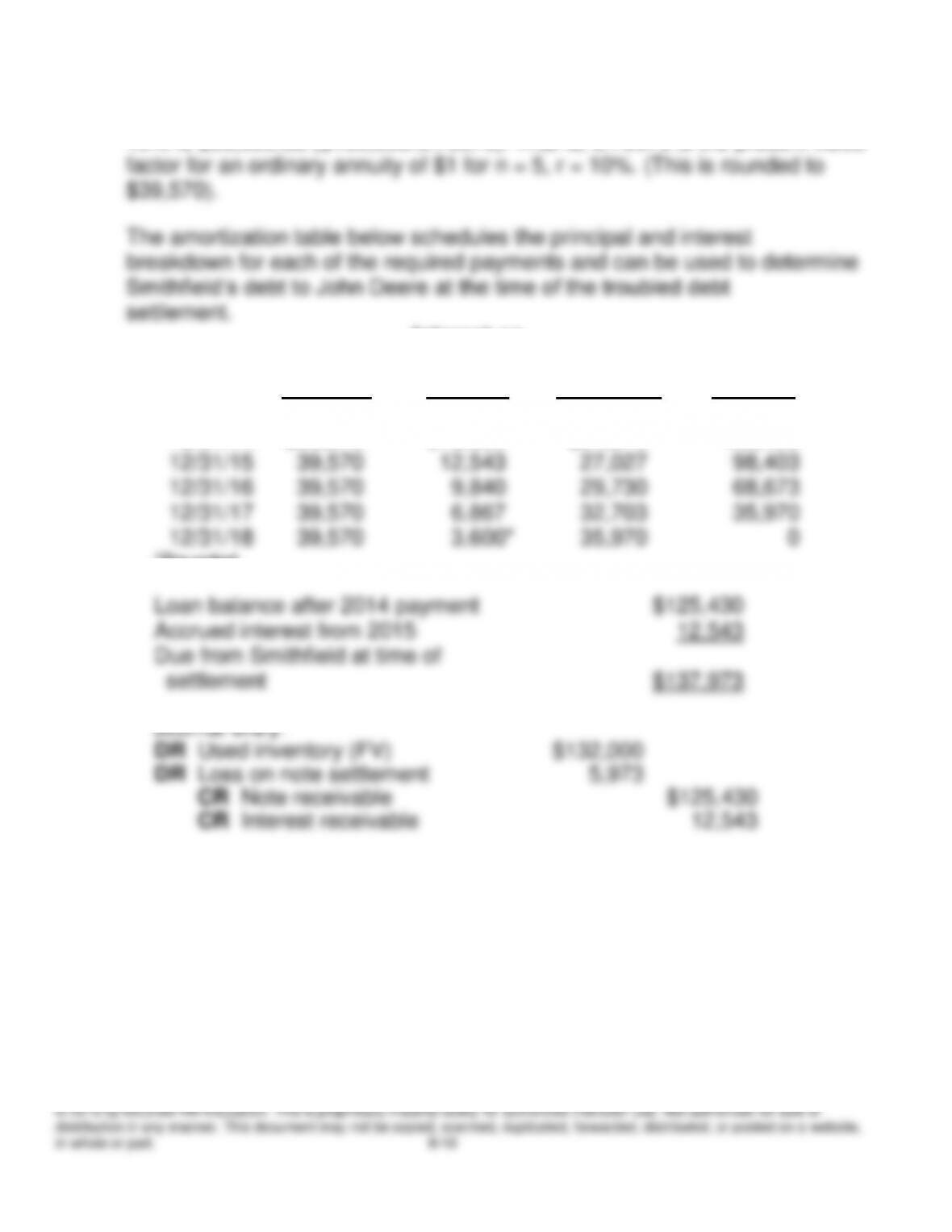
E8–13. Factoring receivables with recourse
Requirement 1:
DR
Due from factor ($17,500 − $7,000 fee)
$ 10,500
($7,000=$175,000 x 4%)
DR
Allowance for doubtful accounts
3,000
DR
Loss on sale of receivables (plug)
8,000
DR
Cash ($175,000 x 90%)
157,500
CR Accounts receivable
$175,000
CR Recourse liability
4,000
Requirement 2:
DR
Recourse liability
$4,000
DR
Cash ($10,500 – $2,500)
8,000
CR Due from factor
$10,500
CR Loss on sale of receivables (plug)
1,500
(or Gain on sale if received in a subsequent year)
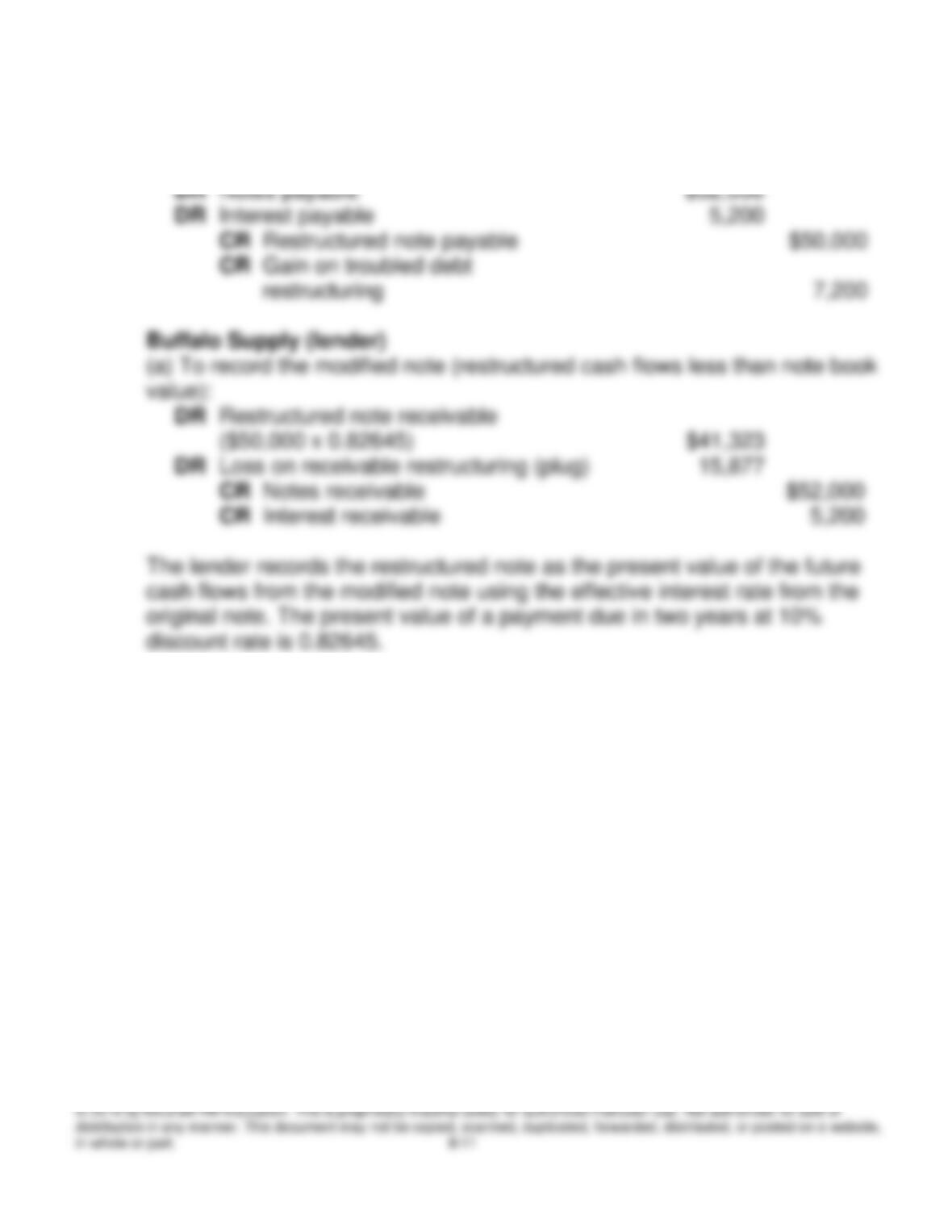
E8–14. Recording troubled debt settlement
The annual payment required to amortize the $150,000 loan over 5 years at
10% is $39,569.58 ($150,000/3.79079). That is, 3.79079 is the present value
Interest on
Annual
Previous
Principal
Loan
Payment
Balance
Reduction
Balance
$150,000
12/31/14
$39,570
$15,000
$24,570
125,430
12/31/15
39,570
12,543
27,027
98,403
12/31/16
39,570
9,840
29,730
68,673
12/31/17
39,570
6,867
32,703
35,970
12/31/18
39,570
3,600*
35,970
0
*Rounded
Loan balance after 2014 payment
$125,430
Accrued interest from 2015
12,543
Due from Smithfield at time of
settlement
$137,973
5,973
$125,430
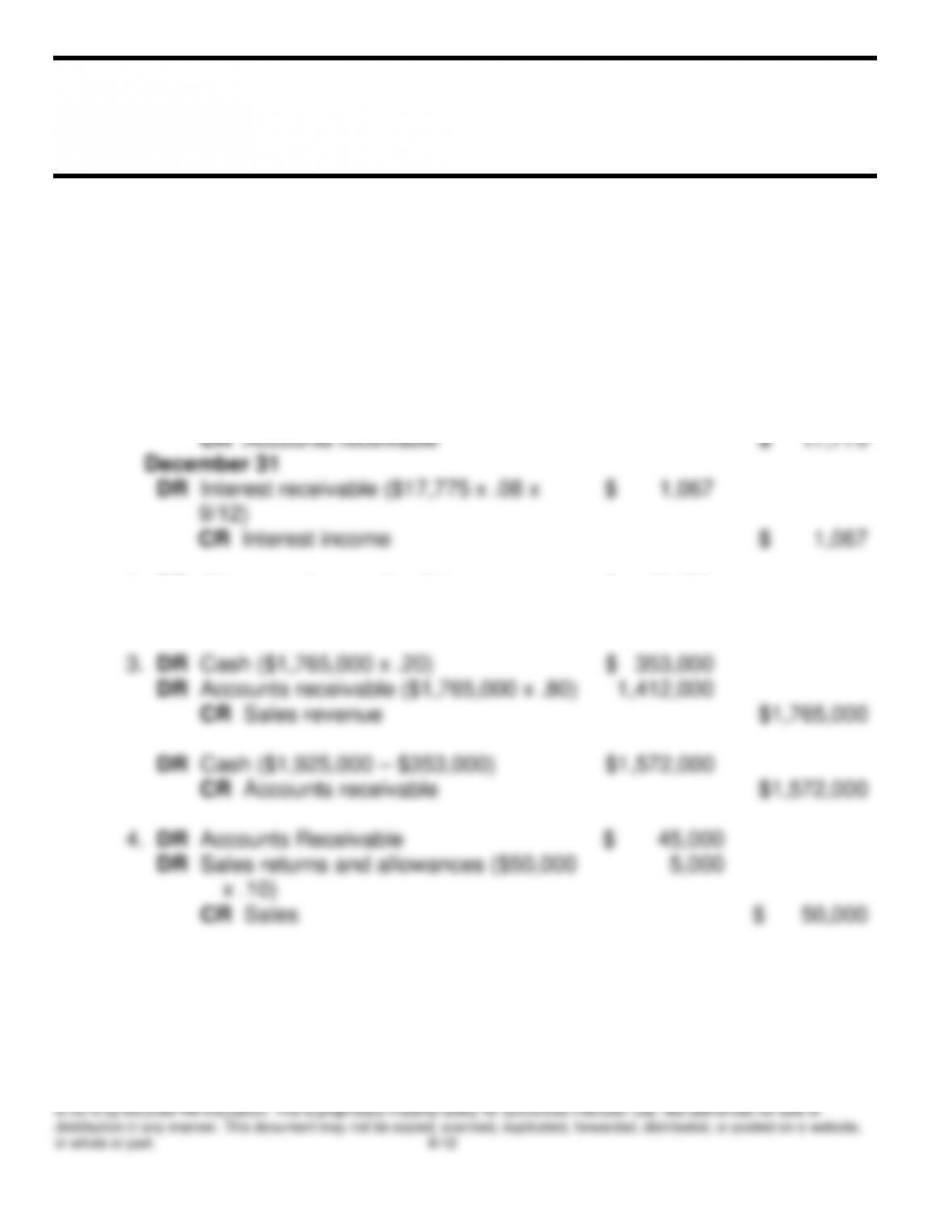
E8–15. Recording troubled debt restructuring
CVC (borrower)
(a) To record the modified note (restructured cash flows less than note
book value):
DR
Notes payable
$52,000
DR
Interest payable
5,200
CR Restructured note payable
$50,000
CR Gain on troubled debt
restructuring
7,200
Buffalo Supply (lender)
(a) To record the modified note (restructured cash flows less than note book
value):
DR
Restructured note receivable
($50,000 x 0.82645)
$41,323
DR
Loss on receivable restructuring (plug)
15,877
CR Notes receivable
$52,000
CR Interest receivable
5,200
The lender records the restructured note as the present value of the future
cash flows from the modified note using the effective interest rate from the
original note. The present value of a payment due in two years at 10%
discount rate is 0.82645.
Financial Reporting and Analysis (6th Ed.)
Chapter 8 Solutions
Receivables
Problems
Problems
P8–1. Determining balance sheet presentation and preparing journal entries
for various receivables transactions
Requirement 1:
Journal entries
1.
April 1
DR Notes receivable
$ 17,775
CR Accounts receivable
$ 17,775
December 31
DR Interest receivable ($17,775 x .08 x
9/12)
$ 1,067
CR Interest income
$ 1,067
2. DR Allowance for uncollectibles
$ 23,200
CR Accounts receivable
$ 23,200
3. DR Cash ($1,765,000 x .20)
$ 353,000
DR Accounts receivable ($1,765,000 x .80)
1,412,000
CR Sales revenue
$1,765,000
DR Cash ($1,925,000 – $353,000)
$1,572,000
CR Accounts receivable
$1,572,000
4. DR Accounts Receivable
$ 45,000
DR Sales returns and allowances ($50,000
x .10)
5,000
CR Sales
$ 50,000
© 2015 by McGraw-Hill Education. This is proprietary material solely for authorized instructor use. Not authorized for sale or
distribution in any manner. This document may not be copied, scanned, duplicated, forwarded, distributed, or posted on a website,
in whole or part. 8-13
5. DR Cash ($65,000 x (1.0 – .05))
$ 61,750
DR Prepaid interest ($65,000 x .05)
3,250
CR Notes payable
$ 65,000
DR Notes payable
$ 65,000
CR Cash
$ 65,000
DR Interest expense
$ 3,250
CR Prepaid interest
$ 3,250
6. DR Bad debt provision [ ($1,765,000 +
$50,000 from part 4) x .015]
$ 27,225
CR Allowance for uncollectibles
$ 27,225
7. DR Notes receivable
$ 79,383
CR Sales revenue
$ 79,383
DR Notes receivable ($6,351 x 6/12)
$ 3,176
CR Interest income
$ 3,176
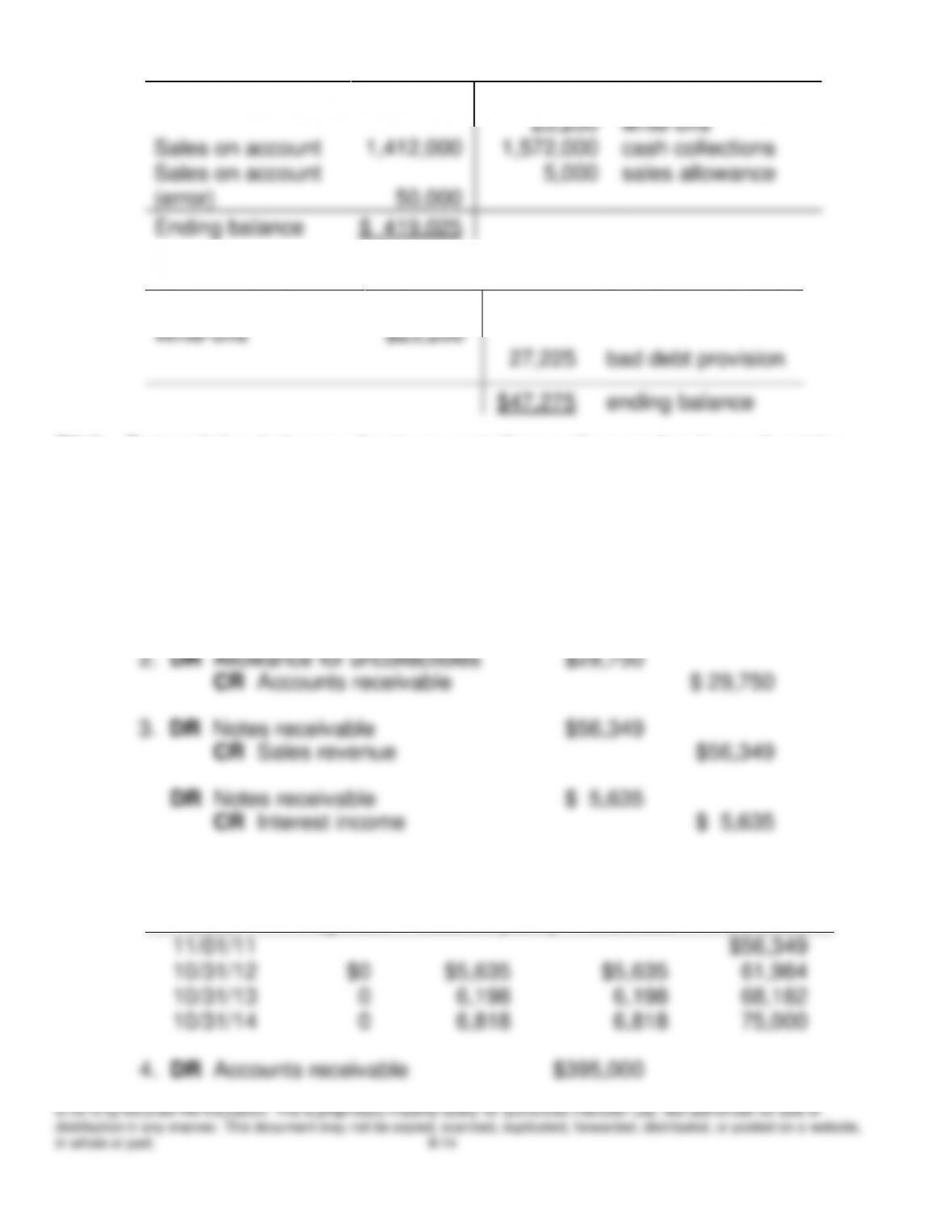
Accrued interest over 3-year loan term.
Date
Annual
Payment
Interest
Income (8%)
Receivable
Increase
Receivable
Balance
7/01/11
$79,383
6/30/12
$0
$6,351
$6,351
85,734
6/30/13
0
6,859
6,859
92,593
6/30/14
0
7,407
7,407
100,000
Requirement 2:
Notes receivable
$100,334
Accounts receivable
369,025
Less: Allowance for uncollectible accounts
(46,525)
$422,834
Notes receivable
Smith note
$17,775
Zebra note
79,383
Imputed interest
3,176
Ending balance
$100,334
Accounts receivable
Beginning balance
$ 575,000
$ 17,775
exchange for note
23,200
write-offs
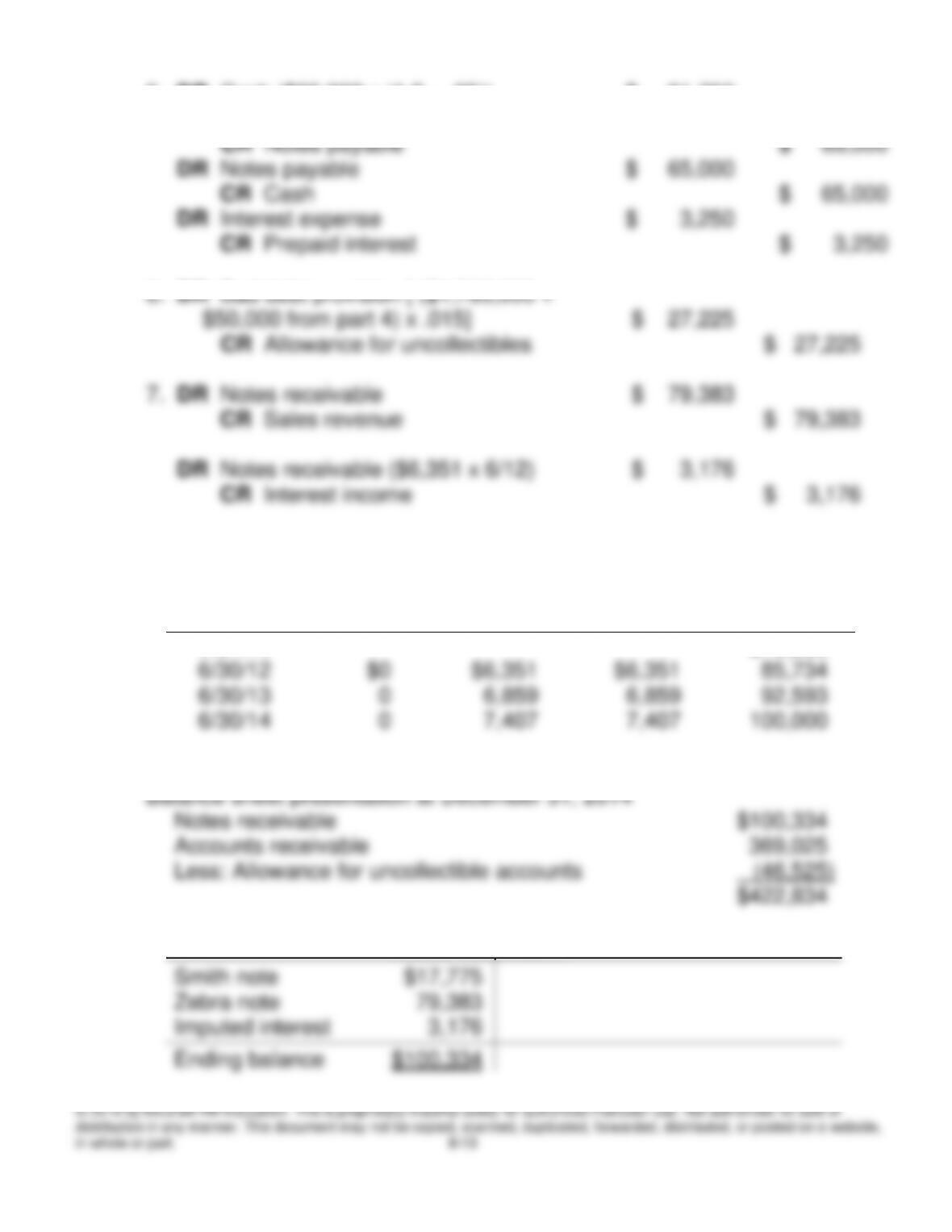
Sales on account
1,412,000
1,572,000
cash collections
Sales on account
(error)
50,000
5,000
sales allowance
Ending balance
$ 419,025
Allowance for uncollectibles
$43,250
beginning balance
Write-offs
$23,200
27,225
bad debt provision
$47,275
ending balance
P8–2. Determining balance sheet presentation and preparing journal entries
for various receivables transactions
Requirement 1:
Journal entries
1. DR Sales returns and allowances
$10,500
CR Accounts receivable
$10,500
2. DR Allowance for uncollectibles
$29,750
CR Accounts receivable
$ 29,750
3. DR Notes receivable
$56,349
CR Sales revenue
$56,349
DR Notes receivable
$ 5,635
CR Interest income
$ 5,635
Date
Annual
Payment
Interest
Income (10%)
Receivable
Increase
Receivable
Balance
11/01/11
$56,349
10/31/12
$0
$5,635
$5,635
61,984
10/31/13
0
6,198
6,198
68,182
10/31/14
0
6,818
6,818
75,000
4. DR Accounts receivable
$395,000
CR Sales revenue
$395,000
DR Cash
$355,000
CR Accounts receivable
$355,000
5. DR Cash
$ 40,950
DR Loss on sale of receivables
(45,000 x 9%)
4,050
CR Accounts receivable
$ 45,000
6. DR Bad debt provision
$ 31,750
CR Allowance for uncollectibles
$ 31,750
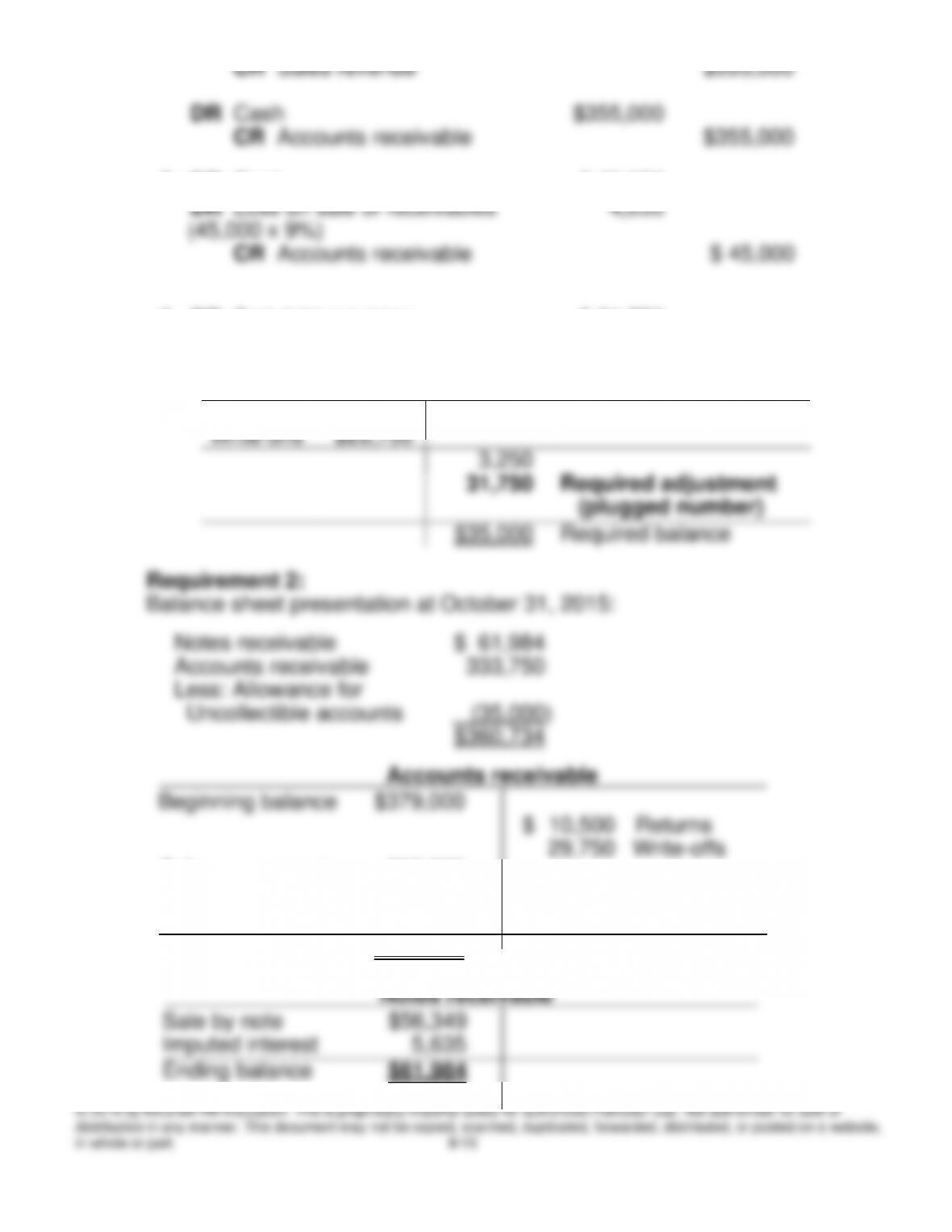
Allowance for uncollectibles
$33,000
Beginning balance
Write-offs
$29,750
3,250
31,750
Required adjustment
(plugged number)
$35,000
Required balance
Sales on account 395,000
355,000 Collections
45,000 Factoring
Ending balance $333,750